

ABUS 55/50 vs Master Lock: Which Is More Difficult
A tougher shackle doesn’t automatically make a padlock harder to pick. The ABUS 55/50 vs. Master Lock difficulty depends on the specific Master Lock model and whether you mean picking or cutting resistance. The ABUS 55/50 has a 5-pin cylinder and a double-locking hardened steel shackle, but those details alone don’t make it harder to pick than every Master Lock.
It’s easy to treat overall toughness as one measure, but picking and cutting challenge different parts of a padlock. The cylinder design matters for picking difficulty; shackle material matters when comparing cut resistance.
This comparison explains how the ABUS 55/50 stacks up for different uses, what to look for in Master Lock models, and how shackle materials affect resistance to cutting. You’ll also get a practical way to choose between them based on the job, rather than assuming one brand is always the more difficult lock.
Key Takeaways
- Judge picking difficulty by the cylinder, and cutting resistance by the shackle; these are different measures of a padlock’s challenge.
- Compare the ABUS 55/50 with a specific Master Lock model and intended use rather than treating either brand as one uniform level of difficulty.
- Use shackle material as a key factor when weighing resistance to cutting, especially for the lock’s intended setting.
- Build locksport skills ethically by choosing practice locks that match your current ability and progressing through belt ranks at your own pace.
- The free Black Belt Challenge offers a path to earn reward picks and share picks-in-action content toward its social reach goal and $5,000 bounty.
Join the Free Black Belt Challenge
After comparing padlocks, ethical locksport hobbyists can take a practical next step with Lockpick Pros’ free Black Belt Challenge. Build skills one belt at a time and share progress with a community of pickers. The challenge offers beginners a structured starting point and gives experienced hobbyists a goal to work toward, from learning foundational feedback to refining technique on more challenging locks.
Sign-up starts an email sequence that guides participants through the challenge and its belt-ranking progression. Participants can earn reward picks by advancing through the ranks and sharing progress on social media with Lockpick Pros tools. The aim is not to rush through a checklist, but to develop good habits, learn from each practice session, and share progress honestly.
The belt ranking system describes growth in locksport skill and lock complexity. Each rank marks a stage in a longer learning path, not a promise that a picker can open every lock at that level. Use the ranks to set goals, choose suitable practice, and track how your approach changes over time.
Start with a clear practice goal
Start with a simple goal: set aside a practice lock, work patiently, and notice the feedback you feel through the tool. Speed is not the point. Focus on recognizing feedback, controlling tension, and making deliberate movements. Beginner Lockpick Sets and Practice Locks give newcomers equipment intended for learning and practice.
Practice only on locks you own or have explicit permission to use for locksport. Keep practice separate from locks that secure property or protect something you are responsible for. This boundary keeps the activity ethical and lets you experiment without creating problems for others. A dedicated practice setup also makes it easier to repeat a challenge and see what you have learned.
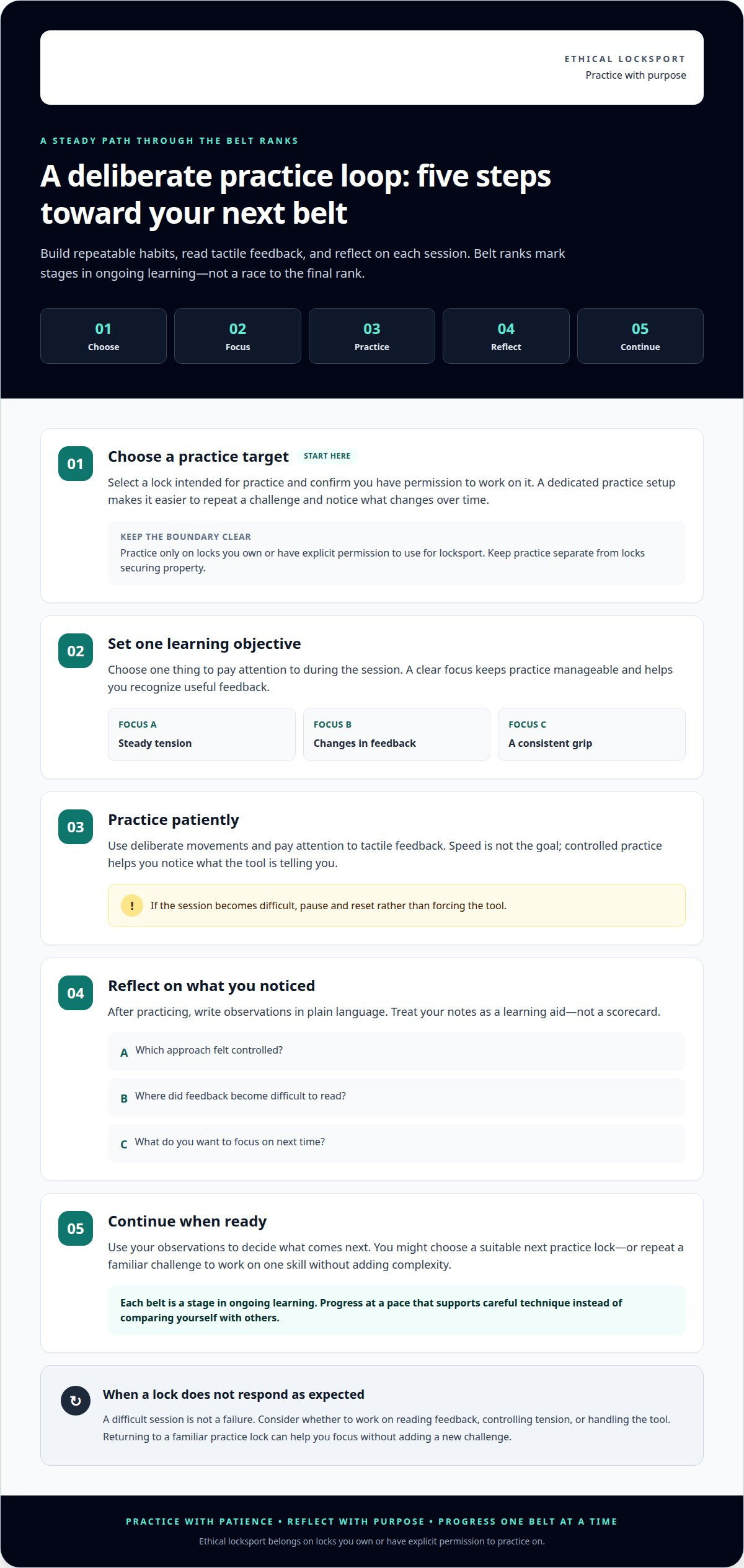
Before each session, choose a specific goal to guide your attention. You might focus on steady tension, recognizing a change in feedback, or maintaining a consistent grip. Work on one thing at a time instead of trying to correct every movement at once. If the session becomes difficult, pause and reset rather than forcing the tool. Patience builds better habits than pushing harder after every setback.
After practicing, write down what you observed in plain language: which approach felt controlled, where feedback became difficult to read, and what you want to focus on next time. Treat these notes as a learning aid, not a scorecard. They make progress easier to see and help you avoid repeating sessions without a goal. Over time, your observations can guide your choice of a suitable next practice lock, or show that repeating a familiar challenge is more useful.
Progress one belt at a time
The challenge encourages steady progress, not a leap from beginner to advanced picking. First build skills that make practice repeatable, then add complexity as your approach becomes more controlled. Belt ranks can help frame the next step, but progress comes from the practice and reflection behind them. Work at a pace that supports careful technique rather than comparing yourself with others.
Think of the ranks as learning stages. Early practice builds familiarity with a lock and the feel of a tool. As you progress, focus more closely on precision, interpreting feedback, and adjusting your approach when a lock behaves differently than expected. Later ranks call for continued refinement. The goal is not to memorize one movement, but to respond thoughtfully to what you feel.
- Choose a practice target. Use a lock intended for practice, and make sure you have permission to work on it.
- Set one learning objective. Pick a technique or observation to focus on during that session.
- Practice with patience. Keep your movements deliberate, notice tactile feedback, and pause when you need to reset.
- Reflect on the session. Record what you noticed and what you want to try in a future practice session.
- Continue when ready. Treat each belt as a step in ongoing learning, not a race to the final rank.
A difficult session is not a failure. If a lock does not respond as expected, consider whether you need to work on reading feedback, controlling tension, or handling the tool. Return to a familiar practice lock to focus on a particular skill without adding a new challenge. Repetition is productive when you approach it with a clear question and pay attention to what your hands tell you.
As your skills develop, your preferred equipment may change too. A beginner set can help you get started, while an experienced hobbyist may explore Advanced Lockpick Sets for a different stage of practice. A more advanced set will not make a lock easier or replace skill development. Match equipment to your practice goals, comfort, control, and the type of lock.
Earn reward picks through participation
The challenge’s reward-pick structure recognizes progress through the belt ranks and sharing that progress. Signing up starts the email sequence, which supports participants as they move through the challenge. To join the share-to-earn loop, post picks-in-action content featuring Lockpick Pros tools and share your progress on social media. These posts connect individual practice with the wider challenge community.
Keep shared content focused on ethical locksport. Show practice on a lock set aside for the hobby, describe the skill you are working on, and make the learning process clear. A brief reflection on what you noticed can help fellow hobbyists more than a result without context. Show progress without revealing private information or suggesting that tools should be used on locks without permission.
Sharing also creates a record of your development. Looking back at earlier posts can help you notice changes in confidence, patience, and technique, and encourage participants working through similar challenges. The community matters because locksport skills grow through focused practice, careful observation, and learning from others who value ethical participation.
Lockpick Pros states that over 10,000 ethical lockpickers are already climbing the ranks in the Black Belt Challenge. The community gives participants a shared progression to follow while leaving space for each person to learn at their own pace. Joining doesn’t require a polished demonstration. A sincere post about practice, what you’re learning, and the tools you’re using can make the process approachable for someone just starting out.
The social reach goal adds a collective aim to the challenge. Participants share picks-in-action content as part of the effort toward a $5,000 bounty for reaching that goal. The bounty is connected to achieving the social reach goal; it isn’t a reward that should be presented as automatic for each post or participant. Keep the emphasis on contributing useful, ethical content and supporting the challenge as it grows.
Choose tools for the stage you’re practicing
Tools are part of the learning process, but they’re not a shortcut around it. Beginner Lockpick Sets can serve as an entry point for someone building foundational handling skills. Practice Locks provide dedicated hardware for repeated attempts and controlled learning. When your interests move toward vehicle-related practice, Vehicle Locksmith Tools are a relevant category to explore; select and use tools only for lawful, authorized practice.
The right setup depends on your practice goals and the skills you are developing. Start with the lock and learning objective, then consider which tools suit the task. Do not buy equipment simply because it sounds more advanced. A set that fits your current needs can be more useful than a wider selection you do not yet know how to use. Your preferences may change as your practice develops.
If your curiosity extends to specialty lock types, choose tools intended for that style of practice rather than assuming a standard set covers every mechanism. For example, Kaba-style picking tools relate to a distinct category of locksport equipment. Keep the focus on authorized practice, and build familiarity with the relevant tool type before setting a more ambitious goal.
Comfort and control matter during practice. Notice whether your grip stays relaxed and you can feel changes without abrupt movements. Take a break if you become tired or frustrated. Continuing when you can no longer focus on feedback is unlikely to help. A clear head makes it easier to distinguish what the lock is communicating from what your hands are doing.
Make each shared update useful
A useful progress post can be simple and specific. Say which belt stage you are working toward, describe your practice objective, and share a brief reflection on what you learned. Keep any picks-in-action content on your dedicated practice setup. That makes the ethical context clear and shows other hobbyists what responsible participation looks like.
Keep your post honest. Do not claim a skill you have not developed or treat one successful session as proof that every similar lock will respond the same way. Locks differ, and practice is ongoing. Sharing what worked, what felt challenging, and what you plan to practice next can help peers while accurately representing your experience.
Consider what your content communicates to new hobbyists. Clear framing shows that the activity is locksport practice, not an invitation to interfere with property or gain unauthorized access. Avoid identifying details that could reveal a location or a lock protecting someone’s belongings. Keep the focus on learning, responsible tool use, and progress through the ranks.
Use the challenge to stay motivated, not to pressure yourself into posting constantly. A thoughtful update after meaningful practice can contribute more than frequent posts without reflection. Sharing connects your progress with the community and supports the challenge’s social reach goal. You can also use the belt progression as a personal structure when you prefer to practice privately.
Start the free Black Belt Challenge by signing up, following the email sequence, practicing ethically, and working toward the next rank. As your skills and interests develop, choose Beginner Lockpick Sets, Advanced Lockpick Sets, or Practice Locks to suit your goals. Share picks-in-action content as part of the community effort, and focus on steady improvement rather than rushing to finish.
The challenge connects individual goals with a shared effort. Participants bring different starting points, practice styles, and learning paces. The belt structure gives that variety a common path, while reward picks recognize progression and participation. Whether you are starting out or refining advanced habits, choose the next step that helps you practice deliberately and ethically.
For questions about the Black Belt Challenge or choosing locksport tools for your practice, contact Lockpick Pros.
Put Your Locksport Skills Into Practice
Make your next practice session about careful observation, not simply choosing a harder lock. A padlock comparison can clarify what you are evaluating, while deliberate practice helps you notice how a lock responds. Keep sessions ethical, use locks you own or have permission to practice on, and take time to learn from each attempt.
Lockpick Pros offers Beginner Lockpick Sets, Advanced Lockpick Sets, and Practice Locks for different stages of locksport. If you’re ready to choose equipment for continued practice, explore the Carbon Fiber Gen 2 Pro Series. Set a manageable goal, build consistency one session at a time, and enjoy the progress you make.
Frequently Asked Questions
What are the key differences in cylinder design and key security between the ABUS 55/50 and Master Lock?
The ABUS 55/50 has a 5-pin cylinder. Master Lock, ABUS, and American Lock keys are generally not interchangeable across brands, but no Master Lock cylinder details are given for a direct comparison.
How resistant is the ABUS 55/50 to bolt cutters, drilling, and other forced-entry attacks compared with Master Lock?
The ABUS 55/50 has a double-locking hardened steel shackle. Boron-alloy shackles are more cut-resistant than hardened steel and are recommended for outdoor, unsupervised, or high-value applications; no direct forced-entry comparison with a Master Lock model is available.
Which applications are suitable for an ABUS 55/50 versus a Master Lock, and what security limitations should buyers know?
The ABUS 55/50 is a 2-inch solid brass padlock with a double-locking hardened steel shackle. Master Lock’s 6800 series is used for commercial facilities, while the 6100 and 6200 series are solid-body commercial choices. For demanding settings, consider the level of cut resistance needed and compare specific models and intended uses rather than brands overall.
Which Master Lock model is the closest equivalent to the ABUS 55/50?
The Master Lock 6100 and 6200 series are the closest listed options for comparison as solid-body commercial padlocks. The 6800 series is a laminated padlock series for commercial facility applications.