

High Yield Steel Lock Picks: Which Material Should You Choose
For most beginner and intermediate pickers, high yield steel lock picks made from 301 stainless steel are the practical starting point. Stainless steel is widely used, and its greater stiffness can give clearer feedback during single-pin picking. Titanium is lighter and more elastic, so it may suit pickers who prefer a tool that flexes more.
When choosing high yield steel lock picks, consider how the material affects durability and bending. Too much flex can soften feedback, while excessive force can damage a pick. The right choice depends on your technique and the feel you want from the tool.
This comparison explains how high-yield steel, other stainless steel, and titanium differ in strength, flex, corrosion resistance, and feel. It also covers the qualities that matter for beginner and intermediate locksport practice, helping you choose tools that suit your current skills.
Key Takeaways
- Compare stiffness and flex before choosing a pick material; each changes how feedback feels during practice.
- Consider how you pick: a stiffer tool can give more direct feedback for single-pin picking, while a more elastic one flexes more.
- Judge durability by the balance of strength and toughness, not by strength alone.
- Match pick thickness and profile to the keyway and the type of practice lock you use.
- Beginners and intermediate pickers can choose based on comfort, feedback, and the skills they want to develop next.
301 Stainless Steel vs Titanium Lock Picks: Which Material Should You Choose?
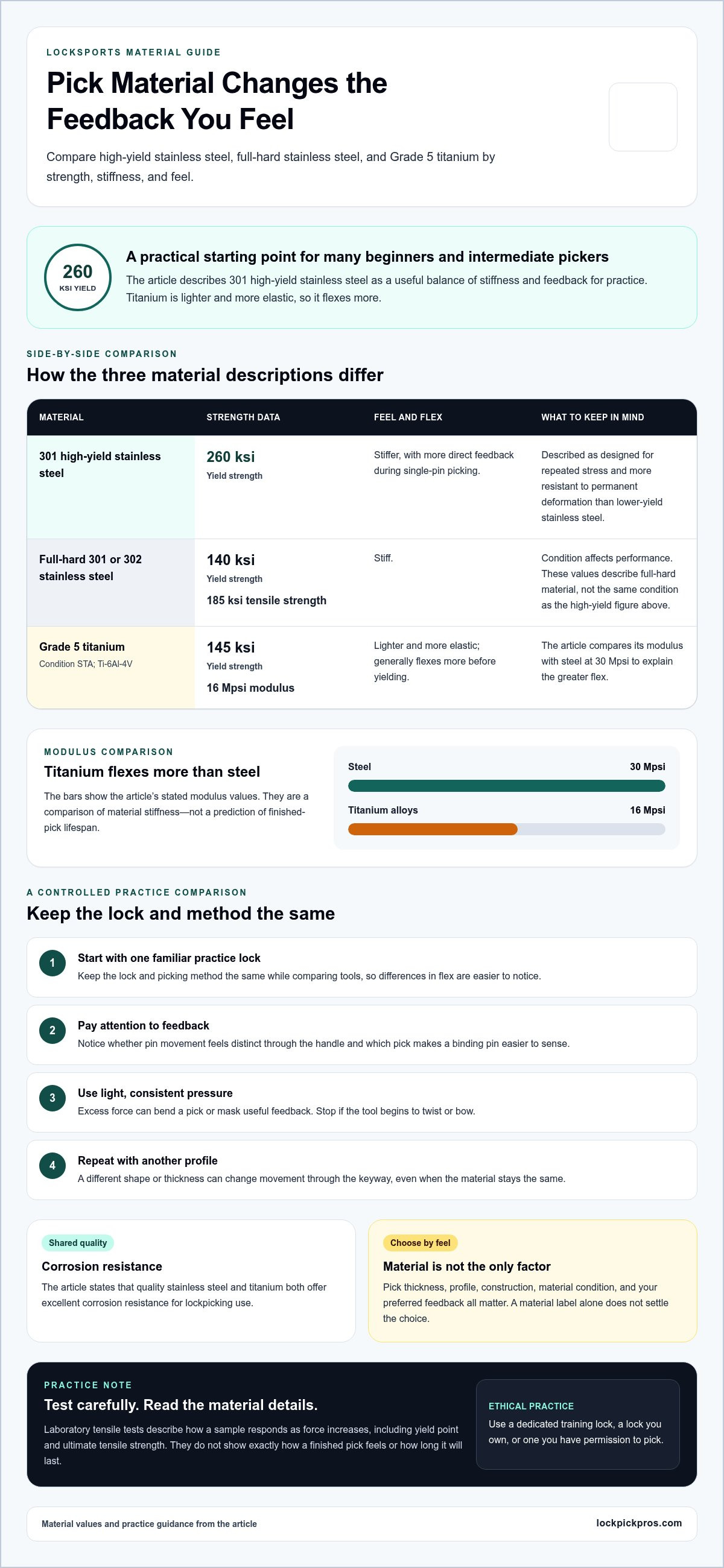
For most beginner and intermediate practice, 301 high-yield stainless steel offers a useful balance of stiffness and feedback. Titanium is lighter and more elastic, so it flexes more before yielding. Choose based on the feel you prefer and the profile that fits your practice lock.
A good pick material should resist corrosion, withstand repeated stress, and transmit useful tactile feedback. The listed yield strength for 301 high-yield stainless steel is 260 ksi. By comparison, 301 and 302 full-hard stainless steel have a yield strength of 140 ksi and an ultimate tensile strength of 185 ksi. These values describe different conditions, not interchangeable grades.
Titanium’s grade and condition matter too. Condition STA Grade 5 titanium, also called Ti-6Al-4V, has a yield strength of 145 ksi. Titanium alloys have a Young’s modulus of 16 Mpsi, compared with 30 Mpsi for steel. That difference helps explain why titanium generally flexes more. Quality stainless steel and titanium both offer excellent corrosion resistance for lockpicking use.
| Material | Strength or property | Typical feel | Comparison point |
|---|---|---|---|
| 301 high-yield stainless steel | 260 ksi yield strength | Stiffer, direct feedback | Designed for repeated stress |
| Full-hard 301 or 302 stainless steel | 140 ksi yield strength; 185 ksi tensile strength | Stiff | Condition affects performance |
| Grade 5 titanium | 145 ksi yield strength; 16 Mpsi modulus | Lighter, more elastic | Flexes more before yielding |
High-yield stainless steel is more resistant to permanent deformation than lower-yield stainless steel. Spring steel is a separate category, and its behavior depends on its grade and treatment. Compare the stated material details rather than relying on a label alone.
Laboratory tensile tests measure how a sample responds as force increases, including its yield point and ultimate tensile strength. They don’t show how a finished pick feels or how long it will last. For a practical comparison, use the same practice lock and note how each tool responds under controlled tension.
“MAX” in a set name isn’t a standardized alloy or test result. The M3000B set, for example, includes two double-ended picks in .023-inch thickness and thirteen tension tools. Compare stated contents and material details rather than assuming the name proves a particular steel grade.
How do high-yield steel picks compare with stainless steel and spring steel picks? High-yield stainless steel resists permanent deformation more than lower-yield stainless steel. Spring steel’s performance depends on its specific grade and treatment.
What U.S. laws and rules apply to owning or carrying lock picks? Rules can vary by jurisdiction and circumstances. Use picks only on locks you own or have explicit permission to practise on, and follow applicable local rules.
What safety and ethical rules should beginners follow? Practise on a dedicated training lock, one you own, or a lock you have permission to pick. Stop if a pick bends or the lock shows signs of damage.
How much do high-yield steel lock pick sets cost in the United States? Prices vary according to the material, profiles, and tools included. Compare set contents and material descriptions rather than assuming the steel label determines the price.
Which reputable U.S. retailers sell high-yield steel lock picks? Lockpick Pros sells High Yield Lockpicks. Compare material descriptions and set contents to find tools that suit your practice needs.
Material choices for beginner and intermediate pickers
For a first practice set, choose a material that helps you feel what the pick is doing inside the lock. A stiffer pick can make pin movement feel more direct during single-pin picking. A more elastic pick bends further under pressure, changing the feedback you feel. Neither material replaces controlled tension or careful practice.
Start with the lock and technique you plan to practise. Standard pin-tumbler locks reward clear feedback as you feel for binding pins. If your pick feels too flexible, try a stiffer stainless-steel profile. If you prefer more flex, titanium picks can sit alongside steel picks in the same kit.
Use these steps to compare materials during a practice session:
- Start with one familiar practice lock. Keep the lock and picking method the same while comparing tools. That makes differences in flex easier to notice.
- Pay attention to feedback. Notice whether pin movement feels distinct through the handle. Record which pick makes it easier to sense a binding pin.
- Use light, consistent pressure. Excess force can bend a pick or mask useful feedback. Stop if the tool begins to twist or bow.
- Repeat with another profile. A different shape or thickness can change how a pick moves through the keyway, even when its material stays the same.
Material labels alone don’t settle the choice. For example, 302 full-hard stainless steel contains 1-2% more chromium and nickel than 301 full-hard stainless steel. That chemistry difference is not a substitute for comparing the pick’s feel, construction, and intended use. Heat treatment and material condition also affect how steel behaves.
Beginners can start with a few profiles and build familiarity before adding more options. Intermediate pickers may prefer a mixed kit, using a stiffer pick for precise feedback and a more elastic one when extra flex feels helpful. Record the lock, pick material, profile, and feedback after each attempt.
Choose for control, not a material name alone. If you’re developing standard pin-tumbler skills, compare the profiles in the Carbon Fiber Gen 2 Pro Series pick set as one option for your practice setup. Pair any tool with locks you own or have permission to pick, and keep the focus on ethical locksport.
Stainless steel is the most common material used for professional and hobbyist lock picks. The comparison gives 185,000 PSI as the tensile strength for Full Hard material against high-yield stainless steel. A range of 48-52 HRC is identified as more likely to balance toughness and strength in lock-pick materials.
Material durability and bending
A durable pick resists permanent bending without becoming so brittle that it snaps. A pick that is too soft can bend out of shape, while excessive brittleness increases the risk of breakage. Durability depends on the alloy, its treatment, the pick’s thickness, and the force applied.
Yield strength marks the stress at which a material begins to deform permanently. Laboratory figures show how different alloy conditions compare: 440C stainless steel tempered at 400°F has a yield strength of 276 ksi. MP35N, cold reduced 53% and aged at 1000°F for 4 hours, has a yield strength of 290 ksi. Elgiloy, also called Phynox, in H560 extra-hard condition after heat treatment has a yield strength of 297 ksi.
Material strength figures describe specific conditions, not a finished pick’s guaranteed lifespan. A thin pick can still bend under force, and a high-strength alloy can fail if stressed beyond its limits. Profile matters too: a narrow shaft distributes force differently from a wider one. Treat strength figures as one point of comparison, not a substitute for careful handling.
Use this practice routine to spot deformation before it affects feedback:
- Inspect the pick before use. Look along its shaft under good light. Check for a new curve, twist, or rough edge.
- Start with controlled pressure. Apply only enough tension to feel pin movement. If the pick flexes sharply, ease off instead of pushing harder.
- Notice changes during practice. A pick that suddenly feels less precise may have bent or developed pick-warp, a twist or bow caused by high spring tension.
- Stop using damaged tools. A visible bend can change how the tip contacts pins. Set the pick aside rather than trying to force it straight.
Repeated bending can contribute to fatigue, even if a pick returns to its original shape after each use. For example, repeatedly flexing one thin pick against a resistant practice lock creates more stress cycles than alternating tools and using measured tension. Don’t use picks as levers or force them against a stuck plug.
Good storage helps prevent damage between sessions. Don’t leave picks loose where they can be crushed in a bag; separate thin profiles from heavier tools. After practice, wipe away moisture and check the tip and shaft. Stainless alloys resist corrosion, but clean, dry storage helps preserve the surface and makes small defects easier to spot.
Choose a pick that gives useful feedback under light pressure, and monitor its shape as you practise. Use picks only on locks you own or have permission to pick, and retire any tool with a permanent bend or crack.
How does high-yield steel affect lock pick strength, flexibility, and durability?
High-yield steel is designed to resist permanent deformation under stress, which can help a lock pick retain its shape during repeated use. It doesn’t make the pick impossible to bend or break. Thickness, profile, heat treatment, and applied force all affect how a finished tool behaves.
Yield strength and flexibility describe different properties. Yield strength concerns when deformation becomes permanent; flexibility describes how much a pick bends under force. Steel’s Young’s modulus is 30 Mpsi, while titanium alloys measure 16 Mpsi. That difference helps explain why steel usually feels stiffer, but it doesn’t predict every pick’s performance by itself.
Steel grades and treatments also vary. For example, 17-7PH stainless steel in CH900 condition has a yield strength of 260 ksi. 420 stainless steel measures 221 ksi when tempered at 400°F and 170 ksi when tempered at 1100°F. These figures show why a material name alone cannot describe strength: condition and processing matter.
Connect material properties to the feedback you feel during locksport practice. A stiffer pick can transmit pin movement more directly during single-pin picking. A pick that flexes more may feel less direct, especially if you press hard against a binding pin. High yield strength can help resist permanent bending, but it doesn’t guarantee a longer service life.
Use this sequence to judge a pick’s behavior during practice:
- Inspect the profile. Compare the shaft and tip before use. A narrow profile may flex differently from a broader profile, even with the same steel.
- Begin with light tension. Apply controlled rotational force with the tension wrench. Notice whether pin feedback remains clear as you move the pick.
- Watch for lasting changes. After practice, lay the pick against a flat surface. A visible curve or twist suggests permanent deformation.
- Stop at damage. Don’t keep using a pick with a crack, sharp burr, or lasting bend. Those defects can affect movement and feedback.
Durability also depends on avoiding unnecessary stress. Forcing a pick against a pin that won’t move can load the shaft without improving tactile feedback. Ease the pressure, reset your hand position, and choose a suitable profile instead of treating strength as a reason to push harder.
When comparing high yield steel lock picks, look beyond the alloy label. Match the profile and stiffness to your practice lock, then assess feedback under controlled tension. This helps beginners build consistent technique and gives intermediate pickers a clearer basis for choosing tools.
What thickness and profiles are best for high-yield steel lock picks?
No single thickness suits every practice lock. Keyway width, pick profile, and pin layout all affect fit. A thicker pick may feel more stable in an open keyway, while a thinner one may fit a tighter opening. But a poorly fitting profile can scrape the warding or make pin feedback harder to read.
Match the tool to the lock, not just the steel. A narrow keyway calls for a slimmer profile that moves without binding against the sides. In a roomier keyway, a broader pick may be easier to guide. Before practising, check that the pick enters and moves freely without pressing it against the keyway walls.
Profile matters as much as thickness. A short hook offers a compact contact point for working individual pins. A deeper hook reaches pins farther from the keyway entrance. A half-diamond can serve as a general-purpose shape, while a rake profile is designed for a different picking motion. Compare shapes on the same practice lock to see how reach and control differ.
Use this selection sequence with a lock you own or have permission to pick:
- Identify the keyway. Look at its opening and warding. Note whether the entrance is open or narrow.
- Choose a profile to test. Start with a short hook for close control, or a deeper hook when pin reach is the issue.
- Check movement without force. The pick should travel through the keyway without scraping or getting trapped.
- Assess feedback. Apply controlled tension and notice whether pin contact feels distinct. Change one variable at a time.
- Record the result. Note the lock, profile, and how easily the pick moved, so you can compare tools later.
A thinner pick isn’t automatically better for a narrow keyway. Its overall shape and tip still need to clear the warding, and excessive flex can make precise movement harder. A thicker pick may offer useful control if it fits, but forcing it into a tight opening risks damaging the tool or lock.
For beginner and intermediate practice, start with a few profiles rather than choosing by thickness alone. Test each on the same practice lock, then keep the one that moves clearly without scraping. This comparison helps distinguish a fit problem from a technique problem.
To compare a range of profiles for standard pin-tumbler practice, explore the Carbon Fiber Gen 2 Pro Series and assess which shapes suit your practice locks.
Lockpick Pros: Beginner Lockpick Sets
Lockpick Pros offers Beginner Lockpick Sets and Practice Locks for ethical locksport practice. As your skills develop, Advanced Lockpick Sets let you explore additional tools. Practise only on locks you own or have clear permission to pick.
The free Black Belt Challenge gives you a way to progress one belt at a time, share picks-in-action content, and work toward black belt. Participants can earn reward picks as they advance, and shared content contributes to the challenge’s $5,000 bounty for reaching its social reach goal.
Visit lockpickpros.com to explore the available tools and join the challenge.
Put Your Material Choice Into Practice
Make your next practice session a focused comparison. Choose a lock you own or have permission to pick, keep tension steady, and note how each pick moves and feels. Recording the profile, material, and tactile feedback can help you identify which tool suits your technique. Change one factor at a time to keep your observations useful.
As your control develops, let the lock and keyway guide your next tool choice. The goal isn’t to collect picks for their material label. It’s to build reliable feel and thoughtful technique through ethical locksport practice. If you’re ready to compare profiles on standard pin-tumbler locks, explore the Carbon Fiber Gen 2 Pro Series as a possible next step. The best high yield steel lock picks for your routine are the ones that fit your practice lock and give you clear feedback.
Keep learning at your own pace, respect the locks you practise on, and enjoy each new skill milestone.
Frequently Asked Questions
What does “high-yield steel” mean for lock picks?
If you’re buying high yield steel lock picks, treat “high-yield” as a material description and look for the details behind it. Check whether the listing names the alloy and its condition, then compare that information with the pick’s profile and intended use. A specific steel type gives you a clearer basis for comparing sets than a broad label alone. Also consider whether the set includes profiles suited to your practice locks.
Which steel types are commonly used for lock picks, and how do they compare?
Common steel options include 301, 302, 17-7PH, and 420 stainless steel, along with spring steel. Compare them by reading the exact alloy and condition listed for each tool, then check whether the available profiles fit your practice locks. A useful comparison is specific: note the steel description, pick profile, and intended lock type for each set. Titanium is another pick material, but it isn’t a steel.
What are the best lock pick sets made from high-yield steel?
Choose a set by matching its range of profiles to your practice goals. The Carbon Fiber Gen 2 - Pro Series includes 16 stainless-steel picks and 6 tensioners. For a broader selection, the Gen 2 Pro Max - Stealth Edition includes 26 stainless-steel picks, 6 Elite Series tensioners, and a carbon-fiber case. Both options support practice on locks you own or have permission to pick.