

How to Find and Join a Nearby Locksport Group
A nearby locksport group may be easier to find online than at a local meetup. To learn how to join a locksport group, start with directories of local meetups or look for locksport Discord servers and Facebook groups. In the United States, examples include TOOOL chapters, the Longhorn Lockpicking Club in Austin, Texas, and the Fraternal Order Of Lock Sport in Bloomington, Indiana.
It’s natural to wonder whether you need experience before showing up. Many locksport communities welcome beginners, while some ask new members to be introduced by someone already involved. Approach the group respectfully, and practice only on locks you own or have explicit permission to pick. Avoid locks someone depends on.
This guide explains where to find local and online communities, what to expect at a meetup, and how groups’ screening and ethical guidelines may differ. You’ll also find practical ways to make a good first impression, whether you’re joining a conversation online or attending an event in person. Bring curiosity, respect for the group’s rules, and a willingness to learn one skill at a time.
Key Takeaways
- Use local meetup directories and online communities to find locksport groups in your area.
- Follow each group’s ethical guidelines and practice only on locks you own or have permission to pick.
- Learn what to expect at meetups and how group rules shape participation.
- Some groups screen new members or ask for an introduction, so start by reading their joining guidelines.
- Practice locks and beginner or advanced pick sets can help you build skills between community meetups.
Finding local locksport groups and meetups
Start with a local-meetup directory, then search the group name alongside your city or state. In the United States, examples include TOOOL US, TOOOL SF, the Longhorn Lockpicking Club in Austin, Texas, and the Fraternal Order Of Lock Sport in Bloomington, Indiana. These are useful starting points for finding nearby gatherings and online announcements.
Use a simple search process: look for “locksport” with your location, check group pages for recent activity, then read the joining instructions. A group’s page may list meetups, discussion channels, or public events. Check whether its focus matches your interests, such as beginner picking, practice challenges, or mechanical security discussions.
- Hook pick: A single-pin picking tool for feeling individual pins and learning their feedback.
- Tension wrench: Applies turning force to the plug and helps you notice when a pin sets.
- Practice lock: Dedicated learning hardware lets you practice without relying on a working door lock.
To find competitions, workshops, and public meetups nearby, search local event listings and the social pages of locksport groups. Try your city name with “lockpick meetup” or “locksport event,” then look for organizer details. Conference schedules and community announcements can also point to lockpick villages or demonstrations.
Joining a local group usually starts with reading its rules and following the stated process. Some groups ask newcomers to be introduced by an existing member. If the group provides a contact or sign-up method, use it to introduce yourself, describe your experience level, and ask about attending a public gathering. A clear, respectful message helps organizers understand your interest.
Are there legal restrictions on owning lock picks or practicing locksport in your state? Rules can differ by state and circumstances, so review current state and local requirements before carrying picks or practicing. Keep the activity limited to locks you own or have explicit permission to pick.
How much do locksport club membership, events, and beginner tools typically cost? There’s no standard cost: group policies, event arrangements, and your choice of tools or practice hardware all affect the total. Check the group’s event information for any stated participation terms.
TOOOL has United States chapters, including TOOOL US and TOOOL SF. Local clubs such as the Longhorn Lockpicking Club in Austin and the Fraternal Order Of Lock Sport in Bloomington can also help narrow your search. To find a nearby meetup, prioritize groups and event listings in your area, then follow the organizer’s joining instructions.
Before attending, note the location, access instructions, and any event-specific rules. If the organizer permits personal tools, bring suitable practice equipment, such as a tension wrench and a practice lock. Clear expectations make it easier to focus on learning and meeting other pickers.
Ethical expectations in locksport
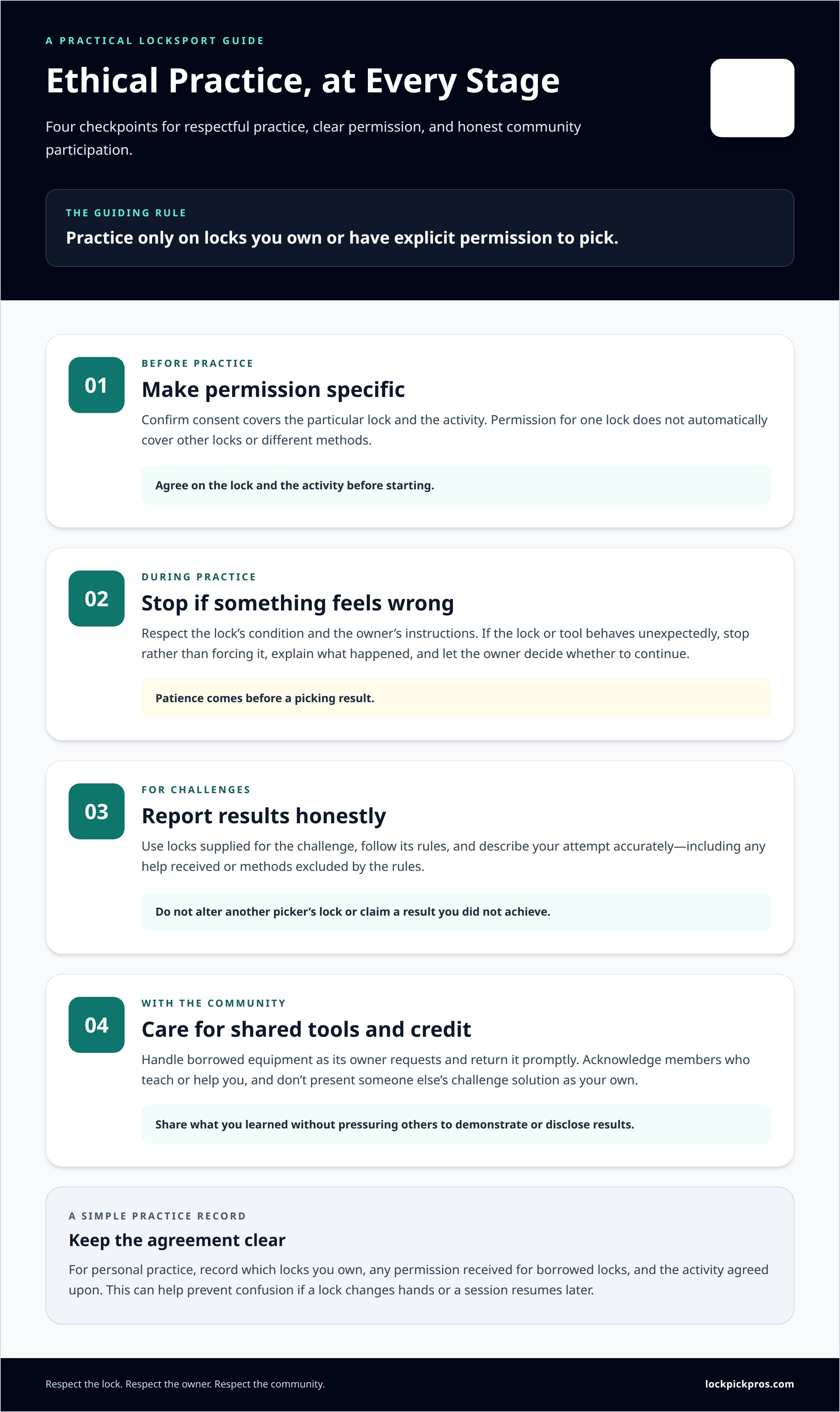
Permission should be specific to the lock and activity. If an owner agrees to a practice session, don’t assume that includes other locks they own or different methods. Clarify which lock is involved and what the owner has authorized. This keeps consent clear and gives everyone a shared understanding before practice begins.
Respect the lock’s condition and the owner’s instructions throughout the session. If the lock behaves unexpectedly, stop rather than forcing the tool or plug. Tell the owner what happened and let them decide whether to continue. Patience matters: a successful picking attempt is never more important than respecting someone else’s property.
Challenge locks also call for care. Use a lock supplied for that purpose, and follow the challenge rules. Don’t alter another picker’s lock or claim a result you didn’t achieve. In a belt-ranking challenge, describe your attempt accurately, including whether you received help or used a method the rules exclude. Honest reporting makes shared progress meaningful.
- Before practice: Confirm the owner’s permission covers that specific lock and activity.
- During practice: Stop if the lock or tool behaves unexpectedly, then explain the issue.
- For challenges: Follow the stated rules and report your result honestly.
- With shared equipment: Handle it carefully and return it as the owner requests.
Handling tools responsibly is part of respectful participation. A tension wrench applies rotational force, so use it with appropriate control on the practice lock. A hook pick helps explore individual pins, but it doesn’t justify trying unfamiliar locks without consent. If another member lends you a tool, ask how they want it handled and return it promptly.
Ethical discussion also means giving credit. If another picker explains a technique or helps you understand feedback, acknowledge their contribution when sharing what you learned. Don’t present another person’s challenge solution as your discovery. In group conversations, distinguish personal experience from advice, and don’t pressure members to demonstrate a skill or share a result.
For personal practice, keep a simple log of the locks you own, the permission you received for any borrowed lock, and the activity agreed upon. That record can prevent confusion when a lock changes hands or a practice session resumes later. A standard pin-tumbler pick set supports focused work on suitable practice locks.
Meeting locations and events
Locksport events can be part of a broader security gathering or a club meeting. Oak City Locksport’s BSidesRDU Lockpick Village is one example of locksport activity at a conference. Before attending, read both the event schedule and the venue instructions. The schedule helps you locate the activity, while venue guidance explains where attendees should enter and gather.
A club meeting may feel different from a public event. Oak City Locksport’s December meeting listed six attendees, while its BSidesRDU Lockpick Village listed eight. These examples show two possible event sizes, not a standard turnout. A smaller meeting may allow more time for conversation, while visitors may arrive throughout a public conference activity.
Plan the practical details before leaving. Save the event location and organizer’s instructions, note the listed start time, and allow time to find the meeting area. If the event is part of a conference, find its room or activity space on the schedule. Keep the organizer’s event post handy so you can refer to any changes or entry guidance.
- Practice lock: Provides suitable hardware for a permitted hands-on activity.
- Tension wrench: Applies turning force and helps a picker notice tactile feedback.
- Hook pick: Supports individual-pin practice on an appropriate lock.
- Notebook: Helps record a demonstration’s terminology and questions for later discussion.
Bring only equipment that suits the event’s format. A demonstration may call for attentive observation rather than personal tools. For a hands-on activity, a practice lock and a small set of tools can keep your setup manageable. Ask the host before setting up equipment, recording a demonstration, or joining a shared activity.
Use the event to learn how the group works. Listen to the organizer’s introduction, notice how activities are structured, and save detailed questions for an appropriate pause. At a lockpick village, observe how demonstrations move between explanation and practice. At a club gathering, notice whether members rotate among challenges or focus on individual locks.
Afterward, note the event’s name, the topics discussed, and any follow-up details the organizer shared. For example, notes from BSidesRDU can help you remember which activity you attended and what you want to ask next time. Keep personal observations separate from instructions, especially when describing a lock or challenge to someone who wasn’t there.
A thoughtful follow-up can make the next event easier to approach. If the organizer shared a public discussion channel or event announcement, use it for a concise thank-you or a question about the format. Mention the activity you attended, such as the Lockpick Village, rather than sending a generic message. This connects your follow-up to the gathering.
Online locksport communities
Online groups connect U.S. hobbyists across city and state lines. TOOOL has a United States presence, including TOOOL US and TOOOL SF. Discord servers and Facebook groups also host locksport conversations. These options let you follow community discussions even when local meetups don’t fit your schedule.
Choose a group by reading its description and recent conversations. Check whether posts focus on beginner questions, belt-ranking discussions, event notices, or practice-lock feedback. A useful community makes its expectations clear. Review pinned posts and moderator guidance before posting, since each space may have different rules for images, questions, and member conduct.
Start with a short introduction that fits the group’s format. Mention your general region, your locksport interests, and the discussions you hope to join. For example, you might say you’re learning to recognize pin feedback and would value beginner-level discussion. Avoid sharing your home address, private access details, or identifying information about a lock’s location.
- Practice lock: Gives you a suitable object for a permitted demonstration.
- Tension wrench: Applies rotational force during practice and helps you notice feedback.
- Hook pick: Supports individual-pin practice on appropriate hardware.
- Notebook: Helps track terminology, questions, and useful feedback from discussions.
Make online questions easy to answer. Describe your practice setup, explain what you tried, and ask one focused question. For example, ask how to describe a change in tactile feedback rather than posting only “Why won’t this work?” If the group allows images, frame the practice lock clearly and keep unrelated personal details out of the shot.
Contribute thoughtfully to conversations. Read the full thread before replying, and distinguish what you observed from what another member suggested. If someone corrects a detail, acknowledge it and update your understanding. In a belt-ranking discussion, refer to the community’s own criteria instead of assuming every group uses the same standards.
Keep shared material within the group’s rules. Ask permission before reposting another member’s photo, video, or explanation. Don’t publish private messages or identify another participant without consent. If a moderator removes a post, follow their direction rather than reposting it elsewhere. These habits protect member privacy and keep discussion focused on responsible hobby practice.
Use online conversations to build continuity. Save useful notes about terminology or feedback, then return to the thread with a concise update after trying the suggestion on appropriate practice hardware. If a community announces a public event, read its specific instructions before attending. A thoughtful update gives other members context and moves the discussion beyond one-off questions.
How groups screen potential members
Joining steps vary by locksport group. Some require a new member to be introduced by someone already involved. That process can help organizers explain the group’s expectations before a meetup. It doesn’t mean every club uses invitations, interviews, or the same membership rules.
Start with the group’s public joining instructions. Read its description, pinned posts, and event details before sending a message. If the group asks for an introduction, contact the member who referred you and ask how they prefer to make it. If you don’t know a member, follow the group’s listed process instead of repeatedly messaging organizers.
A brief introduction can clarify your interests without oversharing. Include your general location, your locksport experience, and what you hope to learn. For example, explain that you’re interested in practice challenges and want to understand the group’s meeting format. Avoid sharing your home address, private access details, or information about locks you don’t own.
Groups may use screening to set expectations for conduct, participation, and safe practice. Treat written rules as part of joining, not optional advice. Look for guidance on discussion topics, event participation, and handling practice equipment. If a rule is unclear, ask one focused question through the group’s stated channel before attending.
- Read first: Review the group description and current event instructions.
- Introduce yourself: State your interest and experience accurately.
- Respect privacy: Keep personal details and sensitive lock information out of public posts.
- Follow through: Use the organizer’s stated process and respond courteously.
At an in-person gathering, screening may continue through ordinary participation. Arrive as instructed, listen to the host, and ask before joining an activity. Bring only permitted practice equipment. A tension wrench applies rotational force during practice, while a hook pick supports single-pin work on an appropriate practice lock. These tools don’t replace group rules or permission.
A respectful first visit also lets you see whether the group’s format suits you. Notice how members share advice, explain challenges, and welcome newcomers. If the group uses a belt-ranking system, ask where its criteria are posted rather than assuming every club follows the same standards. Clear communication builds trust without requiring you to claim skills you haven’t developed.
For ethical practice between meetups, choose a lock you own or have explicit permission to pick. A standard pin-tumbler practice set can support deliberate skill-building; choose a standard pin-tumbler pick set for focused practice on suitable locks.
Lockpick Pros: Practice Locks
Lockpick Pros sells practice locks and beginner lockpick sets for hobbyists developing foundational skills between meetups. A dedicated practice lock gives you a place to focus on tool control and tactile feedback without practicing on a lock someone relies on. Choose equipment that matches your experience and the kind of locksport practice you want to pursue.
As your skills develop, advanced lockpick sets and Everyday Carry (EDC) Tools can support different stages of your hobby. Practice ethically: use locks you own or have explicit permission to pick, and follow your local group’s rules when bringing equipment to an event. Practice at your own pace, then share questions and progress with your community.
If you’d like help choosing equipment for ethical locksport practice, contact Lockpick Pros.
Make your next locksport connection count
Your first meetup can be the start of a steady learning routine. Choose one skill to practice before your next group conversation, such as noticing changes in tactile feedback or describing what you felt during a practice session. A focused observation gives other members something specific to discuss and helps you build confidence through shared learning.
As you decide how to join a locksport group, think beyond the first visit. Stay engaged in the community’s discussions, follow its participation guidelines, and bring thoughtful questions to future meetups. Progress comes from patient practice and respectful exchanges, not from rushing through milestones.
When you’re ready to develop your standard pin-tumbler practice, explore the Carbon Fiber Gen 2 Pro Series at Lockpick Pros as a tool option for your next stage. Keep learning at your own pace, share your progress, and take the next step with care.
Frequently Asked Questions
Where can I find a locksport community near me?
Search for locksport communities by city, metro area, or state, then compare recent announcements and participation guidelines. Online groups can help you find nearby members even if they don’t hold regular local meetups. Look for event posts, discussion channels, and clear instructions for newcomers. If a group’s location isn’t obvious, ask whether it has members or gatherings near your area.
How can I find a local locksport group or lockpicking club near me?
Try several search terms, such as your city name with “locksport club,” “lockpicking meetup,” or “lockpick event.” Search a nearby metro area too, since a group may use the larger city’s name. Once you find a club page, check its latest posts for active discussion and upcoming gatherings. A quiet page may still point you to a more active community channel.
What are the steps to join a locksport group or attend a first meeting?
To figure out how to join a locksport group, read its entry instructions, introduce yourself through its stated channel, and follow any invitation or registration process. Describe your interest and experience honestly. Before attending, review the event details and ask the organizer about anything unclear. At the meeting, follow the host’s directions and wait for permission before joining a demonstration or handling shared equipment.
Do locksport groups require membership, registration, or background checks?
Joining requirements vary by group. Some locksport communities require new members to be introduced by an existing member, while an event may have its own sign-up process. Read the posted rules to learn the group’s requirements; don’t assume every club uses the same screening steps. If the instructions don’t explain how newcomers can participate, send the organizer one brief question through the group’s stated channel.
What rules do locksport clubs have about practicing on locks and handling tools?
Follow the club’s rules and practice only on locks you own or have explicit permission to pick. For example, don’t use a challenge lock attached to someone’s property without the owner’s permission. At a meetup, ask before borrowing a tool, testing another member’s lock, or filming a demonstration. Organizers may set additional event guidelines, so treat their instructions as part of the activity.
What locksport tools and practice locks should a beginner bring to a meeting?
A beginner can start with a practice lock, a tension wrench, and a hook pick for controlled practice and single-pin work. Bring only equipment the organizer permits, and keep it together in a small carrying case. If you don’t own tools yet, ask whether the meetup provides shared practice equipment. Use dedicated practice hardware rather than a working lock someone relies on.
Are there legal restrictions on owning lock picks or practicing locksport in my state?
Rules can differ by state and circumstances, so review current state and local requirements before carrying picks or practicing. Practice only on locks you own or have explicit permission to pick.