

Organizing Your Lock Picks: A 2026 Locksport Guide
You're one pin away from an Orange Belt open when you realize your favorite TOK tension wrench has vanished into the heap of loose metal on your desk. It's a frustrating moment that every picker faces as their collection grows. We know that a cluttered workspace does more than just slow you down. It leads to lost wrenches and bent tips on your most delicate tools, turning a relaxing hobby into a search mission.
In this guide, you'll master how to organize your lock picks to streamline your workflow and protect your high end Carbon Fiber Lockpicks. We believe that a structured kit mirrors a structured mind, which is exactly what you need to accelerate through the locksport belt ranks. We are going to walk through the best ways to utilize a professional Pinning Tray, how to choose a Carrying Case that fits your current skill level, and how to build a logical layout that keeps your focus on the pins. Let's get your gear ready for the Black Belt Challenge.
Key Takeaways
- Learn why a dedicated "Lock Lab" mindset improves your tactile feedback and keeps you focused on the pins during complex Single Pin Picking sessions.
- Discover how to organize your lock picks by tool type and thickness so you always grab the right profile for your current belt rank challenge.
- Compare the benefits of a portable Carrying Case for EDC versus a stationary Master Bench setup using professional Pinning Trays.
- Master a five-minute maintenance routine to check for tool burrs and identify pick thickness at a glance using color-coded handles.
- Understand why a modular approach is superior to buying bulk sets when integrating the Pro Series Expansion into your growing tool kit.
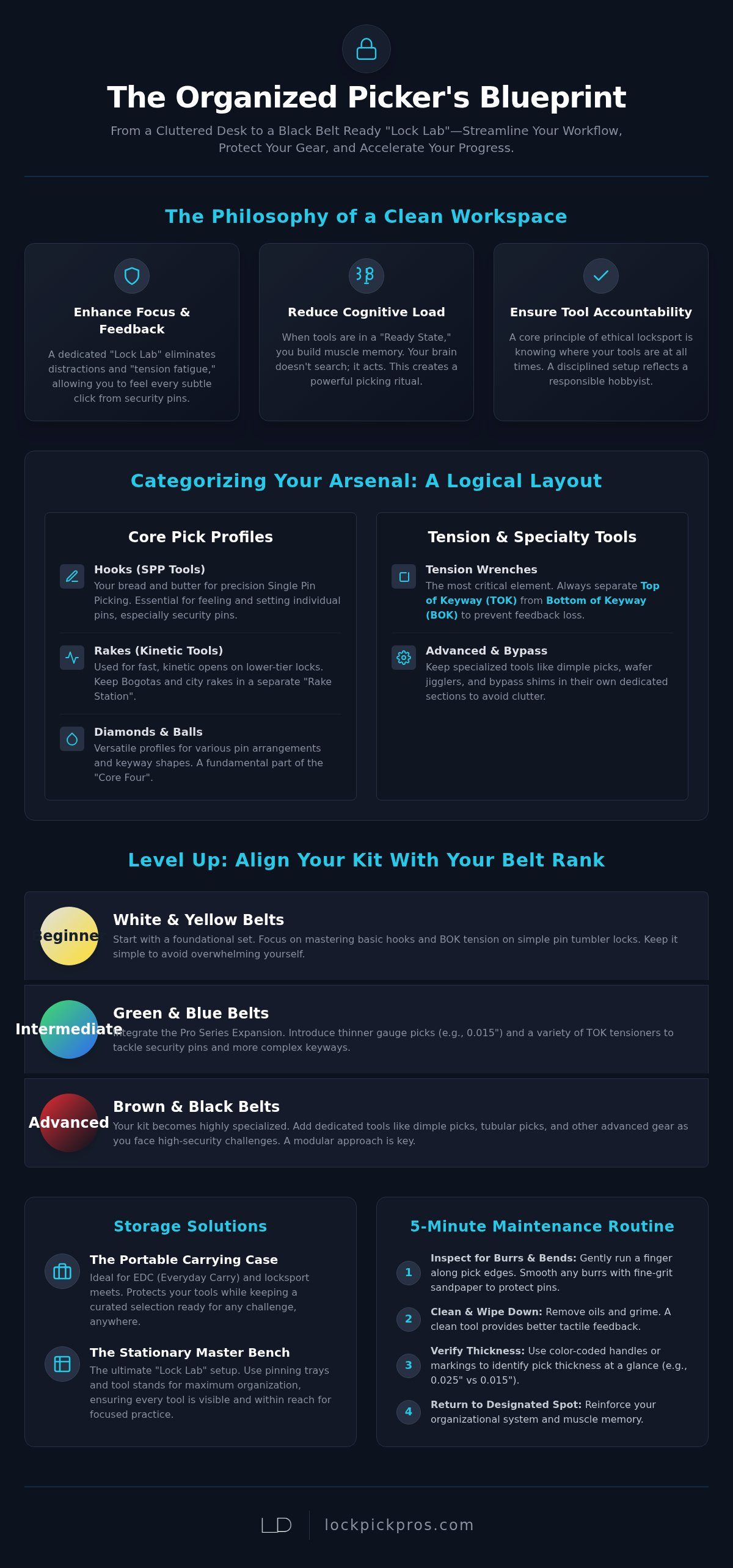
The Philosophy of the Organized Picker: Why Your Setup Matters
Imagine your workspace as a "Lock Lab." This isn't just a desk where you dump your gear; it's a dedicated environment where you sharpen your focus and refine your tactile feedback. When you're deep into a Single Pin Picking (SPP) session, every distraction counts. If you're hunting for a specific 0.040 inch TOK wrench while your hand is already starting to cramp, you've lost the battle before the plug turns. Learning how to organize your lock picks is about more than just aesthetics. It's about maintaining your flow state. Clutter leads to "tension fatigue," a common frustration where you settle for the wrong wrench simply because it was the only one you could find. This mistake ruins the feedback you need to feel those subtle clicks in high security pins.
A disciplined setup is also a core requirement for ethical lockpicking. As members of the locksport community, we pride ourselves on responsibility. Part of that responsibility is tool accountability. You should know exactly where your tools are at all times. Looking back at the history of lock picking, we see that while the tools have evolved from simple wires to precision Carbon Fiber series, the need for a disciplined approach remains constant. Accuracy matters. Focus matters. A clean station ensures both.
From Beginner to 'Belt-Minded' Hobbyist
Most of us started our journey with a beginner lock pick set. It likely arrived in a simple pouch or even a cardboard shipping box. That works for White Belt locks, but as you climb the ranks, your "bag of tools" must become a "precision kit." Transitioning to a structured setup allows you to track which tools work for specific locks. If you know exactly which 0.015 inch hook navigated that tight Abus keyway, you can replicate that success. Organization helps you set goals. It turns a pile of metal into a roadmap for your next belt rank.
The Psychology of a Clean Workspace
Picking a Green Belt lock or higher requires intense mental energy. You need to reduce your cognitive load wherever possible. If your tools are always in the same "Ready State" position, your brain doesn't have to search for them. This creates a powerful ritual. Setting out your Pinning Tray and aligning your hooks prepares your mind for the pick. It signals focus. When your go-to hook and tensioner are always in the same spot, you can reach for them without breaking eye contact with your vice. This level of preparation is what separates a trainee from a master.
Categorizing Your Arsenal by Tool Type and Belt Rank
Once your workspace is ready, it's time to tackle the physical layout of your gear. Learning how to organize your lock picks effectively starts with grouping your "Core Four." These are your standard hooks, rakes, diamonds, and balls. Hooks are your bread and butter for precision work. Rakes allow for those satisfying, fast kinetic opens on lower-tier locks. Keep these profiles separated to prevent the "pick-pile" shuffle. Tension wrenches require even stricter tiering. You should always separate your Top of Keyway (TOK) tools from your Bottom of Keyway (BOK) bars. As noted in the MIT Guide to Lock Picking, tension is the most critical element of the open. Having the right bar within reach prevents you from over-tensioning or losing tactile feedback.
Advanced picking requires advanced sorting. Dimple picks and wafer jigglers deserve their own dedicated section. These tools are specialized. They shouldn't be mixed with your standard pin tumbler picks. Mixing them only leads to confusion when you're under the pressure of a difficult pick. A clean hierarchy ensures that your hand moves to the right tool instinctively. This becomes especially important as you start mapping your tools directly to the lock picking belt levels. Your kit should grow as you do, with each rank adding new layers to your organization system.
Sorting by Picking Technique
Group your SPP (Single Pin Picking) tools for precision work. These are your thin-gauge hooks designed for tight keyways and security pins. Create a separate "Rake Station" for your Bogotas and city rakes. This separation is vital. The aggressive motion used in raking is the polar opposite of the delicate touch needed for SPP. Finally, keep your bypass tools like combs or shims in their own pouch. They are situational tools and shouldn't clutter your precision picking space. Keep it clean. Keep it focused.
Aligning Tools with Community Standards
Your kit should reflect your current challenge. For White and Yellow belts, keep things simple with The Trainee 2.0. It contains the foundational tools needed for basic locks without the clutter of specialty gear. As you move into intermediate Green or Blue ranks, integrate the Pro Series Expansion to handle serrated and spool pins. By the time you reach the Black Belt, you'll be managing high security specialty equipment. If you want the best feedback for those expert-level locks, the Carbon Fiber Gen 2 Pro Series offers the precision required for world-class opens.
Storage Solutions: Carrying Cases vs. Stationary Bench Setups
Deciding how to organize your lock picks usually depends on where you do your best work. Many hobbyists find themselves split between two worlds. You might have a dedicated "Lock Lab" at home, but you also need a portable kit for club meetups or practicing on the go. This is where the choice between an Everyday Carry (EDC) setup and a stationary Master Bench becomes vital. A portable kit focuses on a slim, durable profile. It needs to fit in a pocket or bag without adding bulk. However, portability shouldn't come at the cost of protection. Delicate pick tips are prone to "tip-curling" if they are allowed to rattle around. A quality case keeps each tool under individual tension, ensuring your 0.015 inch hooks stay straight and true for your next session.
Your storage strategy must also account for your growing collection of practice locks. Tools and locks should exist in a shared ecosystem. If your picks are in one room and your locks are in another, you'll spend more time walking than picking. We recommend using labeled bins or modular drawers right next to your picking station. This allows you to transition from a Yellow Belt padlock to a Green Belt mortise cylinder in seconds. Keeping your gear grouped by difficulty rank keeps your momentum high and your workspace clear of unnecessary clutter.
Selecting the Right Carrying Case
When you're away from the bench, the Gen 2 Pro Max Stealth Edition is the gold standard for high capacity organization. It features a tiered internal pocketing system that holds both picks and tensioners securely. Many generic cases fail because they don't have specific slots for TOK bars. They end up sliding to the bottom, forcing you to dump the whole case to find one wrench. A professional fold-out design offers immediate visibility. You can see your entire arsenal the moment you unzip it, which is a massive advantage during timed community challenges.
DIY and Magnetic Workbench Solutions
For those who prefer a permanent station, magnetic strips are a brilliant addition. Mounting a strip at eye level keeps your most-used hooks within reach but off the desk surface. This leaves more room for your vice and your pinning tray. While trays are essential for lock rekeying and mastering internal mechanics, they also serve as perfect temporary docks for tools during a complex pick. If you want a truly bespoke feel, consider customizing foam inserts for your drawers. Cutting exact shapes for your Carbon Fiber series tools provides a "Pro" aesthetic and ensures nothing shifts out of place when you're not there.
Professional Maintenance: Keeping Tools 'Black Belt Ready'
Maintenance is the silent partner of effective organization. You can have the most expensive kit in the world, but if your hooks are burred or your wrenches are bent, your performance will suffer. A dedicated five-minute post-session cleanup is the best way to keep your gear in peak condition. Use this time to wipe down your tools to remove skin oils and check for any slight bends in the tips. This is also the ideal moment to refine how to organize your lock picks by thickness. Using color-coded handles or small strips of heat-shrink tubing helps you identify a 0.015 inch pick versus a 0.025 inch pick at a glance. When you're working on a tight paracentric keyway, grabbing the wrong thickness can lead to a snapped tool or a ruined lock.
Your storage environment also plays a massive role in tool longevity. Steel picks are highly susceptible to corrosion in high-humidity areas. We suggest keeping silica gel packets inside your carrying case to stay ahead of rust. Beyond daily care, you should develop a "Tool Audit" schedule. Every three months, take every tool out of your kit. Perform a "ping" test by lightly flicking the metal; a healthy pick should have a clear, bright ring. If a hook feels "spongy" or looks dull, it's likely suffering from metal fatigue. Replacing worn equipment before it fails inside a lock is a hallmark of a professional hobbyist.
Labeling and Identifying Tension Wrenches
The "Wrench Chaos" problem is a major hurdle for growing collections. Many tensioners look identical until you try to fit them into a keyway, which wastes valuable time. Mark your wrenches with small notches or colored dots to indicate specific widths like 0.030, 0.040, or 0.050 inches. You should also organize them by feedback levels. Separate your stiff bars from your flexible ones. Stiff bars are perfect for heavy tension, while flexible ones help you "feel" counter-rotation in security pins. Small modular cases or even magnetic tins are perfect for keeping these small components from getting lost in the bottom of a larger bag.
Tool Care for the Carbon Fiber Series
High-performance materials like those in the Carbon Fiber Gen 2 Pro Series require specialized attention. These tools are designed for maximum tactile sensitivity, but that sensitivity depends on cleanliness. Carbon fiber requires different handle-spacing than traditional steel to prevent the handles from rubbing together and dulling the finish. Use a dry microfiber cloth to maintain the "Stealth" finish and avoid harsh chemicals that might degrade the resins. By keeping these tools clean and properly spaced, you ensure that every vibration from the pins travels directly to your fingertips without interference.
If you're serious about your progression, you need gear that responds to your touch. Upgrade your precision today with our Carbon Fiber Gen 2 Pro Series to experience the difference that high-yield materials make.
Leveling Up: Building Your Ultimate 2026 Tool Kit
Building a world class kit is a marathon, not a sprint. Many beginners make the mistake of buying a massive, 50 piece unorganized set right away. These sets often contain filler tools you'll never use, which only adds to the clutter. Modularity is the secret to a professional setup. Mastering how to organize your lock picks means building your kit one specific tool at a time, ensuring every hook and tensioner has a clear purpose. This approach keeps your workspace lean and your mind focused on the pins.
As your skills grow, you'll need to integrate the Pro Series Expansion into your existing layout. This kit is designed to bridge the gap between intermediate challenges and high security locks. It adds the specialized profiles needed for advanced security pins without forcing you to start your organization from scratch. An organized kit also plays a huge role in the "Share-to-Earn" loop. When you post your community progress photos, a structured, professional kit shows your dedication to the craft. It looks better, feels better, and proves you're ready for the next rank.
The Foundation: Starting with Structure
Every expert was once a trainee. Starting with The Trainee 2.0 provides the perfect organizational template. It forces you to learn the "Core Four" profiles before you move on to complex specialty tools. Resist the urge to over-collect. You don't need twenty different rakes to open a Yellow Belt lock. Focus on mastering the basics with a minimal, clean setup first. The Foundational Kit serves as the essential base for every future belt rank you'll earn.
Scaling Your Organization
When you start hitting Green and Blue belt locks, you'll likely move from a single case to a multi-kit system. This is where "Specialist" bags come into play. You might have one pouch dedicated to standard pin tumblers and another for Kaba or dimple lock challenges. This prevents you from digging through specialty picks when you're just doing a standard SPP session. Maintaining a "Black Belt" level of professionalism means your gear is always ready for the most difficult opens. Keep your kits separated, labeled, and clean.
Are you ready to prove your skills to the community? Join our free Black Belt Challenge today. Progress one belt at a time, upgrade your tools at each tier, and share your "picks-in-action" content on social media to earn exclusive rewards. We even have a community bounty for hitting social reach goals, so get organized and start sharing your journey!
Master Your Kit and Claim Your Belt
Mastering how to organize your lock picks is the final piece of the puzzle for any serious hobbyist. By categorizing your arsenal by belt rank and maintaining a clean "Lock Lab," you ensure that every Single Pin Picking session is productive and focused. Whether you are using a portable case for EDC or a stationary bench with professional pinning trays, a structured setup protects your investment and sharpens your skills. It's the difference between a frustrating search and a smooth, successful open.
We're committed to fostering a community of ethical lockpickers who value precision and progress. Our Carbon Fiber Gen 2 Pro Series tools are engineered specifically for those who demand the highest level of tactile feedback. We stand behind our gear with a satisfaction guarantee on all Pro Series cases, ensuring your tools stay protected as you climb the ranks.
Ready to master the ranks? Join the FREE Black Belt Challenge and start your journey today! Keep your tools sharp, your workspace clear, and your focus locked on the next open. Your path to mastery starts with a single organized pick.
Frequently Asked Questions
What is the best way to store lock picks for travel?
The best way to store lock picks for travel is in a slim, durable Carrying Case with dedicated internal slots. These individual pockets prevent your tools from rubbing together and curling the delicate tips. For maximum security, choose a zippered case rather than a simple wrap. This ensures your tensioners and small bypass tools don't slide out while you're on the move.
How do I prevent my lock picks from rusting in their case?
Prevent rust by placing silica gel packets inside your storage case to absorb any trapped moisture. Always wipe your tools down with a dry microfiber cloth after every session to remove corrosive skin oils. If you live in a high humidity area, a light coat of tool oil provides extra protection. Keeping your gear dry is a vital part of how to organize your lock picks for long term durability.
Should I organize my picks by size or by type?
You should organize your picks by tool type first, then by thickness. Group your hooks, rakes, and diamonds into separate sections so you can find the right profile instantly. Within those groups, arrange them from thickest to thinnest. This hierarchy allows you to select a 0.025 inch hook for standard locks and transition to a 0.015 inch version when you encounter a tight, paracentric keyway.
Can I use a magnetic strip to hold my carbon fiber lock picks?
Yes, you can use a magnetic strip for your Carbon Fiber Lockpicks because the core material is still high yield steel. The magnet will hold the tool securely by the shaft or the base. This is a brilliant way to keep your most used hooks at eye level on a Master Bench. Just ensure the strip is strong enough to support the unique handle spacing of the Pro Series tools.
How many tension wrenches should I keep in my everyday carry kit?
Keep three to five tension wrenches in your everyday carry kit to cover most common locks you'll encounter. Include at least two Top of Keyway (TOK) bars in different thicknesses and one or two Bottom of Keyway (BOK) wrenches. This variety ensures you can handle everything from a White Belt padlock to a more restrictive Yellow Belt cylinder without over packing your portable Carrying Case.
What is the best way to label my picks so I know their thickness?
The most effective way to label picks is using color coded heat shrink tubing on the handles. Assign a specific color to each gauge, such as red for 0.015 inch and blue for 0.025 inch tools. This visual system is much faster than reading small engraved numbers. It allows you to identify the right tool for the job even during the pressure of a high tier belt rank challenge.
How do I keep my pinning tray organized during a complex rekeying?
Keep your Pinning Tray organized by using the numbered grooves to hold pins in the exact order they were removed. Place springs and driver pins in the upper sections and keep the plug in the center cradle. Never mix parts from two different locks on the same tray. This disciplined approach prevents "bricked" locks and makes rekeying much smoother during complex intermediate belt sessions.
Is it better to use a hard case or a soft roll-up case for lock picks?
It depends on your environment, but a zippered soft Carrying Case is usually better for portability and quick access. Soft cases offer more flexible pocketing for various tool shapes and fit easily into a pocket. However, a hard shell case provides superior protection for high end tools if you often drop your gear. Most hobbyists prefer a zippered soft case for its balance of protection and slim profile.