

BOK Wrench: A Beginner-Friendly Guide to Bottom-of-Keyway Tension
What if the best way to improve your lockpicking isn’t to apply more force, but to feel more with less? If you’re unsure where a bok wrench sits or worry it will crowd your pick, you’re not alone. Bottom-of-keyway tension is a common starting point, and gentle pressure is the key to noticing how the lock responds.
This guide will help you understand the wrench’s placement and purpose, compare BOK with top-of-keyway (TOK) tension, and build a steadier touch. You’ll also learn why pressure should stay light and controlled, rather than become a test of strength.
We’ll walk through how BOK and TOK setups affect keyway access, what to notice as you apply rotational pressure, and how to practice reading tactile feedback on a lock you own or have permission to pick. With a little patience, this foundational skill can support your locksport progress, one careful practice session at a time.
Key Takeaways
- Learn where a bok wrench sits and how it applies rotational force while you observe pin feedback.
- Compare BOK and TOK tension to understand how wrench position can affect pick clearance and keyway access.
- Use a simple practice routine to build gentle, consistent tension on a lock you own or have permission to pick.
- Choose a setup by considering fit, stable placement, pick clearance, and your locksport practice goals.
- Connect steady practice with your next step in the belt-ranking journey.
What Is a BOK Wrench, and What Does It Do?
BOK means bottom-of-keyway tension: a tension wrench rests at the lower edge of a lock’s keyway and applies rotational force to the plug. The picker uses that tool contact to notice how the lock responds while practicing with a pick. The wrench doesn’t set pins by force alone. Its role is to apply controlled tension and make tactile feedback easier to observe.
The shear line is the boundary between the plug, the part that turns, and the surrounding lock body. In a pin-tumbler lock, pin stacks cross this boundary and can prevent the plug from rotating. Understanding that relationship gives context for tension without treating pressure as a substitute for careful observation. The broader concepts of tension wrenches and the shear line are also outlined in Lock picking.
Where does a BOK wrench sit in the keyway?
A BOK wrench sits at the bottom of the keyway, below the area where the pick moves. The exact fit depends on the keyway’s shape and available space. Some keyways provide a clear lower ledge for the wrench; others may leave less room or cause the tool to shift. A comfortable fit is stable, but it shouldn’t crowd the pick’s path.
Before introducing a pick, check that the wrench rests securely and doesn’t rock or slide with ordinary handling. If it blocks the space needed for the pick, or its position feels unstable, pause and reassess the fit rather than forcing it. This simple check helps separate feedback from the lock from movement caused by a poorly seated tool.
What does tension feel like during locksport practice?
Start with a gentle, controlled touch on a practice lock you own or have permission to pick. There isn’t one universal pressure level: locks and wrench fits vary. The goal is not to twist hard, but to apply steady rotational pressure and pay attention. Abrupt or excessive force can make it harder to tell whether a change came from the lock or from the wrench shifting.
As you practice, notice changes in resistance and small movements transmitted through the tool. These sensations are feedback, not a guarantee that a particular pin has reached a particular position. Keep your attention on consistency: if the wrench slips, binds, or blocks the pick, stop and reset your setup. Repeating a calm, comfortable hold helps you learn what the lock feels like without turning the exercise into a test of strength.
BOK tension is gentle rotational pressure applied at the bottom of the keyway so a picker can observe tactile feedback during ethical practice.
For standard pin-tumbler locks, the Carbon Fiber Gen 2 Pro Series is a relevant option for locksport practice through up to Brown belt. Choose any tension wrench by considering its fit and whether it leaves room for controlled pick movement. Practice only on locks you own or have permission to pick, and treat each session as a chance to refine observation, not force.
How BOK Tension Interacts With Pins and the Shear Line
To understand what a bok wrench does, picture the lock’s plug as a cylinder inside a fixed outer body. In a pin-tumbler lock, each pin stack contains a key pin and a spring-loaded driver pin. The shear line is the boundary between the plug and the outer body. If a pin stack crosses that boundary, it can restrict plug rotation.
Diagram suggestion: Label the outer body, plug, spring, driver pin, key pin, shear line, and tension wrench. Show the wrench applying rotational force to the plug, with pin stacks positioned across the shear line. This simple cross-section helps readers see how the parts relate without implying that pressure alone sets a pin.
Fact to remember: A tension wrench applies rotational force to the plug, and the plug’s slight movement changes how pin stacks contact the shear line, creating sensations the picker can observe through the tools.
Those sensations are clues, not a definitive readout. A click or change in resistance by itself doesn’t prove that a pin is set or that the lock has opened. Pin behavior can vary, and the same sound or feel may have more than one explanation. Treat observations as information to compare, not a recipe or guaranteed signal. For locksport background and ethical context, see The Open Organisation Of Lockpickers (TOOOL).
Why does too much tension make feedback harder to read?
Excessive pressure can make small changes in pin movement difficult to distinguish. The wrench may also shift or bind, adding sensations that come from the tool rather than the lock. During authorized practice, ease pressure if movement feels forced or feedback becomes unclear. There’s no single setting for every lock, so avoid pushing harder to chase a click.
What tactile cues should a beginner observe?
On a purpose-made or personally owned practice lock, notice changes in resistance, movement, and the feel transmitted through the tools. None is a guaranteed signal. Adjust pressure gradually, then note what changes and what stays consistent. A few brief notes after a practice session can help separate repeatable observations from guesses.
- Does the wrench stay in place, or does it shift?
- Does the feel change when pressure is eased slightly?
- Does a sound occur with a change in movement, or on its own?
Keep the focus on observation and repeatable practice, not forcing the plug. For standard pin-tumbler practice, the Carbon Fiber Gen 2 Pro Series is one relevant tool option. Use it only with a lock you own or have permission to pick, and let careful notes guide your next practice session.
BOK vs. TOK Wrench: Which Position Gives Better Access?
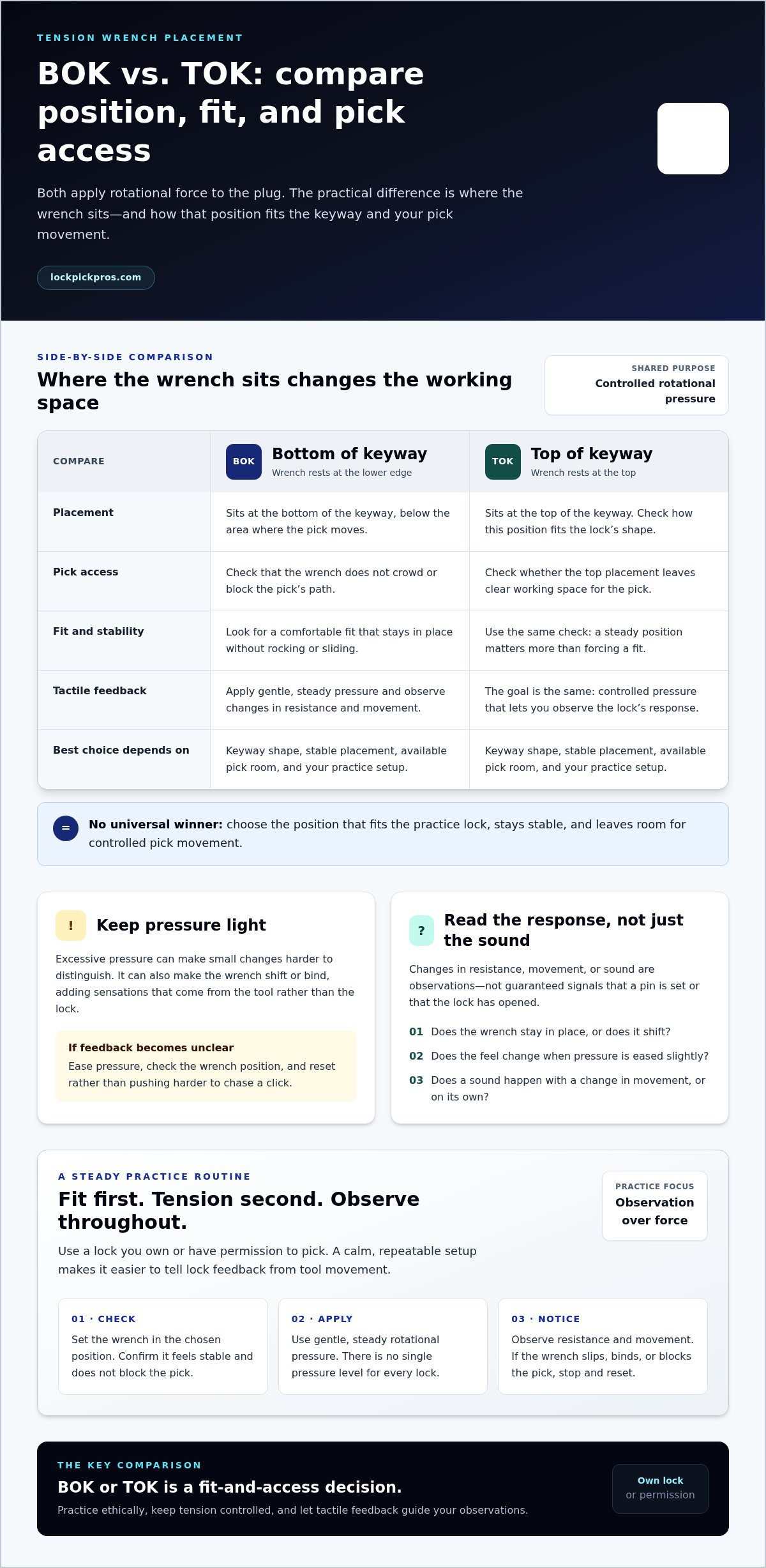
BOK and TOK describe where a tension wrench sits in the keyway: at the bottom or at the top. That placement affects how much room remains for the pick, but it doesn’t determine a universal winner. The useful question is which position fits the practice lock and leaves clear working space for the skill you’re practicing.
| Factor | BOK | TOK |
|---|---|---|
| Placement | At the bottom of the keyway | At the top of the keyway |
| Keyway access | Uses some lower keyway space | Can leave more of the lower keyway open |
| Pick clearance | Works when the pick can move without meeting the wrench | May help when bottom placement crowds the pick path |
| Fit | Depends on the keyway shape and wrench resting securely | Depends on the top edge and the wrench’s fit and stability |
When can BOK placement be a useful starting point?
BOK can be a practical starting position when a bottom-resting wrench fits securely and leaves enough room for the pick to move. It gives beginners a straightforward setup to assess on a practice lock. Check the keyway shape and tool stability first: a wrench that shifts or crowds the pick path is a poor fit for that setup. Not every keyway offers comfortable bottom access.
Compare the space available, not just the wrench position. If the pick can enter and move without catching on the wrench, BOK may suit that practice session. If it repeatedly meets the wrench, that’s a useful sign to reconsider the position rather than forcing the tools into the same space.
When might TOK placement leave more room?
TOK may be worth trying when a bottom-positioned wrench occupies the area where the pick needs to move. Since it sits at the top of the keyway, it can leave more of the lower portion open. That’s an access advantage to assess on the lock in front of you, not proof that TOK is always better. The top edge must also provide a stable fit.
Think about your practice goal, too. A setup that gives clear pick clearance may be more useful for controlled movements, while another lock may feel more manageable with BOK. If you’re selecting your first beginner pick set, start with the tools that match your practice plans. The Trainee 2.0 beginner set is an entry-pick option to consider as you build your setup.
Use a simple comparison on a lock you own or have permission to pick: check whether each wrench position stays stable, then note whether the pick has room to move freely. Let keyway geometry and practice goals guide the choice. For standard pin-tumbler practice as your locksport skills progress, the Carbon Fiber Gen 2 Pro Series is a relevant tool option.
How to Practice BOK Wrench Control on a Practice Lock
Build this exercise around observation, not opening speed. Use a practice lock you own or have permission to pick, and work in a quiet spot where you can keep your hands steady. The aim is to notice how small changes in rotational pressure affect the feel of the tools. Don’t force the plug or treat a click as proof of success.
A simple routine for observing tension and feedback
- Choose one practice lock. Keep the same lock for the exercise so changes in feel are easier to compare. Make sure it’s intended for practice or belongs to you.
- Check the wrench fit first. Before adding a pick, place the BOK wrench in its resting position. Notice whether it feels stable and stays clear of the pick’s working space. If it shifts or feels awkward, pause and adjust the setup.
- Hold a gentle, steady position. Apply light rotational pressure without trying to turn the plug by force. There’s no universal pressure setting; the lock and tool fit affect what feels appropriate.
- Add the pick and observe. Move slowly enough to notice changes in resistance or movement. Treat each sensation as an observation, not a guaranteed indication that a pin has moved into a particular position.
- Change one thing at a time. If feedback is unclear, ease the pressure slightly and notice whether the feel changes. Keep the wrench position consistent while making that adjustment.
- Record a short note. Write down what you changed and what you noticed. A simple note such as “less pressure felt smoother” is more useful than assuming one click means the lock is picked.
Repeat the exercise without rushing. Keeping the lock and wrench position consistent makes it easier to compare one session with the next. The purpose is to develop a calmer, more deliberate touch, not to force a particular result.
Common BOK practice mistakes to avoid
Pressing harder when feedback is confusing can make sensations harder to interpret. Repeatedly shifting the wrench also changes the setup, so it becomes difficult to tell whether a new feeling came from the lock or the tool. And clicks are only sounds or sensations, not confirmation by themselves.
If the wrench slips, the pick catches, or the feedback stops making sense, pause. Remove the tools, reset the fit, and return to gentle observation. Ethical locksport is built on responsible practice and gradual skill development. The community’s belt ranking system offers a way to think about progression, from foundational control toward more challenging practice, one stage at a time.
Deliberate practice builds better control than increasing force. For standard pin-tumbler practice as you develop your locksport skills, explore the Carbon Fiber Gen 2 Pro Series.
Choose a BOK Wrench Setup That Supports Your Locksport Progress
A useful setup is the one that fits the practice lock and lets you work with control. Before choosing a wrench position, consider four things: whether the wrench fits the keyway, whether it stays stable, whether the pick has room to move, and what skill you want to practice. A setup that works on one lock may feel awkward on another, so assess the tools together with the lock rather than choosing by habit.
Keep the purpose of the session specific. You might be learning to keep the wrench steady, comparing how two positions affect pick clearance, or practicing consistent feedback. Use only a lock you own or have permission to pick. A carbon fiber lock picks guide can offer separate material context, but material choice doesn’t replace checking fit and clearance in your practice lock.
Match your wrench setup to the practice lock
Start by testing whether the wrench rests securely without obstructing the pick’s movement. If it shifts, crowds the working area, or makes it difficult to maintain a consistent grip, pause and reassess the fit. Keep the same lock and setup for a practice session when comparing small adjustments. That gives you a clearer basis for noticing what changed, while keeping the exercise focused on ethical locksport skill development.
- Keyway fit: Does the wrench sit comfortably in the available space?
- Stable placement: Can you hold its position without repeatedly resetting it?
- Pick clearance: Is there room to move the pick without it catching on the wrench?
- Practice goal: Does this arrangement help you focus on the skill you intend to refine?
Build skill through the belt-ranking progression
Tension control develops through patient repetition, not as a shortcut to a higher belt. Progress at a pace that lets you understand the feedback and build consistency on suitable practice locks. The belt-ranking system gives locksport hobbyists a shared way to mark increasing skill and challenge themselves over time.
Ready to progress one belt at a time? Join the free Black Belt Challenge. Participants receive an email sequence and can earn reward picks as they advance through belt ranks and share their progress on social media using Lockpick Pros tools. Sharing picks-in-action content also contributes to the challenge’s $5,000 bounty for reaching its social reach goal.
As your practice goals develop, choose tools that suit the locks you’re working with. The Carbon Fiber Gen 2 Pro Series is one option to consider for standard pin-tumbler practice. Explore the Carbon Fiber Gen 2 Pro Series as you build your locksport setup, and keep refining your technique with care.
Make Your Next Practice Session Count
Choose one small goal for your next locksport session, such as keeping your tool position steady or recording how a slight adjustment changes what you feel. A focused goal gives you something concrete to work on without turning practice into a test of strength or speed. Use only a lock you own or have permission to pick, and give yourself time to notice what feels consistent.
As your skills grow, let your practice goals grow with them. The belt-ranking journey is built one step at a time, and patient attention can make each session more purposeful. Lockpick Pros offers tools for ethical locksport hobbyists who want to keep developing their skills.
Ready to choose a tool for your next practice session? Explore the Carbon Fiber Gen 2 Pro Series, then keep building your technique with care. Every thoughtful session is another opportunity to grow as an ethical picker.
Frequently Asked Questions
What does BOK mean in lockpicking?
BOK means bottom-of-keyway, describing where the tension wrench sits in the keyway. The term identifies the wrench position, not a separate picking method or a special kind of lock. For example, a picker might describe using BOK tension on a practice lock to distinguish that setup from top-of-keyway placement. Knowing the abbreviation helps you follow locksport discussions and recognize what a guide means by a BOK wrench.
Is a BOK wrench the same as a tension wrench?
A BOK wrench is a tension wrench used in the bottom position. “Tension wrench” names the tool category, while “BOK” describes its placement. The same distinction applies when someone says TOK, meaning top-of-keyway. When reading tool descriptions, note whether they specify a particular wrench position or refer to tension wrenches generally. The terminology helps you compare setups without assuming every tension wrench fits every keyway.
Is BOK or TOK tension easier for beginners?
Neither position is easier for every beginner or every lock. BOK may feel straightforward if the wrench fits securely and leaves the pick room to move. TOK may be more comfortable when a bottom-positioned wrench crowds that space. For a first practice session, choose the arrangement that feels stable and lets you handle the tools without forcing them. Then keep the setup consistent while learning its feel.
Can a BOK wrench block the pick inside a keyway?
Yes. A BOK wrench uses space near the bottom of the keyway, so it can interfere with the pick if the opening is narrow or the wrench sits in its path. If the pick catches, stops moving freely, or pushes the wrench out of place, pause and reassess the fit. Don’t force the pick past an obstruction. A different wrench position may provide more working room.
What happens if I apply too much tension with a BOK wrench?
Too much tension can make feedback harder to interpret. Resistance may feel more pronounced, while small changes in tool movement become harder to distinguish. Pressing harder doesn’t guarantee progress, and a click alone doesn’t confirm that a lock is open. If the setup feels forced or confusing, ease off, remove the tools if needed, and restart with a lighter, controlled touch on an authorized practice lock.
Do beginner lock pick sets include a BOK wrench?
Whether a beginner lockpick set includes a BOK wrench depends on the specific set. Check the product’s listed contents rather than assuming a wrench is included or that it’s designed for bottom-of-keyway placement. Product descriptions may identify a tension wrench without specifying its position. Matching a wrench to your practice lock is a separate consideration, since fit and keyway shape affect how the setup works.
Can I practice BOK tension on any lock?
No. Keep practice to a lock you own or have permission to pick, and avoid locks currently relied on for security. A dedicated practice lock gives you a suitable place to learn without risking disruption to someone else’s property or an essential lock. If you’re unsure whether a lock is appropriate for practice, choose a purpose-made practice lock instead. Ethical locksport starts with clear permission and responsible choices.