

Bump Key: How It Works and How to Spot a Bumped Lock
A lock can look untouched even when something has gone wrong. If you’re asking how a bump key works, start with what a lock’s behavior and visible condition can and cannot tell you. A scratch or change in key movement alone doesn’t prove a specific entry method.
This guide explains the key terms for bump keys and pin-tumbler locks, then distinguishes bumping from picking, drilling, and other methods. It also covers why exterior clues are limited, what to document if a lock or door seems different, and which lock features relate to bump resistance. The focus is understanding, not trying the technique on a working lock. For locksport, build familiarity safely by practicing only with locks you own and have set aside for learning.
Key Takeaways
- See how a bump key’s shape and impact affect pin stacks inside a compatible pin-tumbler lock.
- Understand why pins aligned at the shear line allow the cylinder to rotate.
- Learn which physical changes may raise concern about bumping, and why a single clue may not tell the whole story.
- Discover what the term “999 key” refers to and how bumping differs from other entry methods.
- Explore how practice locks and beginner lockpicking tools can support ethical locksport learning.
How Does a Bump Key Work?
A bump key interacts with the loaded pin stacks inside a compatible pin-tumbler lock. Its effect depends on how those moving parts respond within the lock cylinder.
Pin and Tumbler Components
A pin-and-tumbler lock contains a plug, an outer housing, springs, and vertical stacks of pins. Each stack has a key pin and a driver pin. The key pin meets the inserted key, while the spring presses the driver pin downward. These parts determine whether the plug can rotate.
Chambers hold the pin stacks in place as the key enters the keyway. The key’s cuts affect the height of each key pin, while the spring keeps the stack under pressure when no key is present. A lock may have several chambers, each with its own pair of pins. Their combined positions determine whether the plug remains blocked.
Understanding each part helps explain how the lock responds. The key pins contact the key, the drivers interact with the housing, and the springs return the stacks after movement. A key that fits the keyway must also match the pin arrangement. Physical fit alone doesn’t tell the whole story.
Pin Tumbler Lock Mechanics
A pin-tumbler lock permits rotation when the pin stacks stop bridging the plug and housing. The boundary between those parts is called the shear line. A correctly matched key raises the pins into positions that let the plug move. If a driver pin remains across that boundary, it blocks rotation.
This mechanism explains why small differences in cut height matter. The key pins lift their paired drivers by different amounts, while the springs push back. The lock responds to the alignment of all the stacks, not just one chamber. If a single stack obstructs the interface, the plug stays in place.
After the key is removed, the springs press the pins downward again, returning the lock to its resting state. The plug, housing, chambers, and springs work as a linked system. A worn key or sticky pin can affect normal operation even without a bump key.
Bump Key Operation
A bump key has a compatible key profile and a distinctive cut pattern that can transmit a brief impact through the pin stacks. The impact can set the key pins and drivers in motion together. For a moment, the drivers may clear the shear line, allowing the plug to rotate if rotational force is present.
The effect is temporary. Springs push the stacks back toward their resting positions, so the brief opportunity for rotation doesn’t create lasting alignment. This explains the general principle, not a reliable result: the lock’s keyway, pin configuration, condition, and internal tolerances all affect its response.
Bump keys aren’t universal. The profile must match the lock’s keyway, and a compatible profile alone doesn’t mean the lock will respond. Ordinary keys work differently: their specific cuts hold the pin stacks at the intended heights during rotation.
How Can I Tell If a Lock Has Been Bumped?
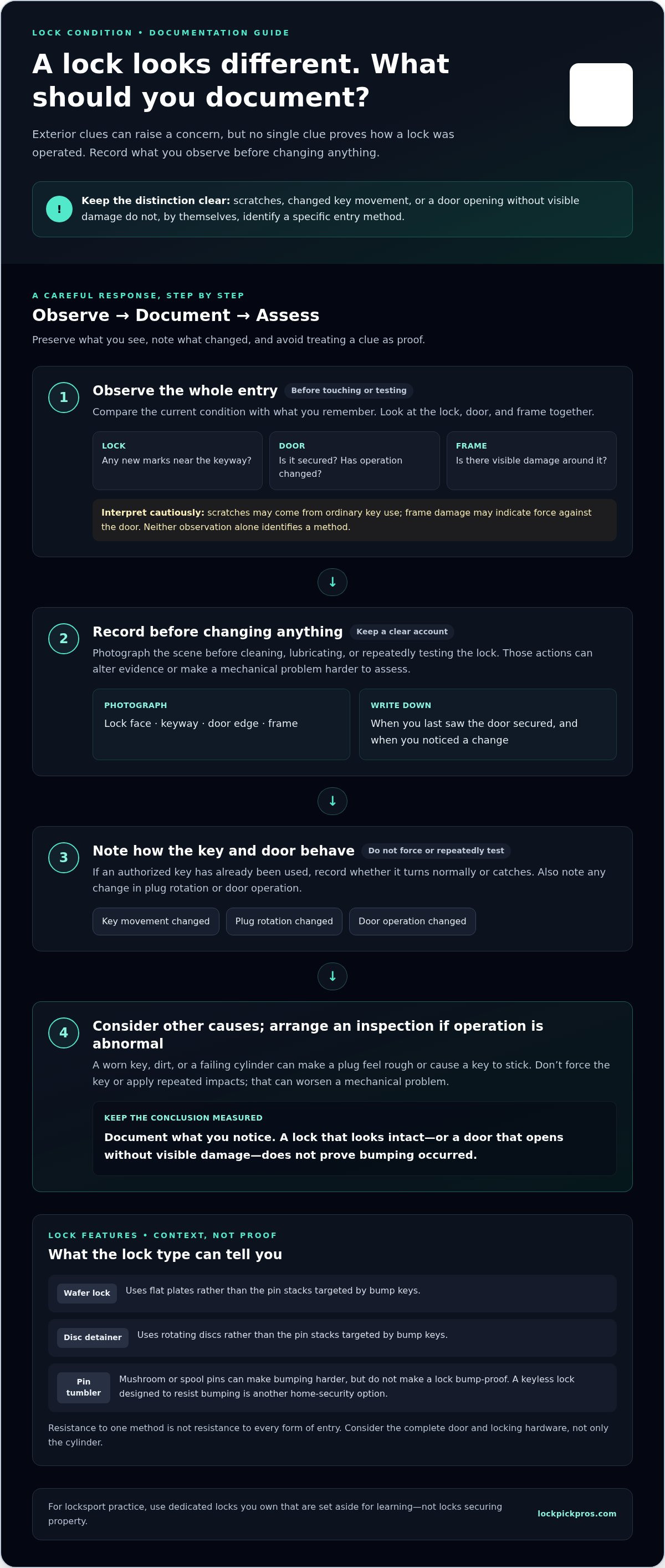
No single exterior clue proves bumping occurred. A lock may look intact, so compare its current condition with what you remember before the concern arose. Note any change in key movement, plug rotation, or door operation. A sticking key can also result from wear or a damaged key, so record what you observe without treating it as proof.
Signs Worth Documenting
Examine the lock, door, and frame together. Check whether the door is secured, whether the keyway has new marks, and whether the key behaves differently. Photograph the scene before cleaning, lubricating, or repeatedly testing the lock. These actions can alter evidence or make a mechanical problem harder to assess later.
- Record the time you last saw the door secured and when you noticed the change.
- Photograph the lock face, keyway, door edge, and frame.
- Note whether an authorized key turns normally or catches.
Scratches near the keyway may result from ordinary key use, while frame damage can indicate force against the door. Neither observation alone identifies a method.
Effectiveness and Possible Damage
Bumping applies only to compatible pin-tumbler locks. A lock’s keyway and internal configuration affect its response, and an opened cylinder may show no obvious exterior damage. A door that opens without visible damage therefore doesn’t prove bumping took place.
Changes in operation can have other causes. A worn key, dirt, or a failing cylinder may make the plug feel rough or cause the key to stick. Don’t force the key or apply repeated impacts, as this can worsen a mechanical problem. Record what you notice and arrange an inspection if the lock no longer operates normally.
Which Locks Resist This Method?
A wafer lock uses flat plates, while a Disc detainer uses rotating discs. Neither mechanism has the pin stacks targeted by bump keys. This distinction concerns resistance to this particular method, not every form of entry.
In pin-tumbler cylinders, mushroom or spool pins can make bumping harder, but they don’t make a lock bump-proof. A keyless lock designed to resist bumping is another home-security option. Consider the complete door and locking hardware rather than judging protection by the cylinder alone.
Insurance and Home Protection
Coverage for theft after suspected bumping depends on the wording of the insurance policy. Most policies require proof of forced entry for theft coverage. Preserve photographs, a timeline, and any evidence of missing property, then review the policy’s conditions when documenting a claim.
For locksport practice, use dedicated locks you own that aren’t securing property. A pin-tumbler practice pick set can support learning on practice hardware, while a lock showing damage or changed operation calls for inspection rather than experimentation.
The shear line and cylinder rotation
The shear line is the boundary between the plug and the lock’s outer housing. In a pin-and-tumbler cylinder, the plug must rotate within that housing to operate the lock. Pin stacks cross the boundary, so their position determines whether the plug can move. Think of a small gate across a rotating part: anything still bridging the gap blocks movement.
Each chamber contains a key pin and a driver pin. Their meeting point must sit at the shear line before the plug can turn. With the correct key inserted, the key’s cut heights raise the stacks into alignment. If even one driver pin extends across the boundary, it acts like a bar through the plug and housing, keeping the cylinder stationary.
The shear line isn’t a physical groove or separate part. It describes the narrow interface where the plug’s outer surface meets the cylinder housing. This matters because a lock can have several correctly positioned pins, yet one misaligned stack can still stop rotation. For example, four aligned chambers don’t compensate for a fifth driver pin that remains below the boundary.
The relevant pin stacks must all clear the interface at once for the plug to rotate. During ordinary key operation, the correct key holds them at their matched heights as the plug turns. In bumping, alignment is momentary rather than held by the key’s cuts. This explains the timing without suggesting the shear line is visible on the lock’s exterior.
Small changes in pin position can affect the plug’s behavior. A driver pin that crosses the shear line prevents rotation; one that clears it no longer bridges the plug and housing. Springs press the stacks downward, so alignment doesn’t remain once the key is removed. The plug’s ability to rotate depends on how the pins sit in relation to the boundary.
This distinction helps explain why exterior evidence is limited. The shear line is inside the cylinder, not on the door or faceplate, and an opened lock may show no clear mark there. Scratches near a keyway or a stiff plug don’t establish whether bumping, ordinary key use, wear, or another cause affected the shear line.
Forced entry is a separate question from cylinder rotation. A damaged frame can indicate force against the door, while an intact frame doesn’t reveal exactly how the lock opened. Treat the shear line as a mechanical explanation, not a forensic test. If a lock’s operation changes, document its condition and consider the key, cylinder, and surrounding hardware together.
Bump key definition
A bump key is specially cut to affect the pin stacks in a compatible pin-tumbler lock. It resembles a conventional key, but its cuts are made to a uniform maximum depth rather than matching one lock’s individual pin heights. That’s why it isn’t an ordinary duplicate for a specific door.
The term “999 key” refers to those maximum-depth cuts. In key-making terminology, 999 is the maximum cut depth described for this key type. The name doesn’t mean the key fits every lock, or that it contains 999 separate cuts. Compatibility still depends on the lock’s keyway and pin-tumbler arrangement.
A bump key is a physical device, not a special type of lock. Its role depends on the lock it is intended to fit. The keyway shape determines whether the key can enter and align with the keyway, while the internal pin stacks determine how the lock responds. A key shaped for one keyway won’t automatically fit another.
That’s why “one key per keyway” is a useful phrase when defining bump keys. The general cut pattern doesn’t remove the need for a compatible profile. Two locks may both use pin tumblers yet have different keyway shapes. Sharing a mechanism doesn’t make their keys interchangeable.
It’s also useful to distinguish a bump key from a copied key. A copy reproduces the cuts of an authorized original for a particular lock. A bump key uses a standardized cut pattern intended to interact with compatible pin stacks. Neither term establishes whether a key is authorized for a specific property.
Bump keys are sometimes grouped with lockpicking because both relate to pin-tumbler locks, but the mechanisms differ. Picking broadly refers to manipulating pins individually or in groups with tools. A bump key is shaped like a key and acts through the lock’s keyway. The shared feature is the pin-tumbler mechanism, not the way each method interacts with it.
The definition has limits. A bump key isn’t a universal device for all locks, and the term doesn’t guarantee that a compatible lock will open. A wafer lock uses flat plates rather than pin stacks, so the bump-key label doesn’t describe its operating principle. Identifying the lock type is essential to understanding what the term means.
For readers studying locksport, the useful takeaway is conceptual: “999” names the cut pattern, “keyway” describes the entry profile, and “pin tumbler” identifies the mechanism. Keeping those three terms distinct makes discussions of bump keys clearer without confusing them with ordinary keys, other lock designs, or authorized practice.
How does lock bumping compare with picking, drilling, and other entry methods?
These methods affect different parts of a lock and may leave different signs. Bumping relies on a compatible pin-tumbler mechanism. Picking manipulates internal components with tools. Drilling removes or damages parts of the cylinder. Other bypass methods may act on a latch or door instead. These distinctions explain why finding a lock open doesn’t identify the method.
Bumping and picking
Lock bumping uses a specially shaped key to create brief movement among compatible pin stacks. Lock picking generally means manipulating components inside the keyway without using the lock’s ordinary key. Both methods involve the cylinder, but they interact with it differently: one transfers impact through a key, while picking relies on tool contact and feedback.
Neither method necessarily leaves an obvious mark on the door. A scratch at the keyway can have several causes, and a smooth-looking cylinder doesn’t establish how it was opened. In ethical locksport, practice only on locks you own that aren’t securing property, never on an occupied door.
Drilling and other bypass methods
Drilling is different because it physically damages the lock cylinder or its internal parts. The lock may become unusable and need replacement. Visible damage can help distinguish drilling from methods that leave the cylinder intact, though damage alone may not explain exactly what happened.
“Bypass” describes methods that avoid manipulating the pin stacks. Depending on the lock and door, a method might target a latch or another component. This differs from bumping, which depends on a compatible pin-tumbler lock. The term covers varied techniques, so it doesn’t identify one specific tool or result.
What the comparison can tell you
Start with the physical evidence, then consider how the lock behaves. A damaged cylinder raises a different concern from a key that suddenly sticks. Visible damage to a door or frame may indicate force against the surrounding hardware. An intact door, however, can’t prove bumping occurred. Record what you observe before changing or testing the lock.
- Bumping: affects compatible pin-tumbler locks and may leave little visible evidence.
- Picking: manipulates lock components through the keyway, without the ordinary key.
- Drilling: damages the cylinder or internal parts.
- Other bypass: may target a latch or door component instead of the cylinder.
For hands-on learning, use dedicated practice locks and focus on how different mechanisms respond. A pin-tumbler practice pick set can support that study on locks reserved for ethical locksport.
Lockpick Pros: Beginner Lockpick Sets
Lockpick Pros offers Beginner Lockpick Sets and Practice Locks for readers ready to explore pin-tumbler mechanics through ethical locksport. A dedicated practice lock lets you study keyway feel and pin feedback without experimenting on a door that secures property. Start with beginner tools as you learn the fundamentals, then consider Advanced Lockpick Sets as your skills and practice goals develop. Everyday Carry (EDC) Tools serve a different purpose: carrying equipment conveniently, rather than replacing a suitable practice setup. Choose tools for locks you own and have set aside for practice. For a next step, contact Lockpick Pros with your locksport questions.
Build Your Next Locksport Skill
Understanding how a bump key works can deepen your knowledge of lock design, but locksport skills develop through careful, repeatable practice. Set a clear goal for your next session, such as noticing how small changes in touch affect your understanding of a practice lock. Keep the exercise focused on locks you own and have set aside for learning.
Build patience and consistency rather than chasing speed. Record what you notice between attempts, and take time to recognize tactile feedback without forcing a tool. This habit supports steady progress as you move from beginner exercises to more challenging practice.
Choose equipment that fits your current practice goals, then keep developing one skill at a time. Explore the Carbon Fiber Gen 2 Pro Series as a pick-set option for continued pin-tumbler practice. Stay curious, practice ethically, and enjoy the progress you earn with each session.
Frequently Asked Questions
What Are Bump Keys and How Can You Protect Your Home Against Them?
Bump keys are specially cut keys associated with compatible pin-tumbler locks. To reduce this risk, ask about a cylinder designed to resist bumping, or security pins such as spool or mushroom pins. These pins can make bumping harder, but they don’t make a lock bump-proof. For example, a homeowner replacing a worn cylinder can ask about bump resistance as part of choosing its replacement.
Is It Illegal to Own a Bump Key?
Rules vary by location, so ownership alone doesn’t have one nationwide answer. Lockpicking tools are legal in most areas when they aren’t used for illegal purposes, but state and local laws can differ. For example, local rules may treat possession differently from use connected to a crime. Always check your local laws before purchasing or carrying tools in public.
Part 1: What Is a Bump Key?
A bump key is a key with a standardized cut pattern intended for compatible pin-tumbler keyways. It’s also called a “999 key,” referring to cuts made to maximum depth. That label doesn’t mean it fits every lock. For instance, a key’s profile must match the keyway, and a lock must use a compatible mechanism. It’s distinct from a duplicate made to match one original key.
What is a bump key and how does it work mechanically?
Mechanically, a bump key transfers a brief impact through the pin stacks of a compatible lock. That movement can momentarily clear the cylinder’s shear line, allowing rotation under applied force. The key doesn’t hold the pins in place like a correctly cut key. Its effect depends on the lock’s keyway and internal design, so the same key won’t operate every pin-tumbler cylinder.
How do bump keys exploit pin tumbler locks?
Bump keys take advantage of how pin-tumbler locks use stacked pins to block plug rotation. A compatible key can cause a brief separation between key pins and driver pins, creating a moment when the plug may turn. This differs from ordinary key operation, where the key’s cuts maintain the needed alignment. The principle applies to compatible cylinders, not every lock type.
Which types of locks can bump keys open?
Bump keys are designed for compatible pin-tumbler locks, and the keyway profile must match. They don’t work through the same mechanism as a wafer lock, which relies on flat plates, or a Disc detainer, which uses rotating discs. A lock that looks similar from the outside may use a different internal mechanism. Appearance alone can’t show whether bumping applies.
How common are bump-resistant locks, and how do they differ?
Bump-resistant designs exist, but their availability varies across lock types and product ranges. Some pin-tumbler cylinders use spool or mushroom pins to make bumping more difficult, though these features don’t guarantee resistance. Another option is a keyless design. When comparing locks, focus on stated resistance features and cylinder type, not appearance alone.
What tools and steps are involved in lock bumping?
At a high level, bumping involves a compatible bump key, a matching pin-tumbler keyway, and force that briefly moves the pin stacks. The exact interaction depends on the cylinder. This isn’t a how-to: don’t test the method on a lock securing property or on a lock you don’t own. Ethical locksport practice belongs on dedicated practice hardware, with permission.