

Decoding a Combination Lock: How the Mechanism Works
What if a forgotten combination calls for a different solution than you expect? Decoding a combination lock means identifying its existing combination, while resetting changes the combination on a lock designed to allow it. The distinction matters: trying the wrong approach can waste time or damage the lock.
If you’re unsure how the mechanism works, you’re not alone. Many combination locks use a dial, spindle, drive cam, and a set of wheels. When the correct combination aligns notches in the wheels, a fence can drop and allow the lock to open. That’s a different mechanism from a keyed pin-tumbler lock, so pin-tumbler picks aren’t combination-lock decoders.
This guide explains the basic mechanism and clarifies the difference between decoding, resetting, and recovering a forgotten combination. You’ll also learn how to choose a responsible next step for a lock you own or have permission to handle, without resorting to force or guesswork. If you’re building locksport skills, you’ll see where combination locks fit alongside pin-tumbler practice and how to choose suitable practice equipment.
Key Takeaways
- Decoding a combination lock means identifying its existing combination; resetting means changing it through an intended reset method.
- Learn how the dial, wheel pack, locking element, and shackle relate without treating the diagram as an opening guide.
- If you’ve forgotten a combination, identify the lock and its intended use, document what you know, and follow authorized reset options.
- Stop if you’re unsure about ownership, permission, or the lock’s reset process rather than risking damage.
- Combination locks and pin-tumbler locks work differently; the Carbon Fiber Gen 2 Pro Series is for authorized pin-tumbler locksport practice, not combination-lock decoding.
What Does Decoding a Combination Lock Mean?
Decoding a combination lock means identifying the combination already associated with that specific lock. It’s different from resetting the lock, which changes the combination through a procedure designed for that model. This section explains the terms and broad mechanism categories, not a bypass sequence or an opening technique.
Only study a lock you own or have explicit permission to handle. If your goal is to regain access, first identify the lock and look for its authorized recovery or reset information. Designs differ, so a method intended for one lock may be unsuitable for another.
Decoding, resetting, and recovering a combination are different
These terms describe separate goals. Knowing which one fits your situation helps you avoid unnecessary attempts and possible damage.
- Decoding means learning or identifying the existing combination associated with a particular lock.
- Resetting means changing the combination by following that lock’s intended reset procedure. A reset option may depend on the model and its design.
- Recovering means using the manufacturer’s authorized process for a forgotten combination. That process may vary by lock, so don’t assume that resetting and recovery are interchangeable.
For example, a person who wants to change a known combination has a different task from someone who has forgotten theirs. In the latter case, use the manufacturer’s recovery guidance rather than treating decoding as a universal solution.
Which locks does this guide discuss?
Combination locks include dial-operated designs and other locks that use a number sequence or combination input. Their internal parts and operating features can vary. A dial lock, for instance, may use a set of internal wheels, while another design may use a different arrangement. The Combination lock overview offers background on common types and basic principles, but it doesn’t make one procedure suitable for every model.
Here, “decoding” is discussed as a concept, not as instructions for opening a lock. The safe next step depends on the lock’s design and your reason for handling it. Keep any study limited to a lock you own or have clear permission to examine, and stop if you’re uncertain about authorization or the intended procedure.
Combination locks are also distinct from keyed locks. For example, dimple locks use a different mechanism and belong to a separate area of locksport practice. A dimple lockpick set is for authorized practice with compatible dimple locks, not for decoding a combination lock.
How a Combination Lock Works: The Parts Behind the Dial
A combination lock responds to a sequence of inputs rather than a key. In a common mechanical dial design, turning the dial moves internal parts into positions tied to the numbers entered. The exact construction varies by model, so this overview explains the parts conceptually, not how to operate, decode, or bypass a lock.
Conceptual parts diagram
- Dial: The numbered input on a dial-operated lock.
- Internal wheel pack: A group of components that correspond to the combination input.
- Locking element: A fence or other component that interacts with the wheel pack.
- Shackle: The U-shaped part secured by many padlocks. Other combination locks may use a bolt or different locking element instead.
For a broad explanation of the internal workings of a combination lock, HowStuffWorks describes how parts such as the wheel pack and fence relate in a mechanical design.
What the dial and internal wheel pack do
The dial is the user-facing control. Its input corresponds broadly to positions of components inside the lock. In a traditional mechanical design, the wheel pack contains multiple wheels, and the locking element interacts with them. The precise arrangement and operation depend on the lock’s model and category.
When the correct combination aligns the lock’s internal components as designed, the locking element can move and the lock can operate normally. That principle is a conceptual explanation, not a decoding sequence. Keypad models instead accept a number sequence through buttons; electronic combination locks may use electronic controls and a release mechanism. These designs don’t necessarily contain a dial or wheel pack.
Why combination locks differ from pin-tumbler locks
Combination locks use a number-based input and their own internal components. A pin-tumbler lock uses stacks of pins inside a keyed cylinder. Those are different mechanisms and call for different forms of study. A standard lockpick set is designed for locksport practice with compatible keyed locks; it is not a combination-lock decoder.
Keep the distinction clear when choosing a practice activity. If you’re interested in authorized pin-tumbler locksport, the Carbon Fiber Gen 2 Pro Series is a tool option for that separate practice, not for decoding combination locks. Study only locks you own or have explicit permission to handle, and follow the intended instructions for the specific lock.
Decoding vs. Resetting: Choose the Right Route for Your Situation
The right next step depends on what you need to do. A manufacturer-authorized reset changes a combination through the lock’s intended procedure; combination recovery follows an authorized process to regain access to a forgotten combination. Neither term means the same thing as studying how a mechanism works.
Lock designs vary, so don’t assume a reset method for one model applies to another. The lock’s documentation can help you identify the intended process. For background on the parts inside a mechanical dial lock, see How a Combination Lock Works.
| Your situation | Safe next step |
|---|---|
| Forgotten combination | For a lock you own, consult its manufacturer’s official documentation and use the authorized recovery process. For shared or managed property, contact the responsible owner or administrator. |
| Planned reset | Identify the exact lock model, then follow its official instructions for changing the combination. Don’t rely on a procedure intended for a different model. |
| Mechanism education | Study diagrams or other educational material, or use purpose-made practice equipment suited to the mechanism. Keep practice to locks you own or have explicit permission to study. |
If you forgot the combination to your own lock
Start with the manufacturer’s documentation for that specific lock. Look for its official recovery options rather than trying improvised manipulation or force. Those attempts may damage the lock and won’t establish that a method is appropriate for its design.
If the lock belongs to a workplace, school, facility, or another shared setting, speak with the person responsible for it. Don’t attempt to handle a lock without permission, even if you believe you know what it protects. When ownership or the authorized process is unclear, stop and clarify first.
If your goal is learning locksport
Choose practice equipment designed for the mechanism you want to study. Combination-lock education and the community belt-ranking progression for keyed-lock locksport are separate paths. Belt ranks provide structure for practicing with appropriate locks; they aren’t a combination-recovery system.
For ethical pin-tumbler practice, the Carbon Fiber Gen 2 Pro Series is a tool option for that distinct mechanism, not a combination-lock decoder. Keep learning one authorized practice lock at a time, and follow the belt-level progression to build skills responsibly.
A Safe, Step-by-Step Plan for a Combination Lock You Own
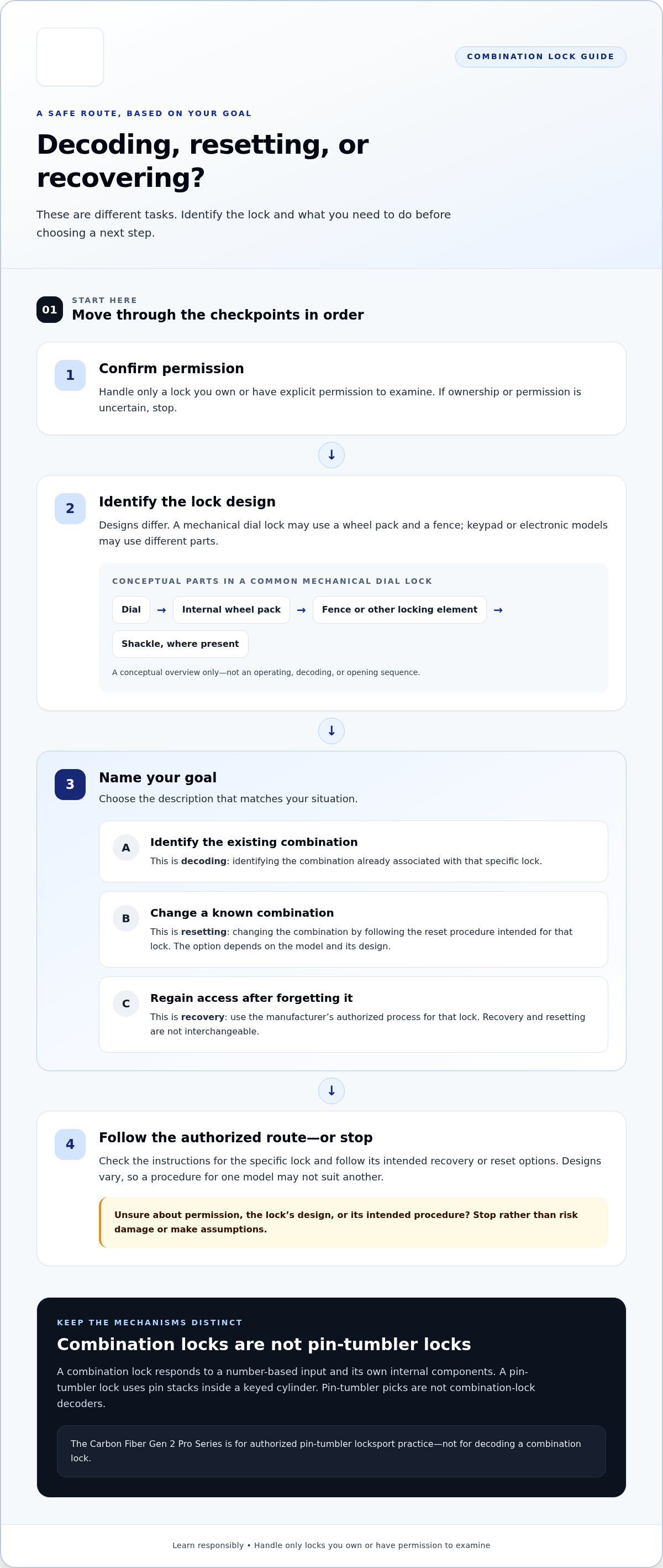
If you’ve forgotten a combination, pause before trying anything on the lock. A responsible plan starts by confirming you’re authorized to handle it, identifying the exact model, and using only the manufacturer’s instructions. This approach to decoding a combination lock avoids testing or manipulating the mechanism.
Start with ownership, model identification, and documentation
- Confirm authority. Make sure the lock belongs to you or that you have explicit permission to study it. If it’s attached to shared or managed property, identify the person responsible before taking action.
- Identify the lock. Check its packaging, visible model markings, or your purchase records. Note the information needed to find the correct documentation.
- Consult official instructions. Use documentation for that specific model to learn whether it has an intended reset option or an authorized recovery process. Don’t assume another lock’s procedure applies.
- Keep details private. Avoid sharing identifying information about the lock or any combinations you may have tried. Don’t test possible combinations or manipulate the lock to infer its settings.
Know when to stop and use the intended recovery process
Stop if the lock is damaged, attached to property managed by someone else, or outside your authority. Also stop if the model or instructions are unclear. Applying force or improvising a method can damage the lock and won’t establish that you’re following an approved process.
A forgotten combination may not be recoverable through the same process as a planned reset. Follow only the manufacturer’s reset or recovery instructions for the identified model. If those instructions don’t resolve the issue, don’t substitute a procedure from a different lock.
Simple decision path
- Can you confirm ownership or permission? If not, stop and get authorization.
- Can you identify the model? If yes, find that model’s official instructions. If not, stop rather than guessing.
- Do the instructions describe an authorized recovery or reset process? Follow them as written for the intended situation.
- Is the process unclear, unavailable, or unsuccessful? Stop. Don’t force, test, or manipulate the lock.
For hands-on locksport, choose practice equipment built for the mechanism you want to learn. Combination locks and pin-tumbler locks are different disciplines. If you’re ready to practice authorized pin-tumbler locksport, explore the Carbon Fiber Gen 2 Pro Series, a tool option for that separate practice, not for combination-lock recovery.
From Combination-Lock Curiosity to Ethical Locksport Practice
Learning about combination locks can spark an interest in locksport, but the mechanisms call for different kinds of study. Combination locks use a number-based input and internal components designed for that system. Pin-tumbler locks use stacks of pins inside a keyed cylinder. The distinction matters: tools intended for one mechanism aren’t automatically appropriate for another.
That’s why decoding a combination lock and practicing pin-tumbler locksport are separate activities. Keep combination-lock study focused on educational material and authorized recovery procedures. For hands-on practice, choose equipment made for the specific lock type you intend to study, and use it only on locks you own or have explicit permission to handle.
Choose practice tools for the mechanism you want to study
A practice tool should match both the lock mechanism and your learning goal. A standard lockpick set is for suitable keyed locks, not for identifying or recovering a combination. Likewise, a tool for another lock category shouldn’t be treated as a universal solution.
The Carbon Fiber Gen 2 Pro Series is intended here only as an option for authorized pin-tumbler locksport practice. It isn’t a combination-lock decoder. If your next step is learning that separate discipline, explore the pin-tumbler locksport practice set for practice with compatible locks.
Progress through locksport with permission and purpose
Ethical locksport is built on clear boundaries: practice on locks you own or have permission to use, and don’t pick a lock that’s in use. These principles keep learning focused on the craft, not on access to someone else’s property.
The community belt ranking system offers a structured way to progress through keyed-lock practice, with levels that reflect increasing lock complexity. Follow the belt progression at a pace that suits your skills, and select practice locks and tools for the level and mechanism you’re studying. A beginner interested in pin-tumbler locks can start with appropriate practice equipment, then build experience step by step.
Keep the mechanism in mind as you choose what to study next. For authorized pin-tumbler practice, take a look at the Carbon Fiber Gen 2 Pro Series; for a forgotten combination, return to the lock’s official recovery guidance instead.
Choose Your Next Locksport Step
Understanding the mechanism helps you choose a responsible path. Decoding a combination lock means identifying its existing combination, while resetting changes it through the lock’s intended procedure. If you’ve forgotten a combination, follow the manufacturer’s guidance for that specific model.
Combination locks and pin-tumbler locks use different mechanisms. The Carbon Fiber Gen 2 Pro Series is for authorized pin-tumbler locksport practice, not combination-lock decoding. Use tools only on locks you own or have permission to practice on.
Ready to progress one belt at a time? Join the Black Belt Challenge for free, build your skills through the ranks, and share picks-in-action content as you progress toward Black Belt. Participants can earn reward picks through the challenge’s share-to-earn progression. Keep learning ethically, and enjoy each step of the journey.
Frequently Asked Questions
Can you decode a combination lock without opening it?
Some locks may allow an existing combination to be identified without normal operation, but whether that’s possible depends on the design. This article doesn’t provide techniques for testing, manipulating, or bypassing a lock. If you own the lock and have forgotten its combination, consult its documentation for an authorized recovery option. Don’t assume recovery is possible for every lock, or try a method intended for another model.
How does a combination lock work?
A mechanical dial lock commonly uses a dial connected to internal parts, including a wheel pack and a locking element. The combination input corresponds to positions of those parts. When the internal components align as designed, the locking element can move and the lock can operate normally. Other combination locks, such as keypad or electronic models, use different designs, so their parts and operation may vary.
Is decoding a combination lock the same as resetting it?
No. Decoding means identifying the combination already associated with a lock. Resetting means changing the combination by following the lock’s intended procedure. Recovery is a separate route for a forgotten combination and should follow the manufacturer’s authorized process. Before taking action, identify the exact model and your goal. A reset procedure for one lock may not apply to another, even if both use number combinations.
Can a lockpick set decode a combination lock?
A standard lockpick set is intended for compatible keyed locks, not for decoding a combination lock. The mechanisms differ: pin-tumbler locks use stacks of pins, while combination locks rely on a combination input and their own internal parts. Choose practice tools to match the lock type you’re studying. For locksport, use suitable keyed practice locks and keep any hands-on work within clear authorization.
What should I do if I forgot my own combination?
Identify the lock’s model using its packaging, markings, or purchase records, then consult the manufacturer’s official instructions for that model. Follow only its authorized recovery or reset process. If the lock is attached to shared or managed property, contact the responsible owner or administrator before taking action. Avoid force or improvised attempts, and stop if you can’t confirm the correct procedure.
Is it ethical to practice on a combination lock?
Practice can be ethical when you own the lock or have explicit permission to study it. Keep the activity separate from locks that are in use or belong to someone else. For hands-on learning, use practice equipment suited to the mechanism and follow its intended guidance. Combination-lock study is also distinct from pin-tumbler locksport, so choose tools for the specific skill you want to develop.