

Are Dimple Locks More Secure? What Actually Makes a Lock Harder to Defeat
A dimple key can look more complex, but its shape alone doesn’t make a lock harder to defeat. So, are dimple locks more secure? Sometimes, but the answer depends on the cylinder’s design and quality, not just the keyway. Dimple locks use cuts on the flat face of a key to position pins, while standard pin-tumbler locks use cuts along the key’s edge. That difference creates room for more complex layouts, but it doesn’t guarantee stronger security.
It’s easy to mistake an unusual key for proof of a stronger lock. To compare locks with confidence, look beyond appearance: pin count and arrangement, security pins, manufacturing tolerances, and documented ratings all matter. This guide explains what dimple locks do differently, which design features can increase picking difficulty, and how to assess manufacturer claims without relying on key shape alone. You’ll also learn how ethical locksport practice can help you understand these mechanisms, using only locks you own or have explicit permission to pick, and never a lock that’s in use for security.
Key Takeaways
- Are dimple locks more secure? The keyway alone can’t tell you; assess the complete cylinder design.
- Compare construction, protective features, and relevant documented ratings rather than relying on a feature list or key appearance.
- Before choosing a lock, check its intended use, exact model, documented rating, fit, and installation needs.
- Use ethical locksport practice to learn about lock mechanisms, and only practice on locks you own or have permission to use.
- Dimple picks are specialized tools for lawful practice, not a measure or guarantee of a lock’s security.
Are dimple locks more secure, or does the keyway just look different?
Are dimple locks more secure? Not simply because the key has dimples. A dimple lock is a type of pin-tumbler lock whose key has small cuts on its flat surface, matching pin stacks arranged in different orientations. That layout changes the mechanism’s design, but it doesn’t establish how well the complete lock resists attack.
Quotable definition: A dimple lock is a pin-tumbler design with differently oriented pin stacks; its security depends on the complete cylinder’s construction and tested performance, not the keyway’s appearance alone.
What makes a lock a dimple lock?
In a standard pin-tumbler lock, cuts along the edge of the key correspond to pins positioned in a familiar arrangement. In a dimple design, the key’s flat face carries the cuts, and the matching pin stacks may be oriented differently within the cylinder. Both are variations on the pin-tumbler principle, described in this overview of the pin-tumbler lock.
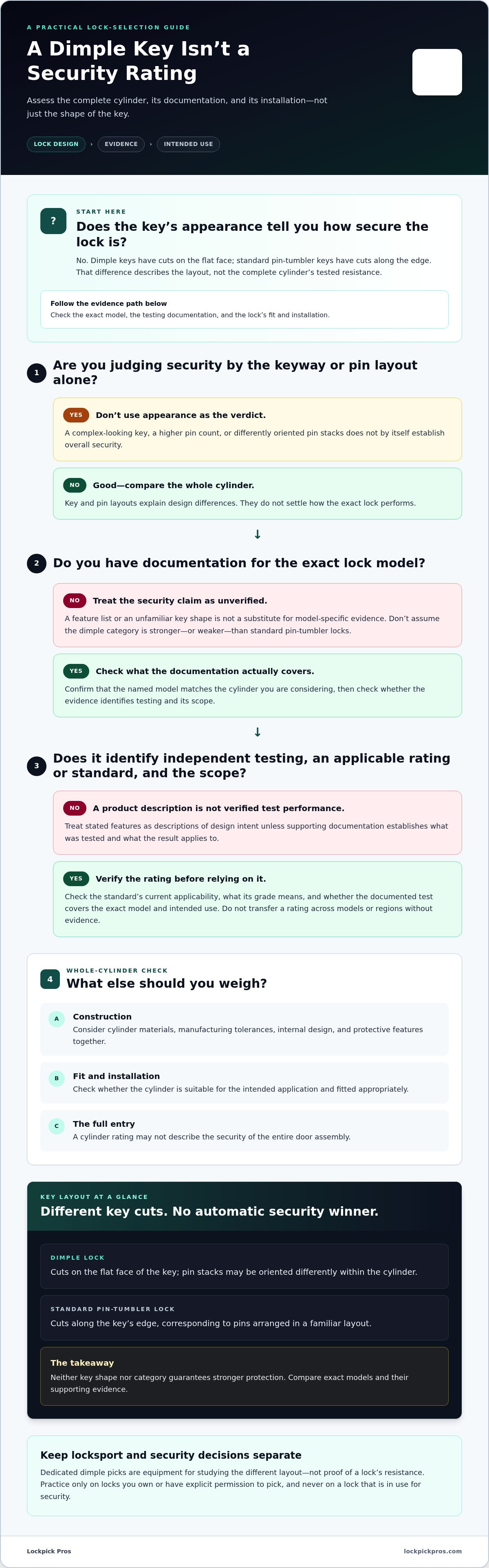
The keyway and pin layout tell you how a lock is designed, not what security rating it has. A complex-looking key may indicate a more involved key pattern, but appearance alone says little about the cylinder’s tested resistance or its suitability for a particular door.
Why key appearance is not a security rating
Security depends on more than the key. Cylinder materials, manufacturing tolerances, protective features, and how the lock is fitted and installed can all affect its performance. A feature list describes what a product includes; it isn’t the same as independent testing or a relevant, documented rating.
When comparing locks, look for documentation tied to the exact model and intended use. Don’t assume every dimple lock is stronger than every standard pin-tumbler lock, or that a familiar keyway means a lock is weak. The categories overlap, and quality varies within each.
For ethical locksport, dedicated dimple picks provide tools for studying this different layout on locks you own or have explicit permission to use. They don’t make a lock more secure. Explore dimple-pick tools for practice as equipment for learning, while keeping security decisions grounded in the complete cylinder and its documentation.
How dimple-lock security depends on the cylinder, not one feature
A cylinder is a system, not a keyway in isolation. Its materials, manufacturing quality, internal design, and protective features work together, while the way it fits and is installed can affect the security of the finished door. A dimple layout may allow for design choices such as differently arranged pin stacks, but pin count or orientation alone can’t establish how resistant the complete lock is.
Design features describe what a cylinder includes; only applicable, independently documented testing can support claims about its verified performance.
Which design details can affect a cylinder’s security?
Look at the full construction, not one headline feature. The cylinder’s material and precision of manufacture can matter, as can protective elements intended to resist physical attack or unauthorized key use. Installation matters too: even a well-designed cylinder must be fitted appropriately for its intended application.
Claims about specific protections should be supported by documentation for the exact lock model. A higher pin count, multiple pin orientations, or a list of added features doesn’t automatically establish the overall level of security. Treat each as one part of the design, not a stand-alone verdict.
How to read security claims and ratings
Start with the product’s exact model number and look for independent documentation that identifies what was tested, which standard or rating applies, and the scope of the result. A manufacturer’s feature description can help explain design intent, but it isn’t interchangeable with evidence of tested performance.
Standards, rating systems, and grade meanings vary by market and product model. Don’t assume a rating for one cylinder applies to every product in the same family, or that a result transfers across regions. Before relying on a claim, verify the standard’s current applicability, the meaning of its grade, and whether the documented test covers the exact model and intended use. A cylinder rating also may not describe the security of the entire door assembly.
For a real property-security decision, the right choice depends on the door and its use. A qualified assessment can help weigh the lock alongside the rest of the entry. For locksport, practice with locks you own or have permission to use, and keep tool selection separate from security claims. The Carbon Fiber Gen 2 Pro Series is an option for ethical practice with standard pin-tumbler locks; a pick set is practice equipment, not proof of a cylinder’s resistance.
Dimple locks vs. standard pin-tumbler locks: a fair comparison
Both designs use pins inside a mechanical cylinder, but their key and pin layouts differ. That difference can shape how a lock is designed, not settle the question of which is more secure. If you’re asking, are dimple locks more secure, compare the exact models and supporting evidence rather than judging by key appearance or category.
What the two designs share, and where they differ
A standard pin-tumbler lock generally has key cuts along the edge, while a dimple lock uses cuts on the key’s flat face and differently oriented pin stacks. Neither arrangement guarantees stronger protection. A complex key can look impressive without demonstrating how the complete cylinder performs.
| Comparison point | Dimple lock | Standard pin-tumbler lock |
|---|---|---|
| Design | Pin-tumbler mechanism with differently oriented pin stacks. | Pin-tumbler mechanism with a more familiar pin arrangement. |
| Keyway | Key cuts appear on the flat face of the key. | Key cuts typically appear along the key’s edge. |
| Documentation | Depends on the exact model and its available testing records. | Also depends on exact-model documentation, not the category name. |
| Buying considerations | Check intended use, cylinder fit, installation, and compatible hardware. | Check the same factors, along with model-specific performance evidence. |
The table describes design differences, not a security ranking. Both categories include locks with varied construction and features. Their labels alone don’t tell you how either model will perform in a particular door.
When the lock’s full specification matters more
Compare the exact model’s documentation with the needs of the door. Check that the cylinder fits the hardware and that the installation is appropriate. A rating, where applicable, should relate to the specific model and intended market; don’t assume one product’s documentation covers every lock in a family.
For broader high-security decisions, review the full cylinder and door setup rather than choosing by keyway style. Lockpickers can also build familiarity with different mechanisms through ethical practice on locks they own or have permission to use. Dedicated tools for advanced locksport practice support skill development, but a pick set is not evidence of a lock’s security rating.
How to assess a dimple lock before choosing one
To decide whether a specific dimple lock fits your needs, assess the product and the door it will protect. A keyway’s shape won’t answer the practical questions: Is the lock intended for this application? Does its documentation support the security claims? Will it fit the existing hardware and be installed as directed?
A practical checklist for comparing lock specifications
- Intended use: Identify the type of door or application the lock is designed for. Don’t assume one cylinder suits every entry.
- Exact model: Record the model identifier so you can match the product to its own documentation.
- Documented rating: Look for applicable, independent evidence tied to that exact model. Check what was tested and where the rating applies.
- Supported claims: Separate documented results from feature descriptions and general marketing language. A claimed feature may describe the design without proving tested performance.
- Fit and compatibility: Compare the cylinder with the door’s existing hardware and the lockmaker’s product guidance.
- Installation: Follow the documentation for the specific lock. If the security decision affects a property, a qualified assessment may help account for the door and hardware as a whole.
Checklist summary: Verify the exact model, applicable evidence, intended use, hardware fit, and installation guidance; treat unclear claims as unknown, not proof of strength or weakness.
Why fit and installation belong in the comparison
A cylinder doesn’t work in isolation. Compatibility with the surrounding hardware and correct installation can affect the security of the finished door. A lock with documented performance may not deliver the intended result if it’s poorly matched to the application or installed in a way its maker doesn’t recommend. Follow the lockmaker’s instructions for that product, and avoid assuming that a specification applies to other models or doors.
If you’re asking, are dimple locks more secure, use this checklist to compare evidence and context, not key appearance. For a property-security choice, get a qualified assessment when the door, hardware, or risk factors make the decision uncertain.
For ethical locksport, keep product evaluation separate from practice. Work only with locks you own or have explicit permission to use. If you’re building skills with standard pin-tumbler practice locks, explore the Carbon Fiber Gen 2 Pro Series as a lockpicking tool option, not as a way to judge a cylinder’s security.
Explore dimple locks through ethical locksport practice
Security evaluation and locksport practice are related, but they aren’t the same activity. Studying a practice lock can help you notice how a mechanism feels and how its design differs from others. It can’t, by itself, establish how secure a lock will be in a particular setting. The question “are dimple locks more secure” calls for model-specific evidence, not a test on a lock that’s protecting a door.
Keep practice responsible: work only on locks you own or have explicit permission to use, and never practice on a lock that’s in active use for security. Choose practice hardware intended for learning. That gives you room to observe and build skill without putting someone’s property or access at risk.
Learn the design through responsible practice
Focus on careful observation and tactile feedback as you study a practice mechanism. Notice how the lock responds during lawful practice, then record what you learn and compare it with other practice locks. Progress at a pace that suits your experience. Locksport is a skill-building hobby, and a belt ranking system can give that progression a clear community framework.
Dimple picks are specialty tools for practicing with dimple locks. They’re not a security measure, and owning a set doesn’t guarantee a particular result. For a dedicated option, explore The Lifesaver dimple-pick set as equipment for ethical locksport practice.
Choose tools that match the practice goal
Match your tools to the mechanism you’re studying. A dimple-pick set is relevant for lawful practice with dimple locks; a general locksport set supports practice with standard pin-tumbler locks. Neither tool category says anything about a lock’s security rating. Keep your goal clear: learn about the mechanism, respect permission, and use practice hardware rather than a lock currently securing property.
The free Black Belt Challenge is an optional way to connect practice with a staged community progression. It can help hobbyists set goals and share progress while advancing through belt ranks. Choose tools that suit the next step in your practice, then keep building skill through ethical use. For a general locksport set, explore the Carbon Fiber Gen 2 Pro Series.
Choose with evidence, then keep learning
Are dimple locks more secure? The keyway alone can’t answer that. Security depends on the complete cylinder, its documented performance, and whether it fits the intended door and hardware. Compare the exact model and evidence, and treat fit and installation as part of the decision.
For locksport, practice only with locks you own or have explicit permission to use. Dedicated dimple-pick sets can support practice with that design, while general lockpick sets suit other locksport goals. Ready to build your skills with standard pin-tumbler practice locks? Explore the Carbon Fiber Gen 2 Pro Series for ethical locksport practice.
Take your next step with the free Black Belt Challenge. Progress through the belt ranks, share picks-in-action content using Lockpick Pros tools, and earn reward picks as you advance. Participants can also work toward the challenge’s $5,000 bounty by reaching its social reach goal. Keep practicing responsibly, celebrate each milestone, and enjoy the journey toward Black Belt.
Frequently Asked Questions
Are dimple locks harder to pick than regular pin-tumbler locks?
Sometimes, but dimple locks aren’t automatically harder to pick than standard pin-tumbler locks. Their key and pin arrangement differs, yet difficulty depends on the exact cylinder’s construction, tolerances, and protective features. A model with a familiar keyway may still have a challenging design, while a dimple keyway alone doesn’t establish resistance. Compare model-specific information rather than assuming one lock type always presents the greater challenge.
Are dimple locks more secure than standard locks?
No. Whether dimple locks are more secure depends on the complete lock, not the dimple pattern by itself. Cylinder materials, manufacturing quality, protective features, documented performance, hardware compatibility, and installation all matter. A well-designed standard pin-tumbler lock may offer stronger protection than a lower-quality dimple cylinder, and the reverse may also be true. Check evidence for the exact model and its intended application instead of ranking locks by key shape.
What makes a dimple lock different?
A dimple lock is a pin-tumbler design whose key has cuts, or dimples, on its flat face. Those cuts correspond to pin stacks arranged in different orientations within the cylinder. This geometry distinguishes it from a common edge-cut key design, but it doesn’t establish the lock’s security rating or tested performance. Think of “dimple” as a description of the mechanism’s layout, not a guarantee about protection.
Can a dimple keyway alone tell me how secure a lock is?
No. A keyway can show something about a lock’s design, but it can’t tell you how secure the cylinder is. Look up the exact model and review applicable documentation, including any independently supported test results or rating. Also consider construction, compatibility with the door hardware, and installation. If product information is unclear, treat the security evidence as unknown rather than assuming the lock is either strong or weak.
Do all dimple locks have security pins?
No. Dimple locks don’t all use security pins. Internal features vary by model, and a key’s appearance can’t confirm which pins or other protections a cylinder contains. Check the manufacturer’s documentation for the exact lock instead of inferring its construction from the keyway. Security pins, when present, are only one element of the design; their presence alone doesn’t establish a cylinder’s overall security or documented performance.
Are dimple locks used in high-security cylinders?
Yes. Dimple-pin designs are used in some cylinders marketed for higher-security applications, but the dimple layout alone doesn’t establish a high-security level. Look for evidence tied to the exact model, including applicable independent testing or a relevant documented rating, and check what that rating covers in its market. Don’t extend a product’s claims to an entire family or assume every dimple cylinder has the same protections.
Are dimple picks suitable for locksport practice?
Yes. Dimple picks are specialty tools for locksport practice with dimple locks, and dedicated sets can match equipment to that learning goal. Practice only on locks you own or have explicit permission to use, and never on a lock in active use for security. Choose practice hardware intended for learning, focus on observation and tactile feedback, and treat the tools as hobby equipment, not a guarantee of opening or a measure of lock security.