

How to Get Into Locksport Through Clubs, Books, and Videos
The right tension matters as much as the pick. Learning how to get into locksport starts with a clear purpose: explore a mechanical puzzle, build a hands-on skill, and practice responsibly. Books and videos can introduce the ideas, while clubs and online communities offer ways to share questions and learn from other hobbyists. Your first aim isn’t speed. It’s understanding how the hobby fits together and choosing a learning path that keeps practice focused.
As you consider how to get into locksport, remember that locks vary in design and difficulty. That variety is part of the challenge: a technique or tool suited to one mechanism may not work with another. Beginners can build their knowledge gradually, using educational resources to understand new concepts and community conversations to add context. Keep the hobby focused on authorized practice.
This guide explores how to get into locksport through clubs, books, videos, and thoughtful tool selection. It also covers what shapes the learning curve and how tension tools help beginners understand tactile feedback. Use the sections ahead to choose a next step that suits your interests, and keep curiosity and responsible practice at the center of your progress.
Key Takeaways
- Build lock-picking skill through steady practice on locks you own or have permission to use, and never pick a lock that’s in use.
- Start with beginner tools and practice locks to learn how tension and pin feedback feel before taking on harder challenges.
- Look to clubs and online communities for shared knowledge, encouragement, and chances to learn alongside other hobbyists.
- Use books and videos to understand techniques, then practice what you learn with suitable hardware.
- Choose tension wrenches in different thicknesses and shapes so you can adapt to the lock and develop a feel for applied force.
How long does it take to learn lock picking?
Locksport is a hobby focused on understanding locks and practicing non-destructive picking as a mechanical challenge. A picker applies controlled tension and uses a pick to explore how a lock responds, learning from tactile feedback rather than forcing the mechanism. Practice only on locks you own or have the owner’s express permission to pick.
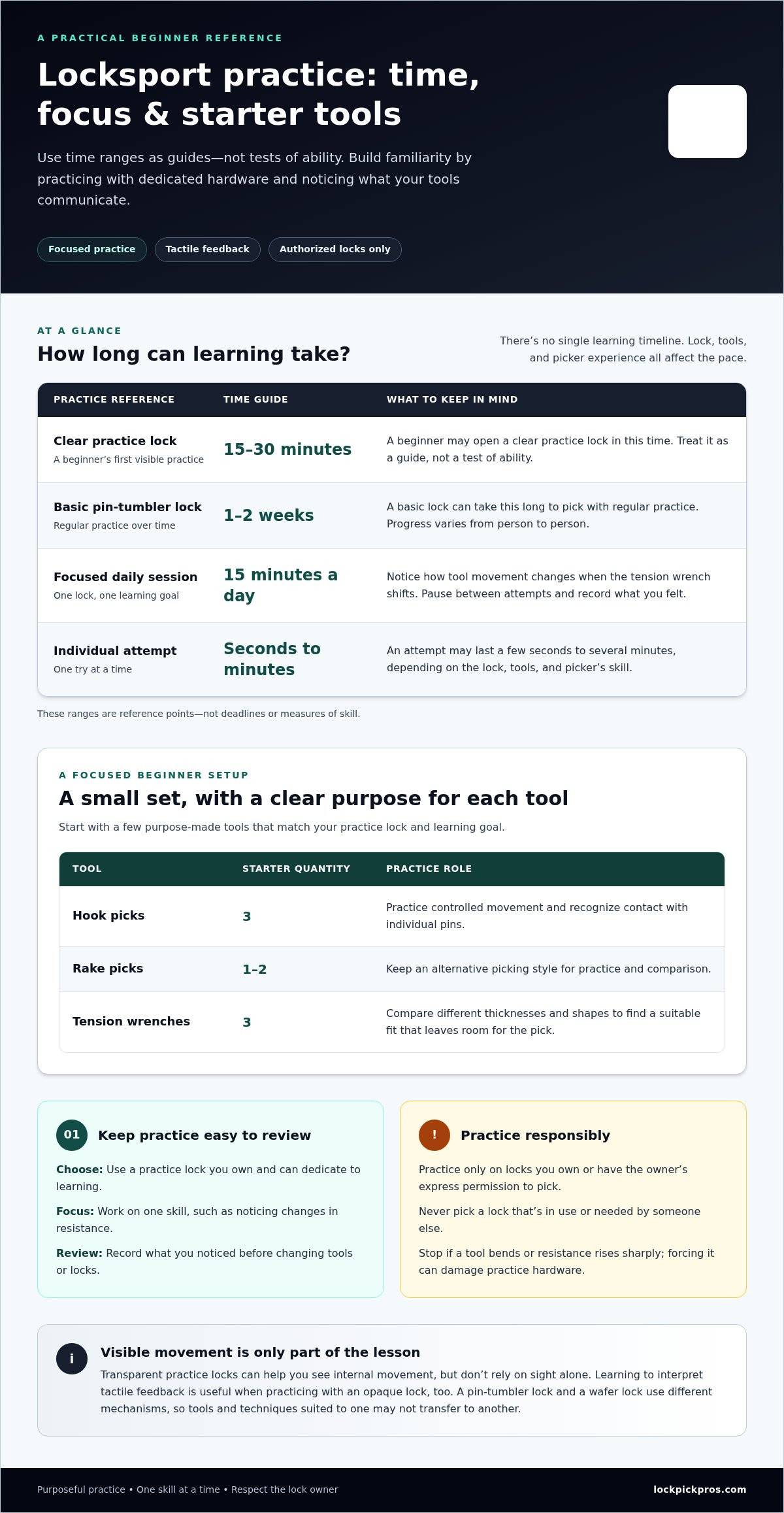
There’s no single learning timeline. A beginner may open a clear practice lock in 15 to 30 minutes, while a basic pin-tumbler lock can take one to two weeks of regular practice to pick. Individual attempts may last a few seconds to several minutes, depending on the lock, tools, and picker’s skill. Treat each time range as a guide, not a test of ability.
Consistency helps turn brief attempts into useful learning. Set aside 15 minutes a day for focused practice. Choose one practice lock and one goal, such as noticing how tool movement changes when the tension wrench shifts. Pause between attempts and note what you felt. A short record can reveal which conditions help you stay controlled and which make feedback harder to interpret.
Non-destructive picking lets locksport hobbyists study a mechanism without intentionally damaging practice hardware. For example, a beginner can compare how two practice locks respond and use those observations to understand why one feels different. The goal is mechanical knowledge and skill development, not opening locks that protect property or are needed by someone else.
Lock types also shape the learning curve. A pin-tumbler lock uses pins, while a wafer lock uses flat plates. Techniques and tools suited to one mechanism may not transfer to another. Start by identifying your practice lock’s type, then choose a learning resource that covers that design. Get familiar with one mechanism before adding another to your practice rotation.
- Choose: Use a practice lock you own and can dedicate to learning.
- Focus: Work on one skill, such as recognizing changes in resistance.
- Review: Record what you noticed before changing tools or locks.
Common beginner mistakes include using excessive force, rushing, and practicing on a lock someone relies on. Stop if a tool bends or resistance rises sharply. Forcing it can damage practice hardware and obscure useful feedback. Never pick a lock that’s in use. Pick an abandoned lock in a public place only if you can return it to its original locked position and state. Ethical practice also means respecting other people’s security needs.
Can you really pick a lock with a bobby pin?
A bobby pin might move parts inside some simple locks, but it’s an improvised object, not a dependable learning tool. Its shape can make controlled contact and tactile feedback difficult to interpret. Purpose-made picks and a tension wrench give beginners tools designed for locksport practice on dedicated hardware. Keep experiments to locks you own and have set aside for practice.
Start by practicing steady tool handling, noticing changes in resistance, and making small, controlled movements. These basics help you understand what your tools are communicating without relying on force. Set a goal of describing what you feel, such as a change in resistance, rather than judging each attempt only by whether the lock opens.
A beginner set can stay focused. One practical arrangement is three hook picks for single-pin practice, one or two rake picks, and three tension wrenches in different thicknesses and shapes. Hooks help you study individual pin feedback, while rakes offer a different picking style. Different wrench shapes help you find a stable fit for the keyway without crowding the pick.
- Hooks: Use these to develop control and recognize contact with individual pins.
- Rakes: Keep these as an alternative tool for practice and comparison.
- Tension wrenches: Compare shapes and thicknesses to find a suitable fit.
Choose a practice lock that’s separate from hardware used to secure property. A simple practice padlock or spare deadbolt gives you dedicated equipment for learning. Transparent practice locks can help you see internal movement, but don’t rely on sight alone. Learning to interpret tactile feedback is useful when you practice with an opaque lock, too.
Keep each session organized by changing one variable at a time. For example, use the same practice lock and pick while comparing how different tension wrench shapes fit. Note whether the wrench stays in position and leaves room for the pick. Changing several tools at once makes it harder to tell what affected your observations.
Bobby pins and other improvised tools can bend or break, and excessive force can damage practice hardware. Stop if a tool deforms or the lock resists unexpectedly. Don’t try improvised tools on locks that secure a home, vehicle, or someone else’s belongings. Ethical locksport requires the owner’s express permission, and locks that are in use are off-limits.
Choose tools that match your practice lock and current learning goal instead of collecting profiles you can’t yet use. Keep your practice equipment together, handle each tool carefully, and write down useful observations. This focused approach builds familiarity with your tools and their feedback while keeping practice responsible and controlled.
Joining lockpicking clubs and meetings
A locksport club can turn solo practice into shared learning. Members compare tools, discuss tactile feedback, and set friendly challenges using locks brought for practice. The Open Organisation of Lockpickers has chapters in many countries, giving newcomers a familiar name to look for when exploring the community. Local groups may also organize through online forums or social platforms, where they share meeting details and participation expectations.
Start by finding a group that clearly focuses on ethical locksport. Read its meeting information, note whether newcomers are welcome, and learn the rules before attending. Some gatherings focus on informal practice, while others include presentations or timed challenges. If the event description mentions padlocks, bring one you own and have set aside for practice. Don’t bring a lock that secures someone’s property or is still in use.
At your first meeting, introduce yourself as a beginner and describe what you’ve practiced. For example, say you’re learning to recognize pin feedback on a practice lock. This gives experienced members a useful starting point for explaining techniques. Watch demonstrations, ask before handling another person’s tools, and don’t treat a challenge as a contest involving other people’s property.
- Before attending: Read the group’s code of conduct and meeting details.
- For practice: Bring a lock you own, plus the tools you already use.
- During a demonstration: Listen first, then ask specific questions about feedback or tool choice.
- Afterward: Write down one technique or concept to review at home.
Community rankings can make progress easier to discuss. The belt ranking system uses colored levels to represent growing skill and lock complexity. Ask members how their group interprets belt challenges, since a ranking is most useful when the practice lock and rules are clear. A beginner might focus on consistent, controlled picking before trying a harder challenge. Aim to understand the lock, not race another picker.
Respect and consent matter throughout a meeting. Pick only locks you own or have the owner’s express permission to practice on, and never pick a lock that’s in use. If a member brings a lock for a group challenge, confirm that it’s intended for practice before handling it. Keep practice locks separate from keys and hardware used for security, and return borrowed items promptly.
Not near a physical group? Online locksport communities can still help you learn. Share a clear description of your practice lock and the feedback you noticed, rather than posting content that could reveal access to property. A specific question, such as why a pick stops moving during a practice attempt, gives members something useful to discuss. Apply their feedback in your next session, then share what you observed.
Learning from videos, books, and online communities
Books, videos, and community discussions offer different kinds of locksport knowledge. A book can explain how a mechanism works, while a video shows tool movement and hand position. An online discussion can help clarify a confusing detail. Use these sources together: choose one concept, study it, then compare the explanation with what you notice on a practice lock you own.
A well-known starting point is The MIT Guide to Lock Picking by Theodore T. Tool. Notes from the MIT Roof and Tunnel Hacking community became widely available in 1991. Read a section at a time, identify unfamiliar terms, and write a short definition in your own words. That simple step makes later demonstrations easier to follow, especially when presenters use different names for the same part.
Illustrated books can help connect vocabulary to visible parts. The Beginners Visual Guide is 178 pages long, while an expanded illustrated lock-picking book is 60 pages long. Treat page count as a guide to format, not proof that one book suits every learner. Before practicing, note the lock type shown and the technique being explained. Avoid transferring a method from one mechanism to another without understanding the difference.
Videos add motion and timing to your learning. YouTube has thousands of channels dedicated to lock picking, so choose demonstrations that explain the lock and the reason for each movement. Pause at key moments instead of copying fast hand motions. Compare the presenter’s explanation with your own tactile feedback, then replay the relevant section if the two differ.
- Before viewing: Write down one question, such as how a presenter distinguishes pin movement from tool contact.
- During viewing: Note the lock type, tool shape, and sequence of actions.
- After viewing: Summarize the idea, then test your understanding on suitable practice hardware.
Online communities add context that a book or video may not provide. A focused question about a specific observation is more useful than asking for a quick way to open a lock. Describe your practice setup, the tool you used, and what you felt, without sharing information that could expose someone else’s security. Compare replies with a reliable written explanation before adopting unfamiliar advice.
Keep a learning log with the resource name, topic, and one takeaway from each session. For example, after reading a chapter of The MIT Guide to Lock Picking, record a new term and the question it raised. This turns scattered viewing into structured learning. As your knowledge grows, revisit earlier notes. A concept that once seemed abstract may become clear after more practice with locks.
Tension tools
A tension wrench applies rotational force to a lock’s plug, allowing pins to be set and giving you feedback. That feedback shows why tension is more than a supporting action. Too much force can make pin movement harder to feel, while inconsistent force changes the response during practice. On a pin-tumbler practice lock, notice how the plug’s resistance changes as you maintain steady pressure.
Wrench fit matters because keyways vary in shape and available space. A poorly seated wrench may shift during practice, distracting you from the feedback you’re trying to recognize. Use a lock you own to compare wrench thickness and shape. Choose a stable fit that leaves room for the pick, and don’t force a wrench into a keyway.
A beginner set should include three tension wrenches in different thicknesses and shapes. That range lets you compare how each wrench feels in a suitable practice lock, rather than assuming one size fits every keyway. Change one thing at a time. If you switch both the wrench and pick during an attempt, it’s harder to tell which change affected the feedback.
- Fit: Check that the wrench sits securely without crowding the pick.
- Consistency: Keep your pressure steady while observing changes in resistance.
- Comparison: Try a different wrench shape when the first feels unstable.
- Reset: Ease off and pause if you lose track of the lock’s response.
For a simple practice exercise, use the same lock and pick while comparing two wrench shapes. Notice whether each wrench stays stable and whether you can still feel the pick’s contact. This isolates the effect of the tension tool. Record observations after each attempt, such as “the narrower wrench shifted” or “the broader shape felt steadier.” Specific notes are more useful than a vague judgment that one felt better.
Common mistakes include gripping too tightly, changing pressure without noticing, and using a wrench that obstructs the pick. These habits can mask tactile feedback and make practice less consistent. Never use tension tools to bypass a lock or access property. Practice locksport only on locks you own or have the owner’s express permission to pick, never on locks that are in use.
Build familiarity with tension tools on dedicated practice hardware before adding more complex locks. For continued work with standard pin-tumbler locks, explore a standard pin-tumbler pick set and keep comparing tool fit, stability, and feedback during ethical practice.
Lockpick Pros: Beginner Lockpick Sets
Lockpick Pros offers Beginner Lockpick Sets and Practice Locks for readers ready to move from learning to hands-on locksport practice. Pairing tools with dedicated practice hardware gives you a suitable setup for developing control and recognizing tactile feedback. As your skills and interests grow, Advanced Lockpick Sets and Everyday Carry (EDC) Tools offer options for exploring further.
Choose equipment that matches the locksport techniques you’re studying, and practice only on locks you own or have permission to pick. A focused setup makes it easier to track what you’re learning without adding tools you don’t yet need.
Visit lockpickpros.com to explore the available options, or contact Lockpick Pros with questions about getting started.
Choose Your Next Locksport Challenge
Let curiosity guide your next practice goal. Choose a lock you own, set a clear skill to work on, and make each session about learning rather than speed. A steady approach can turn an interest in how to get into locksport into a rewarding hobby built around care, precision, and community.
When you’re ready to develop your standard pin-tumbler practice, Lockpick Pros offers Beginner Lockpick Sets, Advanced Lockpick Sets, and Practice Locks to support different stages of learning. Explore a standard pin-tumbler pick set as a next step for focused practice. Keep your ethical boundaries clear, stay curious, and enjoy the challenge ahead.
Frequently Asked Questions
Do high-security locks need different techniques?
Yes, high-security locks can require different tools and techniques because their mechanisms vary. A pin-tumbler lock with security pins gives different feedback from a dimple lock or a Disc detainer, which uses rotating discs instead of pins. Start by identifying the mechanism on a practice lock, then study techniques suited to that design. Don’t assume a method for one lock type transfers directly to another.
How to Start with Lockpicking?
Start by choosing a dedicated practice lock and learning its mechanism before selecting tools. A simple pin-tumbler practice lock gives you a clear focus for learning pick movement and tension control. Use a beginner set, then record which pick profile and wrench suit that lock. A steady routine and a specific practice goal make each attempt useful, even when the lock doesn’t open.
Why Pick Locks as a Hobby?
Locksport offers a hands-on way to explore how mechanical parts interact. A practice session can challenge your patience, attention, and ability to notice small changes in resistance. The hobby also brings people together to compare techniques and discuss puzzle-like challenges. For example, a club challenge can focus on understanding a mechanism rather than speed, making careful observation and shared knowledge part of the enjoyment.
How can a beginner learn lock picking safely and legally?
Practice only on locks you own or have the owner’s express permission to pick, and never pick a lock that’s in use. Keep practice hardware separate from locks that protect a home, vehicle, or belongings. Before carrying tools, understand the rules that apply where you live. At a meeting or online, share only practice examples and avoid details that could expose another person’s property or security.
What beginner lock picking tools should I buy?
Choose tools for your practice lock’s mechanism rather than buying a large assortment. For a basic pin-tumbler lock, a hook supports individual pin work, a rake offers another picking style, and a tension wrench applies rotational force. Check that the wrench fits the keyway without blocking the pick. Leave specialty profiles until you’re studying a lock type that needs them, and pair your tools with dedicated practice hardware.
How much does a beginner lock picking set cost?
There isn’t one set price for beginner lock-picking equipment. Costs depend on the set’s contents, materials, and whether it includes practice hardware or a carrying case. Compare what each option includes instead of judging by the number of tools alone. A useful starting point is a set that matches your practice lock and learning goals. Advanced or specialty profiles may be unnecessary for initial exercises.
Which practice locks are best for learning locksport?
A straightforward pin-tumbler practice lock is a useful first choice because it lets you focus on one familiar mechanism. Choose hardware reserved for practice, not a lock currently protecting property. As your understanding grows, try a different practice lock to encounter another mechanism or challenge. Keep notes on the lock type and your observations so you can compare what changes when the hardware changes.
What are the rules and ethics of locksport?
Ethical locksport means practicing only on locks you own or have the owner’s express permission to pick, and never on locks that are in use. Respect other people’s security needs, including when discussing techniques or sharing photos. Get clear permission for the specific lock before handling it, and return borrowed practice hardware as agreed. Community standards make consent and responsible practice central to the hobby.