

How to Use a Rake Pick and What to Expect
A rake pick works across several pins at once, while a tension wrench applies the rotational pressure that helps the pins set. If you’re wondering what a rake pick is used for, it’s a tool for practicing a faster, less precise approach to opening suitable pin-tumbler locks. The two tools work together, but the feel of the tension matters just as much as the movement of the rake.
It’s natural to wonder whether raking is easy or effective on every lock. It isn’t: lock design and tactile feedback both affect the result, and high-security locks may resist this approach. Practice only on locks you own or are authorized to pick, and start with a practice lock so you can focus on technique without rushing.
This guide explains how a rake pick and tension wrench work together, what to expect from raking, and how to recognize when the technique isn’t working. You’ll also learn how to choose practice tools that support steady, ethical locksport progress.
Key Takeaways
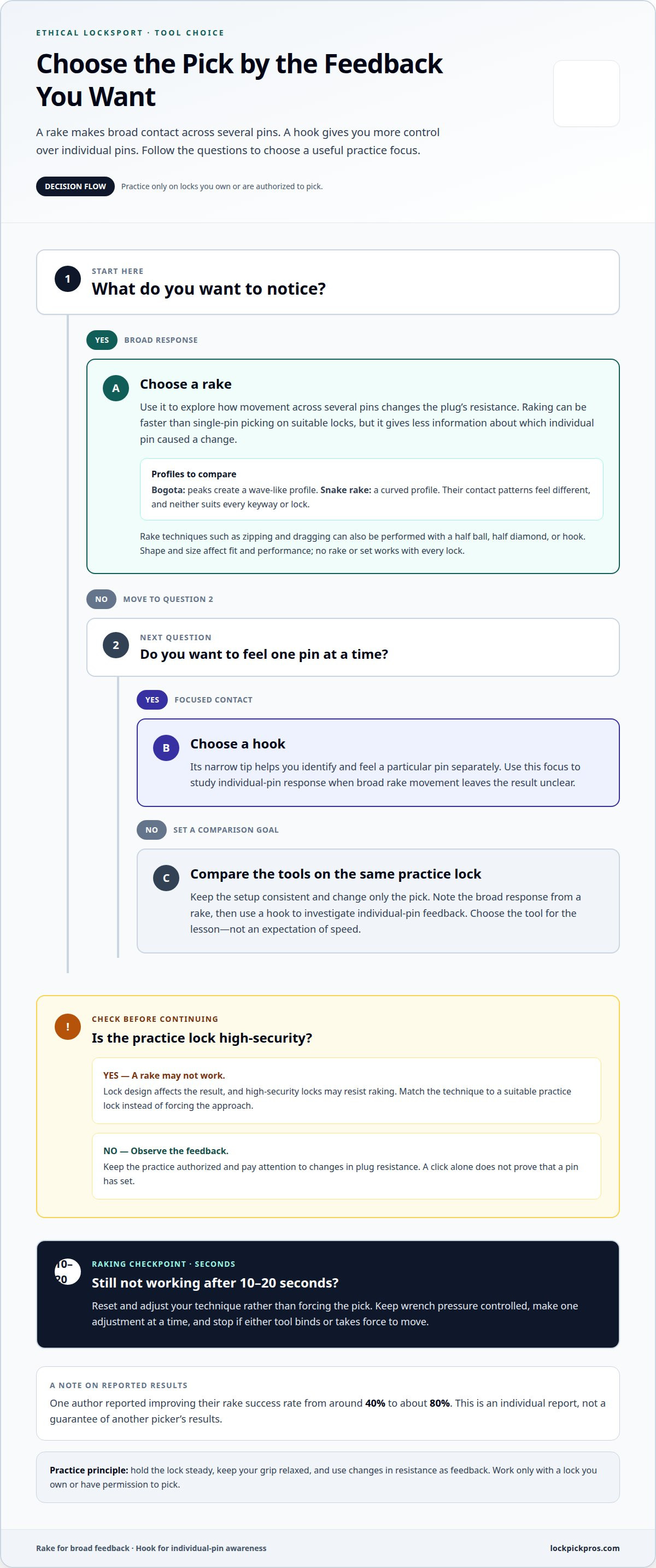
- Choose a rake for broad, quick movement; choose a hook when you want more control over individual pins.
- Raking is less precise than single-pin picking and may not work on high-security locks, so match the technique to the practice lock.
- If raking hasn’t opened the lock after 10-20 seconds, reset and adjust your technique rather than forcing the pick.
- Practice only on locks you own or are authorized to pick, and use practice locks to build tactile feedback.
- Progress through the free Black Belt Challenge one rank at a time, share picks-in-action content, and work toward its social reach goal and $5,000 bounty.
Rake and tension-wrench functions
For ethical locksport practice, a rake and tension wrench perform different jobs in a pin-tumbler lock. Understanding their roles helps you interpret feedback instead of relying on force.
-
Pair the Rake with a Tension Wrench
Place the tension wrench in the keyway and use it to apply controlled rotational pressure to the plug. The rake moves against multiple pins, while the wrench helps you feel changes in the plug’s resistance. In practical terms, what is a rake pick used for? It lets a picker explore how several pins respond to one moving tool.
-
Use the Rake on a Pin Tumbler Lock
Use an authorized pin-tumbler practice lock and guide the rake through the keyway so it contacts the pin stacks. Move it smoothly while keeping wrench pressure consistent. Notice whether the plug’s resistance changes, then pause and compare that feedback with how it felt before the pass. Avoid sudden movements that make the response harder to interpret.
- Keep the wrench pressure controlled rather than treating it as a fixed setting. The right amount depends on how the plug and pins respond. If the wrench makes the plug feel firmly bound, ease the pressure and observe whether the rake moves more freely. Make one adjustment at a time so you can connect each change with the feedback you feel.
- Separate tool feedback from hand movement. Hold the lock steady, keep your grip relaxed, and pay attention to small changes at the wrench. A slight change in resistance can be more useful than a large movement. This helps you learn how the lock responds without assuming every click means a pin has set.
- Use the same practice setup for a short comparison. Note how the plug feels before and after a rake pass, then release the tension wrench and let the mechanism return to rest. This gives you a consistent reference for later attempts. Practice only with a lock you own or have permission to service.
- Stop if either tool binds or takes force to move. Remove the tools gently and inspect the practice lock before continuing. A rake should move through the keyway without being forced against the lock body. Careful handling protects the practice hardware and keeps feedback clear during future locksport sessions.
Rakes compared with hook picks
Compare these tools by the feedback you want to study during ethical practice. A rake makes broad contact, while a hook supports focused, individual-pin control.
Common rake designs include the Bogota, with peaks that create a wave-like profile, and the snake rake, with its curved shape. Their contact patterns differ, so each can feel distinct in a practice lock.
- Choose a rake when you want to observe a broad response across several pins. Its contact pattern can help you notice whether movement in the keyway changes the plug’s resistance. This makes it useful for exploring general feedback, but it gives less information about which individual pin caused a change.
- Choose a hook when your practice goal is pin-by-pin awareness. Its narrow tip lets you identify a particular pin and feel its movement separately. That focused contact can help you distinguish one pin’s response from nearby pin stacks, especially when broad rake movement leaves the result unclear.
- Compare a Bogota and snake rake on the same authorized practice lock. Keep the setup consistent, change only the rake, and note how each feels during a pass. The Bogota’s peaks and the snake’s curved profile create different contact patterns. Neither design suits every keyway or lock.
- Use a hook after a rake attempt when you want to investigate a specific response. Instead of repeating the same broad motion, pause and use the hook to locate individual pins. This comparison can help separate general movement from feedback tied to one pin, without treating a click as proof that the lock has opened.
- Match your choice to the lesson, not an expectation of speed. A rake introduces broad contact patterns, while a hook encourages careful observation of individual pins. During practice, record the tool profile and feedback you noticed. Use only locks you own or are authorized to pick, and stop if a tool binds.
Rake practice can also compare techniques performed with standard picks. Zipping and dragging are rake techniques that can be performed with a half ball, half diamond, or hook. Rakes are not profile-specific, but their shape and size still affect fit and performance; no rake or set works with every lock. The author reports having improved his success rate with rakes from around 40% to about 80%. Treat that as an individual report, not a guarantee of what another person will experience; continue to focus on observing feedback rather than assuming a particular result.
A product listing showed 17 Rake Picks With Handle in stock and ready to ship. Availability is separate from whether a tool matches a particular learning goal, so compare its profile and handling with the feedback you want to study. For anyone considering locksmithing as a profession, study local licensing requirements. Keep practice authorized and use it to build careful observation, whether working with a rake or a hook.
Raking speed and effectiveness
Raking can be faster than single-pin picking on suitable locks, but it offers less precision. Single-pin picking requires focused, pin-by-pin control and can provide clearer information about individual pins.
- Set a practice goal before comparing methods. If you want to explore broad movement and general plug feedback, try raking. If you want to learn how individual pins respond, choose single-pin picking. This distinction helps you judge each attempt by what you’re practicing, not speed alone.
- Use an owned or authorized practice lock and note how long each method takes. Raking may open a suitable lock in seconds, while beginners may need minutes or more practice. Treat these as possible outcomes, not a schedule. Lock design, experience, and the feedback you can read all affect the attempt.
- Assess the quality of feedback, not just whether the plug turns. After an attempt, note whether you felt a change in resistance, whether the movement seemed repeatable, and which method gave you clearer information. These observations can help identify a useful next practice focus, even when the lock remains closed.
- Choose single-pin picking when broad rake movement gives little information. Its focused contact helps you examine pins individually and may make it easier to understand where your control needs work. Return to raking when you want to compare that detailed feedback with a broader approach on the same practice lock.
- Consider lock difficulty before deciding that a technique failed. Raking is not always effective on high-security locks, so repeated attempts may reveal more about the lock’s resistance than your speed. Treat a lack of progress as a reason to reassess the method and practice goal, not to increase force.
- Review several sessions before changing your approach. Compare notes from raking and single-pin practice, looking for consistent feedback rather than one quick result. If focused picking helps you understand the lock better, keep building that skill. If broad feedback is useful on a simpler practice lock, use raking as one part of your locksport practice.
For beginners, basic locks may be raked in minutes or less with practice and a suitable lockpick set. Treat this as a possible benchmark, not a promise for every session. Keep the lock and goal consistent when comparing attempts, and record whether your movement felt controlled and the feedback was useful. If progress is uneven, return to deliberate practice rather than rushing. A measured comparison can help you decide whether raking or focused pin-by-pin work better suits your next session.
What types of locks can a rake pick open?
Start by identifying the lock’s mechanism, not just its outside shape. Rakes are primarily associated with pin-tumbler locks, and their usefulness depends on the lock’s design.
- Use a simple pin-tumbler practice lock to learn where raking fits. This mechanism has pin stacks that respond to rake contact, making it a common starting point for locksport practice. Choose a lock you own or have permission to work on. A transparent training lock can make pin movement visible as you practice.
- Check whether the lock is a standard pin-tumbler design before choosing a rake. A rake or rake set is not profile-specific and can fit a wide range of locks, but that doesn’t mean it will open every compatible-looking cylinder. Treat fit and effectiveness as separate questions: entering the keyway doesn’t guarantee useful pin movement.
- Approach locks with security pins as a different challenge. Spool and serrated pin designs can produce feedback that complicates broad rake movement. A rake may move standard pins, yet the lock can remain closed if security features prevent the plug from turning. Use these locks to build skill, not as a reason to apply more force.
- Set aside wafer locks when selecting a standard pin-tumbler rake. A wafer lock uses flat metal plates rather than pin stacks, so its mechanism differs from the one a conventional rake targets. Automotive doors are a common example of where wafer locks may appear, and they call for tools suited to that lock type.
- Don’t assume a rake suits a Disc detainer lock. Disc detainer mechanisms use rotating discs instead of pins, so a pin-tumbler rake isn’t designed for their internal parts. Identify the mechanism first: a familiar-looking keyway alone doesn’t establish that the lock uses pins.
- Use practice locks to compare mechanisms safely and methodically. Begin with a simple pin-tumbler model, then observe how security features change the feedback. Keep wafer lock and Disc detainer examples separate from standard pin-tumbler exercises. Work only on locks you own or are authorized to service, and stop if a tool binds.
How do you use a rake pick on a pin tumbler lock?
Practice only with a lock you own or are authorized to work on. Use these steps to learn the process and observe feedback without forcing the hardware.
- Choose a dedicated practice lock with a pin-tumbler mechanism. Place it on a stable surface so you can focus on the lock rather than holding it. A transparent training model can help you see pin movement as you study how the mechanism responds.
- Identify the rake and tension wrench before practice. The rake is designed to contact multiple pins, while the wrench applies rotational force to the plug. Learn each tool’s role separately, and keep practice focused on ethical locksport.
- Observe the lock’s pin stacks through a transparent body or cutaway view. Notice how the pins sit at rest, then compare that position with visible movement during a controlled demonstration. Use the view to connect tool feedback with the mechanism, rather than relying on speed or force.
- Make each practice attempt deliberate. A rake uses broad contact, so focus on whether the lock’s feedback changes. Don’t force a stuck tool or increase pressure to make the plug turn. Excess force and poor technique can contribute to wear over time.
- Use a brief attempt, then reset if the lock hasn’t opened after 10-20 seconds of raking. Release the attempt and return the practice lock to its starting state before observing it again. A reset gives you a clearer comparison than continuing with the same movement indefinitely.
- Change only one element between demonstrations, such as the rake profile or movement rhythm. Keeping other conditions consistent makes it easier to notice which change affected the lock’s response. Record observations in plain language, such as “more movement” or “no change,” rather than assuming a particular pin has set.
- Stop if the rake binds, bends, or begins to feel forced. Remove it carefully and inspect the practice setup before continuing. If a lock isn’t intended for training, don’t experiment on it. Ethical locksport uses owned or explicitly authorized locks and treats the hardware with care.
Join the Free Black Belt Challenge
The Black Belt Challenge gives ethical locksport hobbyists a structured way to build skills, share progress, and work toward higher belt ranks. Joining is free, and participation follows a step-by-step path from beginner practice toward Black Belt.
- Start by joining the challenge and following its email sequence. The emails guide participants through belt progression and explain how reward picks connect to progress. Treat each message as a prompt to focus on the next skill, rather than rushing through several ranks at once.
- Work on one belt at a time. Choose an appropriate practice lock, learn its feedback, and build consistency before moving to a more difficult tier. A beginner lockpick set and suitable practice locks can support early sessions; advanced sets suit later skill development.
- Match tools to the skill you’re practicing. As your belt rank advances, choose equipment suited to the locks and techniques you’re ready to study. Dimple picks, for example, are specialty tools for dimple-lock practice, not substitutes for standard pin-tumbler picks.
- Share picks-in-action content on social media as part of the challenge. Show responsible practice with locks you own or are authorized to work on, and feature the tools you use. These posts contribute to the challenge’s social reach goal and connect your progress with the wider locksport community.
- Keep the $5,000 bounty in perspective: it is tied to hitting the challenge’s social reach goal. Focus first on thoughtful practice and clear progress posts. The bounty is a challenge milestone, not a promised reward for joining or posting once.
- Use each rank as a reason to review your technique and equipment. If your current practice lock no longer teaches you much, choose a more suitable next challenge. Progress comes from steady learning, ethical practice, and sharing useful examples with fellow hobbyists.
Join the free Black Belt Challenge and take your next step toward Black Belt.
Frequently Asked Questions
Are rake picks illegal to own?
Laws about owning or carrying lockpicking tools vary by location. Check the applicable laws where you live before purchasing or carrying tools in public. For ethical locksport, use tools only with locks you own or are authorized to practice on. Responsible ownership means keeping your tools and practice separate from unauthorized access.
Can learning this help me secure my home?
Learning about lock mechanisms can help you understand how locks work, but picking practice does not itself make a home more secure. Keep practice focused on separate training locks, not locks installed on doors or windows. For home security decisions, consider the condition and fit of your existing hardware, and seek qualified help if you need an assessment of your property’s specific needs.
What is it?
A common beginner question is, “What is a rake pick used for?” It’s a lockpicking tool for locksport practice with compatible pin-tumbler locks. Its profile contacts pins as it moves through the keyway, helping learners explore how the mechanism responds. It isn’t a universal key or a substitute for identifying the lock type first.
How does a rake lock pick work?
In practical terms, what is a rake pick used for during practice? It moves against pins in a compatible pin-tumbler lock while a tension wrench applies rotational force to the plug. The technique relies on controlled tool movement and feedback from the lock. It isn’t designed for every mechanism, so identify the lock type and practice only on locks you own or are authorized to work on.
Can a beginner use a rake pick, and what skills are needed?
Yes, a beginner can learn with a rake and a suitable practice lock. Start by recognizing tool contact, maintaining steady control, and stopping rather than forcing a stuck pick. Patience matters: a practice session can be useful even when the lock stays closed. Ethical judgment matters too. Practice only on locks you own or are authorized to pick.