

Understanding Different Lock Pick Profiles and When to Use Them
The thinnest pick isn’t automatically the best. A slim profile may fit a narrow keyway, while a standard hook or rake can provide better access and control in another lock.
It’s natural to wonder why a pick set needs several shapes. Lock features vary, so the right profile depends on the keyway, pin arrangement, and technique. Understanding different lock pick profiles means matching the tool to those features instead of reaching for the same pick every time.
This guide explains when slimline picks, single hooks, and rake profiles suit pin-tumbler locks, and why wafer locks require specialized tools. It also covers how keyway shape affects a pick’s movement and where a profile may feel awkward. You’ll find a practical way to think about tool choice without treating any one profile as a universal solution. Use these tools only on locks you own or have clear permission to practice on, and build your locksport skills one thoughtful choice at a time.
Key Takeaways
- Choose a pick profile to suit the keyway and pin layout; a slimmer pick isn’t automatically the better choice.
- Use a single hook when you need control over individual pins, and consider rake profiles for a different style of pin interaction.
- Wafer locks use flat plates instead of pins, so they call for specialized tools rather than standard pin-tumbler picks.
- Match practice locks to your current skill level and build tactile feedback through ethical locksport practice.
- Progress through belt ranks one step at a time, pairing each new challenge with suitable tools and shared picks-in-action content.
Why not use slimline lock picks all the time?
Slimline picks can navigate narrow keyways, but standard picks suit many practice locks and may be more durable. The right choice depends on the available space and the control your technique requires.
Slimline and Standard Pick Differences
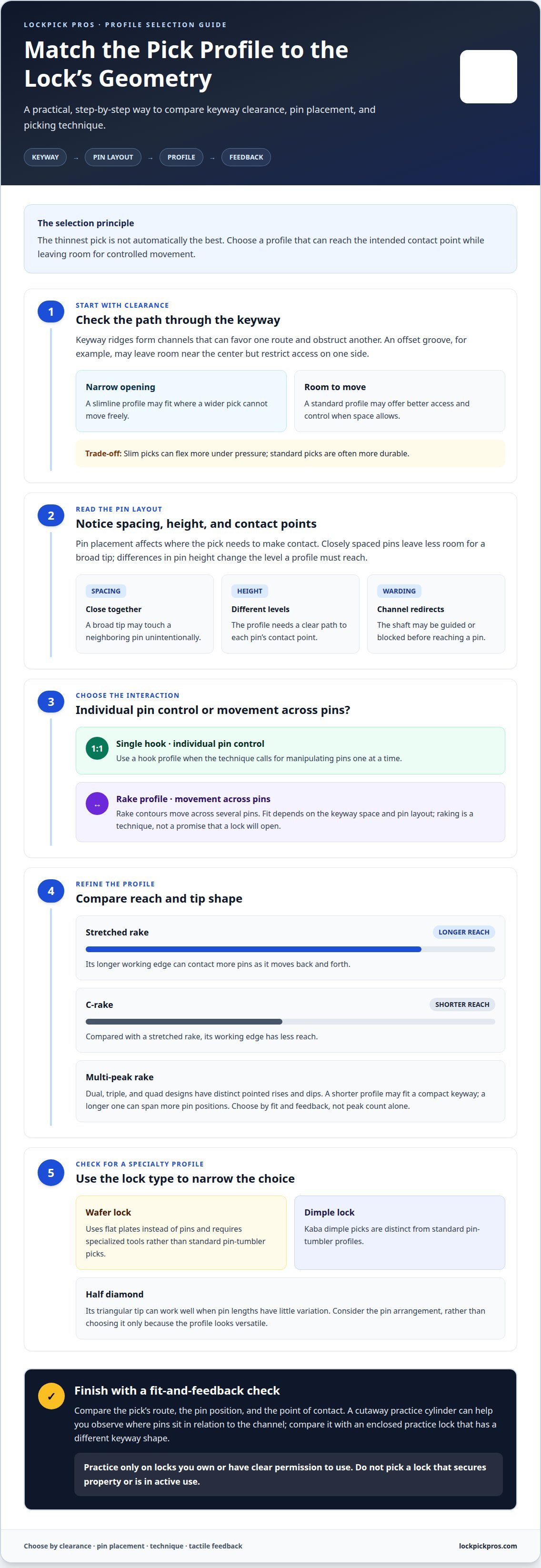
Slimline and standard lock picks differ in width and height, which affects how they fit and move inside a keyway. A slim profile can reach through tight openings, but may flex more under pressure. Standard picks are often more durable, helping beginners develop a lighter touch. Choose based on clearance, access, and the feedback you can feel.
Half Diamonds and Pin-Height Variation
A half diamond has a triangular tip that can work well when a lock’s pins have little variation in length. Half-diamond picks can vary in size. Their angled edge can contact pins at different points, but pin-height differences affect how useful that contact is. Consider this profile when the pin arrangement suits its shape, not simply because it looks versatile.
Choosing Picks for Complex Locks
For a more complex lock, match the pick to the keyway and technique instead of defaulting to a thin profile. A narrow opening may limit movement, while pin placement can make one tip awkward and another easier to position. Try a standard profile when space allows, then consider a slimmer pick if the keyway restricts access. Practice only on locks you own or have permission to use.
Lock Pick Shapes and Profiles
Hooks are shaped to give control when manipulating individual pins, while rake profiles have contours for moving across several pins. A comb pick is different: it has multiple teeth that lift the entire pin stack past the shear line. It can bypass some padlocks with keyways drilled deeply into the lock body. Specialty profiles serve different lock features; for example, Kaba dimple picks are distinct from standard pin-tumbler profiles.
For US flights, the page says the TSA allows lock picks in carry-on and checked baggage. The Transportation Security Administration says rules differ for tools longer than 7 inches, so that length matters when considering air travel.
Keep practice ethical: use your own practice lock or get clear permission from its owner. Don’t pick a lock that secures property or is in active use.
How pin placement and keyway geometry affect performance
Keyway geometry determines the path a pick can take before reaching a lock’s internal components. Pin placement determines where the pick needs to make contact along that path. The two features interact: a tip may align with a pin in an open channel but approach it poorly if the keyway’s warding redirects the shaft.
A keyway is more than an entrance slot. Its ridges form channels that can favor movement along one path while obstructing another. For example, an offset groove may leave room near the center but restrict access on one side. The pick’s position in the channel can affect which pins are reachable.
Pin spacing affects how precisely a tip can be placed. When two pins sit close together, the contact area between them is limited. A tip that is broad relative to the gap may unintentionally touch a neighboring pin. Wider spacing can leave more room to distinguish one contact point from another.
Pin height matters too, because each pin presents a contact point at a different level. A profile needs to approach that point without its shaft or adjacent parts blocking the path. Understanding different lock pick profiles means considering the relationship between the tip’s working height and the pin’s position, rather than treating the keyway as empty space.
For a useful comparison, study a cutaway practice cylinder and note where each pin sits in relation to the channel. Then compare it with an enclosed practice lock with a different keyway shape. The contrast can show why similar pin arrangements may feel different when the surrounding geometry changes.
During practice, keep three observations separate: the direction the keyway allows, each pin’s position, and the point where the pick makes contact. This helps you identify whether difficulty comes from the route, pin location, or contact itself. A single change in geometry can affect more than one factor.
These observations help guide profile selection without relying on appearance alone. Consider whether the tip can reach the intended contact point along the available path and whether neighboring pins leave room for controlled contact. Practice on locks you own or have permission to use, and let the lock’s geometry guide your comparison.
Stretched and multi-peak rake profiles
Rake profiles differ in length and peak shape, affecting how many pins they contact as they move. Compare a stretched rake with a C-rake or pointed multi-peak design on an authorized practice lock.
Stretched Rake Profiles
A stretched rake has a longer working edge than a C-rake, so it can contact more pins as it moves back and forth. That broader contact may suit a practice cylinder where pin positions align with the rake’s length. Fit still matters: keyway space and pin layout affect how freely the profile moves. Raking is a technique, not a promise that a lock will open.
Multi-Peak Rake Profiles
Multi-peak rakes have pointed rises and dips along the tip. Dual, triple, and quad designs vary in length and create several contact points, making them suited to quick raking movements on appropriate practice locks. A shorter profile may fit a compact keyway, while a longer one can span more pin positions. Choose based on fit and feedback, not peak count alone.
A C-rake and a stretched rake differ chiefly in reach: the stretched shape can touch more pins at once. Dual, triple, and quad rakes instead have distinct pointed peaks. Their lengths suit different locks, so one profile may move smoothly while another catches against the keyway. These shapes offer options, not a universal ranking of effectiveness.
Keep raking and lifting distinct. Raking moves the profile back and forth, aiming to set pins through contact along its edge. Despite its name, an L-rake is a lifting tool, not a rake. It moves slightly up and down in an attempt to set pins together, and it rarely works.
On an authorized practice lock, assess the rake’s length, clearance, and tactile feedback separately. If the tip scrapes the keyway or feels blocked, the profile may not suit the lock’s geometry. A different rake shape can change the contact points, but extra pressure won’t fix a poor fit. Keep movements controlled and stop if the tool bends.
Use rake profiles only on locks you own or have explicit permission to practice on. A transparent practice lock can show how rake shape relates to pin contact, while a standard lock offers less visual feedback. Note which profile feels controlled on each practice lock, then compare results without treating one successful opening as a rule for other cylinders.
Wafer locks and compatible tools
A wafer lock uses flat metal plates, called wafers, rather than the individual pins in a pin-tumbler cylinder. This distinction matters: pin-tumbler profiles are shaped for pin stacks, while wafer mechanisms need tools suited to their own layout. Wafer locks commonly appear in automotive doors, so identifying the lock type is the first compatibility decision.
Check the lock’s keyway and intended use before choosing a practice tool. A vehicle door lock may use a wafer mechanism, but appearance alone doesn’t confirm its internal design. Use a dedicated practice lock to learn the difference. Don’t assume a hook or rake designed for pins will make useful contact inside a wafer lock.
Wafer-specific tools are designed for the lock’s plate arrangement. Their profile and reach need to suit the keyway, just as pin-tumbler picks need to fit their cylinders. A tool that is too wide may not enter freely; one with the wrong working shape may not engage the intended parts. Match the tool category to the mechanism, not just the lock’s size.
Tension tool placement affects access too. Top-of-keyway tension tools apply rotational force from the upper part of the keyway, leaving room for a compatible tool to enter the lock body. This can matter when the opening is crowded. It doesn’t make a pin-tumbler pick suitable for a wafer lock; the picking tool still needs to match the wafer mechanism.
Keep the learning goal focused on recognition and controlled practice. Compare a known pin-tumbler practice lock with a wafer training lock, noting their different internal components. Then choose tools labeled for the mechanism you’re studying. This comparison helps explain why one profile may feel misplaced in a wafer keyway, even if it works well in another lock type.
For ethical locksport, practice only with a lock you own or have explicit permission to use. Avoid working on an active vehicle lock or any lock securing property. A dedicated practice lock keeps the exercise separate from real access needs. In short, wafer locks need wafer-compatible tools; standard profiles aren’t interchangeable just because both tools enter a keyway.
As the guide notes, some customers start with a nine-piece slim pick set, though tool choice should still suit the mechanism being studied.
What are the main lock pick profiles and their shapes?
Pick profiles describe the shape of a tool’s working tip. In pin-tumbler locks, that shape affects contact, reach, and control. Hooks, rakes, and diamond profiles serve different purposes, so matching the shape to the lock’s features matters more than choosing by appearance.
A hook has a narrow, upward-curving tip that gives control when manipulating individual pins. A single hook is used for single-pin picking on a standard lock. Hooks vary in curve and reach, which can help access pins at different depths. A useful profile fits the keyway and provides clear tactile feedback.
Rake profiles have ridges, waves, or peaks along the tip. Their shape lets the tool contact multiple pins as it moves through a pin-tumbler lock. A C-rake has a wave-like contour, while dual, triple, and quad rakes have pointed peaks. The profile’s length affects how many pin positions it can reach at once.
A diamond pick has angled faces and a pointed tip. A half diamond is useful when pins have little variation in length, while a full diamond has a pointed working end and angled sides. These profiles can feel different from a hook because their sloped edges create contact as the tool moves. Consider clearance and pin layout when choosing one.
Tubular picks have a round shape designed for tubular locks, rather than the flat keyway of a standard pin-tumbler cylinder. They are made for tubular locks with 6-, 7-, 8-, and 10-pin configurations. That distinction is a reminder to identify the lock mechanism before choosing a profile.
A tension wrench isn’t a pick profile, but it works alongside picks by applying rotational force to the plug. Its position can affect the space available for the working tip. A set with several profiles gives you options for different keyways and techniques, rather than several versions of the same shape.
For ethical locksport, compare profiles on locks you own or have permission to practice on. Notice whether each tip reaches comfortably and gives useful feedback. A hook emphasizes control over individual pins; a rake emphasizes broader contact. These differences provide a practical starting point for selecting a profile.
Rake picks mimic a key sliding in and out of a lock. Applying tension can make driver pins jump above the shear line, helping explain why raking differs from careful contact with one pin: the rake engages several positions during a pass. In this approach, the profile and tension work together.
Lockpick Pros: Practice Locks and the Black Belt Challenge
Lockpick Pros offers practice locks and beginner lockpick sets for hobbyists building a regular locksport routine. Understanding different lock pick profiles helps you decide what to observe during practice, while a belt goal can give that practice direction. Keep notes on what you learn, then use those observations to track progress from one rank to the next.
The free Black Belt Challenge starts with an email sequence that guides participants through belt-rank progression and reward picks. Each rank provides a milestone to work toward. Rather than racing through the sequence, focus on steady progress and give each new skill time to settle before advancing.
As you progress through the ranks, consider how your tools support the next stage of practice. Beginner lockpick sets offer an entry point, while later progress may call for different tools. Plan upgrades around the skills you’re developing and the practice locks you’re using, rather than collecting equipment without a learning goal.
The challenge also invites participants to post picks-in-action content using Lockpick Pros tools. A useful post can share a practice milestone, a lesson learned, or progress toward a belt rank. These contributions feed the challenge’s social reach goal, which is tied to a $5,000 bounty. The bounty depends on reaching that goal; a single post does not promise a reward.
Following the sequence adds a community dimension to locksport practice. Track each rank, share your progress, and keep working toward Black Belt at a pace that suits your learning. The challenge connects individual milestones with other hobbyists’ contributions, making progress more visible than practicing entirely on your own.
Join the free Black Belt Challenge and take your next step through the belt ranks.
Frequently Asked Questions
In summary, when does each property matter?
Each factor matters at a different point in choosing equipment. Mechanism type determines the tool category; keyway clearance affects access; the practice goal guides the profile; and handle comfort influences how steadily you can work. Start by identifying the lock type, then select tools for that learning task. A brief log of the lock, tool, and result can help reveal useful patterns over time.
What About Pin Tumbler Locks?
Pin-tumbler practice helps build consistency, but locks can differ in condition and internal configuration. The same approach may therefore produce different feedback across practice cylinders. For a useful comparison, use the same lock repeatedly and note whether your results change between sessions. Record the lock’s identifying details too, so you can track progress against a familiar challenge rather than an unexplained change in hardware.
Which lock pick profiles are best for beginners to learn with?
Beginners benefit from a manageable set for focused practice, rather than a large assortment chosen by piece count alone. Look for tools that feel comfortable to hold and a practice lock suited to learning the fundamentals. Build familiarity with a small selection before adding specialty tools. This makes it easier to notice how handling, positioning, and repetition affect your control without constantly switching equipment.
What are common lock pick handle and shaft profile designs?
A pick’s handle is the grip area, while its shaft connects the grip to the working tip. Designs vary in material, width, and overall shape. A carbon fiber handle can transmit vibrations from pins to the picker, providing tactile feedback. For longer practice sessions, consider whether the handle remains comfortable in your grip and whether the shaft is easy to guide with controlled movements.
How do different pick profiles work with wafer and dimple locks?
Use practice hardware made for the specific mechanism rather than learning on an installed vehicle or active lock. Keep specialty tools clearly separated from standard pin-tumbler picks, and label them by lock type. That simple habit helps prevent mix-ups during practice and makes it easier to track which equipment belongs with each learning exercise. Choose an appropriate practice setting before attempting a new mechanism.
What lock pick profiles are included in common starter sets, and what do they cost?
Kit contents vary, so compare the listed components rather than relying on the set name or piece count. Some options include practice hardware, tensioners, or a carrying case, while others focus on picks. The selected kit determines the price. Review the product options on this page for each set’s exact contents and price, then choose one that fits your practice goals.