

Lock picking for manual dexterity: skills, costs and practice
What do manual dexterity skills look like in practice? They’re the small, controlled movements that coordinate your hands and fingers, from picking up a coin to noticing subtle feedback from a practice lock. Lock picking for manual dexterity brings that precision into locksport, where steady tool control and attention to tactile feedback are part of the challenge.
It’s reasonable to wonder whether lockpicking can provide useful fine-motor practice. It can encourage deliberate hand and finger movements, but it isn’t a substitute for therapy or an occupational therapist’s plan. Familiar activities such as touching each finger to the thumb, moving coins, and shaping putty also practice coordination and control.
This guide explains which manual dexterity skills are involved, how lockpicking relates to fine motor practice, and how to approach regular sessions gradually. It also covers practice equipment, the factors that affect kit costs, and administration time for the Minnesota Manual Dexterity Test, which can take up to 56 minutes. Use the distinctions to choose a practice approach that suits your goal, whether that’s exploring locksport or understanding dexterity activities.
Key Takeaways
- Build hand control with simple activities such as moving coins, shaping putty, or practicing finger-to-thumb touches.
- Notice how precise finger movement, coordination, and tactile feedback connect to fine motor skills.
- Start practice slowly and increase effort gradually, focusing on controlled movements rather than speed.
- Understand what equipment supports practice and why the Minnesota Manual Dexterity Test can take up to 56 minutes to administer.
- See how practice locks and the free Black Belt Challenge can support ethical locksport practice and step-by-step skill progression.
1. Manual dexterity activities for therapy
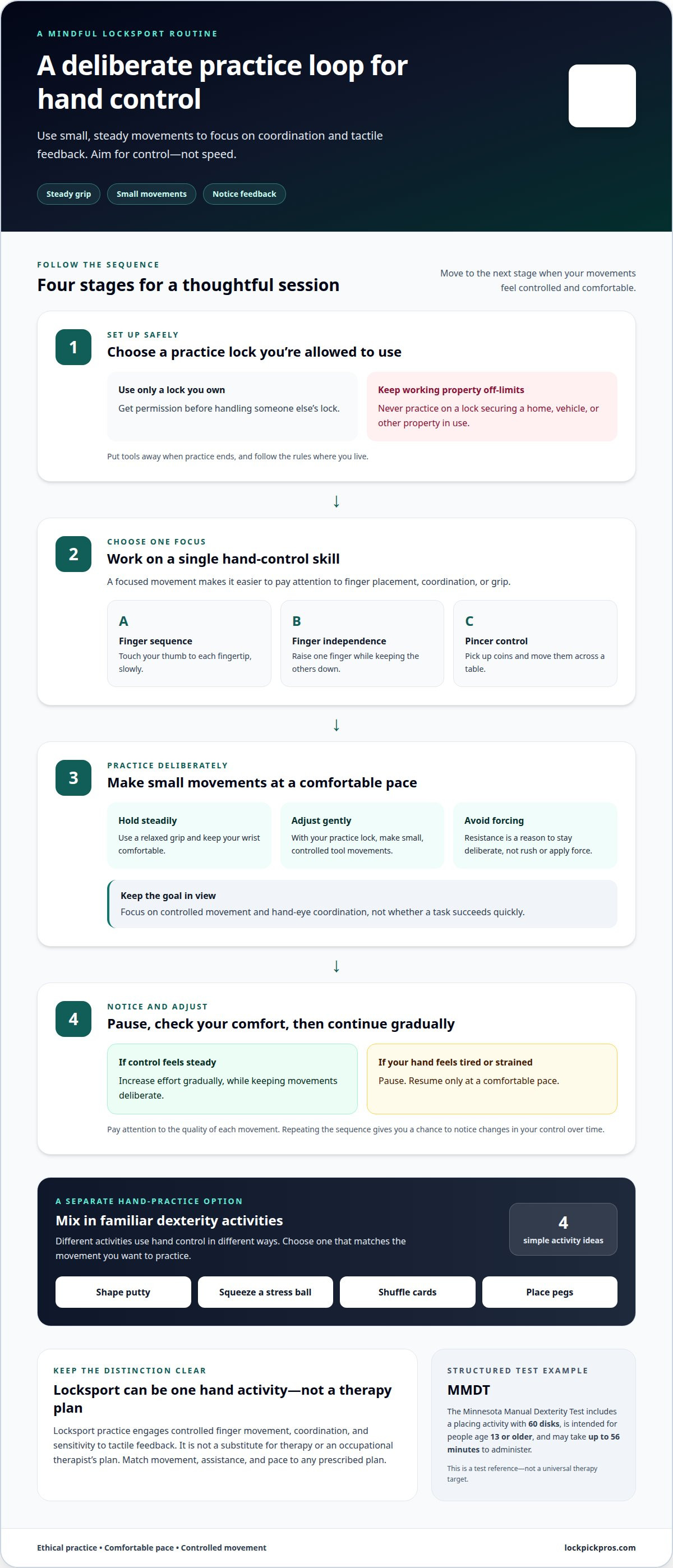
Therapy activities can focus on a specific hand movement, such as pinching, finger independence, or wrist control. Try touching your thumb to each fingertip in sequence, then repeat slowly with the other hand. Finger lifts offer another focused exercise: rest one hand flat and raise one finger while keeping the others down. These exercises isolate movements that everyday tasks often combine.
For grip and coordination, squeeze a stress ball, shape therapeutic putty, or crumple a hand towel using one hand. To practice a pincer grasp, pick up coins and move them across a table. Buttoning, shuffling cards, and placing pegs also connect finger control with useful tasks. Notice whether your fingers move deliberately and your grasp stays controlled.
Choose an activity that matches the ability you want to practice. For example, press, roll, and flatten putty, or use coins to practice picking up and releasing small objects. A therapist may set a measurable goal around a task, such as stringing beads or handling classroom tools. The movement, assistance, and pace should match the person’s therapy plan.
How does lock picking compare with other hobbies for practicing manual dexterity? Like shuffling cards or playing piano, it calls for controlled finger movement and hand-eye coordination. Its distinctive feature is tactile feedback, while putty, painting, and puzzles provide different kinds of hand practice.
The Minnesota Manual Dexterity Test (MMDT) provides a structured example of timed hand tasks. Its placing activity uses 60 disks, and the test is intended for people age 13 or older. The cited study authors (not identified in the research facts) reported a mean time of 82.73 seconds (SD 32.19) for the placing-dominant activity among adults with multiple sclerosis. That result describes one study group, not a therapy target for every person.
For locksport practice, use only locks you own or have permission to work on. Deliberate, comfortable movements matter more than rushing through an activity. Specialized tools, such as dimple-lock picking tools, add a distinct hand-control task, but they are not a substitute for prescribed therapy activities.
2. Manual dexterity and fine motor skills
Fine motor skills are the small, controlled movements used for tasks like writing or fastening buttons. Manual dexterity adds precision, speed, and coordination when the hands handle objects. For example, threading a needle calls for a steady grip, fingertip control, and visual attention at once. These abilities work together, but they describe different parts of skilled hand movement.
Can lock picking improve manual dexterity and fine motor skills? Ethical locksport practice engages controlled finger movement, hand-eye coordination, and sensitivity to tactile feedback. It can be one deliberate hand activity, but it isn’t a substitute for a therapy plan.
What skills does recreational lock picking develop? It asks you to hold a tool steadily, make small adjustments, and interpret subtle feedback without rushing. Those actions involve grip control, attention, and coordination. For safe practice, work only with locks you own or have permission to pick.
Progress comes from noticing the quality of your movements, not just whether a task succeeds. During a session, keep your wrist comfortable, use a relaxed grip, and pause if your hand feels strained. Compare the controlled motion of a pick with writing a short line or fastening a button. Each task has different demands, so skill in one activity doesn’t automatically mean equal ability in another.
A measurable goal can help make practice specific. For instance, a fine-motor goal might aim to improve a BOT™-2 score from 11 to 18 points across 3 of 4 trials over six months. That example describes a structured goal, not a universal benchmark. Healthy aging is associated with declining manual dexterity beginning at age 60, while muscle atrophy, arthritis, and neurological conditions such as Parkinson’s disease can also affect hand control. These factors make the task and the person’s starting ability relevant when setting goals.
During a locksport session, focus on one element of control at a time: steady the tool, make a small movement, then notice the feedback. Repeating that sequence encourages careful coordination. The goal is thoughtful practice with a lock used ethically, not speed or force.
3. Building dexterity through regular practice
Begin each practice session slowly, increasing effort only as your control feels steady. A short routine can focus on grip, finger placement, and noticing small movements. Keep your wrist relaxed and pause if your hand feels tired. Deliberate movement matters more than speed. Regular practice gives you a chance to notice changes in your control over time.
What beginner lock picking exercises improve dexterity? With a lock you own or have permission to use, practice holding a pick steadily and making small, controlled movements. Pair this with a simple hand exercise, such as touching your thumb to each fingertip, to focus on coordination without rushing.
How can beginners practice lock picking safely and legally? Use a dedicated practice lock that you own, and never pick a lock securing a home, vehicle, or other property in use. Get permission before handling someone else’s lock. Put tools away when practice ends, and follow the rules where you live.
Damage and lockout risks are real when you practice on a lock you rely on. Forcing a tool against resistance may bend or break it, and the lock may become difficult to operate. Avoid practicing on an exterior door or any lock needed for immediate access. A separate practice lock keeps the exercise apart from your everyday security.
Try this measured routine: first, make sure your practice lock is stable and separate from an in-use door. Hold the tool with a light grip and focus on smooth movement. Pause, relax your fingers, and notice whether fatigue affects your control. Stop if the tool catches or the lock behaves differently. A dedicated practice lock supports this routine, while beginner lockpick tools offer an entry point for learning controlled handling. Build consistency before taking on harder practice challenges.
Make progression part of the practice: begin manual dexterity exercises slowly, and increase effort gradually instead of making every movement demanding from the outset. Pay attention to how much effort you use so each change remains deliberate.
A measured pace lets you increase effort without making a sudden jump. Continue step by step, starting slowly and progressing gradually. Keep this measured approach throughout your manual dexterity practice.
4. Definition and importance of manual dexterity
Manual control matters because small movements can determine whether a task works on the first attempt. Placing a SIM card into its tray, for example, takes careful positioning and gentle pressure. If the card shifts, pause and reposition it. Similar adjustments come up when handling tiny craft pieces or aligning a connector with its port.
Precise hand movements can make multi-step daily tasks smoother. Preparing a packed lunch might involve opening a container, arranging food, and closing the lid. Each step calls for a different grip and amount of pressure. A secure hold helps prevent spills, while careful positioning makes the next step easier.
Dexterity also matters in work and hobbies involving small components. A model-building project may require placing a tiny part without disturbing nearby pieces. Repairing a loose eyeglass screw means holding the frame steady while guiding a small tool. In both cases, you adapt your movements to the object rather than simply applying more force.
In locksport, careful hand control helps you manage a pick without forcing it. The practical value lies in focus: noticing the tool’s position and making measured adjustments can make a practice session more deliberate. This skill applies to the activity at hand, but success with one task doesn’t prove equal control in every other task.
Understanding why dexterity matters can help you identify which part of an activity needs attention. If a task becomes frustrating, notice whether the challenge comes from positioning, grip, pressure, or coordinating both hands. For example, assembling a small model may be difficult because one hand can’t stabilize the piece while the other guides it. Naming the specific challenge clarifies the goal, whether you’re working on a hobby project, a household routine, or locksport practice.
5. Equipment, cost, and administration time
Equipment depends on the activity’s purpose. Locksport practice calls for a dedicated practice lock and suitable picks, while a formal dexterity assessment uses its own standardized materials. The setups aren’t interchangeable. Before choosing equipment, decide whether your goal is recreational skill practice, a structured assessment, or a simple hand activity at home.
Cost depends on what the activity requires and what you already have. A locksport setup may involve a practice lock and a beginner pick set, while someone practicing object handling might use ordinary household items. A formal test may require specific materials and a manual. The total expense depends on the equipment you choose, whether you need additional components, and whether existing supplies suit your purpose.
For a standardized assessment, preparation is part of administration. The Minnesota Manual Dexterity Test manual directs administrators to read its administration section and practice giving the test beforehand. Knowing the instructions helps the administrator follow the same procedure throughout. That preparation differs from casual practice, which can be adapted to a person’s immediate goal.
The time needed for a structured dexterity assessment can vary with the procedure and preparation. This is a planning consideration for a formal session, not a practice target or a score. Allowing time for the administrator’s preparation and test procedure helps distinguish a structured assessment from a brief activity. The actual session should follow the test manual’s directions.
Choose equipment to match your purpose. For locksport, use a separate practice lock and pick set, not a lock needed for access. For a formal assessment, use the designated materials and follow its administration procedure. For a home activity, a familiar object may be enough to practice a specific movement. The key question is whether you need standardized results or simply a focused way to practice hand control. This distinction helps keep equipment choices and time expectations appropriate.
In a healthy-adult study, mean time to complete the 60-disk MMDT placing test was 63.9 seconds (SD 6.7), and the 20-disk test mean was 20.9 seconds (SD 2.8).
Lockpick Pros: Practice Locks
Lockpick Pros offers Practice Locks for hobbyists who want a dedicated place to develop controlled tool handling. They’re a useful next step when finger movements feel familiar and you’re ready to apply them in a locksport setting. A separate practice lock also keeps hobby sessions apart from locks used for everyday access.
Consider a practice lock when you’re starting locksport, returning after a break, or working toward a new skill level. Pair it with a Beginner Lockpick Set to learn basic handling, or choose an Advanced Lockpick Set as your practice needs change. The right combination depends on your experience and the type of lock you’re practicing with, not on promises of faster results.
Use a dedicated lock to focus on steadiness, tool positioning, and tactile feedback without risking an in-use lock. Set it on a stable surface, clear your practice area, and stop if a tool catches or the lock behaves unexpectedly. Choose a lock you own or have permission to use. This ethical approach keeps the activity centered on sport and skill-building.
Practice Locks suit hobbyists who prefer hands-on repetition to exercises with coins or putty. They can also help you notice how grip and small movements change as you handle different practice equipment. Keep sessions deliberate, and don’t turn a dexterity activity into a test of speed. Vehicle Locksmith Tools are a separate equipment category for vehicle-related practice; use them only for appropriate, authorized practice.
Lockpick Pros’ Practice Locks are the practical next step when you’re ready to apply controlled hand movements to locksport. Choose practice equipment that fits your current goals, keep ethical use at the center, and build your skills one session at a time. Contact Lockpick Pros to discuss Practice Locks for your locksport practice.
Join the Free Black Belt Challenge
The free Black Belt Challenge gives ethical locksport hobbyists a step-by-step way to progress through practice. Joining starts an email sequence that guides participants through belt ranks and the challenge’s reward-pick process. Begin with skills and equipment suited to your current level, then work toward the next rank at a measured pace.
The belt ranking system makes progress easier to organize. Focus on one belt at a time instead of jumping straight to advanced locks. As your skills develop, choose tools suited to the level you’re practicing. A beginner set supports early handling practice, while more advanced picks can suit later stages. This approach connects each equipment choice to a clear learning goal.
Sharing is part of the challenge. Participants post picks-in-action content on social media using Lockpick Pros tools, showing their practice and progress. Those posts contribute to the challenge’s social-reach goal, tied to a $5,000 bounty. The bounty depends on reaching that social goal, so treat sharing as a community activity, not a guaranteed reward.
Keep every demonstration ethical. Use locks you own or have permission to pick, and make the locksport context clear in any shared content. A short clip can focus on careful tool handling, tactile feedback, or a practice milestone. Don’t show activity involving locks used to secure property or provide access.
To take part, join the free Black Belt Challenge, follow the email sequence, and progress through the ranks one at a time. Select tools that suit each stage, share picks-in-action posts, and keep building toward Black Belt. The challenge connects individual practice with a community progression, giving each belt a next step and each post a role in the shared social-reach goal.
Give your next practice session a clear goal: steadier control, more deliberate movement, or a new locksport challenge. Small, focused steps can keep the activity purposeful while leaving room to enjoy the process.
For hobbyists choosing equipment, Lockpick Pros offers Beginner Lockpick Sets, Advanced Lockpick Sets, and Practice Locks. Match your setup to the kind of practice you want, then progress at a manageable pace.
Think of lock picking for manual dexterity as one way to practice precision, not a measure of every hand skill. Choose a next step that fits your interests and keeps your practice ethical.
Ready to explore a pick set for your next stage? Contact Lockpick Pros and keep building your locksport skills with confidence.
Frequently Asked Questions
What are manual dexterity skills?
Manual dexterity skills are abilities used to carry out precise hand tasks with accuracy and control. In practical settings, they may be assessed by observing how consistently someone completes a task, how much assistance they need, and whether they can adjust after an error. A useful goal names the task and the expected quality, rather than relying only on a general label such as “good coordination.”
What tools do beginners need for lock picking, and how much do they cost?
For basic pin-tumbler locksport, beginners typically start with a pick set and a tension wrench. Specialty tools can wait until a specific lock type or learning goal calls for them. There isn’t one total cost for every setup: it depends on the set you choose and whether practice hardware is included. Compare each option’s contents and use its current listed price to plan your purchase.
Can beginners practice lock picking on clear practice locks or training kits?
Yes. A clear practice lock or training kit can help beginners connect what they see with a tool’s movement inside the lock. This visual reference can make early practice easier to follow than working with an opaque lock alone. Treat it as a learning aid, not proof that every lock has the same internal layout. As your familiarity grows, move on to other dedicated practice locks.
What are the best beginner lock picking resources, clubs, or courses in the United States?
Beginner resources include structured online material, practice hardware, and communities focused on ethical locksport. Every purchase includes the Lockpicking Bootcamp video series, which gives beginners material to study alongside their equipment. The free Black Belt Challenge offers another community-oriented path for hobbyists interested in belt progression. These resources support self-paced learning; choose options that emphasize responsible practice and clear skill development.