

Mastering the Advanced Lock: A Guide to High-Security Picking (2026)

That mushy, unresponsive feeling from a high-security core isn't a sign of your failure. It's an invitation from the lock, a challenge to prove you understand its secrets. We know the feeling well. You've mastered standard pins and can pop open practice cylinders with ease, but every time you approach an advanced lock, you hit a wall of zero feedback and confusing counter-rotation. It's frustrating, and it's the exact point where many pickers stall on their journey to the next LPU belt ranking.
This guide is your breakthrough. We promise to demystify the complex engineering inside these locks, from the sidebar pins in a Medeco Biaxial to the rotating discs of an Abloy Protec2. You will learn the specific techniques and tool choices required to finally get that clean, satisfying open. Get ready to explore the internal mechanics of expert-level locks, match the right dimple picks to specific keyways, and gain the confidence you need to level up your locksport skills for 2026 and beyond.
Key Takeaways
- Learn to identify the features that separate a basic pin tumbler from a true high-security lock, such as secondary mechanisms and tighter tolerances.
- Discover how to correctly interpret feedback from security pins and master the counter-rotation needed to defeat a false set.
- Find out why your beginner kit won't work on an advanced lock and when to use thinner picks for navigating complex keyways.
- Explore the internal engineering of high-security cores to understand the specific challenges you need to overcome for a successful open.
What Defines an Advanced Lock in the World of Locksport?
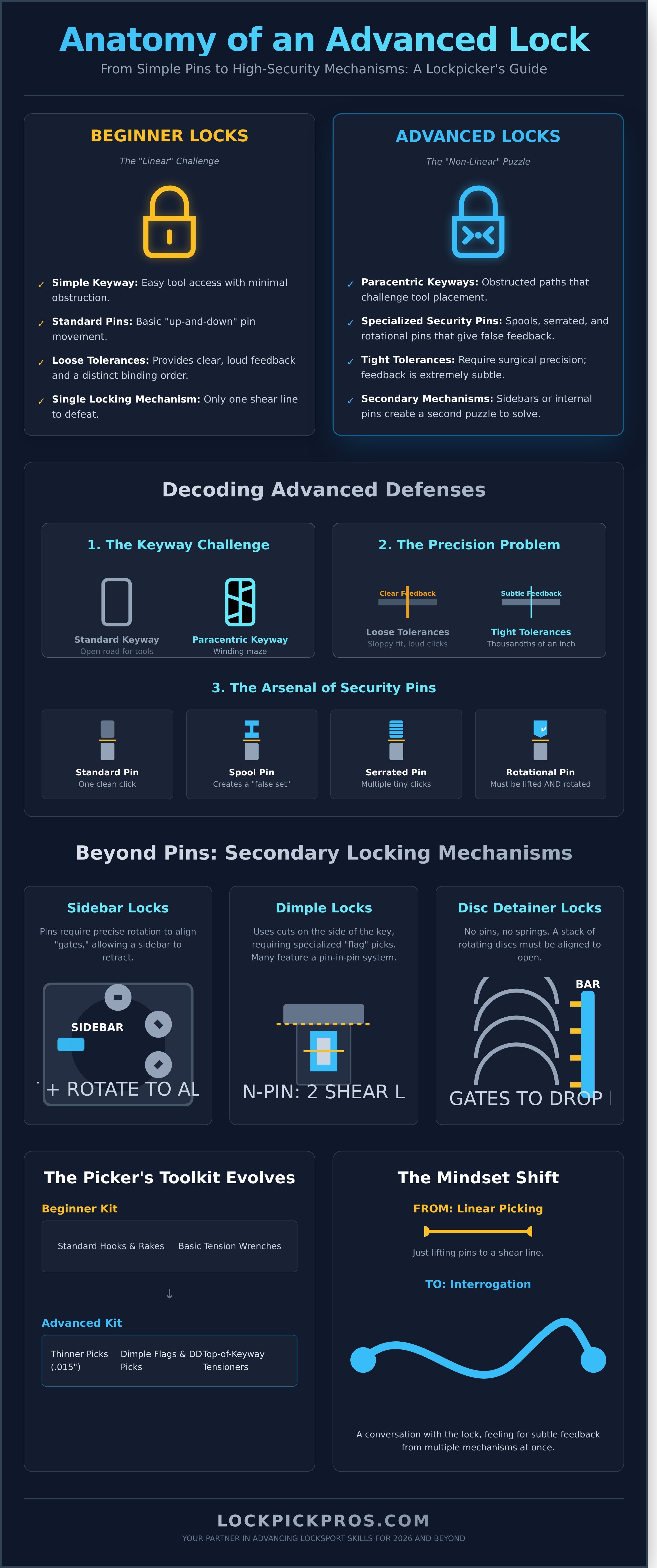
In locksport, the journey from a basic padlock to an advanced lock is a significant leap. It’s not just about more pins; it’s about a fundamental shift in design philosophy. An advanced lock is any lock that incorporates secondary locking mechanisms, extremely tight manufacturing tolerances, or complex keyways specifically designed to frustrate and defeat standard picking techniques. You're moving beyond the simple up-and-down world of standard pins and into the realm of high-security (Hi-Sec) engineering.
So, what signals you've got a challenge on your hands? Look for these key indicators:
- Restricted or Paracentric Keyways: The keyway is intentionally shaped with jagged edges and wards that obstruct your tools, making it difficult to maneuver a pick and apply tension correctly.
- Specialized Security Pins: You've mastered spools and serrated pins. Now get ready for pins that require rotation (like in a Medeco) or custom-milled shapes designed to interact with other parts of the lock.
- Sidebar Interactions: The lock has a second locking mechanism, often a "sidebar," that won't retract until the pins are not only lifted to the correct height but also rotated to the correct angle.
Ultimately, "advanced" is a relative term. What's advanced for a Yellow Belt picker is a warm-up for a Black Belt. The Lock Pickers United (LPU) belt ranking system provides a fantastic roadmap. A lock like an American Lock 1100 is a rite of passage for Green Belts, while a high-end Abloy Protec2 represents the pinnacle of the challenge, reserved for the highest ranks.
The Role of Precision and Tolerances
Beginner locks often have loose tolerances, which creates a very clear "binding order"-the sequence in which pins must be set. An advanced lock flips this script. High-security locks like Medeco or Abloy are manufactured with tolerances measured in the thousandths of an inch. This precision means feedback is incredibly subtle. Surgical tool placement isn't just a goal; it's a requirement. A sloppy tension wrench or a misplaced pick will give you zero feedback and zero progress. This challenge is magnified by paracentric keyways, which force your pick to navigate a winding path just to touch the pins.
Primary vs. Secondary Locking Mechanisms
Most pickers start by learning to manipulate pins to a single shear line. This is the foundation of the classic pin tumbler lock mechanism. A secondary locking mechanism, like a sidebar, introduces a second requirement that must be met simultaneously. It's a metal bar that sits in a channel along the lock cylinder and prevents it from turning. Only when every pin is lifted to the correct height and rotated to the proper orientation will the gates on the pins align, allowing the sidebar to retract. This massively increases the mental load on the picker. You're no longer just lifting; you're feeling for rotation, sidebar movement, and pin height all at once.
Beyond Pin Tumblers: Understanding High-Security Mechanisms
You’ve mastered the Master Lock No. 3. You can feel the shear line, and you know the satisfying click of a set pin. That’s linear picking. Now, get ready for a new challenge. High-security locks don't give up their secrets so easily. They lie and they misdirect. Defeating them requires a new mindset: Interrogation. You're not just picking; you're having a conversation with the lock, listening for subtle feedback that reveals its internal state. This is the world of non-linear picking, where setting one element might unset another, and the path to an open isn't a straight line. It’s a puzzle with moving parts, and your tools are how you talk to it.
Dimple Locks: Picking the Side of the Pin
Instead of lifting pins from the bottom, dimple locks use pins that interact with cuts on the flat side of the key blade. This means your standard hook is useless. You need to apply precise rotational force, which is why specialized "flag" picks are essential. These locks, common in Europe from brands like Mul-T-Lock, Kaba, and Mottura, often feature incredibly tight, paracentric keyways that test your tool control. A brand like Mul-T-Lock takes it further with its iconic pin-in-pin system, creating two shear lines within a single pin stack. Mastering these requires a delicate touch and the right set of dimple pick flags.
Disc Detainer Locks: The Rotating Challenge
Here, springs and pins are gone, replaced by a stack of rotating discs. Each disc has a small notch, or "gate," that must be aligned to allow a sidebar to drop in and open the lock. The challenge is twofold. First, you need a specialized disc detainer pick to apply tension to the rear of the lock while rotating individual discs at the front. Second, the feedback is completely different. As you rotate a disc to its true gate, you feel a slight dip. For a deeper look at these complex mechanics, this university lock picking lecture provides an excellent technical breakdown. This is why brands like Abloy, especially their Protec2 system with its notorious false gates and tight tolerances, are considered a "final boss" for many in the locksport community.
Magnetic and Hybrid Systems
Welcome to the invisible threat. Magnetic locks use opposing magnetic poles to repel or attract internal components, often controlling a sidebar that blocks the core from turning. The problem? Magnets don't provide the crisp, tactile feedback of a spring. You're working almost entirely by feel and sound. Hybrid systems combine these elements, pairing a traditional pin tumbler stack with an active sidebar or a set of sliders. This design forces you to pick the lock twice. The pinnacle of this technology is the EVVA MCS (Magnetic Code System), an incredible piece of engineering that uses multiple, independently rotating magnetic rotors, making it a true holy grail for any advanced lock picker.
Defeating the Defense: Mastering Security Pins and False Sets
Standard pin tumblers are a great place to start, but the real challenge in locksport begins with security pins. These are driver pins engineered specifically to give you false feedback, making you think a pin is set when it's actually trapped. Before we dive in, let's get the terminology right. The pins your key touches are key pins. The pins above them, pushed by the springs, are driver pins. In any decent advanced lock, these driver pins are where the security features live.
The first and most common piece of false feedback you'll encounter is the "false set." It feels like a major win, but it’s a carefully designed trap. The plug rotates a few degrees with a deep click, and you think you're almost home. What's really happening is the wide edge of a security pin, like a spool, has caught on the shear line, not its narrow center. To diagnose this, use the "Jiggle Test." Gently touch the top of each pin stack with your pick while lightly rocking your tensioner. A truly set pin will feel solid. A pin causing the false set will still have a slight springiness. This test confirms your progress without oversetting pins.
Spool Pins and Counter-Rotation
The classic spool pin is the primary cause of a false set. As you lift a spool, its narrow waist reaches the shear line, but its wider top edge gets caught, forcing the plug to turn. To beat it, you must slightly release tension as you continue to lift. You'll feel the plug rotate back toward you. That's counter-rotation. Counter-rotation is the plug’s response to a spool pin passing the shear line. Ease your tension just enough for the spool to clear the edge, then push it up until you hear the true set click. Fighting the feedback with heavy tension is a common mistake that will keep you locked out every time.
Serrated Pins and Micro-Clicks
Serrated pins are pure psychological warfare. These driver pins have tiny grooves cut into their sides, and each one catches on the shear line, giving you a small "click." This mimics the feeling of a set pin, tricking you into moving on. The key is to develop your "Click Count" method. You must learn to differentiate the faint, gritty micro-clicks of serrations from the loud, final click of a true set. Defeating them requires a "pulsing" tension technique. You'll need to slightly vary your tension, almost vibrating it, to walk the pin up one serration at a time without dropping your progress.
Mushroom and T-Pins
Mushroom and T-pins use tricky geometry to trap your pick. A mushroom pin's overhanging top can get caught on the shear line, creating a false set and sometimes physically wedging your pick tip. T-pins, often found in high-end cylinders from manufacturers like ASSA, function similarly. Both are common features in many genuine high-security locks because they add another layer of complexity. The technique to defeat them is a refined version of handling spools: feather-light tension and precise pick placement to navigate their unique shapes. This is where an advanced lock truly tests your feel for the pins.
The Advanced Lockpicker’s Toolkit: Essential Gear for High-Sec
Once you’ve mastered standard pin tumblers, you’ll quickly discover a hard truth: your beginner kit is holding you back. The 0.025" picks that felt so sturdy on a Master Lock No. 3 will feel clumsy and oversized in the tight, paracentric keyways of a high-security lock. It’s time to level up your gear to match your ambition.
The first major shift is in profile thickness. Moving down to 0.018" and 0.015" picks isn't just a preference; it's a necessity for navigating the warding in locks from brands like ASSA or Medeco. But thinner metal means less strength. That's why material choice becomes non-negotiable. Standard steel in these profiles will bend, break, and provide mushy, unreliable feedback. You need picks crafted from high-yield steel, like 301 High-Yield, which maintains the rigidity required to transmit the subtle clicks of security pins.
Your goal is to stop buying generic sets and start building a toolkit where every piece has a purpose. Think like a surgeon. You must match the tool to the specific mechanism you intend to defeat.
Specialized Picks for Specialized Locks
High-security locks use mechanisms far beyond simple pin tumblers. Your toolkit must evolve to defeat them. Dimple locks require dimple flags with a variety of left and right-hand curves to properly engage pins from the side. Tubular locks, often found on safes and vending machines, are best opened with a dedicated tubular pick. For disc detainer locks, you’ll need a specialized tool that can tension and manipulate the discs, choosing between front-tensioning and rear-tensioning models based on the lock's design.
Advanced Tensioning Strategies
Tension is 90% of picking. With an advanced lock, that number feels closer to 99%. While Bottom of Keyway (BOK) tension works for basic locks, it often obstructs your pick's path in more complex keyways. This is why most pros switch to Top of Keyway (TOK) tension. It clears the working area and provides more direct control over the core, giving you better feedback. Pair this technique with tapered tension wrenches for a more secure fit and the ability to apply "feather tension"-the incredibly light, nuanced pressure needed to feel the counter-rotation from a spool pin.
The "Must-Have" List for Green Belt and Above
As you target specific locks for your LPU Green Belt and beyond, your shopping list becomes more focused. Don't just buy a kit; build an arsenal. We recommend creating a "What Pick Do I Need?" checklist for your target brands. For example:
- Medeco Biaxial: A medium hook in 0.018" and a set of TOK pry bars.
- Mul-T-Lock Classic: A complete set of dimple flags and a dedicated dimple tensioner.
- ASSA Abloy: A steep hook or DeForest Diamond in 0.015" to navigate extreme bitting.
Finally, invest in a high-quality pinning tray. It’s one of the most powerful learning tools you can own. Gutting a lock lets you see exactly what you're fighting against, turning an abstract challenge into a tangible problem you can solve. Understanding the inner workings is the final step to defeating it.
Ready to upgrade? Explore our Advanced Lockpick Sets and get the precision tools your skills deserve.
Advancing Your Skills with Lockpick Pros
Having the right tools is only the first step. True mastery comes from practice, community, and a deep understanding of the mechanisms you're defeating. This final stage of your journey is where you transition from a hobbyist to a serious locksport practitioner. It’s also where the ethical code of our community becomes paramount. Advanced skills carry an advanced responsibility to pick only locks you own or have explicit permission to open. This is the core of being an ethical picker.
The journey to a Black Belt in locksport isn't always easy. You'll hit plateaus. You'll encounter a lock that feels impossible. This is normal. It's a sign that you're pushing your limits and are on the verge of a breakthrough. Don't get discouraged; get curious.
The LPU Belt Ranking Pathway
The Lock Pickers United (LPU) belt system provides a clear, structured roadmap for your progress. It’s not just a list; it’s a curriculum. Once you defeat a Green Belt lock like the American Lock 1100, the system guides you to your next challenge. It tells you exactly which Blue or Purple belt lock to acquire. This is how you systematically level up, ensuring you're always tackling an appropriate and challenging advanced lock.
For higher ranks (Blue Belt and above), the LPU requires you to film your pick and also "gut" the lock on camera. This proves you understand the internal components and didn't get lucky. Our LPU-approved tools, like the SSDeV hooks for deep access and heavy-duty top-of-keyway tensioners, are designed for the precision needed to defeat the high-sec pins found in these locks.
One of the most valuable habits you can build is gutting every lock you successfully pick, even practice locks. Popping a lock open is a great feeling, but seeing why it opened is where real learning happens. When you disassemble it, you can see the exact spool pin that gave you that deep false set or the serrated pin you had to feather your tension on. This visual feedback connects the feeling in your pick to the reality inside the lock, accelerating your skill development tenfold.
Join the Ethical Locksport Community
You don't have to learn in a vacuum. The locksport community is one of the most supportive and knowledgeable groups you'll find. For real-time help and to share your successes, we highly recommend getting involved.
- Discord: The official Lock Pickers United Discord server is a fantastic place for immediate feedback.
- YouTube: Channels run by the LockPickingLawyer and BosniaBill are legendary for a reason. They offer masterclasses in technique and tool selection.
- Local Meetups: Groups like TOOOL (The Open Organisation Of Lockpickers) have local chapters that host hands-on events.
Our commitment to you is simple: no fluff, just the tools and knowledge you need to succeed. We're here to support your growth as a serious, ethical picker. When you hit that wall, remember it's part of the process. Your next breakthrough is just one practice session away. Shop Professional Lock Pick Sets and start your next challenge today.
Your Next Challenge Awaits
You've learned that defeating an advanced lock isn't about magic; it's about knowledge and feel. Remember the two core principles: you must master the feedback from security pins to navigate false sets, and your success depends entirely on the quality of information your tools provide. Every subtle click and bit of counter-rotation tells a story, but you have to be equipped to listen.
When you're ready, having the right gear is critical. It's why LPU Green and Black Belt pickers trust our precision-engineered, high-yield steel tools to transmit maximum feedback from the keyway to your fingertips. Shop our curated collection of Advanced Lockpick Sets and get the gear you need with same-day shipping for ethical lockpickers worldwide. That next belt is yours for the taking.
Frequently Asked Questions
What is the hardest lock to pick in the world?
The hardest lock to pick is a constant debate, but top contenders include the EVVA MCS (Magnetic Code System) and the Abloy Protec2. These locks move beyond traditional pins, using magnetic elements or rotating discs with extremely tight tolerances. They require highly specialized tools and techniques that are worlds away from standard pin tumblers. Defeating one is a true mark of an elite-level picker and a goal for many in the locksport community.
Do I need a special license to buy advanced lockpicking tools?
No, in over 90% of U.S. states, you don't need a special license to buy lockpicking tools. However, possession of picks with intent to commit a crime is illegal almost everywhere. It's your responsibility as an ethical lockpicker to know your local and state laws. Always use your tools for locksport or on locks you own. When in doubt, check your state's statutes regarding "burglar tools" before purchasing or carrying your kit.
What is the difference between a false set and a true set?
A false set is the distinct core rotation you feel when a security pin, like a spool, gets trapped at the shear line. The core turns slightly but won't open. This is a clear signal you've encountered a security pin and need to adjust your technique. A true set, on the other hand, happens when a standard pin is correctly set at the shear line, giving a subtle click with no major core movement. Recognizing this difference is key to defeating security pins.
Can all advanced locks be picked, or are some "unpickable"?
Theoretically, no mechanical lock is unpickable, but some are practically impossible for nearly everyone. High-security locks like the EVVA 3KS or the DOM Diamant have so many interacting elements and require such precision that they're considered "unpickable" in any realistic scenario. These advanced locks are designed to resist expert picking for hours, not minutes, making them a huge challenge even for professionals with custom tools.
How do I know if my lock has security pins like spools or serrated pins?
You can identify security pins by the feedback they give through your tension tool. A spool pin will cause counter-rotation, where the core turns slightly backward as you lift the pin. Serrated pins feel gritty and give off multiple tiny clicks as you push them toward the shear line. For a definitive answer before you start, look up your lock's model on a resource like the LPU belt ranking list to see its known internal components.
Why do I keep dropping pins when I try to pick a spool pin?
You keep dropping pins because setting a spool requires a delicate release of tension. When you feel counter-rotation, you must slightly ease off your tension wrench to allow the spool's thin middle section to pass the shear line. If you release too much tension during this process, the standard pins you've already set will drop back down. It's a common hurdle that requires practice to master the precise amount of give-and-take.
What thickness of lock pick is best for advanced European locks?
A pick thickness of 0.015 inches (or 0.4mm) is an excellent choice for most advanced European locks. These locks, particularly from German and Scandinavian manufacturers, are famous for their tight, paracentric keyways that leave little room to maneuver. While a standard 0.025-inch pick won't even fit in many of them, a 0.015-inch pick provides the necessary slim profile to navigate these complex challenges without sacrificing too much feedback.
Is it better to buy a full advanced set or individual specialized picks?
Choosing between a full set and individual picks depends on your goals. A full advanced set offers great value and equips you for a wide variety of locks you might encounter. However, as you target specific locks for your next belt rank, buying individual specialized picks is often better. This allows you to build a custom, high-performance kit with the exact dimple flags or hook profiles needed to defeat the advanced locks on your list.