

The LockPickingLawyer: Decoding the Tools and Techniques of a Locksport Icon

What if you could open your first practice lock with the same quiet confidence as the LockPickingLawyer, but without spending hundreds on tools you don't need? It's easy to watch his videos, see a wall of picks, and feel completely overwhelmed. You know the skill is achievable, but the path from watching to doing seems impossibly steep, filled with cheap, ineffective tools and confusing jargon.
This guide is your map. We're decoding the exact methodology, foundational tools, and ethical philosophy that makes the lockpickinglawyer a locksport icon. You'll leave with a clear shopping list for your first kit, an understanding of the LPU belt system, and the confidence to turn video-bingeing into a hands-on skill. We'll break down his go-to picks for pin tumblers, explain why tension control is 90% of the battle, and show you how to start your journey toward earning that first LPU belt.
Key Takeaways
- Understand the core ethical philosophy championed by the LockPickingLawyer and why you should never pick a lock that is in use.
- Master the foundational technique of Single Pin Picking (SPP) by learning how to feel for pin feedback and manipulate the shear line.
- Discover why proper tension control is the most critical skill in lockpicking and when to use Top of Keyway (TOK) vs. Bottom of Keyway (BOK) tensioners.
- Get a clear, step-by-step roadmap to start your locksport journey, from picking your first acrylic lock to earning your LPU Yellow Belt.
The LockPickingLawyer Effect: Why Ethical Picking Matters in 2026
Few individuals have impacted consumer security awareness more than the creator of the lockpickinglawyer YouTube channel. Since its launch in 2015, the channel has demonstrated, in videos often lasting less than two minutes, the shocking vulnerabilities of locks we trust every day. This is the "LPL Effect": a massive cultural shift where millions of people stopped seeing locks as infallible shields and started seeing them as mechanical puzzles with solvable flaws. It transformed lockpicking from a shadowy skill into a public demonstration of security auditing, proving that true security comes from knowledge, not just a brand name.
This surge in awareness has fueled the growth of locksport, turning it into a legitimate and respected hobby for 2026. It’s no longer about just popping locks; it's about understanding mechanisms, appreciating elegant engineering, and developing a tactile skill. LPL's direct, no-fluff delivery-stating the lock, the tool, and the result-mirrors the best practices of professional locksmithing. There's no drama, only a clear demonstration of a lock's success or failure. This clinical approach is the foundation of ethical picking.
The Core Tenets of Ethical Locksport
To participate in this community, every picker must live by two simple, non-negotiable rules. They are the bedrock of our hobby and what separates a locksport enthusiast from a criminal.
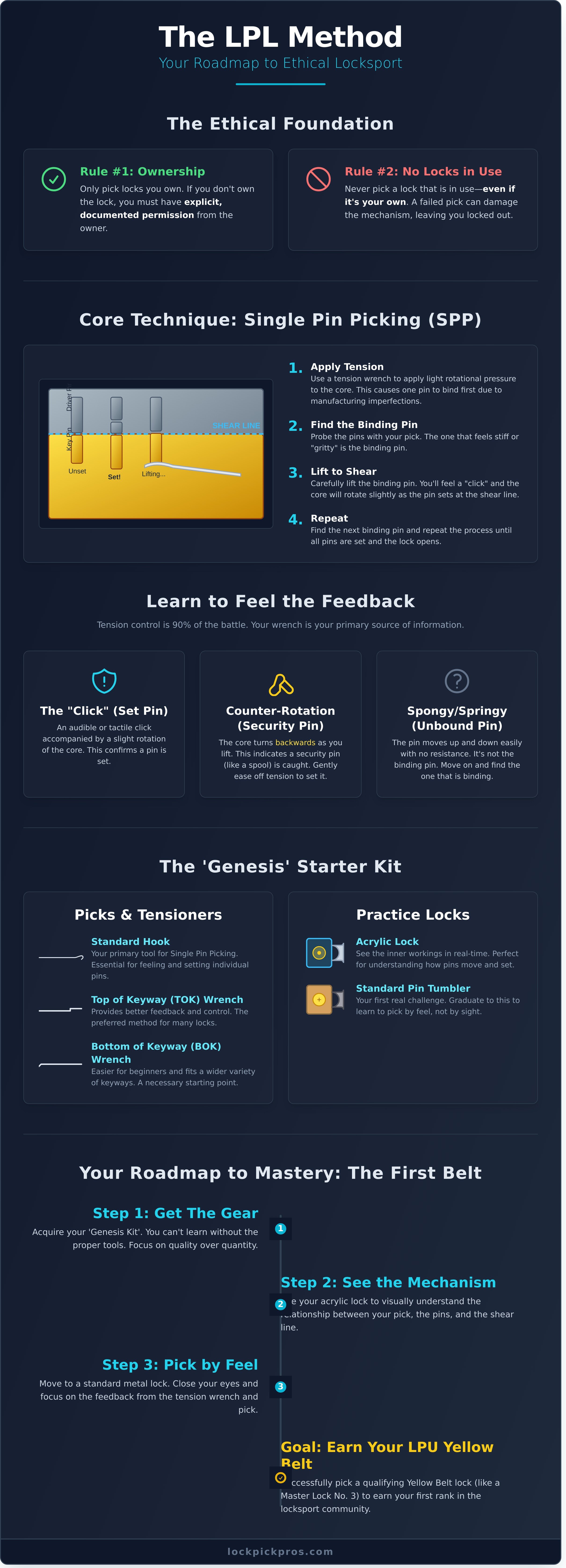
- Rule #1: Only pick locks you own. If you don't own the lock, you must have explicit, documented permission from the owner to pick it.
- Rule #2: Never pick a lock that is in use. Even if it's your own lock on your own front door, don't pick it. A failed pick could damage the lock, leaving you stranded.
Following these rules protects you from legal trouble and preserves the integrity of locksport. They ensure the skill remains a positive force for learning and security improvement, not a tool for malicious intent.
From Viewer to Picker: The Transition
Watching LPL for the first time feels like witnessing a magic trick. The transition from viewer to picker begins when you realize it’s not magic; it’s a learned skill based on interpreting physical feedback. The click of a set pin, the slight rotation of the core into a false set, the feedback from a tension wrench-these are the mechanical clues you learn to feel. By 2026, the resources available to new pickers are better than ever, with precision toolsets and structured learning paths widely accessible.
This journey from observer to creator is a powerful one, applicable to many fields beyond locksport. The same principles of learning, practice, and using the right resources apply whether you're mastering a physical craft or a digital one. For those inspired by this process to explore other skills, resources like livingthehustle.co.uk provide roadmaps for building profitable digital products from scratch.
This philosophy of using the right tools extends to other hands-on hobbies as well. For those interested in outdoor pursuits, for example, you can check out Vse za Lov in Prosti Čas for a wide range of specialized equipment.
Emulating the "LPL style" is an excellent goal for any new picker. It's defined by an economy of motion, deliberate tool selection, and a deep understanding of the lock's internal state. It's about precision, not speed. This methodical approach, which has helped his channel gain millions of subscribers as documented on the LockPickingLawyer Wikipedia page, is what separates skillful picking from random scraping. It’s the difference between guessing and knowing exactly which pin you are lifting to the shear line. This is the first skill you'll need on your journey to earning your LPU belts.
Decoding the LPL Methodology: SPP, Bypassing, and Feedback
Watching the lockpickinglawyer open a high-security lock in under 60 seconds can feel like witnessing a magic trick. But it’s not magic. It's a mastery of fundamental principles, primarily Single Pin Picking (SPP). This technique, the foundation for every LPU belt level, is about methodically defeating a lock one pin at a time. It requires understanding the lock's internal mechanics and, most importantly, interpreting the feedback it gives you through your tools.
The entire goal of SPP is to manipulate pins across the 'shear line'. This is the invisible physical gap between the inner core (the part that turns) and the outer housing. When all the top driver pins are pushed above this line and all the bottom key pins are below it, the core is free to rotate. The lock opens. The challenge is that due to tiny manufacturing imperfections, only one pin will be ready to be picked at any given moment. This is called the binding order, and finding that first binding pin is your entry point.
Mastering the Shear Line and Pin States
Inside each pin chamber sits a stack of two pins: a key pin (bottom) and a driver pin (top). Your pick lifts the key pin, which in turn pushes the driver pin up. With tension applied, the binding driver pin will catch on the edge of the core as you lift it. When the gap between the two pins aligns perfectly with the shear line, you'll feel a slight click and a tiny rotation of the core. That pin is 'set'. You then hunt for the next binding pin and repeat the process. Counter-rotation is the slight backward turn of the core you feel when a spool pin's wide middle section catches the shear line, signaling you need to ease off tension to set it.
Identifying Security Pins: Spools, Serrated, and T-Pins
High-security locks use special 'security pins' to give false feedback. The lockpickinglawyer identifies these by feel within seconds, a skill every ethical picker must develop.
- Spool Pins: These are shaped like a spool of thread. When you lift one, the core will turn dramatically, giving you a 'false set'. This deep rotation feels like you've opened the lock, but it’s a trap. The key is to recognize this, ease off tension, and find the pin causing the counter-rotation to set it properly.
- Serrated Pins: These pins have tiny grooves cut into them. They provide a series of gritty clicks as you lift, designed to trick you into thinking a pin is set. The solution requires a very light touch to distinguish the final, definitive click of a true set from the noise. Differentiating these sounds is much easier with tools that transmit every vibration. A quality foundational pick set can make the difference between feeling the set and getting lost in the static.
Finally, there's the strategic choice: picking vs. bypassing. SPP attacks the pin mechanism itself. A bypass, however, exploits a different vulnerability in the lock's design, like a poorly protected actuator. Choosing to bypass a lock is a strategic decision. This principle of identifying and exploiting vulnerabilities is a core concept in professional security analysis, forming a key part of the University of Cambridge security course where students learn to think like an attacker. LPL often chooses a bypass not because he can't pick the lock, but to demonstrate that even a complex pin mechanism is useless if the lock has a fatal design flaw.
This same security-first mindset applies to the digital world, where understanding online vulnerabilities is just as critical. For those looking to secure their digital footprint, you can discover vpnMentor and its in-depth analysis of modern privacy tools.
The 'Genesis' of a Kit: Essential Tools for the LPL Fan
If you've watched more than a handful of his videos, you'll notice a pattern. The lockpickinglawyer rarely dumps a massive 50-piece kit on his workbench. Instead, he selects a small number of precision tools, often from specialized sets or individual selections that align with his design philosophy. This isn't an accident; it's a philosophy. The belief is that mastery comes from understanding feedback and technique, not from owning every pick profile imaginable. His influence is so profound that the LockPickingLawyer's Wikipedia page details his impact on both the locksport community and the physical security industry. This section breaks down the core components of his preferred toolkit and why they are so effective.
Why Minimalist Sets Win for Beginners
The allure of a huge, cheap pick set is a trap that snares many new pickers. These sets are typically stamped from low-grade metal with poor finishing, leading to tools that damage locks and provide muddy, indistinct feedback. A quality minimalist set, by contrast, often focuses on three foundational profiles: a versatile short hook for single pin picking, a triple peak rake for rapid entry, and a set of flat bar tensioners for superior control.
The Critical Role of Tension Tools
Tension is everything. It's the skill that separates novices from experts, and the tool you use is a massive part of that equation. LPL's success often hinges on his masterful use of Top of Keyway (TOK) tensioning. Using flat pry bars in the top of the keyway, rather than standard "L" wrenches in the bottom (BOK), frees up the entire lower portion of the keyway. This gives your pick maximum room to maneuver, which is essential for navigating tight, paracentric keyways and getting the perfect angle on stubborn pins.
The feedback from a TOK pry bar is also fundamentally different. Because a flat bar doesn't twist like a standard tensioner, the subtle rotation of the core when you set a pin is transmitted directly to your finger. You feel the "click" with much greater clarity. This direct feedback is how you learn to differentiate between a pin setting at the shear line and the counter-rotation from a spool pin.
Finally, let's talk steel. Many of LPL's preferred tools are made from 301 Cold Rolled Steel, a departure from the more common spring steel. While spring steel is flexible and forgiving, it can also absorb and dampen the tiny vibrations that constitute feedback. 301 Cold Rolled is significantly stiffer. It has a high tensile strength of over 270,000 PSI, which means it flexes less under pressure. This rigidity acts like a high-fidelity antenna, transmitting every microscopic movement inside the lock directly to your hand. It's less forgiving of clumsy handling, but the clarity it provides is a game-changer for learning to read a lock.
This focus on high-fidelity feedback from precision instruments is a principle shared by technicians in other complex fields, from microsurgery to drone repair, where experts at firms like Drone Doctor LLC rely on clear diagnostics to service sophisticated aerial equipment.
Your Roadmap to Mastery: The LPU Belt Ranking System
Watching an expert like the lockpickinglawyer open a high-security lock in seconds is inspiring, but that skill isn't magic. It's the result of a structured journey. For the locksport community, that journey is mapped out by the Lock Pickers United (LPU) Belt Ranking System. Think of it as your personal guide from fumbling with your first pick to confidently defeating complex locks. It’s a proven path to build foundational skills, and it starts with your White Belt.
The first steps are all about understanding the basics. You’ll earn your White Belt by picking your first lock, typically a clear acrylic practice lock. From there, you’ll progress through Yellow and Orange Belts by defeating common, real-world locks like the Master Lock No. 3 and basic Abus cylinders. These locks build your feel for tension and setting standard pins. But the real challenge begins at the Green Belt level, where you’ll face your first security pins and truly enter the world of locksport.
Choosing Your First Practice Locks
A clear acrylic lock is an excellent visual aid. It lets you see exactly how the key pins, driver pins, and springs interact. The downside? They provide terrible feedback. Their sloppy manufacturing tolerances mean you won't learn the subtle cues of a real lock. That's why the Master Lock #3 is a classic White Belt lock; it's a real-world product that teaches the fundamentals of binding order. For an even better start, try progressive pinning: load a practice cylinder with just two pins, then add more as you succeed. This isolates the skill of finding and setting the binding pin.
The Green Belt Milestone: Defeating Security Pins
Reaching the Green Belt is the point of no return. It’s where you graduate from opening simple locks to defeating security mechanisms designed to stop you. This is where the hobby gets serious. The undisputed king of Green Belt locks is the American Lock 1100 series. It’s packed with serrated and spool driver pins that provide false feedback. You'll learn to feel the distinct counter-rotation from a spool pin caught at the shear line and the tiny clicks of a serrated pin. Mastering this lock is a huge confidence booster.
To truly understand what you're feeling, you have to gut the lock. Disassembling your American 1100 after picking it allows you to see the exact spool or serrated pin that gave you trouble. This diagnostic skill is non-negotiable for advancing. It connects the physical feedback in your hands to the mechanical reality inside the lock core, cementing your understanding and preparing you for even tougher challenges at the Blue Belt level and beyond.
Ready to tackle your first security pins and see what’s inside? Our Lock Gutting and Re-pinning Kit has the pinning trays and followers you need to safely disassemble and reassemble your first Green Belt lock.
Building Your Professional Legacy with Lockpick Pros
Watching the lockpickinglawyer demonstrates a level of mastery that comes from thousands of hours of dedicated practice. That journey from beginner to expert isn't about collecting a massive pile of tools; it's about building a curated kit of high-quality, no-fluff implements that teach you something with every click. At Lockpick Pros, we focus exclusively on these educational tools. We believe that serious pickers deserve gear that provides crisp, unambiguous feedback, helping you learn to read a lock's internal state instead of just guessing.
Your toolset should evolve with your skill. A picker aiming for an LPU Yellow Belt needs a solid short hook and a tensioner. But if your goal is a Green Belt, you'll need a deeper hook and top-of-the-keyway tensioners to tackle the required spool and serrated pins. The difference is quality steel. Cheap tools made from stamped metal will bend and deform under the subtle pressure needed to set a spool pin, giving you "mushy" feedback that hides what's happening at the shear line. Our tools prevent this, ensuring you feel the counter-rotation of a spool pin, not the flex of your pick.
Skill isn't built in a vacuum. The locksport community is one of the most welcoming and helpful hobby groups you can find. To connect with other ethical lockpickers, start by searching for local chapters of TOOOL (The Open Organisation Of Lockpickers) in your area. You can also join vibrant online communities like the Lock Pickers United or the Lockpicking Subreddit Discord servers, where you can ask questions, share your progress, and get advice from seasoned experts.
Selecting the Right Beginner Set for Your Journey
Getting started correctly is critical. Our Lockpick Pros Beginner Sets are specifically designed for LPU compliance, giving you the foundational tools needed to earn your first belts. We use high-yield 301 stainless steel because it offers the perfect balance of strength and flexibility, transmitting maximum feedback from the pins to your fingertips. As you progress toward security pins, this foundational kit is easily customized with specialized hooks and tensioners for more complex challenges.
Next Steps: Beyond the YouTube Screen
True skill is built with hands-on practice. It's time to take what you've learned and apply it. Your next steps are simple but essential for real progress in the locksport world. Reaching a skill level that feels effortless, like you see from the lockpickinglawyer, is a journey of a thousand tiny clicks. Embrace the process, stay persistent, and you'll get there.
- Set Up a Practice Station: You don't need much. A simple pinning tray to hold pins, a non-slip mat to work on, and good, direct lighting will make your practice sessions more efficient and enjoyable.
- Document Your Picks: To earn LPU belts, you'll need to verify your opens. Get comfortable recording a video of you picking a lock from start to finish, including gutting it to show the internal pins. This is a core part of the community verification process.
- Stay Patient: Every picker hits a wall. The key is to see it not as a failure, but as a puzzle. Take a break, try a different tensioner, or ask the community for advice. Every lock you open teaches you something new.
From Viewer to Picker: Start Your Locksport Journey
The influence of the lockpickinglawyer proves that understanding a lock's weaknesses is the first step toward better security. His methodical approach to single pin picking and exploiting design flaws provides a clear blueprint for any aspiring picker. You've seen how this discipline, structured by the LPU belt ranking system, creates a tangible path from novice to expert.
Watching is one thing. Doing is another. You don't need a massive collection to start; you just need the right foundation. It's time to turn that inspiration into tangible skill and feel the satisfaction of your first open.
Start your journey to Green Belt with our curated Beginner Kits. Each set is trusted by the LPU community and features tools precisely crafted from high-yield 301 stainless steel for maximum feedback. Every kit also includes our detailed technical guides to get you picking correctly, right from day one. The first click of an open shackle is a feeling you won't forget.
Frequently Asked Questions
Is it legal to buy and own lockpicking tools in 2026?
Yes, owning lockpicking tools is legal in most U.S. states, and we don't anticipate major changes by 2026. However, legality often depends on intent. Carrying picks into a place you don't belong can be considered "prima facie evidence" of criminal intent. As ethical pickers, we only use our tools on locks we own or have explicit permission to pick. Always check your specific state and local laws, as they are subject to change and vary significantly by location.
What is the specific set of picks the LockPickingLawyer uses most often?
The LockPickingLawyer primarily uses tools he designed with Covert Instruments. While he uses many prototypes, his go-to set for single pin picking is the Genesis Set. It contains the essential hook profiles and tensioners he relies on. For everyday carry, he is famous for using the Covert Companion, a versatile multi-tool that includes a turning tool and several pick profiles. He has consistently used these tools in hundreds of videos since their release around 2020.
Can I really learn to pick a lock just by watching YouTube videos?
Yes, you can absolutely learn the theory and techniques from videos, but you must pair that knowledge with hands-on practice. Videos are fantastic for understanding concepts like setting a pin to the shear line or identifying a false set. But they can't teach you the feel of the lock. You need a good beginner pick set and a clear practice lock to translate what you see on screen into the subtle feedback you feel through your tools.
What is the 'Genesis Set' and is it good for beginners?
The Genesis Set is a foundational lock pick set developed by the LockPickingLawyer and Covert Instruments. It's specifically designed to be an ideal starting point for beginners. Unlike cheap sets filled with useless rake profiles, the Genesis Set includes four essential hook profiles and six different tensioners, including various Top of Keyway (TOK) options. This gives a new picker every core tool they need to learn single pin picking properly without any confusing filler.
How do I know if a lock has security pins like spools or serrated pins?
You can identify security pins by the unique feedback they provide. A spool pin will cause a "false set," a deep rotation of the core that feels like you've opened it, but it's a trap. To defeat it, you'll need to apply counter-rotation. Serrated pins feel completely different; they create a gritty, sandy sensation as you lift them. You'll hear multiple tiny clicks as the serrations pass the shear line, requiring very precise tension control.
What is the LPU Belt Ranking system and how do I join?
The Lock Pickers United (LPU) Belt Ranking system is a community-based skill progression framework for locksport, modeled after martial arts. You advance from White to Black Belt by picking and documenting progressively harder locks from an official list. To join, you don't need to pay anything. Just find the LPU subreddit or Discord server, read the rules, and submit a video of you picking a qualifying lock to earn your first belt.
Why does the LockPickingLawyer always use Top of Keyway (TOK) tension?
He almost exclusively uses Top of Keyway (TOK) tension because it offers superior feedback and control. Applying force to the top of the core provides more direct rotational feedback, making it easier to feel the subtle movements of pins and the core. TOK also leaves the entire bottom half of the keyway unobstructed, giving your pick maximum room to maneuver. This is a massive advantage in locks with restrictive or paracentric keyways where a BOK tensioner would get in the way.
Where can I buy ethical lockpicking tools that won't break?
You should always buy from reputable retailers dedicated to the locksport community. High-quality tools are typically made from specific materials like 301 High Yield steel, which offers the right balance of flexibility and strength. Avoid generic, mass-produced sets from sites like Amazon or Wish, as they are often made from poor-quality stamped metal and break easily. Brands like Sparrows, Peterson, and Covert Instruments are trusted by pickers for their durable and well-designed tools.