

Picking Locks with a Lock Pick Set: Your First Guide (2026)

You’ve just opened your first lock pick set. The polished steel gleams, a dozen different tools promising a new skill, but that excitement can quickly turn to confusion. Which one is the hook? What does this weirdly shaped one do? It’s the most common hurdle for new pickers, but we're here to clear the path. Forget the entire collection for now. The truth about successfully picking locks with a lock pick set is that your journey into locksport begins with mastering just two essential tools.
This is your foundational, no-fluff guide. We're going to ignore the noise and focus on the only two pieces you need: the tension wrench and the short hook. We will walk you through the core principles of a pin-tumbler lock, how to apply proper tension, and how to feel for that first binding pin. By the end of this article, you won't just understand the theory-you'll have a clear, actionable plan to get that first satisfying *click* and open your first lock. Let's get started.
Key Takeaways
- Overcome the initial confusion of a new kit by learning the only two tools you actually need for picking locks with lock pick set: the hook and the tensioner.
- Discover the fundamental principle of tension control, which is the secret to setting individual pins and successfully picking locks with lock pick set.
- Master the foundational technique of Single Pin Picking (SPP) with our clear, step-by-step process for picking locks with lock pick set.
- Understand why starting with a practice lock is the most effective way to build muscle memory and visualize what's happening inside the core.
Unboxing Your Set: From Confusion to Clarity
You’ve opened the case, and a dozen pieces of gleaming, mysterious steel spill out. It’s a common feeling for every new picker: a mix of excitement and intimidation. What do all these hooks, rakes, and strange bent bars even do? Relax. The biggest secret in locksport is that you can ignore almost all of them for now. Welcome to a hobby with a rich and fascinating past. While the history of lock picking is deep, your starting point is wonderfully simple.
The path to mastery isn't about learning 20 tools at once. It's about deeply understanding two. By setting everything else aside, you build a solid foundation. This focused approach is the fastest way to get your first open and truly understand what’s happening inside the lock.
Why You Should Ignore Rakes (For Now)
In that collection of tools, you'll find picks with bumpy, wave-like profiles. These are rakes. Raking is a technique designed for speed, scrubbing the pins to get a fast, but imprecise, open. While effective in some cases, it teaches you very little about the lock’s mechanism. Learning Single Pin Picking (SPP) first is like learning your musical scales-it’s the fundamental skill that makes everything else possible.
The Two-Tool Rule for Beginners
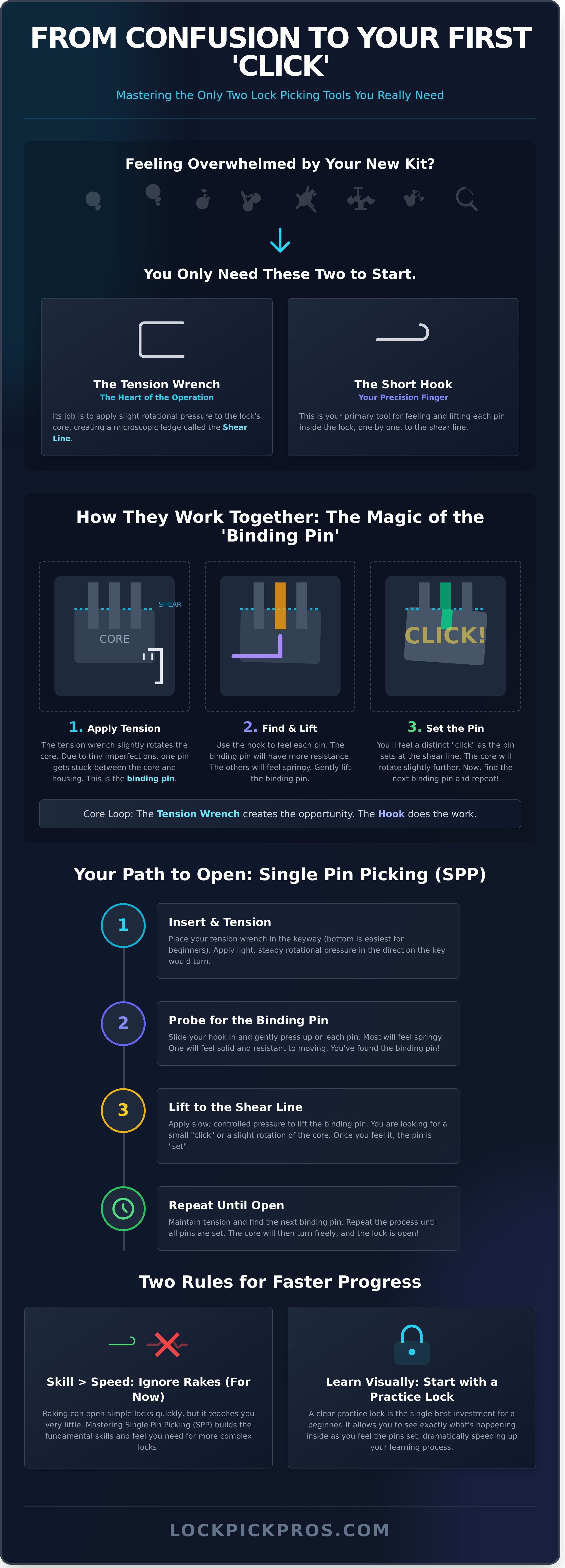
Your journey into picking locks with a lock pick set starts here. Isolate just two tools from your kit: a tension wrench (also called a tensor) and a standard hook. That’s it. Set everything else aside. Think of it this way:
- The Tension Wrench is the hand applying slight turning pressure to the lock core, just as you would with a key.
- The Hook is the finger that reaches in to feel and set each pin individually, acting like the bitting on a key.
This simple, two-tool focus prevents frustration and dramatically accelerates your learning. You’re not just opening locks; you’re learning their language.
The Only Two Tools You Need: The Hook & The Tensioner
Forget complex kits with dozens of mysterious tools. To start your journey in Single Pin Picking (SPP), you only need two fundamental instruments: a tension wrench and a standard hook. These tools are extensions of your senses, designed for finesse, not force. Successful picking locks with a lock pick set is about feeling the subtle feedback from inside the lock, not overpowering its mechanics.
Mastering the Tension Wrench
The tension wrench, or tensioner, is the heart of the operation. Its job is to apply slight rotational pressure to the lock's core, mimicking the turn of a key. This pressure is critical because it intentionally misaligns the pin chambers, creating what we call the shear line. This is the tiny gap between the core and the housing where the pins must align for the lock to open. For a deeper mechanical breakdown, the U.S. DOJ guide to lock mechanisms provides an excellent foundational overview. You'll encounter two main styles:
- Top of the Keyway (TOK): Offers superior control and feedback but can be tricky for newcomers.
- Bottom of the Keyway (BOK): Simpler to use and commonly included in beginner kits. Start here.
Apply light to medium pressure-just enough to feel the pins, similar to resting your finger on a keyboard key right before you press it down.
Understanding the Standard Hook
Your other essential tool is the standard hook, often called a 'short hook'. Look for the pick in your kit with a simple, small, upward-curving tip. Its clean, minimal shape makes it the most versatile and precise tool for learning to feel and lift individual pins. There are no extra frills to get in the way. Hold it with a light, sensitive grip, much like you would a pencil. This allows the subtle clicks and vibrations from the pins to travel up the pick shaft to your fingertips.
How They Work Together (The 'Binding Pin')
Here’s where the magic happens. When you apply tension, tiny manufacturing imperfections cause one pin to get stuck between the core and the housing before the others. This is the binding pin, and it's your first target. Use your hook to gently probe each pin stack, feeling for the one that has the most resistance-that's your binding pin. The other pins should feel springy and loose. Once you find it, lift it slowly until you feel a tiny 'click' and a slight rotation in the core. That's the pin setting at the shear line.
This interaction is the core loop of SPP. Remember this: The tension wrench finds the binding pin; the hook lifts it. You'll repeat this process, finding and setting each binding pin one by one, until the lock opens. This is the foundational skill for anyone serious about picking locks with a lock pick set.
The Core Technique: Single Pin Picking (SPP) Step-by-Step
Single Pin Picking (SPP) is the foundation of high-skill locksport. It’s not about raking or luck; it’s a direct conversation with the lock's internal mechanism. You are feeling each pin stack individually and setting it at the shear line. This methodical approach is essential for picking locks with a lock pick set, especially when you encounter security pins. The physics behind this process is fascinating, and for those who want to dive deep, the legendary MIT's guide to single-pin picking breaks it down in incredible detail. Let's get started.
Step-by-Step Guide to Your First Pick
This is the core loop of SPP. Every complex pick comes back to these four fundamental steps. Patience is your greatest tool here.
- 1. Apply Tension: Insert your tension wrench into the bottom of the keyway (BOK). Apply light, steady rotational pressure in the direction you'd turn the key. Too much tension will bind every pin; too little won't be enough to hold a set pin. Find the "heavy feather" sweet spot.
- 2. Find the Binding Pin: Slide your hook pick to the back of the lock. Gently test each pin by lifting it. Most will feel springy and move easily. Due to tiny manufacturing imperfections, one pin will be slightly misaligned and will bind first. It will feel solid and resist you-this is your target.
- 3. Set the Pin: Maintain your tension and apply slow, increasing pressure only to the binding pin. You will feel and often hear a subtle "click" as the driver pin clears the shear line. At the same moment, the core will rotate a tiny amount. That's a "set."
- 4. Repeat the Process: With the first pin set, a new pin will now be the binding pin. Your job is to hunt for it. Probe each pin again until you find the one that's binding now. Set it, and repeat this cycle until the final pin sets and the lock pops open.
Feeling for Feedback: Clicks, Sets, and Rotations
Effective SPP is all about interpreting what you feel. That faint "click" and slight core rotation is your confirmation that a standard pin is set. Soon, however, you'll encounter security pins. A spool pin, for example, will give you a false set-a much deeper core rotation that feels like a huge win. But when you try to find the next binding pin, everything will feel loose. This is the spool's trap. To escape it, you must learn to manage counter-rotation. As you lift the spool pin, the core will try to rotate backward, pushing your tension wrench against your finger. You must ease off the tension just enough to allow this to happen while continuing to lift the pin. Once it clears the tight spot, it will set with a satisfying click.
Putting It All Together: Using a Practice Lock
You have the theory and the tools. Now it's time to develop the feel. Before you even think about the lock on your front door, you need a dedicated training tool. This is non-negotiable for every ethical lockpicker. Practicing on a lock you rely on is a recipe for disaster. Practice locks are designed to accelerate your learning, build confidence, and make the invisible, visible.
Your first goal is simple and achievable: learn to consistently open a 2-pin or 3-pin lock. Don't rush. The muscle memory you build here is the foundation for everything that comes next in your journey of picking locks with lock pick set. Two types of practice locks are essential for getting this right.
Cutaway Locks: Seeing is Believing
A cutaway lock is the single best starting point for a new picker. It has a window milled into the side of the cylinder, exposing the inner workings. You can see the key pins, driver pins, springs, and the all-important shear line. As you manipulate a pin, you can visually confirm when it's set correctly. This direct feedback connects the subtle click you feel through your pick with the physical reality of what's happening inside the lock, training your hands and mind simultaneously.
Progressive Locks: Leveling Up Your Skill
Once you understand the mechanics, it's time to rely on feel alone. Progressive locks allow you to increase the difficulty as your skill improves. They are designed to be re-pinned, meaning you can start with just two pin stacks. Once you can open that configuration reliably, you add a third, then a fourth, and so on. This method creates a structured learning curve, preventing the frustration that often stops new pickers in their tracks.
Building your skill with these tools is the fastest way to advance in locksport. Ready to practice? Check out our beginner-friendly practice locks and start building that foundational skill today.
What Are All Those Other Picks For?
You've now built a solid foundation with a hook and a tension wrench-the heart of Single Pin Picking. But what about the other oddly shaped tools in your kit? Those aren't just filler. They are specialized instruments, primarily rakes and versatile hybrid picks like the half-diamond, designed for specific tasks.
Unlike a hook that isolates individual pins, these tools are built for speed over precision. A half-diamond, for example, can be used to pick single pins in a wide-open keyway or act as a makeshift rake. Rakes, however, are designed exclusively to manipulate multiple pins at once.
An Introduction to Raking
Raking is a kinetic attack that attempts to bounce the pin stacks to the shear line all at once. It's a lower-skill, faster method that works well on simple locks without security pins. The two most common techniques are:
- Rocking: Using a rake like a Bogota or Snake, you apply light tension and gently "rock" or scrub the tool over the pins.
- Zipping: You insert a rake to the back of the keyway, apply tension, and quickly "zip" it out, letting the pick's profile hit all the pins on the way out.
While a great trick for opening basic locks, raking will fail against the security pins you'll encounter as you advance. True skill in picking locks with a lock pick set comes from mastering SPP.
Your Next Steps in Locksport
Our best advice? Stick with your hook and practice lock. Master SPP until you can open it consistently without looking. Feel every click and every bit of feedback from the core. This foundational skill is what separates hobbyists from true locksport enthusiasts.
When you're ready for a structured challenge, look into the locksport belt ranking system. It's a fantastic roadmap that guides you from beginner locks to high-security challenges. At Lockpick Pros, we see ourselves as your partner on this journey, from your first clear padlock to the most complex tools in your kit.
Mastered the basics? Explore our advanced lock pick sets and prepare for your next belt.
Unlock Your Potential
You now have the blueprint. This guide has shown that the exciting journey of picking locks with lock pick set is less about magic and more about patience, practice, and understanding the mechanics inside the keyway. By mastering the delicate relationship between your tensioner and your hook, you can learn to feel for that first binding pin and set it to the shear line. That's the core skill, and you're ready to start building it.
Having quality gear makes all the difference. We're here to equip ethical lockpickers and locksport hobbyists with the precision tools needed for skill refinement. Every set we offer is designed to give you the clear feedback required to learn effectively. With our satisfaction guarantee and free shipping on qualifying orders, you can invest in your new hobby with total confidence. Start your locksport journey. Shop our Beginner Lock Pick Sets!
Welcome to the community. The lock is waiting.
Frequently Asked Questions
Is it hard to learn to pick locks with a lock pick set?
Like any new skill, it takes practice, but it's more about patience and developing a feel for the lock's internals than being difficult. The initial challenge is learning to coordinate light tension with precise pick movements. With a good beginner set and a clear practice lock, most people can get their first open in a few hours. The journey of picking locks with a lock pick set is incredibly rewarding as you progress to more complex challenges.
What is the best first lock to practice picking on?
Start with a clear acrylic practice lock. This allows you to see exactly how the pins, springs, and plug interact as you manipulate them. Once you understand the mechanics visually, move on to a simple 3 or 4-pin padlock, like a Master Lock No. 3. These locks typically contain standard pins, providing a perfect foundation for learning tension control and how to set pins to the shear line before tackling security pins.
Can picking a lock damage or break it?
While possible, it is very unlikely if you use the proper technique. Damage almost always results from using excessive force, such as bending the tension wrench or aggressively jamming a pick, which can break the pick off in the keyway or damage internal components. Locksport is a finesse-based skill. By applying light, controlled tension and gentle pick movements, you can practice on a lock thousands of time without causing any harm to its function.
How long does it take to learn how to pick a lock?
This varies for every new picker! Some may get their first simple lock open in 15 minutes, while for others it might take a few dedicated practice sessions. The key isn't speed, but understanding the feedback the lock is giving you. Mastering the fundamentals of single pin picking on basic locks can take a few weeks of consistent practice. From there, the journey to defeating high-security locks is a continuous process of skill refinement.
What's the difference between a hook and a rake in a lock pick set?
A hook is a precision tool designed for Single Pin Picking (SPP). You use it to locate and set each pin individually at the shear line, which is the core skill of locksport. A rake is designed for a faster, less precise attack called raking, where you rapidly scrub the tool in and out of the keyway to bounce multiple pins to the shear line at once. While raking can be effective on simple locks, hooks are essential for defeating security pins and advancing in the sport.
Is it legal to own and use a lock pick set?
Legality varies by state and country, so you must check your local laws. In most parts of the United States, it is perfectly legal to own lock picks. However, the laws often focus on intent. Possessing picks with the intent to commit a crime is illegal ("possession of burglary tools"). As an ethical locksport hobbyist, you should only ever be picking locks that you own and for which you have permission to pick, never locks that are in use.
Which pick should I use for a standard front door lock?
For most residential front door locks, like a standard Schlage or Kwikset, your most valuable tool is a short hook. These locks often contain security pins like spools, which require you to set pins one by one. A short hook provides the excellent feedback and control needed to navigate a keyway, identify pin states, and manage the counter-rotation from spool pins. It is the foundational pick for mastering single pin picking on real-world locks.