

How to Choose a Lock Picking Set: The Ultimate 2026 Buyer's Guide

Staring at a wall of lock picks can feel like trying to read a foreign language. Hooks, rakes, tensioners-the jargon and sheer number of options are enough to intimidate anyone new to locksport. You want to start picking, but you’re worried about wasting money on a cheap, flimsy kit that will only lead to frustration. Choosing your first lock picking set is a critical step, and getting it right is the key to building a solid foundation for your skills.
This guide cuts through the noise. We're not just going to show you lists of tools; we’re going to teach you why certain picks and tension wrenches are essential for a beginner. You'll learn to identify quality steel, understand the core tools needed to tackle your first pin-tumbler locks, and confidently select a set that will serve you well on your path to earning your first LPU belt. It’s time to stop guessing and start your locksport journey with the right gear in your hands.
Key Takeaways
- Learn to spot the difference between a high-piece-count "filler" kit and a professional-grade set built for feedback and durability.
- Find the right lock picking set for your experience by aligning kit types with the locksport belt ranking system, from absolute beginner to advanced picker.
- Discover which foundational picks and tension wrenches are essential for tackling common beginner locks and security pins.
- Move beyond guesswork and learn a clear framework for choosing tools that support your specific locksport goals and ensure a successful start.
Anatomy of a Lock Pick Set: What's Actually in the Case?
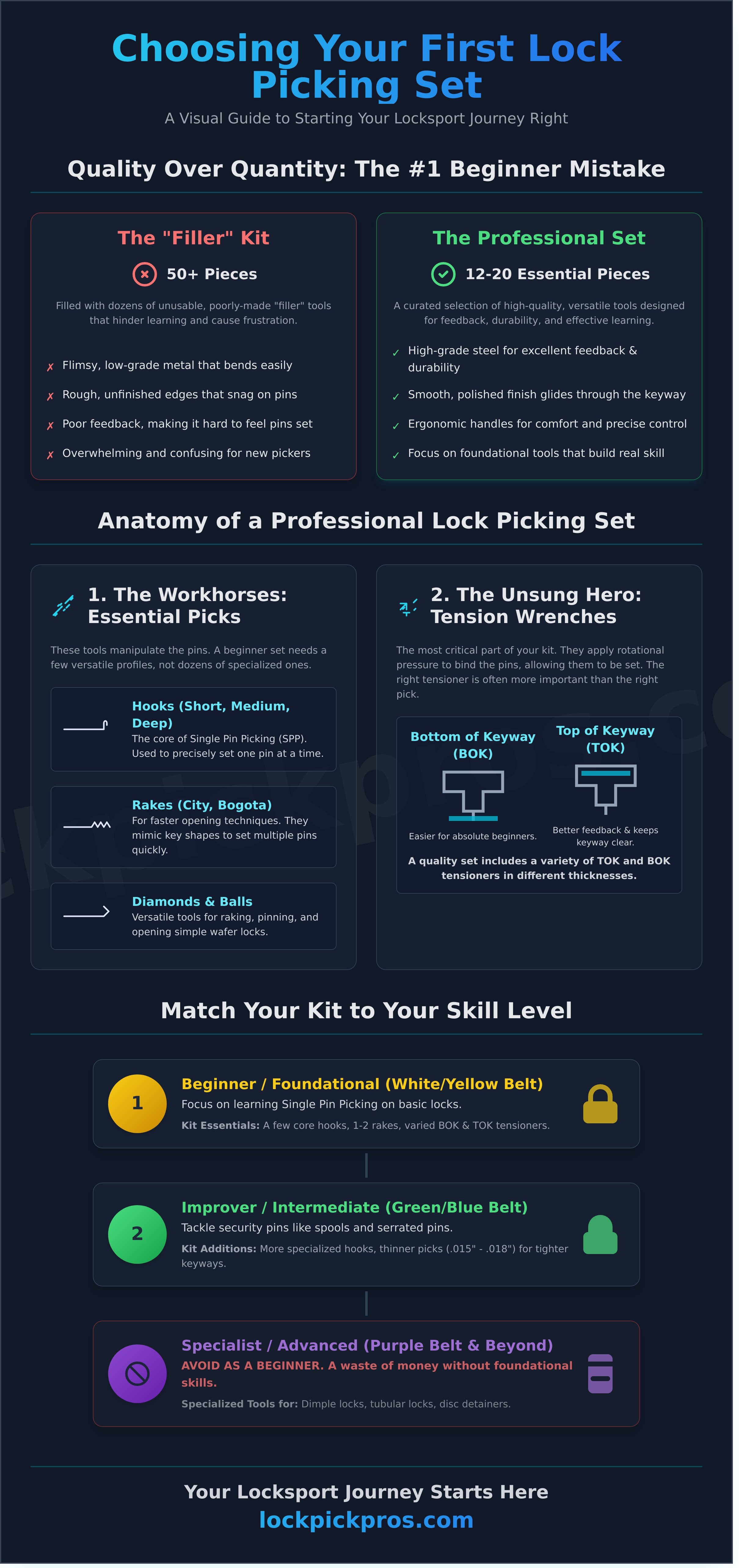
When you're starting out, it's easy to get mesmerized by a 50-piece kit promising a tool for every situation. But here’s a core truth of locksport: a high piece count often means a high amount of filler. A great beginner lock picking set isn't about quantity; it's about the quality and versatility of its foundational tools. Understanding the function of each piece is the first step in telling a precision toolkit from a cheap pile of metal.
Every effective kit is built on three core components: the picks themselves, the tension wrenches, and the case that holds them. Let's break down what you actually need.
The Workhorses: Essential Pick Profiles
These are the tools that interact directly with the lock's pins. A solid beginner set will focus on these essentials:
- Hooks: The heart and soul of Single Pin Picking (SPP). A short hook is your go-to for most standard locks, while medium and deep hooks give you the reach needed to set pins in the back of a keyway without oversetting the ones in front.
- Rakes: Designed for faster, less precise opening techniques. A city rake mimics the shape of a common key bitting to quickly set standard pins, while a Bogota rake uses a more aggressive pattern to bounce pins to the shear line.
- Diamonds and Balls: More specialized, but useful. A half-diamond is great for pinning, raking, and even opening wafer locks. A ball pick is used almost exclusively for wafer locks, which you'll find on desks and cabinets.
The Unsung Hero: Why Tension Wrenches Are Critical
Picks get all the glory, but the tension wrench does the real work. Its job is to apply slight rotational pressure to the lock's core. This creates a microscopic ledge on the pins, allowing them to bind and "set" at the shear line. This fundamental principle is the basis of nearly all lock picking and is non-negotiable for success.
Tensioners come in two main styles: Top of Keyway (TOK) and Bottom of Keyway (BOK). BOK is often easier for absolute beginners, but TOK provides better feedback and keeps the keyway clear for your pick. A quality lock picking set will include a variety of tensioners in different thicknesses. Having the right tension tool for the keyway is often more critical than having the perfect pick.
Finding Your Starting Point: Sets for Every Skill Level
The best lock picking set for you depends entirely on your current skill and future goals in locksport. It’s tempting to grab a massive 100-piece kit, believing more tools equal more success. This is a classic beginner's mistake. True skill comes from mastering the fundamentals, not from owning a tool for every theoretical situation. Understanding the core mechanics, as detailed in resources like the classic MIT Guide to Lock Picking, is far more valuable than having a dozen picks you don't know how to use. We'll align our recommended sets with the locksport belt ranking system to give you a clear path from novice to expert.
Beginner & Foundational Sets (White/Yellow Belt)
A foundational lock picking set is designed for one primary purpose: learning single pin picking (SPP) on basic pin-tumbler locks. These kits focus on quality over quantity, typically including:
- A few essential hooks (short, medium, deep)
- A couple of versatile rakes (like a Bogota or city rake)
- A varied selection of Bottom of Keyway (BOK) and Top of Keyway (TOK) tensioners
This is the perfect toolkit to pair with clear practice locks and simple padlocks to build muscle memory and feel for the pins.
Improver & Intermediate Kits (Green/Blue Belt)
Once you've mastered the basics, you're ready to tackle security pins like spools, serrated, and mushroom pins. Improver kits are built for this challenge. They expand on a foundational set by adding more specialized hook profiles for better feedback and control inside complex keyways. You will often find thinner picks (.015" - .018") included, which are essential for navigating the tighter tolerances of higher-quality locks.
Specialist & Advanced Sets (Purple Belt & Beyond)
These sets are purpose-built for high-security locks and are not for beginners. They contain highly specialized tools for mechanisms like dimple locks, tubular locks, and disc detainers. Purchasing one of these too early is a waste of money, as they require a deep, practical understanding of lock mechanics to be used effectively. Focus on mastering pin-tumbler locks before venturing into these advanced disciplines.
Quality Over Quantity: 4 Hallmarks of a Professional-Grade Set
When you're choosing your first lock picking set, it's easy to get drawn in by kits boasting 50+ pieces for a low price. Let's be clear: more is not better. A well-made 12-piece professional set will outperform a massive collection of poorly made, mystery-metal tools every single time. Investing in quality from the start is the difference between a frustrating toy and a precision instrument. It prevents bent picks, speeds up your learning, and helps you truly feel what's happening inside the lock.
1. The Steel: Material & Thickness
The heart of any pick is its steel. Look for tools made from high-yield stainless steel, like 301 High Yield. This material offers the perfect blend of strength and flexibility, allowing it to navigate the keyway and lift pins without permanently bending. For beginners, a standard thickness of around 0.025 inches is ideal. It’s durable enough to withstand early mistakes, whereas cheap, flimsy steel will bend or snap, ending your practice session instantly.
2. The Finish: Smoothness is Function
A pick's finish is about function, not just looks. A professional-grade tool will have a smooth, tumbled, and polished surface. This allows it to glide effortlessly over and between the pins, transmitting clear feedback directly to your hand. In contrast, cheap, stamped picks have rough edges that grind against the pins. This creates "gritty" noise that masks the subtle clicks you need to feel, and can even damage the internal components of a practice lock.
3. The Handles: Comfort & Control
Comfort is key for control. Ergonomic handles allow for longer, pain-free practice sessions, but their real benefit is feedback. A quality handle transmits the subtle movements of the pins far more effectively than bare, thin metal. Even professionals, like those in organizations such as The Society of Professional Locksmiths, rely on tools that provide both comfort and precise control for daily use. Whether molded plastic or a simple dipped coating, a good handle turns the pick from a piece of metal into an extension of your hand.
Your First 'Open': Matching a Kit to Beginner-Friendly Locks
A quality lock pick set is only half the battle; the other half is having the right lock to practice on. This is where theory meets steel. By pairing your new tools with locks designed for learning, you set yourself up for success from the very first attempt. The goal is simple: get those early wins, build your confidence, and feel that incredible 'click' of an open lock that gets every picker hooked.
Let's match the right tools to the right challenge.
For Clear Practice Locks & Cutaways
These transparent locks are your training wheels. They are designed to give you a clear view of the internal mechanics, letting you see exactly how the key pins lift the driver pins to the shear line. This visual feedback is invaluable for connecting what you see to what you will eventually only feel. For these locks, a foundational set with a couple of essential hooks and a tension wrench is all you need to master the basic principles of pin-tumbler locks.
For Your First Real-World Padlocks (e.g., Master Lock No. 3)
Once you understand the mechanics, it's time to grab a common padlock like a Master Lock No. 3. These locks are perfect for beginners because their manufacturing tolerances are very forgiving, meaning the internal parts are a bit "sloppy." This makes them much easier to pick than high-security locks.
A good starter lock picking set will make short work of these. You'll want:
- A Medium Hook: This is your go-to for Single Pin Picking (SPP) these simple locks.
- A BOK Tensioner: A simple Bottom of the Keyway tension wrench provides perfect control.
- A City Rake: Rakes are highly effective on locks with poor tolerances and can give you a quick, satisfying open.
Starting with the right gear for the right challenge is the fastest way to build real skill. Having the right tools isn't just about convenience; it’s about building a solid foundation for your entire locksport journey.
Lockpick Pros' Recommendations for Your Locksport Journey
Understanding the theory behind a good lock picking set is the first step. Now, let's put that knowledge into action with tools built for success. We don't just sell picks; we design them with direct input from the locksport community. Our kits are curated to align perfectly with the skill progression from beginner to advanced, ensuring you have the right tool for every challenge without paying for filler you'll never use. Start your journey with precision tools you can trust.
For the Absolute Beginner: The 'Foundational' Set
Consider this your entry ticket to the world of locksport. Our foundational kits are designed to take you from your first open all the way through your White and Yellow Belt challenges. Inside, you'll find the essentials for learning proper feedback and technique:
- A core selection of versatile hooks (like a short and medium hook).
- Essential top-of-the-keyway and bottom-of-the-keyway tensioners.
This streamlined lock picking set is the perfect companion for clear practice locks and basic padlocks, giving you exactly what you need to build a solid skill base. No fluff, just function.
Ready to start picking? Shop our Beginner Lock Pick Sets.
Ready to Level Up? Our 'Expert-Level' Kits
When you can consistently open standard pin tumblers and are ready to tackle security pins-the key to earning your Green Belt-it’s time to upgrade. Tackling the counter-rotation from a spool pin or the subtle clicks of a serrated pin requires more specialized tools.
Our expert-level kits expand on the fundamentals by adding specialized hooks for tricky bitting and thinner profiles (like 0.018" or 0.015") for more restrictive keyways. This isn't just about having more tools; it's about having the right tools to defeat more complex locks and continue your growth in the sport.
This is the logical next step in your locksport journey. Explore Advanced Sets for Your Next Challenge.
Your Locksport Journey Starts with the Right Tools
Stepping into the world of locksport is an exciting challenge, and it all begins with the tools in your hand. As we've covered, selecting the right gear isn't about having the most picks; it's about having the right ones. Always prioritize quality materials over sheer quantity, and ensure the tension wrenches in your kit give you the control and feedback you need to feel what's happening inside the lock. This is the foundation for building real skill.
Choosing the best lock picking set for a beginner means pairing it with locks you can realistically open, turning potential frustration into that rewarding first 'click'. You're not just buying tools; you're investing in your own progress and a fascinating new hobby.
Ready to make that investment? Our sets are engineered by ethical lockpickers who live and breathe this sport. Each tool is crafted from high-quality, high-yield steel to last for years of practice. With free shipping on qualifying orders, getting started has never been easier. The pins are set. The tension is right. All that's left is for you to begin.
Find the perfect set to start your locksport journey.
Frequently Asked Questions
How many picks does a beginner really need in a set?
Forget the massive 80-piece sets; quality always beats quantity. A beginner thrives with just a few foundational tools. You need a good short hook, a medium hook for varied keyways, and perhaps a rake for fast opens on simple locks. Most importantly, you need a solid variety of tension wrenches. A well-curated beginner set of 5-10 high-quality, well-finished tools will serve you far better than a case full of useless filler profiles you'll never touch. To keep your tools organized, many pickers use professional marking supplies from PoscART to color-code their handles for quick identification.
What's the main difference between a cheap Amazon lock pick set and a professional one?
The difference is feedback and durability. Cheap sets use poor-quality, stamped metal that bends easily and has rough edges that get stuck in the keyway. This poor finish deadens the subtle feedback from the pins, making it impossible to feel what's happening inside the lock. A professional lock picking set is made from high-yield steel with a smooth, polished finish, allowing it to transmit every tiny click and rotation needed to learn and open locks consistently.
Can I just buy individual picks instead of a set?
Absolutely! This is a fantastic way for a dedicated beginner to build a custom, high-quality kit from day one. To start, we recommend purchasing three core tools: a quality short hook in a standard thickness, a Top of the Keyway (TOK) tensioner, and a Bottom of the Keyway (BOK) tensioner. This minimalist approach forces you to master Single Pin Picking (SPP), the most crucial skill in the sport of lockpicking, without the distraction of unnecessary tools.
Are lock pick sets with a 'credit card' or 'jackknife' form factor good for beginners?
While they look cool, these novelty sets are not recommended for learning. Their small, awkward form factor provides terrible grip and almost no feedback, which are the two most critical things you need when starting out. They are designed for emergency use or as a gimmick, not for the focused practice required to develop real skill. To properly learn tension control and how to set pins, you need the control and feedback of full-size, individual tools.
What is the best first lock to buy with my new lock picking set?
Start with a clear practice lock. This allows you to see how the pins move and interact with your pick, connecting what you feel to what is actually happening. Once you understand the mechanics, move on to a real lock like a Master Lock No. 3 or a similar 4-pin padlock with no security pins. This is a perfect first challenge that directly corresponds to earning your White or Yellow Belt in the locksport community. Opening it is a huge confidence booster!
Do I need a license to buy or own a lock picking set?
In most jurisdictions in the USA, Canada, and Europe, it is legal for hobbyists and professionals to own lock picks. However, laws vary significantly by state and country, especially concerning carrying tools. As an ethical lockpicker, you must know your local regulations. The key is intent; never carry picks if there could be any suspicion of intent to commit a crime. Always use your tools on locks you own, for sport and education only.
What is the most important tool in a lock pick set?
Without a doubt, the most important tool is the tension wrench. Many beginners focus on the pick, but proper tension is everything. The tension wrench is what creates the tiny ledge on the shear line that allows you to set the pins. It is also your primary source of feedback, telling you when a pin is binding or when the core has entered a false set. A great collection of tensioners, both TOK and BOK, is far more valuable than dozens of pick profiles.