

Raking vs. Single Pin Picking: Mastering the Two Pillars of Locksport in 2026
If you think raking is just "cheating" your way to an open, you're missing out on half the fun of the sport. Many newcomers feel a strange sense of guilt when they use a rake, while others hit a wall of frustration when their single pin picking progress stalls. We've all been there, sitting at the bench with a cramped hand and a lock that won't budge. Understanding the technical nuances of raking vs single pin picking is the secret to moving from a trainee to a confident hobbyist who knows exactly how to tackle any keyway.
You want to earn your next belt ranking without feeling like you're spinning your wheels. I'll show you the technical differences between these two foundational techniques so you can accelerate your journey through the ranks. We'll look at the specific scenarios where each method shines, the tool upgrades like our Carbon Fiber series needed for intermediate tiers, and a roadmap to help you master the pins with precision. It's time to stop guessing and start picking with purpose.
Key Takeaways
- Master the core mechanics of raking vs single pin picking to identify which technique will get you that satisfying click based on the lock's internal feedback.
- Learn why raking is your best friend for speed on basic locks, while SPP is the only way to conquer advanced security pins like spools and serrated drivers.
- Discover the "False Open" hybrid strategy that combines both methods to shave minutes off your opening times during belt ranking attempts.
- Get a clear roadmap for your tool kit, starting with foundational beginner sets and graduating to the Carbon Fiber Gen 2 Pro Series as you climb the ranks.
- Understand how to map a lock's pin heights using a rake before committing to the surgical precision of single pin picking for a more efficient workflow.
Raking vs. Single Pin Picking: Defining the Core Techniques
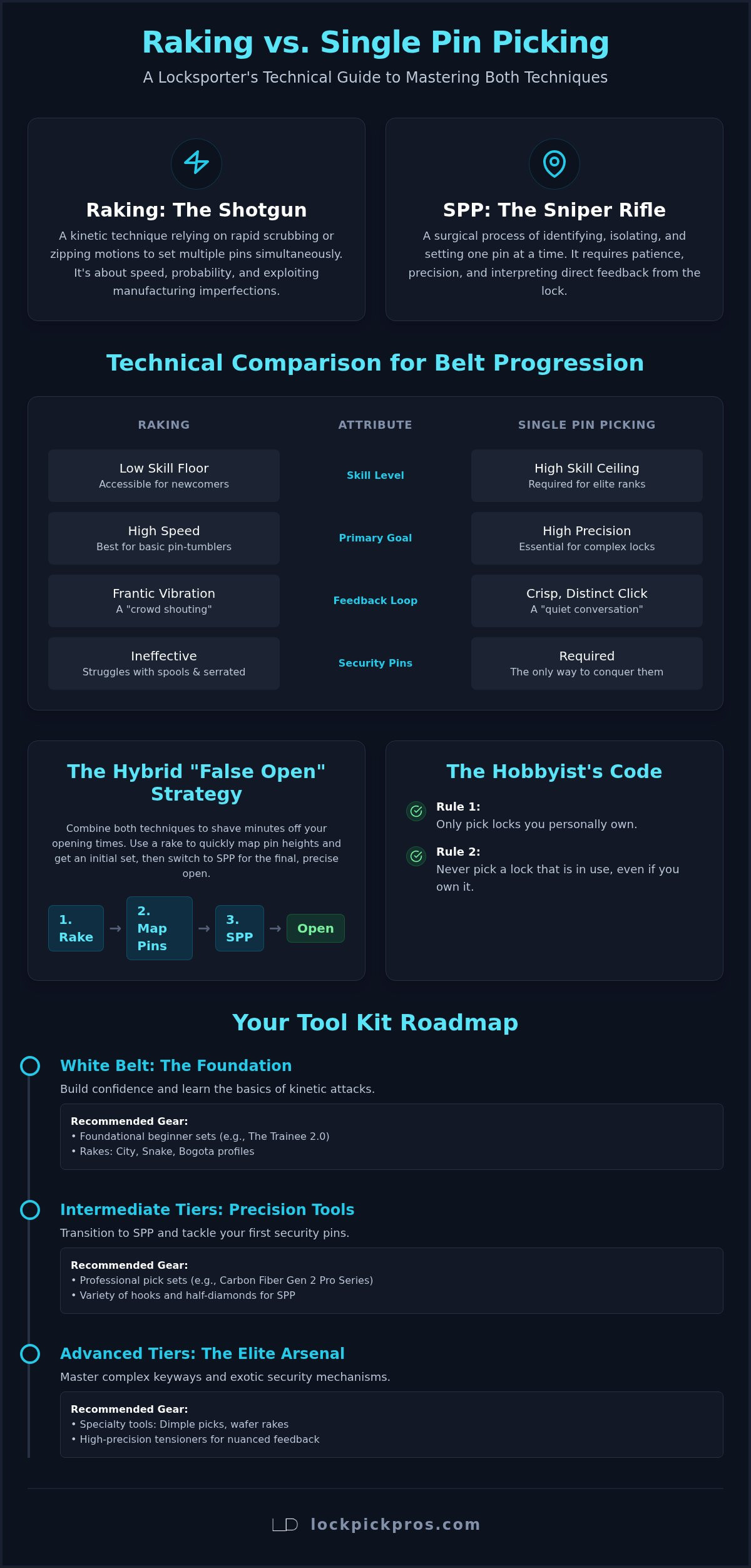
Every locksport journey begins with a choice between two distinct paths. Raking is a kinetic technique that relies on scrubbing or zipping to set multiple pins simultaneously through rapid movement. In contrast, Single Pin Picking (SPP) is a surgical process where you identify and set one pin at a time. While some beginners debate raking vs single pin picking as if one is better than the other, the 2026 locksport community views them as complementary tools in an ethical picker's arsenal. Raking has a low skill floor, making it accessible for newcomers, while SPP offers an incredibly high skill ceiling for those chasing the elite ranks.
Scrubbing involves a rhythmic back and forth motion within the keyway, while zipping is a fast, single pull technique. Both aim to exploit the tiny manufacturing imperfections inside a cylinder by using probability to set pins. In 2026, hobbyists respect a clean rake for its efficiency, even if the higher belt rankings require the granular control of SPP. Think of raking as the shotgun approach and SPP as the sniper rifle. You wouldn't use a sniper for every target, and you wouldn't use a shotgun for precision work. Mastering both ensures you never get stuck on a simple lock that just needs a bit of kinetic energy.
The Philosophy of the Ethical Lockpicker
We treat every lock as a ranking reference challenge rather than a defeat manual. This mindset shift is what separates a hobbyist from a criminal. The core of lock picking as a sport is built on two rules: only pick locks you own and never pick a lock that is in use. Mastering both techniques doesn't just make you faster. It makes you a more versatile hobbyist who understands the internal mechanics of security. You aren't just trying to beat the lock; you're learning to speak its language. Ethical picking is about the puzzle, the community, and the personal satisfaction of a clean open.
When Raking Wins: The Power of Kinetic Energy
Raking is often the first click a newcomer hears. It relies on the Momentum Effect. By using tools like The Trainee 2.0, you can bounce the pins within the chamber until they happen to land on the shear line. This is the primary tool for conquering White Belt challenges because it builds immediate confidence. However, raking has its limits. It struggles with high precision tolerances and security pins. That is where your transition to SPP becomes essential for progression. Raking gets you started, but SPP is what will eventually earn you your Black Belt.
The Mechanics of the Open: How Raking and SPP Manipulate Pins
To understand the magic of an open, you have to understand the shear line. It is the invisible boundary where the plug meets the housing. In a perfect world, all pins would bind at once. But manufacturing is messy. This "binding defect" is what we exploit. The MIT Guide to Lock Picking explains this beautifully. It is the foundational theory for every ethical picker. Whether you are scrubbing a stack or picking a single pin, you are hunting for that tiny physical gap. This concept is the "Golden Rule" that governs every pin tumbler lock ever made.
The feedback loop differs wildly between the two methods. In SPP, you feel a distinct, crisp click when a pin sets. It is a binary state. Raking is different. You feel a frantic vibration through the handle as the rake profile hits the pin stack. This is why raking vs single pin picking feels like two different sports. One is a quiet conversation; the other is a crowd shouting. Profiles like the Snake, Bogota, and City rake each interact with the pins differently. The Bogota mimics a random wave to find the shear line, while the City rake imitates a standard key profile to rock the pins into place.
Your tension wrench is the most important tool in your kit. It provides the rotational force needed to catch the pins on the ledge of the shear line. Beginners often use too much tension. This makes raking impossible and SPP exhausting. Light, consistent tension is usually the secret sauce. You are trying to create a tiny ledge for the pin to sit on without jamming the entire mechanism. Mastering your tension is what separates a lucky open from a repeatable skill.
Anatomy of a Rake Attack
Scrubbing is the most common rake attack. You move the pick in and out like a toothbrush, hitting all the pins in a rapid sequence. Zipping is more aggressive. You insert the pick to the back and pull it out quickly with a snapping motion. Use The Trainee 2.0 to master these basic profiles and find your rhythm. Kinetic energy bounces pins across the shear line, allowing the plug to rotate once they all align by chance.
The Precision of SPP
SPP requires identifying the binding pin. This is the one pin resisting movement because of the tension you've applied. A standard hook pick is your best friend here. You probe each pin until you find the one that won't budge. The importance of pick thickness cannot be overstated. A thinner pick allows for better navigation in tight keyways. Carbon Fiber Lock Picks offer superior rigidity, transmitting every tiny vibration from the pin stack directly to your hand. If you're ready to upgrade your feedback game, the Carbon Fiber Gen 2 Pro Series is designed for this exact level of professional precision.
Technical Comparison: Raking vs. SPP for Belt Progression
Speed is the most obvious differentiator in the raking vs single pin picking debate. On low-security locks, raking is often 10x faster than SPP. A skilled hobbyist can frequently rake a basic padlock in under five seconds, whereas single pin picking that same lock might take a minute or more. However, this speed comes with a trade-off. Aggressive raking puts significant stress on your equipment. Constant scrubbing and zipping can lead to premature tool wear; it can even deform the internal springs of the lock if you aren't careful. SPP is much gentler on both your picks and the cylinder.
The learning curve also separates these two pillars. Most beginners can learn to rake their first lock within hours of picking up a tension wrench. It provides that immediate rush of success that keeps people in the sport. Mastering SPP is a different story. It takes weeks or even months of dedicated practice to develop the muscle memory and tactile sensitivity required for high-level opens. While raking gets you through the door, SPP is what allows you to understand the room once you're inside.
The Security Pin Barrier
The Master Lock #3 is the classic White Belt challenge. It is notoriously vulnerable to raking because of its standard pin stack and loose tolerances. You can often open it just by looking at it funny with a triple peak rake. But as you progress, you'll hit a wall. Security pins like mushrooms, spools, and serrated drivers are specifically designed to "kill" raking attempts. These pins get caught in false sets that a rake cannot easily escape. This is the mandatory transition point. To move beyond the basic tiers, a hobbyist must put down the rakes and pick up the hooks to defeat these complex internals surgically.
Mapping Techniques to Belt Tiers
Your journey through the belt ranks requires a diversifying toolkit. In the White and Yellow Belt stages, you should focus on mastering various rake profiles while learning the basics of SPP. These locks are forgiving and help you understand tension. Once you reach Orange and Green Belts, the shift to surgical SPP is no longer optional. The tolerances become tighter and security pins become standard. By the time you reach Blue Belt and beyond, you'll start encountering specialty locks. These require advanced techniques and tools like dimple or wafer picks. Progression is about knowing which tool fits the specific challenge in front of you.
The Hybrid Approach: When to Rake and When to SPP
Mastering locksport in 2026 isn't about choosing a side in the raking vs single pin picking debate. It's about blending them into a single, fluid workflow. Many hobbyists hit a plateau because they treat these techniques as separate silos. The most efficient pickers use a hybrid approach to save time and mental energy. By using a rake to "pre-set" the easy pins, you can isolate the true challenge of a lock much faster. This isn't cheating; it's smart picking.
This is often called the "False Open" strategy. You start with a few light passes of a rake to see if you can get lucky. If the lock doesn't pop immediately, you've likely set the standard pins and reached a false set. Now, you can use the profile of your rake to map the pin heights. Feeling where the pins are naturally sitting helps you choose the right hook for the surgical finish. Just be careful not to overset pins during this transition. Applying too much force while switching tools can drop everything you've already achieved. Keep your tension light and your movements intentional.
Take the ABUS 64TI/30 as a perfect example. This Titalium padlock usually contains four or five pins, often including at least one spool. If you try to rake it entirely, you'll likely just jam the spool. Instead, use a Bogota rake for five seconds to set the standard pins. Once you feel the plug rotate slightly into a false set, stop. Switch to a hook to identify the binding spool and counter-rotate it for the win. This specific combination turns a five-minute struggle into a thirty-second victory.
The Rake-to-Hook Handoff
The handoff is a total "cheat code" for Yellow and Orange belt locks. Start with your favorite rake for five seconds. If you feel a deep false set, it's time to grab the hook. This saves you from hunting for every single standard pin manually. For a seamless transition between these profiles, the Pro Series Expansion provides the variety you need to handle the switch without losing your tension. It's about having the right tool ready the moment the lock gives you feedback.
Avoiding "Rake Reliance"
Don't fall into the trap of rake reliance. While it's efficient, becoming a "one-trick pony" will stop your belt progression dead in its tracks. Practice drills where you pick a lock entirely with SPP, then try the hybrid method to compare times. This builds the discipline you'll need for the higher ranks. SPP is required for 90% of high-security locks where raking simply won't work because of tight tolerances. If you want to refine your tactile feedback during these complex opens, check out our Carbon Fiber Gen 2 Pro Series for unmatched precision.
Mastering the Craft: Tools and Training for Every Tier
Your success in the 2026 locksport scene depends on matching your skill progression with the right equipment. Whether you are focusing on raking vs single pin picking, you need tools that translate feedback without distortion. Cheap metal sets often provide "ghost feedback." These are vibrations that don't actually correspond to pin states, which leads to frustration and stalled progress. Investing in quality steel and ergonomic handles ensures that every click or vibration you feel is the lock actually speaking to you.
Every trainee should start with a solid foundation. Check out our guide on what is in a beginner lock pick set to see the essential profiles for 2026. Tools like the Trainee 2.0 are perfect for White Belt challenges because they are robust enough to handle the heavier tension typical of early practice. Cutaway and progressive locks are your best training partners during this stage. They allow you to see the pins move in real time, which bridges the gap between what you feel and what is actually happening inside the cylinder.
Once you set your sights on Green Belt and beyond, your equipment needs to evolve. The Carbon Fiber Gen 2 Pro Series is the gold standard for intermediate and expert pickers. These picks are incredibly rigid; they transmit the subtle feedback of a spool pin setting with surgical clarity. This level of precision is non-negotiable for high-security locks where the margin for error is measured in microns. Professional tools eliminate the guesswork and let your skill shine through.
The Black Belt Challenge
We believe locksport is better when we grow together. Join our free "Black Belt Challenge" to track your progression through the community ranks. It is a roadmap designed to take you from your first rake open to advanced SPP mastery. We've even built a "share-to-earn" loop into the experience. Share your successful "picks-in-action" content on social media to earn rewards. We offer community bounties for hitting social reach goals, helping you upgrade your gear for free as you climb the tiers and inspire others.
Final Recommendation for 2026
My best advice for this year is simple. Use raking to learn the fundamentals of tension and plug rotation. Once you feel comfortable with the vibration of an open, switch to SPP to learn the unique personality of each lock. This balanced approach prevents you from becoming a one-trick pony and prepares you for the most complex cylinders on the market. Don't let poor tools hold you back from your potential. Join the Black Belt Challenge and earn your first belt today!
Elevate Your Locksport Skills for 2026
You now have the roadmap to navigate the technical divide of raking vs single pin picking with total confidence. You've learned that while raking builds the initial momentum needed for White Belt success, the surgical precision of single pin picking is your true ticket to the elite ranks. By mastering the "Rake-to-Hook" hybrid approach, you aren't just guessing anymore. You're manipulating the pin stack with professional intent and efficiency.
Our ethical locksport community is built on the pursuit of mastery, and we're here to support every click of your journey. The Precision Carbon Fiber Gen 2 Series is specifically designed to transmit the feedback you need to conquer advanced security pins. We stand by our gear with a 100% satisfaction guarantee, ensuring you have the best tools for every challenge. It's time to put your practice into action and start earning those belts.
Ready to climb the leaderboard? Join the FREE Black Belt Challenge and start your journey to mastery! We can't wait to see your "picks-in-action" content on social media. Keep your tension light, your picks sharp, and your passion for the sport growing every day.
Frequently Asked Questions
Is raking locks considered "cheating" in the locksport community?
Raking isn't cheating; it's a foundational skill that every well-rounded hobbyist should master. The locksport community recognizes raking as a valid method for achieving an open, especially in the early belt levels. It represents the kinetic side of the sport, while single pin picking represents the surgical side. Both techniques are essential for understanding the full range of lock vulnerabilities.
Can you rake a lock that contains spool or serrated security pins?
It is extremely difficult to rake a lock with multiple security pins. Spools and serrated drivers are specifically engineered to catch on the shear line when pins are moved rapidly in groups. While you might occasionally achieve a "False Open" with a lucky rake, you'll almost always need to finish the job using SPP to navigate the counter-rotation required by these pins.
Which tool is better for a total beginner: a rake or a hook pick?
A beginner should ideally start with both to learn the full spectrum of the hobby. Raking provides the immediate satisfaction of a quick open, which is great for building initial confidence. However, you should use a hook pick to develop the tactile sensitivity needed for higher ranks. Balancing raking vs single pin picking from the start ensures you don't become a one-trick pony.
Does raking damage the internal pins of a lock more than SPP?
Aggressive raking can cause more wear and tear than SPP over time. Because raking involves rapid, high-kinetic movement, it can slightly deform pin tops or fatigue internal springs if you use too much force. SPP is a much gentler, controlled process that preserves the longevity of your practice locks. Always use the lightest tension possible to minimize any potential damage.
What is the best lock pick set for someone aiming for a Green Belt?
For Green Belt mastery, you need a set that offers professional-grade feedback and thinner profiles. We recommend the Carbon Fiber Gen 2 Pro Series for this tier. At this level, you're dealing with tighter tolerances and security pins that require the rigidity and tactile response that only high-quality materials can provide. It eliminates the "ghost feedback" found in cheaper sets.
How long does it typically take to master single pin picking?
Basic SPP mastery usually takes several weeks of consistent daily practice. You need this time to develop the muscle memory required to feel the difference between a binding pin and a set pin. Mastering high-security locks at the Blue or Black Belt level can take months or even years of dedicated study. It is a journey of constant skill refinement rather than a quick sprint.
Can I use a rake to open high-security dimple locks?
Standard rakes are ineffective against dimple locks. Dimple locks use a different pin orientation and require specialized dimple picks to manipulate the pins properly. Trying to use a traditional rake profile will likely result in a stuck tool or a damaged keyway. As you progress to advanced tiers, you'll need to invest in tier-specific specialty tools to handle these unique mechanisms.
Why is tension more important than the actual picking technique?
Tension is the foundation of every open because it creates the physical ledge at the shear line. Without the right amount of rotational force, your pins will simply fall back into the plug no matter how perfect your picking technique is. Mastering tension is often the most difficult part of the hobby. It's the variable that allows you to "trap" pins once they've reached the correct height.