

Mastering the ABUS 64TI Titalium: A Detailed Yellow Belt Picking Guide
The very thing that makes the ABUS 64TI feel like a high-tech marvel, its lightweight Titalium alloy, is exactly what makes it a challenge for hobbyists who rely on heavy tension. If you've tried to tackle this lock only to find the feedback feels mushy or non-existent, you aren't alone. Most pickers struggle with over-tensioning or getting hopelessly stuck in a false set caused by those tricky internal spool pins while learning how to pick ABUS 64TI padlocks.
We understand the frustration of navigating a tight paracentric keyway while trying to feel for a click that never seems to come. This guide will teach you the precise feather-touch tension and feedback techniques required to defeat this 5-pin cylinder and secure a satisfying open. We will break down the specific spool pin mechanics of the Titalium series, recommend the best tools for the job, and provide the technical roadmap you need to earn your Yellow Belt and advance your locksport ranking.
Key Takeaways
- Understand the significance of the ABUS 64TI in the 2026 locksport belt ranks and why this 5-pin stack is the perfect introduction to security pins.
- Master the "feather-light" tension required for how to pick ABUS 64TI padlocks without dampening the unique feedback of its Titalium alloy.
- Learn the optimal pick set selection for thin hooks and Top of Keyway tensioning to conquer the paracentric keyway.
- Follow a detailed Single Pin Picking strategy to identify binding pins and successfully document your open for community verification.
- Prepare for your next challenge by exploring the Orange Belt path and upgrading your kit for more advanced practice locks.
Introduction to the ABUS 64TI Titalium: Your Yellow Belt Milestone
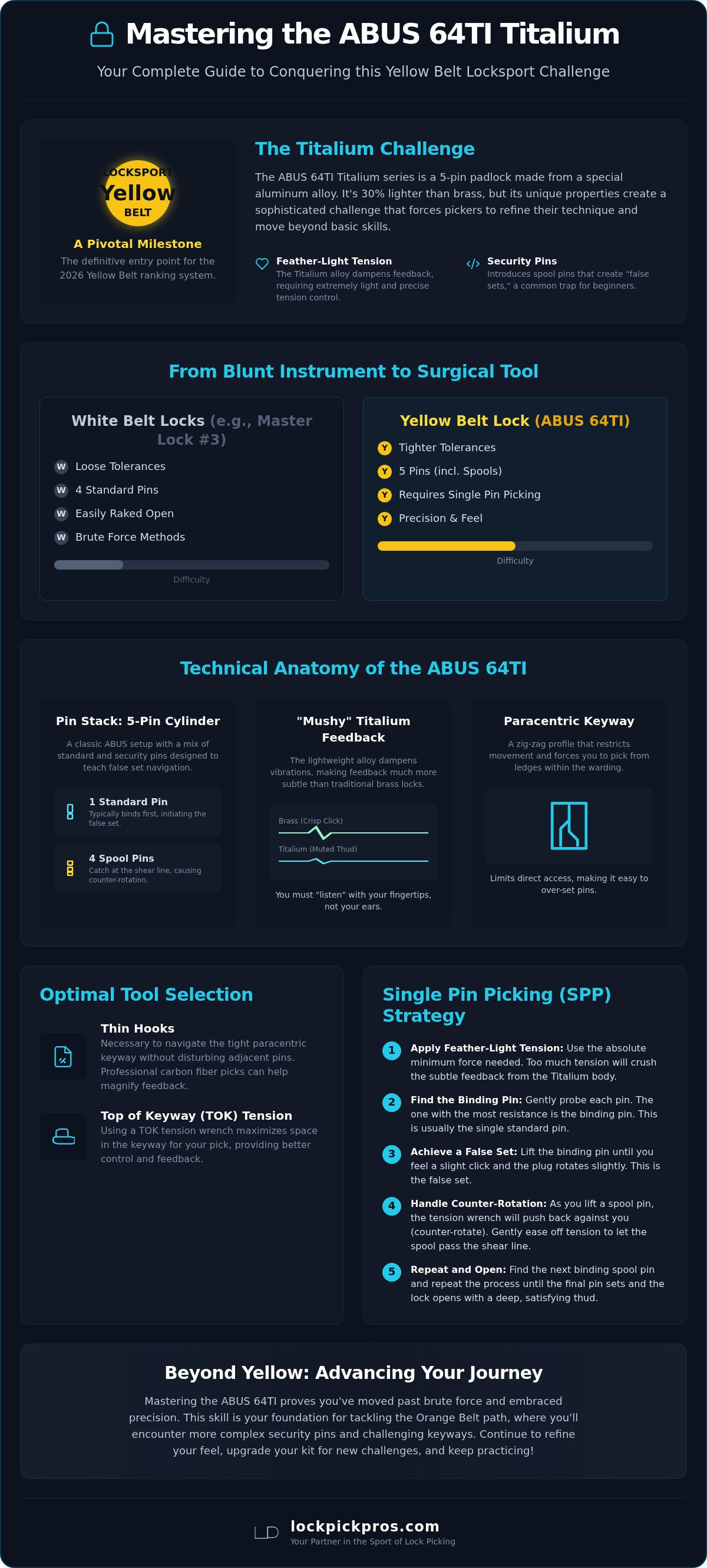
The ABUS 64TI Titalium series represents a pivotal moment for any aspiring picker. It is a 5-pin padlock constructed from a special aluminum alloy that is 30% lighter than brass but maintains impressive strength. For those moving beyond the basics, this lock is the definitive entry point for the Yellow Belt in the 2026 locksport ranking system. While it looks like a standard padlock, the internal mechanics offer a sophisticated challenge that forces you to refine your technique. As you explore the history of lock picking, you'll see that progressing from simple warding to precision pin-tumblers like the 64TI is how true skill is forged. It's a gateway lock that bridges the gap between basic hardware and high-security engineering.
Before we dive into the technical details of how to pick ABUS 64TI models, we must emphasize the ethical code of our community. Always follow the "locks in hand" rule. Only pick locks you own or have explicit permission to pick. Never pick a lock that is in use or serves a life-safety function. This hobby is about the sport and the challenge, not bypassing security for illicit reasons. Keeping your practice ethical ensures that locksport remains a respected and welcoming community for everyone.
Why the 64TI is a Step Up
Moving from White Belt locks like the Master Lock #3 to the ABUS 64TI feels like switching from a blunt instrument to a surgical tool. White Belt locks often have loose tolerances and four standard pins. You can usually rake them open in seconds without much thought. The 64TI changes the game entirely. It features tighter tolerances and introduces security pins, specifically spools. These pins are designed to catch on the shear line and create a "false set." If you try to rake this lock, you'll likely just get stuck in a deep false set that feels like a dead end. Success requires Single Pin Picking (SPP) and a deep understanding of feedback. You'll need to learn how to identify which pin is binding and how to navigate the paracentric keyway.
The 2026 Belt Ranking Context
Earning your Yellow Belt is about more than just getting an open. It signifies that you've moved past "brute force" methods and started mastering "precision feel." You can read more about the current standards in our guide on Lock Picking Belt Levels Explained. Mastering how to pick ABUS 64TI requires a mental shift. You must learn to interpret the subtle vibrations of the Titalium alloy and respond to the counter-rotation of spool pins. It's your first real test of skill refinement. This isn't just about speed; it's about accuracy. By the time you get your first open on a 64TI, you'll have a much better grasp of how security pins work and how to handle delicate feedback.
Technical Anatomy: Titalium Feedback and Pin Stacks
The core of the ABUS 64TI is its 5-pin cylinder, which usually contains one standard driver pin and four security spool pins. This configuration is a classic ABUS setup designed to challenge intermediate pickers. When you're learning how to pick ABUS 64TI padlocks, understanding this stack is half the battle. The standard pin typically binds first. Once you set it, the lock drops into a "false set" as the spools engage the shear line. This means the plug rotates slightly, but the lock remains closed because the wider ends of the spool pins are still trapped.
Titalium feedback is notoriously different from traditional brass. Brass padlocks provide crisp, metallic clicks that resonate clearly through your tools. Titalium, a specialized aluminum alloy, acts more like a shock absorber. It is approximately 30% lighter than brass, and this lower density dampens the kinetic energy of the pins hitting the shear line. The result is a feedback profile often described as "mushy" or "soft." You won't always hear the lock open; you have to feel the subtle vibrations in your tension wrench.
The paracentric keyway adds another layer of technical difficulty. Its zig-zag profile is specifically engineered to limit your pick’s range of motion. You can't simply lift pins straight up from the bottom of the keyway. Instead, you often have to pick from a ledge of warding or use the warding as a fulcrum to reach the pins. This tight space makes it easy to accidentally over-set pins or lose your place in the stack, especially on pins four and five at the back of the lock.
The "Mushy" Feedback Phenomenon
Because the aluminum alloy absorbs energy, the tactile signals are muted. If you apply too much tension, you'll crush the feedback entirely and won't feel the pins moving. You must learn to "listen" with your fingertips. Using high-performance tools like the Carbon Fiber Gen 2 Pro Series can help magnify these dampened vibrations. The goal is to detect the tiny, dull thuds that indicate a pin has reached the shear line rather than waiting for a loud, satisfying click.
Identifying Spool Pins
Spool pins are the true "final boss" of the Yellow Belt tier. You'll know you've encountered one when you feel counter-rotation. As you lift a binding spool pin, the tension wrench will actually push back against your finger, trying to rotate the plug in the opposite direction. This is the pin trying to align its center "waist" with the shear line. If you resist this movement, you'll likely drop all your previously set pins. You must carefully ease off the tension to allow that counter-rotation to happen before the pin finally clicks into place.
Selecting the Right Tools for the ABUS 64TI
Picking the right gear is the difference between a frustrating evening and a successful open. When you are researching how to pick ABUS 64TI locks, you'll see plenty of generic advice suggesting any standard pick will do. That's a mistake. The paracentric keyway in these Titalium locks is tight. A standard .025 inch pick often binds against the warding before it even touches a pin. For this lock, precision is everything. If you're just starting out, The Trainee 2.0 provides the foundational hooks you need to begin, but as you progress through the Yellow Belt tier, you'll quickly realize that tool thickness and material quality are your best friends.
High-yield steel or carbon fiber tools are preferred for Titalium because they don't flex as much as cheaper alloys. Since the 64TI has that "mushy" feedback we discussed earlier, you need a pick that transmits every tiny vibration directly to your hand. A flexible pick will absorb those signals, leaving you guessing whether a pin is set or just stuck. You want a tool that acts as an extension of your nervous system.
The Hook Choice: Reach vs. Thickness
For the ABUS 64TI, a thin profile hook is mandatory. We recommend using a .020 inch or even a .015 inch hook to navigate the zig-zag warding. A standard short hook is usually sufficient for the reach, provided it is thin enough to move freely. If your pick is too bulky, you'll likely "over-set" pins by accidentally bumping them while trying to reach the ones further back. You can pick from the very bottom of the keyway if your tool is thin enough, or you can use the right-hand ledge of the warding as a fulcrum. This "ledge picking" gives you better leverage and control, which is vital when you're hunting for that specific binding pin in a crowded 5-pin stack.
Tension Wrench Mastery
Tension is where most hobbyists fail on this lock. While Bottom of Keyway (BOK) tension is common for beginners, it often cramps the already small ABUS keyway. Top of Keyway (TOK) tensioning is the superior method here. It clears out the bottom of the plug, giving your pick maximum room to maneuver. You need a wrench that fits snugly; any "springiness" or wiggle room in the wrench will mask the counter-rotation of the spool pins. For the absolute best tactile sensitivity, the Carbon Fiber Gen 2 Pro Series is an excellent choice. The rigid carbon fiber construction ensures that even the softest feedback from the Titalium core reaches your fingertips without being lost in the handle.
Step-by-Step Single Pin Picking (SPP) Strategy
Mastering how to pick ABUS 64TI locks is a lesson in patience and tactile sensitivity. Your tension wrench is your most important sensor. Start by applying "feather-light" tension. You only need enough pressure to keep the wrench from falling out of the keyway. Because the Titalium alloy is so light, heavy tension will bind the pins so tightly that you won't feel any feedback at all. It's a delicate balance that requires a soft touch and a steady hand.
Start by probing each of the five pins with your hook. You're looking for the one that feels stiff or "binding." Most other pins will feel springy. When you find the binder, give it a gentle click upward. If it's a standard pin, you'll feel a tiny bit of movement in the plug. This is where the "Jiggle Test" becomes your best friend. A set pin will have a tiny amount of springy "jiggle" when you tap it. If it feels rock hard, it's binding. If it's completely loose, it's not ready to be picked yet.
The Binding Order Dance
Success on the 64TI usually follows a specific rhythm. First, find the standard pin. In many ABUS models, this is pin 1 or pin 5. Once you set this pin, the lock will likely drop into a "false set." You'll feel the plug rotate slightly, giving you the illusion that the lock is almost open. Don't be fooled; this is just the spool pins engaging. Identify which spool is binding by looking for counter-rotation. If you lift a pin and the tension wrench pushes back against your finger, you've found your target. Ease off your tension just enough to let the plug rotate backward, allowing the spool to click into place.
Common Pitfalls and Resets
Over-setting is the most common reason for a failed open on this lock. Because the keyway is so tight, it's easy to accidentally nudge a pin too high while reaching for the one behind it. If the stack feels completely "dead" with no feedback, you've likely over-set something. Don't be afraid to reset. Sometimes, a quick "pulse" of the tension wrench can drop an over-set pin without losing the rest of your progress. To get the best feel for these subtle movements and counter-rotations, we recommend using the Carbon Fiber Gen 2 Pro Series to maximize your tactile feedback.
Beyond Yellow: Advancing Your Locksport Journey
Once you hear that shackle pop, you've officially conquered one of the most respected gatekeepers in the Yellow Belt tier. Learning how to pick ABUS 64TI padlocks is a true rite of passage that proves you can handle security pins and muted feedback. Don't let that successful open go unnoticed. We encourage you to document your progress by filming your "open" or taking a clear photo of the turned core. Sharing these milestones for community verification is the best way to climb the ranks and earn the respect of fellow ethical lockpickers. It turns a solitary hobby into a shared pursuit of mastery.
As you look toward the horizon, the Orange Belt beckons with even more complex challenges. You'll soon find yourself facing locks like the ABUS 55/40 or the Master Lock 150, which require even more refined tension control. To prepare for these hurdles, check out our Mastering the Advanced Lock roadmap. This guide provides a deep dive into high-security picking techniques for 2026. Always remember the golden rule of the sport: only pick locks you own and that aren't currently in use. Keeping your practice ethical ensures our community continues to grow and thrive.
The Black Belt Challenge
We believe every picker has the potential to reach the top. That's why we created the free "Black Belt Challenge." It's a community-driven program designed to guide you from foundational skills to expert-level mastery. We've integrated a "Share-to-Earn" loop to reward your dedication. When you post your successful 64TI pick on social media and tag our community, you can earn exclusive rewards and gear discounts. We even offer a community bounty for hitting specific social reach goals. This helps us spread the word about ethical locksport while giving you the tools to advance your ranking faster.
Upgrading Your Arsenal
As the locks get tougher, your gear needs to evolve. The tight tolerances of Orange and Green belt tiers often require more specialized profiles than what you used for how to pick ABUS 64TI stacks. Transitioning to the Pro Series Expansion is the logical next step for serious hobbyists. These kits provide the thinner hooks and varied reach needed for restrictive keyways. Eventually, your journey will lead you to locks that require specialty tools like dimple picks or wafer tools. Embrace the learning curve and stay focused on the feedback. Earn your belt, one pin at a time.
Claim Your Yellow Belt and Keep Picking
Mastering the ABUS 64TI is a significant milestone that proves your technical refinement. You've learned to navigate the tight paracentric keyway and interpret the unique, dampened feedback of the Titalium alloy. By applying feather-light tension and accurately identifying counter-rotation in the spool pins, you've unlocked the secrets of how to pick ABUS 64TI padlocks and earned your place in the Yellow Belt ranks.
Now it's time to put those skills to work and join a community of over 50,000 ethical lockpickers. To continue your journey toward the Black Belt, you need tools that offer the highest level of tactile sensitivity. Our precision-engineered carbon fiber tools are designed to amplify the subtlest vibrations; this ensures you never miss a set pin again. We even offer a Satisfaction Guarantee on all Pro Series gear so you can pick with absolute confidence.
Join the Black Belt Challenge and upgrade to the Carbon Fiber Gen 2 Pro Series today!
Your progress is a testament to your dedication to the sport. Keep your picks sharp, stay ethical, and enjoy the satisfaction of every hard-earned open. We can't wait to see your next belt verification!
Frequently Asked Questions
Is the ABUS 64TI harder than a Master Lock 140?
Yes, the ABUS 64TI is generally considered a step up in difficulty compared to the Master Lock 140. While both locks feature spool pins, the ABUS has a more restrictive, paracentric keyway and tighter manufacturing tolerances. These factors make it harder to maneuver your pick and require much more precise tension control to avoid over-setting pins. It's the perfect challenge for those ready to move beyond basic entry-level hardware.
How many pins are in an ABUS 64TI/30 vs 64TI/40?
The number of pins depends on the body size. The 64TI/30 contains a 4-pin stack, while the 64TI/40 and larger models feature a 5-pin cylinder. If you are learning how to pick ABUS 64TI locks, starting with the 30mm version can help you master the feedback before tackling the extra pin and tighter keyway of the 40mm variant. Both sizes use the same lightweight aluminum alloy construction.
What tension should I use for the ABUS Titalium series?
You should use extremely light "feather" tension, preferably using a Top of Keyway (TOK) wrench. Because the Titalium body is lightweight, it doesn't provide the same counter-weight as brass. Heavy tension will bind the spool pins so tightly that you won't feel the counter-rotation needed to set them. If your wrench is slipping or you can't feel any movement, ease off your finger pressure until the pins can move freely.
Does the ABUS 64TI have security pins?
Yes, the ABUS 64TI is famous for its security pins. Most models contain one standard driver pin and several spool pins. These spools are designed to drop the lock into a false set, which is a key milestone for anyone learning how to pick ABUS 64TI padlocks. You'll need to identify the counter-rotation on the plug to successfully set these pins and reach the final open.
Why does my ABUS 64TI feel "mushy" compared to other locks?
The "mushy" feel is a direct result of the Titalium aluminum alloy used in the lock body. Aluminum is less dense than traditional brass, so it absorbs the kinetic energy and vibrations of the pins. Instead of the crisp, metallic "click" you might expect from a Master Lock, the 64TI provides a softer, dampened thud. Mastering this lock requires training your fingertips to detect these subtle, quiet signals.
Can I rake the ABUS 64TI or do I have to single pin pick it?
While you might occasionally get a lucky open with a rake, single pin picking (SPP) is the only reliable method for this lock. The combination of a paracentric keyway and multiple spool pins makes raking extremely difficult. SPP allows you to navigate the warding and address each pin individually. This precision is exactly what the belt ranking system is designed to test at the Yellow Belt level.
What tools do I need to get a Yellow Belt in lockpicking?
To earn your Yellow Belt, you need a set of thin hooks and reliable tension tools. We recommend hooks in .020 or .015 thickness to handle the tight ABUS keyways. You'll also want a variety of tension wrenches, including Top of Keyway bars, to maximize your feedback and room to work. High-quality steel or carbon fiber tools are best for transmitting the dampened feedback of these more advanced practice locks.