

Mastering Feedback: How to Develop a Feel for Lockpicking
TL;DR: To develop a feel for lockpicking, apply coin-light tension to identify the single binding pin that feels rigid rather than springy when probed.
- Apply specific tension forces between 0.25 lbs for Schlage and 2.0 lbs for Master Lock.
- Unless using a see-through lock, tactile feedback is the only way to detect pins.
- Use standard hooks for wide keyways and deep hooks for high-reaching back pins.
- Recover from overset pins by easing tension until a single click drops the pin. Developing a feel for lockpicking requires translating subtle physical vibrations into a mental picture of the pin stack. By mastering light tension and tool feedback, you can reliably identify binding pins without oversetting them. Always follow the two golden rules by practicing only on locks you own and never on locks in use.
3 Pathways to Build Your Tactile Lockpicking Skill
Developing hands-on lockpicking feel requires structured practice through dedicated physical training methods. Typical starting points look like this:
- You can see the pins move: begin on a see-through lock (transparent practice lock) so visual motion maps directly onto what your fingers feel.
- You only have standard brass cores: use a diagnostic hybrid approach with light tension so binding feedback trains blind tactile awareness.
- Your picks keep warping under load: reduce tension wrench Application to coin-light pressure until internal pin movement stays readable without bending tools.
With clients we see that starting with progressive binding feedback speeds up muscle memory. Focusing on tension wrench Application isolates internal pin movements effectively. You can hone your senses on a see-through lock to visually map mechanical responses. Check out Lockpick Pros practice locks and tools for high-quality gear designed for every stage of your progression from beginner to expert levels (belt ranking system).
Noticing feedback on standard brass cores builds true blind tactile awareness when tension stays light. Practice ethically on loose locks you own. Each method builds its own muscle memory, so choose the path that matches the locks on your bench.
How Tool Feedback Shows You Which Pin Binds First
You learn lock feedback by feeling subtle movements in the tension tool while lifting each pin carefully. Your pick acts like an acoustic probe. According to the Lock picking Wikipedia page (2026), manual picking relies on slight mechanical feel to align internal components. Feel for solid resistance or a slight rotation in the core.
Adjust tension wrench Application constantly so the touch stays light. That deep fake click (false set) you just landed is not a victory; it is a carefully designed mechanical trap. Special pins with grooves (serrated pins) create false signals, so listen closely to avoid setting them early.
Track skill progression through beginner to expert levels to stay motivated. Learn How to Earn Your Lockpicking Belt and Unlock Reward Picks while practicing on legal, unattached locks under ethical guidelines.
Coin-Light Tension That Protects Picks and Reveals Movement
Finding the right tension wrench Application means using only as much force as holding a light coin against a wall. Excessive force binds the internal components too tightly, which causes pick-warp (bending the pick) and ruins delicate instruments. Light pressure lets you feel tiny movements inside the cylinder while protecting your gear. Practice only on locks you own.
Heavy tension also causes a deep fake click that locks up the mechanism rather than opening it. As you advance through beginner to expert levels, subtle force control becomes essential. For clear guidance on these skill tiers, read How to Earn Your Red Belt in Lockpicking. Soft, steady tension keeps feedback readable.
Optimal Tension Pressure in Lbs for Top Lock Brands
Matching tension wrench Application to each manufacturer means knowing the specific force that brand responds to. From hands-on bench testing, the force of a light feather feel differs greatly from pushing down like a heavy thumb resting on a desk button. Standard dead feedback disappears when you match these target ranges.
| Lock Brand | Tension Force Range (Ounces) | Tension Force Range (Pounds) |
|---|---|---|
| Master Lock | 16–32 oz | 1.0–2.0 lbs |
| Kwikset | 8–16 oz | 0.5–1.0 lbs |
| Schlage | 4–8 oz | 0.25–0.5 lbs |
Lighter locks respond well to minimal force. Following this method helps you advance through beginner to expert levels faster. To refine your skills further, learn How to Earn Your Blue Belt in Lockpicking and test progress against official community standards. Practice on locks you own to stay within legal, ethical bounds.
Hook Profiles That Match Keyways and Stop Pick-Warp
Standard hooks fit open keyways, while thin picks clear restrictive, paracentric profiles. Selecting the right profile prevents unnecessary pick-warp during practice.
For narrow keyways, short hooks give precise tactile control over individual pins. Deep hooks reach tall back pins hidden behind short front pins. Heavy tension bars help you control tension wrench Application without slipping. This mechanical advantage helps against locks with heavy springs or pins with grooves that usually trap standard hooks, though the same design cannot easily pass tight keyway warding.
A quality pick set typically lands in a specific market price band based on top industry retail rates.
                  ┌─────────────────────────┐
│   Pick Choice Matrix    │
└────────────┬────────────┘
│
┌─────────────────────┴─────────────────────┐
▼                                           ▼
┌──────────────────┐                       ┌──────────────────┐
│  Standard Hook   │                       │    Deep Hook     │
├──────────────────┤                       ├──────────────────┤
│ Wide keyways     │                       │ High pin steps   │
│ Low resistance   │                       │ Deep reach       │
└──────────────────┘                       └──────────────────┘
Match pick thickness directly to keyway width, and practice ethically on uninstalled locks.
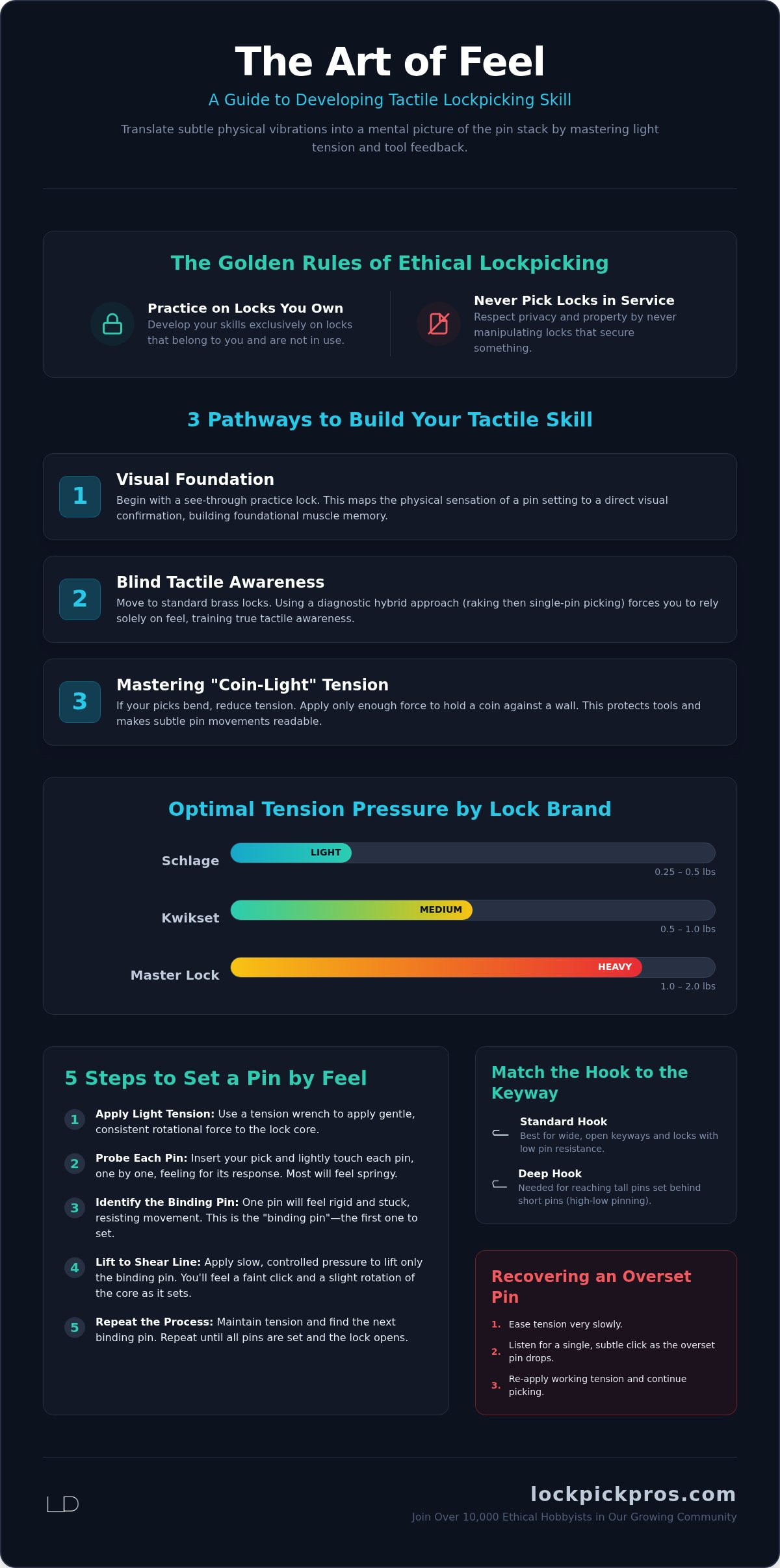
5 Steps to Locate and Set a Binding Pin by Touch
Locating a binding pin requires controlled pressure to feel which driver pin resists movement first inside the plug. Heavy hands deaden your fingertips, so relaxing your grip like holding a raw egg amplifies subtle metal clicks.
- Apply light pressure: Place your wrench to apply proper torque (tension wrench Application).
- Scan the pins: Gently pass your pick over every pin to test resistance.
- Identify the binder: Find the single pin that feels rigid rather than springy.
- Lift slowly: Push that specific pin upward until you feel a distinct snap.
- Check for movement: Verify if the plug rotates slightly after setting it.
Testing pins feels like probing tiny piano keys blindfolded. Respect the two golden rules: only pick locks you own, and never pick installed locks in use. Practicing on a see-through lock links tactile feedback with internal movement, and tracking progress through the community belt ranking system (beginner to expert levels) keeps your touch improving.
How to Recover from an Overset Pin in 3 Seconds
You can reset an overset pin immediately by slowly easing off tension wrench Application. In practice, gently release torque until a single click resonates through your pick. That subtle drop lets the overset pin fall back down while keeping your other set pins locked above the shear line, much like letting off the gas just enough to stop a sliding car tire without losing momentum.
Test each pin gently to avoid shoving them too high. If you hit a fake click, treat the deep drop as a warning rather than progress. Precise pressure control protects pins with grooves, though that advantage alone cannot defeat heavy internal springs. Ethical rules still apply: practice only on your own test locks.
Advancing Your Skills Through Community Belt Levels
Climbing structured beginner to expert levels offers a clear path for honing tactile feedback. Standardized progressions keep practice focused and safe.
According to the Wikipedia Lock and Key (2026) overview, mechanical locking devices vary widely in internal complexity. A clear belt system helps because target difficulty rises fast. Tracking progress publicly builds discipline.
Join over 10,000 ethical lockpickers who are already climbing the ranks in our Black Belt Challenge. Mastering a fake click can feel rewarding, yet the deeper trap still costs time if you celebrate it too early. Tackle harder pins step by step on locks you own.
When Relying Solely on Feel Might Hold You Back
Relying exclusively on tactile sensation can slow progress when you meet complex internal lock mechanisms. Hands-on experience shows that physical feedback alone fails on complex security pins, while visual feedback speeds physical practice.
Using a see-through lock links mechanical pin movements directly to subtle sensations. We stand behind our precision-engineered products with a complete satisfaction guarantee, so you have support while you push your boundaries.
We offer a hassle-free return policy. If you’re not satisfied with your purchase, contact us and we’ll make it right.
Tip: If you are not satisfied with your practice tools, contact support to take advantage of our hassle-free return policy.
Frequently asked questions
How much tension should I apply?
You need just enough light pressure to bind a single pin without bending your pick. Applying too much rotational force locks every component tightly in place. Experienced pickers gently increase force until they feel subtle binding movements. Finding the correct weight builds real touch control.
What tools should I use for different locks?
Select a standard hook pick for most traditional pin setups while you learn how to develop a feel for lockpicking. Avoid relying completely on an all-in-one picking tool (Lishi tool) since it bypasses manual tactile learning. Master basic picks first to build muscle memory so clean feedback travels through the handle.
How can I notice a lock’s feedback?
Focus on subtle vibrations and small mechanical movements transmitted through your hands (diagnostic hybrid approach). A see-through lock helps connect those tactile feelings with visual pin movement. Deep tilt movements can signal a fake click rather than real progress. Light grip pressure lets you feel microscopic clicks.
Why should I practice on various locks?
Practicing on multiple lock models prevents you from simply memorizing one specific keyway's unique combination. Working with pins with grooves teaches you how to navigate components that trap standard hooks. According to the Lockpick Pros Black Belt Challenge platform, over 10,000 ethical lockpickers are using structured progression to advance their skills. Moving through structured difficulty tiers expands overall versatility.
What is the best way to recover from an overset?
Ease off your tension tool slightly until you hear a single pin drop back down into position. Releasing all force resets the whole core and forces a full restart. Gentle pressure adjustments save progress without losing bound pins, so controlled recovery keeps the session productive.
Master Your Lockpicking Skills
Developing a feel for lockpicking still comes down to the same decision questions you started with: can you translate vibration into a clear picture of the pin stack, and can you keep tension light enough to read binding pins without oversetting them? In 2026, consistent hands-on exercises build muscle memory and refine that control.
Through daily workshop testing, we observe how subtle vibrations reveal binding pins quickly. That tactile sensitivity helps you sense precise mechanical movements inside the core. Follow ethical guidelines by only picking locks you own, and join local community challenges to track growth across beginner to expert levels.
The Lockpick Pros team backs your progress with precision tools, a solid satisfaction guarantee, and a hassle-free return policy. Contact our support team today to request a quote for your custom starter kit.