

Thin vs. Standard Thickness Lock Picks: The 2026 Locksport Selection Guide
Have you ever felt that heart-sinking "snap" just as you were about to set the final pin in a tight paracentric keyway? It's a frustrating rite of passage for every aspiring locksport enthusiast. You want the tactile feedback of a sturdy tool, but the restrictive warding of a Green or Blue belt lock often demands something much more surgical. Mastering the balance of thin vs standard thickness lock picks is what separates a frustrated trainee from a precise hobbyist who knows exactly how to navigate a narrow channel.
We know how it feels when a pick gets stuck or loses all sense of pin state because the metal is too thick for the warding. This guide promises to help you master the technical differences between pick thicknesses so you can choose the perfect tool for every keyway and belt rank. You'll understand the exact measurements of standard vs thin picks; you'll also learn how to adjust your tension to protect your gear. We're going to preview the specific requirements for your next rank, from foundational Trainee sets to professional carbon fiber series designed for expert-level precision.
Key Takeaways
- Learn why 0.025" picks are the foundational choice for White and Yellow belt locks due to their superior durability and resistance to heavy tension.
- Discover how to successfully navigate paracentric keyways in higher belt ranks by transitioning to precision 0.015" or 0.020" tools.
- Understand the technical trade-offs of thin vs standard thickness lock picks, including how thinner profiles improve feedback but require more delicate handling.
- Identify the exact pick thickness required for your specific locksport progression, from entry-level sets to advanced carbon fiber series.
- Master the skill of adjusting your tension based on tool thickness to prevent breaking expensive picks while hunting for that perfect click.
Understanding Lock Pick Thickness: Why Thousands of an Inch Matter
Pick thickness is the measurement of the metal stock used for the pick blade. In the locksport community, we measure this in thousandths of an inch. Understanding the difference between thin vs standard thickness lock picks is essential for your progression through the belt ranks. Standard picks are usually 0.025 inches thick. They're the rugged workhorses of any starter kit. Thin picks usually range from 0.015 to 0.020 inches. These are your surgical instruments for advanced challenges.
Feedback is the tactile "conversation" between the lock's internal components and your hand. A thicker pick provides a solid, somewhat dampened feel. This is incredibly helpful when you're just starting and learning to identify a "set" pin. A thinner pick is more sensitive. It vibrates with every movement. It transmits every tiny click and crunch directly to your fingertips. However, every picker eventually faces the "Space vs. Strength" paradox. You need enough space to maneuver inside the keyway, but you also need enough physical strength to move the pins against their springs. If you use an ultra-thin pick on a lock with heavy spring tension, you'll likely bend the tool before the pin moves.
Why do we bother with thin picks at all? It's because of paracentric keyways. These locks feature warding that extends past the center of the keyhole. This design creates a complex, zig-zagging path for the key. To understand the broader context of these designs, you can read about What is Lock Picking? on Wikipedia. A standard 0.025" pick will often get physically wedged in these tight turns. When your pick is stuck against the warding, you lose all feedback. You might even snap the tip if you try to force a thick pick through a narrow channel. Mastering thin vs standard thickness lock picks means knowing when to prioritize durability and when to prioritize access.
Standard Measurements in the Locksport Community
- 0.025 inches (0.635mm): This is the industry standard for North American locks. It's the core of sets like The Trainee 2.0. It's perfect for White and Yellow belt locks.
- 0.020 inches (0.508mm): Often called "Euro-thin." It's the most versatile middle ground. It fits most restrictive keyways without sacrificing too much durability.
- 0.015 inches (0.381mm): These are ultra-thin tools. We reserve these for high-security locks and tight paracentric keyways found in Green belt and above.
How Thickness Affects Your Picking Technique
Your tension style must change with your tool. Heavy tension is fine for a 0.025" pick because it can handle the pressure. If you apply that same force to a 0.015" pick, you'll deform the metal. Thin picks require "surgical" tension. You're also at risk of "profiling." This happens when the pick is so thin it slides off the pin or gets wedged between the pin and the wall. Precision placement is key. For these delicate tasks, many pros upgrade to the Carbon Fiber Gen 2 Pro Series. These tools offer high-tensile strength even at thinner profiles.
Standard Thickness Picks (0.025"): The Foundational Tool
Standard 0.025" picks are the bedrock of the locksport world. When you're first starting your journey toward a White Belt, your hands haven't yet developed the muscle memory for delicate tension. This is where the debate of thin vs standard thickness lock picks usually begins. Most hobbyists recommend starting thick because 0.025" steel is incredibly forgiving. It can handle the heavy-handed approach most trainees use while they learn to feel the difference between a binding pin and the lock body.
If you're practicing on a Master Lock #3 or a standard Kwikset deadbolt, a 0.025" pick feels right at home. These North American keyways are wide and open. They provide plenty of room for a thicker tool to move without getting caught on the warding. In these locks, the extra metal in a standard pick actually helps. It transmits a loud, clear mechanical click when a pin sets. This feedback is vital for beginners. As noted in The MIT Guide to Lock Picking, understanding the mechanical principles of how pins interact with the shear line is the first step toward mastery.
However, standard picks have their limits. Once you move into higher belt ranks or encounter European cylinders, you'll notice the tool starts to feel muffled or bound up. This isn't necessarily a lack of skill. It's simply the physics of a thick tool in a tight space. If you force a standard pick into a restricted keyway, you'll lose the ability to feel individual pin states.
Why Every Beginner Needs a Standard Set
A standard set like The Trainee 2.0 is built for longevity. These picks can survive thousands of practice cycles. They won't bend easily when you're hunting for that elusive fourth pin on a Master Lock 140. Thicker steel provides a stable platform for learning how to manipulate individual pin stacks. It's the best way to build a solid foundation before you eventually transition to more specialized tools.
Technique: Managing the "Fat" Pick
Using a standard pick requires its own set of skills. In wide keyways, you must be careful not to overset pins by accidentally bumping them with the shoulder of the pick blade. You can use this thickness to your advantage, though. For locks with low security, scrubbing or zipping techniques work exceptionally well with a 0.025" rake. The sturdiness allows you to move quickly through the keyway to find those initial binding pins. Once you've mastered the basics with these foundational tools, you might find yourself eyeing the Carbon Fiber Gen 2 Pro Series for more advanced challenges.
Thin and Ultra-Thin Picks (0.015" - 0.020"): Precision for Advanced Locks
As you progress into the Green belt rank and beyond, you'll find that your standard 0.025" tools start to feel like sledgehammers in a watchmaker's shop. Deciding between thin vs standard thickness lock picks becomes a tactical choice once you encounter paracentric keyways. These keyways are designed with warding that overlaps the center line, creating a "zig-zag" path. In locks like the Abus 72/40, a standard pick often gets stuck before it even reaches the first pin. This is where 0.015" to 0.020" picks become your best friends. They provide the clearance needed to navigate around the warding and reach the pins directly.
Understanding the "Flex Factor" is critical when moving to thinner steel. Thinner picks have less material, which means they naturally bend more under pressure. If your pick flexes too much, you lose the crisp feedback needed to feel a pin set. This technical challenge is a core part of tool engineering. You can see how these mechanical requirements are documented in the U.S. Patent for a Lock Picking Apparatus. When picking high-security locks like the American Lock 1100, which features five pins full of serrations and spools, you need a tool that can navigate tight tolerances without losing its structural integrity.
When to Switch to a 0.015" Pick
You'll know it's time to switch when you feel "warding interference." This is the sensation that your pick is rubbing against the sides of the lock body rather than moving freely. In a Yale paracentric profile, a 0.015" hook allows you to pick from the bottom of the keyway or a small ledge. This thinness is essential for detecting the subtle counter-rotation on spool pins. Because thin steel is prone to bending, using high-performance materials is a game changer. The Carbon Fiber Gen 2 Pro Series is designed specifically to offer the rigidity of a thicker tool within a surgical 0.015" profile.
The Fragility Warning
It's a hard truth in the locksport community: 0.015" picks are often considered "consumables." Even with the best technique, the thin neck of the pick is a point of failure. You must adopt "surgical" tension. If you use the same heavy tension you used on a Master Lock #3, you will snap your pick. Focus on using just enough pressure to move the pin. If a pin won't budge, don't force it. Ease off your tension wrench instead. This delicate touch preserves your tools and helps you master the most restricted keyways in the sport.
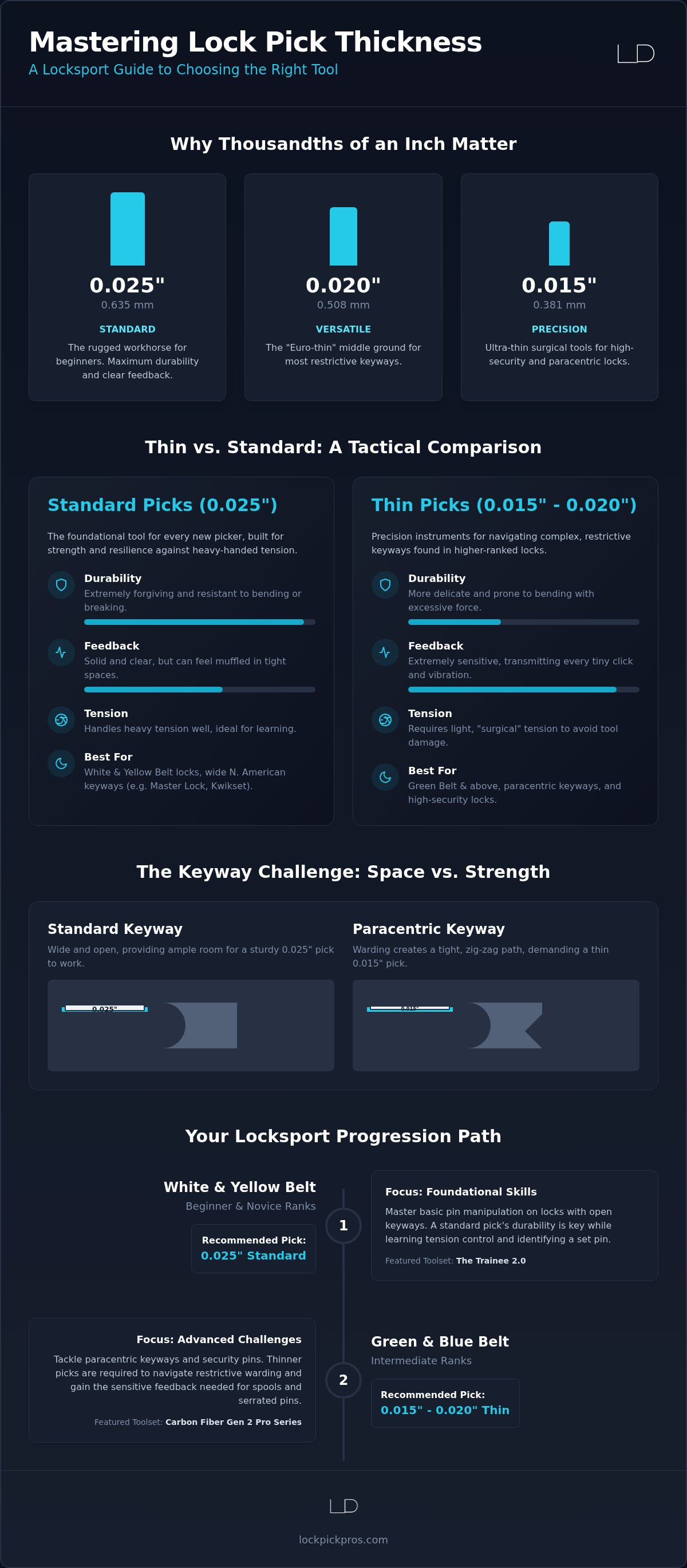
Thin vs. Standard Thickness: A Tactical Comparison
Choosing between thin vs standard thickness lock picks isn't just about what fits in the hole. It's a tactical decision that affects your feedback, speed, and tool longevity. While we've looked at the individual strengths of each, seeing them side-by-side helps you plan your kit for specific belt rank challenges. Standard 0.025" tools are your daily drivers for North American locks. Thin 0.015" picks are your specialized "problem solvers" for when the warding starts fighting back.
One often overlooked factor is the "Feedback Muffle." Thicker steel has more physical mass. This extra material acts as a dampener, absorbing the tiny vibrations that occur when a pin hits the shear line. It's like trying to feel a texture through a thick glove. Thin picks remove that barrier. They provide a raw, direct connection to the lock's internals. If you're tackling a Master Lock 410 LOTO, thickness choice determines your success rate. The 410 features a notoriously paracentric 401 keyway. A standard pick will constantly rub against the zig-zag warding, creating "noise" that feels like a binding pin. A 0.015" pick bypasses that noise, letting you feel the crisp counter-rotation of the six security pins inside.
The trade-off is purely economic and physical. Standard picks are nearly indestructible under ethical use. Thin picks are high-performance consumables. They will eventually succumb to metal fatigue or accidental bending. You're trading durability for the ability to open a wider variety of high-security locks. Mastering thin vs standard thickness lock picks means knowing when to risk the delicate tool for the win.
Thickness vs. Keyway Type
- Standard Keyways (SC1, KW1): Use 0.025" picks. These wide-open channels don't require thin tools, and the added strength allows for faster, more aggressive picking.
- Restricted/Paracentric Keyways: Use 0.020" or 0.015" picks. These are essential for navigating around warding in European locks or specialized safety padlocks.
Durability Expectancy
You can expect a standard 0.025" pick to last for years of consistent practice. They're the best foundational tools for building muscle memory without the fear of breaking equipment. Thin picks usually have a lifespan measured in months. Because they're thinner, they're more susceptible to "work hardening" and snapping at the neck. To get the best of both worlds, many advanced pickers transition to high-tensile materials.
Ready to upgrade your tactical kit with tools that won't flex under pressure? Grab the Carbon Fiber Gen 2 Pro Series to experience professional-grade feedback in a surgical profile.
Choosing Your Next Set: Matching Thickness to Belt Rank
Progression in locksport isn't just about skill; it's about the tools you carry. Your belt rank serves as the perfect roadmap for deciding between thin vs standard thickness lock picks. For White and Yellow belts, sticking with a 0.025" pick is the smartest move. You're building foundational muscle memory. You need a tool that won't deform while you're learning the "feel" of standard pin tumblers. These picks are rugged. They allow you to focus on the mechanics of the lock without worrying about snapping your equipment.
Once you hit Orange and Green belts, the locks get meaner. Tolerances tighten. You'll start seeing security pins like spools and serrations more frequently. This is the ideal time to introduce a 0.020" hook. It's the perfect middle ground. It gives you more room to maneuver in tighter keyways without the extreme fragility of ultra-thin steel. It's about finding that sweet spot between access and durability. You'll find that this slight reduction in thickness opens up a world of European and higher-tolerance padlocks that previously felt impossible.
For Blue belt and beyond, you're entering the big leagues. High-security cylinders often have paracentric warding that makes 0.025" picks useless. At this stage, 0.015" picks become a necessity rather than a luxury. You've developed the surgical tension required to keep these delicate tools intact. Most advanced pickers adopt a hybrid approach. They carry 0.025" for the basics and 0.015" for the specialized puzzles. Mastering thin vs standard thickness lock picks means having the right profile ready for the specific warding in front of you.
Upgrading Your Arsenal
Ready to expand your kit? For those in the intermediate ranks, the Pro Series Expansion offers the variety you need to tackle tougher warding. If you're pushing for those top-tier belts, the Gen 2 Pro Max Stealth Edition provides the ultimate in precision and high-tensile strength. These tools are engineered to provide maximum feedback while maintaining a slim profile for the most restricted keyways.
The Black Belt Challenge
Locksport is better when we do it together. Our community-led progression is designed to help you master every thickness and every security pin. We encourage you to share your journey with other ethical pickers. Post your "picks-in-action" on social media to earn rewards and contribute to our community bounty goals for hitting reach milestones. It's time to test your skills against the best locks in the sport. Join the Black Belt Challenge for free and start your climb to the top today.
Master Your Next Belt Rank with the Right Profile
Your journey through the belt ranks is defined by the tools you master. We've explored how standard 0.025" picks provide the durability needed for foundational learning. We also covered how thinner profiles unlock the complex puzzles of high-security cylinders. Understanding the tactical shift of thin vs standard thickness lock picks ensures you never find yourself stuck in a paracentric keyway without the right clearance. You now have the technical insight to match your tool thickness to the specific warding of your next practice lock.
Our community is built on a 100% ethical locksport focus. We provide Red Dot level precision tools used by professional locksmiths and hobbyists to deliver the crisp feedback required for expert-level picking. Don't let restrictive warding hold back your progression. It's time to refine your touch and tackle those advanced security pins with confidence.
Ready to take your skills to the next level? Join the Black Belt Challenge and upgrade your kit today! You've got the talent and the technical knowledge. Now get out there and earn your next belt.
Frequently Asked Questions
Can I use a 0.015" thin pick for every lock to save money?
No, using a 0.015" pick for everything will likely cost you more in the long run because they are prone to snapping under the heavy tension used on wider keyways. Thinner picks lack the structural rigidity of a 0.025" tool, making them poor choices for beginner locks with high spring tension. You'll end up replacing bent tools frequently instead of building solid muscle memory with a sturdier foundational set.
Why do my 0.025" standard picks feel like they are getting stuck?
Your picks are likely encountering paracentric warding, which is a zig-zag design that creates a tight path inside the keyhole. When comparing thin vs standard thickness lock picks, the 0.025" version is simply too wide to navigate these overlapping metal obstacles without rubbing against the lock body. This friction muffles feedback and can make it physically impossible to reach the back pins without a thinner tool.
Is it easier to break a thin lock pick than a standard one?
Yes, thinner picks are significantly more fragile because they have less metal stock in the neck and tip area. While a standard pick can survive years of heavy-handed trainee use, a thin pick requires surgical tension to avoid metal fatigue. If you apply too much upward force on a binding pin, the thin steel will bend or snap much faster than a standard 0.025" tool would.
What thickness of lock pick is best for European locks?
A thickness of 0.015" to 0.020" is generally best for European locks because they often feature very restrictive, narrow keyways. These locks are specifically designed to prevent thicker North American tools from entering. Using a Euro-thin 0.020" pick provides the best balance of access and strength for these tight tolerances as you work through your intermediate belt ranks.
Do I need special tension wrenches for thinner lock picks?
You don't necessarily need a special wrench, but you must ensure your tensioner doesn't block the extra space you gained by using a thinner pick. Many pickers prefer Top of Keyway (TOK) tension when using thin vs standard thickness lock picks. This setup leaves the entire bottom of the keyway open, giving your 0.015" pick maximum room to maneuver around the warding without getting pinched.
How can I tell the thickness of a pick if it is not labeled?
The most accurate way to identify thickness is by using a digital micrometer or a set of calipers to measure the metal stock of the blade. If you don't have those tools, you can compare the unknown pick side-by-side with a known 0.025" foundational tool. A 0.015" pick will look visibly much thinner and feel significantly more flexible when you gently press the tip against a hard surface.