

Mastering the Basics: The Ultimate Guide to Progressive Practice Lock Sets (2026)
What if your first experience with beginner lockpicking didn't feel like a total guessing game? It's incredibly frustrating to poke at five pins in a standard retail lock without knowing which one is binding or why you keep over-setting them. Most newcomers hit this wall because they're trying to run before they can walk, turning a fun hobby into a headache. You aren't alone in feeling like you're just poking in the dark while your tools do nothing but jam.
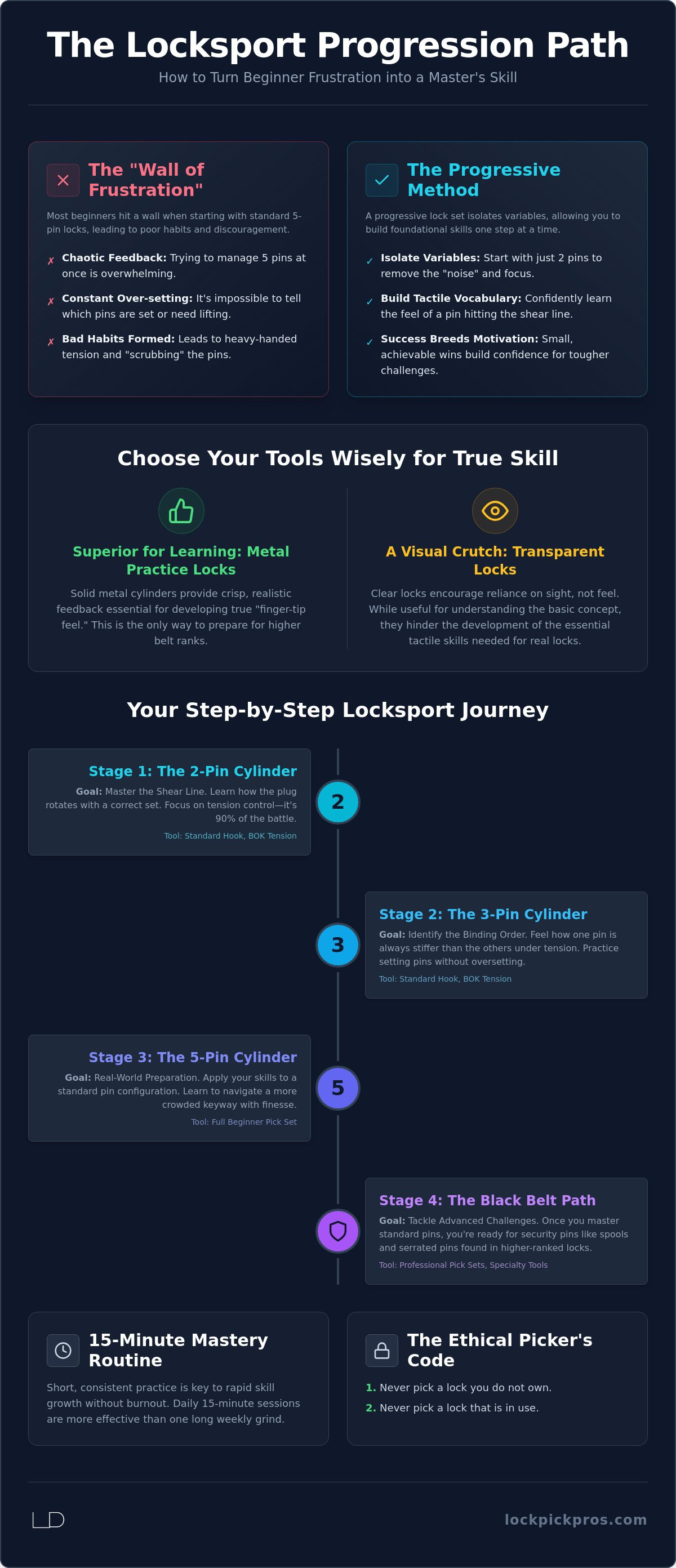
We understand that the jump from a clear training lock to a real cylinder can feel like a cliff. That's exactly why a progressive practice lock set is the most important tool in your kit. It's designed to isolate each movement, helping you develop a reliable tactile vocabulary by starting with just two pins. Instead of guessing, you'll learn to feel the exact moment a pin hits the shear line with total confidence.
In this guide, we'll walk you through the structured path to locksport mastery. You'll learn how to transition from basic sets to advanced configurations, refine your tension control, and prepare to earn your Yellow or Orange belt rank. Let's turn that frustration into the satisfying click of a successful open.
Key Takeaways
- Learn how isolating variables helps you overcome the "Wall of Frustration" and prevents bad picking habits.
- Master the shear line by using a progressive practice lock set to move confidently from 2-pin to 5-pin challenges.
- Understand why solid metal cylinders are superior to transparent locks. They're essential for developing the tactile feedback needed for higher belt ranks.
- Implement the "15-Minute Mastery" routine to ensure rapid skill progression without the burnout of long sessions.
- Start your journey toward locksport mastery by joining the Black Belt Challenge. It's the best way to earn rewards for your progress.
Why Beginners Struggle and How Progressive Practice Locks Solve It
Most newcomers start their journey by grabbing a standard five-pin padlock from a local hardware store. They sit down with a pick and a tension wrench, expecting a quick victory. Instead, they hit the "Wall of Frustration." Trying to manage five pins at once creates a chaotic mess of feedback. You don't know which pin is binding, you can't tell if you've over-set a stack, and the lock stays stubbornly closed. This leads to heavy-handed tension and "scrubbing" the pins, which are bad habits that will haunt you as you advance.
A progressive practice lock set solves this by isolating the variables. By starting with a two-pin cylinder, you remove the "noise" of the other three pins. This allows you to focus entirely on the core mechanics of the shear line. Understanding how the plug rotates when a pin is correctly set is an essential skill for locksmithing and locksport alike. Once you can reliably feel that single "click" in a two-pin lock, you've begun building a tactile vocabulary. You'll soon distinguish between the stiff resistance of a binding pin and the springy, loose feel of one that's already set. This foundational knowledge is the first step in the Lock Picking Belt Levels Explained system, moving you toward your first official rank.
The Psychology of Progressive Success
Success breeds motivation. When you open a two-pin lock in under a minute, your brain gets a hit of dopamine that keeps you engaged. This "small win" strategy builds the confidence you'll need when you eventually face high-security cylinders with spool or serrated pins. By reducing the number of pins, you also reduce the mental load. You can spend more time perfecting your tension control, which is 90% of the battle in locksport. You'll find yourself naturally transitioning from needing to see the pins to relying entirely on the vibrations traveling through your pick.
Ethical Locksport Foundations
Being an ethical picker means following two golden rules: never pick a lock you don't own, and never pick a lock that is currently in use. A progressive practice lock set provides a dedicated environment for learning without risking the security of your front door. Using these sets demonstrates your commitment to the hobby as a sport rather than a clandestine activity. At Lockpick Pros, we encourage every trainee to take the "Ethical Picker" pledge. It's about proving your lawful intent and dedication to the craft while you sharpen your skills on the way to a Black Belt.
The Anatomy of a Progressive Practice Lock Set
A progressive practice lock set consists of a series of identical metal cylinders, each pinned with increasing levels of complexity. These units are built with the same precision as retail hardware, containing a housing, a rotating plug, springs, and driver pins. By using metal instead of plastic, you get the crisp, metallic feedback necessary to master the sport. Brass cylinders are the gold standard here because they provide the most realistic vibrations. Unlike "cutaway" or clear locks, these blind cylinders force you to rely entirely on your hands, which is the only way to develop the "finger-tip feel" needed for higher belt ranks.
Understanding the internal mechanics is your first step toward mastery. When you insert a pick, you're interacting with the pin stack. Your goal is to lift each pair of pins to the shear line. The shear line is the precise point where the gap between the key pin and driver pin aligns with the edge of the plug, allowing it to rotate. In these practice locks, you'll start with just two pins to learn the "Binding Order." Because of tiny manufacturing differences, one pin will always bind first under tension. Finding that specific pin is the secret to a successful open.
The 2-Pin and 3-Pin: Technical Foundations
To master the initial stages of The Trainee 2.0, you'll need to follow a specific technical routine. These foundational cylinders use a pin stack of two or three standard brass driver pins with no security pins present. This clean setup allows you to focus on the basics without being tricked by false sets. Follow these steps for a successful open:
- Pick Choice: Use a standard short hook pick from your beginner set.
- Tension: Apply light to medium Bottom of Keyway (BOK) tension. You want just enough pressure to make one pin resist movement.
- Step 1: Insert your pick and probe each pin. Identify the "binding" pin that feels stiff.
- Step 2: Slowly lift the binding pin until you hear a distinct metallic click.
- Step 3: Once the first pin is set, it will feel springy. Move to the next binding pin and repeat the process until the plug rotates.
The 4-Pin and 5-Pin: Advancing Your Rank
As you progress to the four and five-pin cylinders, the keyway becomes significantly more crowded. The pin stack remains standard brass drivers to ensure you've mastered the fundamentals before moving to security pins. However, the increased pin count requires more delicate "pick set selection" and refined movements. To open the 5-pin configuration, switch to a feather-light tension. This prevents you from binding multiple pins at once, which is a common cause of over-setting. If you find the feedback is becoming muffled as the complexity increases, consider using a pick from the Carbon Fiber Gen 2 Pro Series. The carbon fiber handle transmits the subtle vibrations of the fifth pin much more clearly than standard steel tools.
Progressive Sets vs. Transparent Locks: Which is Better for Learning?
Clear locks are the training wheels of the locksport world. They look fantastic on a desk and offer a fascinating glimpse into the internal mechanics of a pin tumbler. However, they come with a significant catch. If you spend too much time looking at the pins, you'll never develop the "finger-tip feel" required for real challenges. In the community, we call this the "visual crutch." When you can see what you're doing, your brain stops listening to the subtle vibrations traveling through your pick. Since retail locks don't have windows, relying on your eyes will actually stunt your growth as a hobbyist.
Durability is another major factor. Most transparent locks are made of acrylic or similar plastics. These materials are prone to cracking under tension and have very loose tolerances. They don't behave like real metal. A progressive practice lock set, usually made of solid brass, provides a much more realistic experience. Brass doesn't just feel better; it communicates. The "click" of a pin hitting the shear line in a metal cylinder is crisp and distinct. In a plastic lock, that same movement often feels mushy and vague. If you want to build professional habits, you need tools that mirror the real world.
The ideal roadmap for a beginner is simple. Spend about ten minutes with a clear lock to understand the theory. Watch how the pins move and how the springs compress. Once you've got the concept down, put the clear lock aside. Move immediately to your progressive practice lock set to start training your hands. This transition is where the real learning begins.
When to Use a Clear Practice Padlock
Use a clear lock specifically to visualize the "Jiggle Test." This is a vital technique where you tap a pin to see if it's set. A set pin will have a tiny bit of springy "jiggle" to it, while a binding pin will feel rock solid. Seeing this happen helps you understand what your fingers should be searching for later. It's also great for seeing exactly how your tension wrench interacts with the plug. If you're curious about what else you'll need to start, check out our guide on what is in a beginner lock pick set to ensure you have the right picks for the job.
Why Progressive Sets Win for Long-Term Mastery
Progressive sets win because they force you to pick "blind," which is the only way to simulate real-world conditions. This builds the deep muscle memory needed to earn higher belt ranks. Many high-quality sets also allow you to re-pin the cylinders yourself. As you improve, you can swap out standard pins for spools or serrated drivers. This flexibility makes them a long-term investment that grows with you. Mastering these blind sets is the essential bridge to the Mastering the Advanced Lock stage. Don't let your progress stall on a plastic toy; get the metal and start feeling the pins.
A Step-by-Step Training Routine for Rapid Skill Progression
Consistency beats intensity every single time. Instead of spending three hours on a Saturday getting frustrated, adopt the "15-Minute Mastery" rule. Short, focused bursts of practice prevent your hands from cramping and your mind from wandering. When you use a progressive practice lock set, your goal is to achieve ten successful opens in a row before moving to the next cylinder. If a pin feels "stuck" or the plug won't budge, release your tension wrench, let the pins drop, and start over. This reset prevents you from forcing the tools and damaging the internal springs.
Mapping your progress requires careful attention to pick set selection. As the number of pins increases, the space inside the keyway decreases. You'll need to choose tools that allow you to reach the back of the lock without disturbing the pins you've already set. Use the "Jiggle Test" on every single pin stack to verify your progress. If a pin has a tiny bit of springy movement, it's likely set. If it's rock solid, it's binding. If it's loose and mushy, it's not doing anything yet.
Week 1: Refining the 3-Pin and 4-Pin
Your first week is about perfecting Single Pin Picking (SPP) on the intermediate cylinders. Focus on identifying the binding pin within 30 seconds of starting. While you learned the basics on the 2-pin, the 4-pin cylinder introduces more "noise." You must learn to navigate the pick tip precisely to the third and fourth chambers without bumping the first two. This stage is where you truly develop the patience required for official belt rank testing.
Week 2: Conquering the 5-Pin Challenge
The 5-pin cylinder is the final hurdle before you move toward your Yellow or Orange belt rank. This lock is more complex and requires a specific technical approach to overcome the crowded keyway and potential security pins. Follow these instructions for a successful open:
- Pin Stack: 5 standard brass pins (some advanced sets may include one spool pin in the second or third position).
- Pick Choice: A medium hook pick or a deep hook pick is recommended to reach the fifth pin without over-setting the others.
- Required Tension: Use very light Top of Keyway (TOK) tension. This provides maximum room for your pick and better feedback for the back pins.
- Security Pins: If you feel the plug rotate slightly but the lock doesn't open, you've hit a "false set" caused by a spool pin.
- Step-by-Step: Apply light TOK tension and probe to the very back. Set the fifth pin first if it's binding, then work your way forward. If you feel counter-rotation on a spool, slightly ease your tension while maintaining upward pressure with your hook until the pin clicks into place.
To ensure you're getting the most accurate feedback during this challenge, we recommend you upgrade to the Carbon Fiber Gen 2 Pro Series. These picks are designed to transmit the subtle vibrations of a 5-pin progressive practice lock set far better than standard steel tools.
Elevate Your Game with the Lockpick Pros Training System
Starting with a progressive practice lock set is the smartest move any trainee can make. However, the journey shouldn't end once you've opened that final five-pin cylinder. At Lockpick Pros, we believe every successful open is a step toward a larger goal. We've built a comprehensive training system designed to take you from a curious beginner to a seasoned expert. We aren't just a supply shop; we're your mentor in the world of ethical locksport.
Our system centers on the Black Belt Challenge. This isn't a manual for defeating locks in the wild. It's a structured ranking reference that mirrors the high standards of the global locksport community. By following our roadmap, you'll earn more than just technical skills. You'll join a group of like-minded hobbyists who value precision, patience, and legal practice. Using your progressive practice lock set as a foundation, you'll soon find yourself ready for the more complex challenges that define the intermediate and advanced tiers.
The Black Belt Challenge Roadmap
We include free entry into the Black Belt Challenge with any purchase of our beginner kits or training sets. As you climb the ranks, you'll unlock tier-specific rewards that help you upgrade your gear. For example, once you've mastered standard pins, you can earn rewards toward our Pro Series expansion tools. These advanced kits are designed specifically for the tight tolerances found in high-security locks. The roadmap ensures you always have a clear "next step" in your development, preventing the skill plateau that many solo pickers face when they try to learn without a guide.
Join the Ethical Locksport Community
The best way to stay motivated is to share your progress with others. Our "Share-to-Earn" loop allows you to earn rewards simply by being active in the community. When you record a "picks-in-action" video or post a photo of your latest open, you can earn points toward new tools. We also offer community bounties for reaching social milestones. If your tutorial on tension control or pin recognition hits a reach goal, we might send you a specialized Carbon Fiber Gen 2 Pro Series pick to celebrate your contribution to the sport.
To officially advance, you'll need to submit "Belt Request" videos. These are short clips showing you picking a lock to prove your skill level. Our community of ethical pickers will validate your open and help you celebrate your new rank. It's a supportive environment where everyone wants to see you succeed. Stop practicing in isolation and start your journey toward mastery. Join the Black Belt Challenge for Free Today!
Your Journey to Black Belt Starts Today
You now have the roadmap to move from beginner frustration to locksport mastery. By choosing a progressive practice lock set over transparent toys, you've committed to developing the genuine finger-tip feel required for advanced ranking. We've mentored over 10,000 hobbyists on this path, providing precision-engineered gear designed for maximum tactile feedback. As an official partner of the Black Belt Challenge, we're dedicated to helping you earn your stripes through ethical practice and community support.
It's time to put these techniques into action and feel the satisfying click of a real brass cylinder. Your first open is just a few focused sessions away. Whether you're mastering the binding order on a two-pin lock or navigating the counter-rotation of a spool pin, having the right tools makes all the difference in your progression.
Start Your Journey with the Carbon Fiber Gen 2 Pro Series
We're excited to see you progress through the belt ranks and share your success with the community. Grab your picks, set your tension, and let's get started. We'll see you on the leaderboard!
Frequently Asked Questions
What is a progressive practice lock set?
A progressive practice lock set is a series of identical metal cylinders pinned with increasing complexity, typically ranging from two to five pins. These sets allow you to master the feel of a single binding pin before moving to more crowded keyways. By isolating the variables, you build muscle memory much faster than you would by starting with a standard five pin retail lock.
How long does it take to progress through a 5-pin set?
Most hobbyists successfully progress through a full five pin set within two to four weeks of consistent, daily practice. Using the 15-Minute Mastery rule helps prevent burnout and ensures you're developing quality habits. Your individual timeline depends on how quickly you develop a tactile vocabulary and master tension control. Don't rush; the goal is ten consecutive successful opens before moving up.
Can I re-pin my progressive practice locks?
Yes, many high quality progressive cylinders are designed to be re-pinned as your skills advance. This allows you to swap out standard pins for security pins like spools or serrated drivers. This modularity makes the set a long term investment that grows with you. Once you've mastered the standard five pin configuration, you can create custom challenges to sharpen your counter-rotation feedback.
Should I start with a clear lock or a progressive set?
You should use a clear lock for about ten minutes to visualize the internal mechanics, then switch immediately to a progressive practice lock set. Relying on clear locks for too long creates a visual crutch that stunts your progress. Metal cylinders provide the realistic feedback and crisp clicks you need to pick blind, which is how all real world locks function.
Do I need different picks for a progressive lock set?
Standard beginner picks work perfectly well for these sets, but higher quality tools will improve your success rate. As you move into four and five pin challenges, using a Carbon Fiber Gen 2 Pro Series pick provides much clearer feedback. These professional grade tools help you distinguish between a set pin and a tricky spool pin, making your training sessions more productive and less frustrating.
Are progressive practice locks legal to own?
Progressive practice locks are legal to own in most jurisdictions when used for ethical locksport and hobbyist purposes. However, laws vary by state and country, so it's your responsibility to check your local regulations. At Lockpick Pros, we advocate for the Ethical Picker pledge. This means only picking locks you own and never attempting to open a lock that is currently in use.
What belt rank can I achieve with a progressive practice set?
Mastering a standard five pin progressive set typically prepares you for the White and Yellow belt ranks in the locksport community. If you re-pin your set with security pins, you can even use it to train for Orange belt requirements. These sets provide the foundational skills required to transition to the specific retail locks listed in the higher tiers of the Black Belt Challenge.
Why do I keep over-setting pins on my 4-pin lock?
Over-setting usually happens because you're using too much tension or lack a clear tactile vocabulary. When you apply heavy tension, pins become harder to move, causing you to push them past the shear line with too much force. Use the Jiggle Test to verify if a pin is already set. If it feels springy, leave it alone. If it's rock solid, it's binding.