

What is in a Beginner Lock Pick Set? The 2026 Locksport Essential Guide
Your first lockpick set isn't just a toolbox; it's your entry ticket into a global community of ethical problem-solvers. You've likely seen those massive 30-piece kits online and wondered if you're missing out by starting small. It's totally normal to feel overwhelmed by different pick profiles or worry about the legality of your new hobby. Many new hobbyists ask exactly what is in a beginner lock pick set that actually works without snapping on the first try. We know the frustration of staring at a pile of metal and not knowing which end goes in the keyway.
We're here to help you cut through the noise. This guide will clear the confusion and show you the exact foundational tools you need to earn your White Belt rank with total confidence. You'll learn the specific purpose of hooks, rakes, and tension wrenches so you can identify a high-quality kit that grows with your skills. We'll break down the essential components of a starter setup and explain how to choose gear that won't ruin your practice locks.
Key Takeaways
- Master the philosophy of locksport and learn to treat every cylinder as a rewarding puzzle rather than a barrier.
- Discover exactly what is in a beginner lock pick set to avoid wasting money on "filler" tools that offer zero tactile feedback.
- Speed up your learning curve by combining essential picks with progressive pinning techniques on dedicated practice locks.
- Learn to spot professional-grade High Yield steel and smooth, deburred edges that protect your locks and improve your feel.
- Get a clear roadmap for your progression from White Belt basics to the advanced tools used in the Black Belt Challenge.
The Foundation of Locksport: What Exactly Is a Beginner Lock Pick Set?
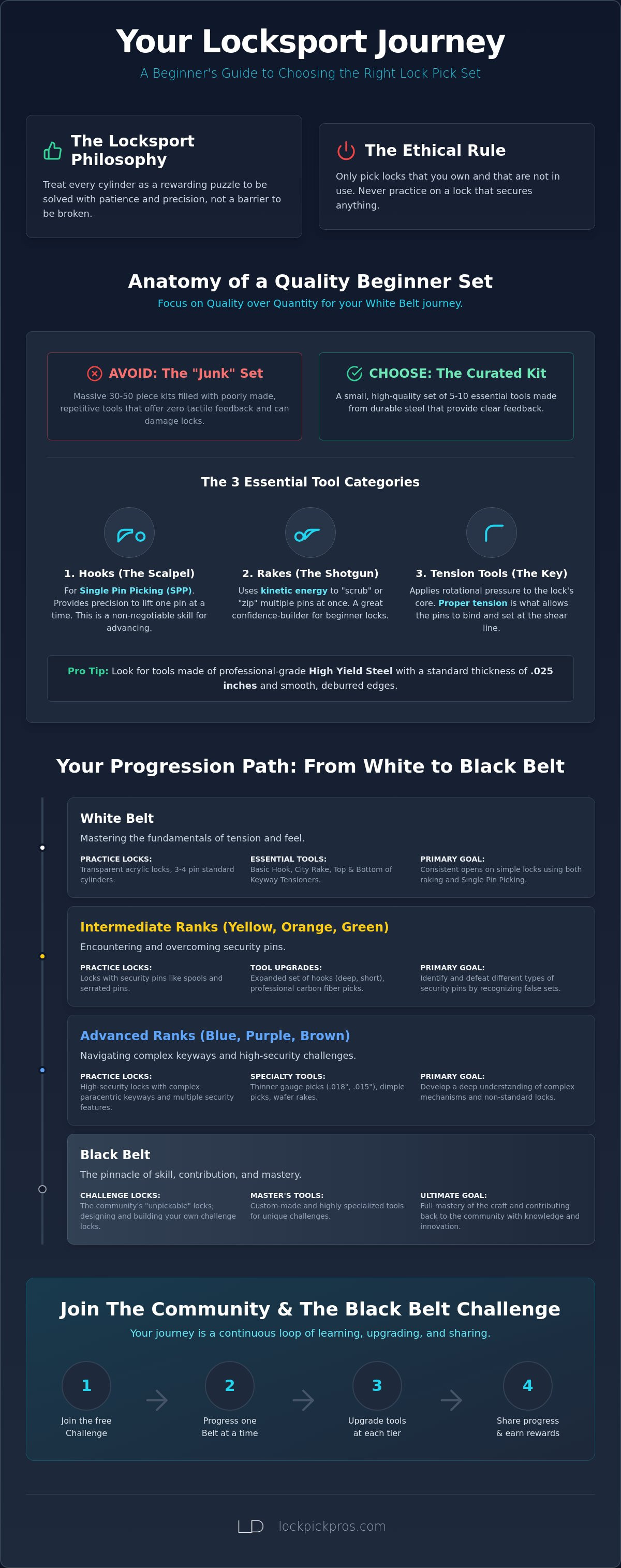
Understanding what is in a beginner lock pick set is the first step toward joining a passionate community of hobbyists. A true starter kit isn't a random collection of metal. It's a curated selection of hooks, rakes, and tension tools designed to teach you the mechanics of a lock. These tools allow you to feel what's happening inside the keyway without seeing it. A beginner set is the essential gateway to the White Belt rank.
Locksport is far more than just a technical skill; it's a competitive and ethical puzzle-solving hobby. It shares a deep connection with the history of lock picking, which has evolved from a trade secret into a modern sport. We treat every cylinder as a challenge to be solved through patience and precision. To keep this community thriving, every member follows the "Ethical Lockpicker" rule. This means you only pick locks that you own and that are not currently in use. Never practice on the front door of your house or any lock that someone relies on for security.
Locksport vs. Locksmithing: A Hobbyist Perspective
While locksmiths often work under pressure to provide entry, locksport hobbyists focus on non-destructive entry and skill mastery. We aren't looking for the fastest way to break a lock. We want to understand it. The community is built on sharing knowledge through forums and local meetups where people compare techniques. For many, locksport for beginners is about the mental challenge rather than the act of opening. It's about that satisfying "click" when the pins align perfectly.
Why Your First Set Defines Your White Belt Journey
The locksport community uses a belt ranking system, moving from White to Black, to track your progress. Your first set determines how quickly you'll advance through these tiers. Knowing exactly what is in a beginner lock pick set helps you avoid the "junk" sets that often flood the market. Many people make the mistake of buying 50-piece sets thinking more is better. In reality, starting with too many tools can actually slow down your learning. It's confusing to choose between ten different rakes when you haven't mastered the basics of tension.
Success in the early stages depends on the feedback loop between the tool and your hand. High-quality beginner sets focus on a few essential profiles that provide clear tactile responses. When you use a well-made hook, you can feel the binding pin move and hear the spring set. This foundational understanding is what allows you to tackle more complex security pins later in your journey. Focus on quality over quantity to build the muscle memory needed for higher ranks.
Anatomy of an Entry-Level Kit: Hooks, Rakes, and Tension Tools
The tools in these kits are the lifeblood of the competitive locksport community. Each piece has a specific mechanical job to do inside the keyway. By mastering how these three categories interact, you'll develop the muscle memory needed to progress through the community ranking system.
The Hook: Precision for Single Pin Picking (SPP)
The short hook is the scalpel of the locksport world. It is the primary tool for single pin picking for beginners, a technique where you lift individual pins to find the binding order. Mastering the hook is non-negotiable for advancing through higher belt ranks. It gives you the surgical precision to bypass security pins that rakes simply cannot handle.
The Rake: Speed and Kinetic Energy
Profiles like the Bogota or City Rake use kinetic energy to "scrub" or "zip" pins into place. Think of this as the shotgun approach to entry. Raking is a fantastic confidence builder for White Belt locks, providing quick opens that prove the mechanics work. While it doesn't offer the deep mechanical understanding of SPP, it's a vital skill for any trainee to master early on.
Tension Wrenches: The Secret to Every Successful Pick
Tension is 90% of your success. Your pick set selection must include both Top of Keyway (TOK) and Bottom of Keyway (BOK) wrenches. TOK tension is often preferred in higher tiers because it keeps the keyway clear for your pick. Choosing the right width wrench ensures a snug fit. This is the only way to feel the subtle vibrations of a setting pin. For those ready to level up their tactile feedback, the Carbon Fiber Gen 2 Pro Series offers unmatched sensitivity.
Beyond the Picks: Practice Locks and Essential Accessories
Owning a collection of high-quality picks is a great start, but your journey will stall if you don't have a way to apply your skills. A set is fundamentally incomplete without something to practice on. When you evaluate what is in a beginner lock pick set, you should prioritize kits that include or pair well with dedicated practice cylinders. Having a controlled environment allows you to test the feedback of your hooks and rakes without the risk of damaging a lock you actually need. It's the difference between reading about a sport and actually stepping onto the field.
Beyond the locks themselves, accessories play a massive role in your long-term success. A sturdy carrying case is not just for organization; it's a protective shield for your investment. Thin steel tips are prone to "pick fatigue" and can easily bend or snap if left loose in a drawer or pocket. As you progress, you'll also want to look into a pinning tray. While you might not need it for your first White Belt open, it becomes essential when you start rekeying locks or exploring the world of "progressive pinning." This technique involves starting with a single pin in a lock and gradually adding more as your confidence grows, which is one of the fastest ways to master the craft.
Visual Learning with Clear Practice Padlocks
For most trainees, the first step involves a clear practice padlock. These transparent tools are incredible for visual learners because they reveal the internal mechanics of the pin stacks and springs. There is a specific "Aha!" moment that occurs when you finally see the shear line align as you set a pin. It connects the physical sensation in your hand to the mechanical reality inside the core. Just keep in mind that clear locks are made of acrylic. They are perfect for visual reference, but they don't provide the realistic feel or "crunch" of a standard metal lock.
Transitioning to Metal Cutaway Locks for Feedback
Once you've mastered the internal layout, it's time to transition to metal cutaway locks. These provide the realistic "click" and vibration feedback you'll encounter in the wild. Metal cutaways are the gold standard for Yellow Belt and Green Belt progression because they bridge the gap between training tools and real-world security. They allow you to see the pins while feeling the true resistance of brass and steel. If you are unsure where to start, check out our guide on how to choose your first practice lock. Understanding what is in a beginner lock pick set means recognizing that your tools are only as good as the practice locks you use to sharpen them.
Avoiding The Junk: How to Spot a Quality Beginner Set
Buying your first kit is an exciting milestone, but don't fall for the trap of "pot metal" sets found on generic discount sites. When you research what is in a beginner lock pick set, the material quality is the single most important factor to consider. Professional-grade High Yield steel is both flexible and incredibly strong. Cheap sets often use brittle alloys that snap the moment you apply a little too much tension. Quality tools translate lock vibrations into your fingertips, allowing you to "hear" the internal mechanics with your hands.
Another hallmark of a quality set is the finish of the tools. Look for picks that have been deburred or polished. If a pick feels rough or has sharp burrs from the factory, it will snag on the pins and the warding inside the lock. This creates "ghost feedback" that makes it nearly impossible for a trainee to feel the true binding order. A smooth, polished pick slides effortlessly through the keyway, ensuring every sensation you feel is actually coming from the pins themselves.
Steel Quality and Feedback Sensitivity
High-quality steel acts like a tuning fork for pin feedback. When a pin reaches the shear line, it sends a distinct vibration through the tool. You want full tang picks where the metal runs the entire length of the handle. This design provides a direct, uninterrupted path for those vibrations to reach your palm. If the metal only goes halfway into the handle, much of that vital information is lost in the plastic. For those looking to reduce weight while increasing tactile sensitivity, explore the benefits of carbon fiber lock picks for your next upgrade.
Ergonomics: Why Handle Design Matters
Bare metal picks are common in EDC kits, but they can be uncomfortable during the long practice sessions required to master the White Belt. Ergonomic handles made of plastic, rubber, or advanced composites are essential for preventing hand cramps. The shape of the handle also affects the "fulcrum" during picking. You need a comfortable grip to maintain precise control over the tip of the hook. We recommend learning how to hold lock picks correctly to maximize your sensitivity and avoid muscle fatigue. A well-designed handle allows you to pick longer and with much greater accuracy.
Don't settle for tools that hinder your progress. If you want a kit that provides professional-level feedback from day one, check out our Carbon Fiber Gen 2 Pro Series to start your journey with the best gear available.
Starting Your Journey: The Trainee 2.0 and the Black Belt Challenge
You've done the research. You know the difference between High Yield steel and cheap alloys. Now, it's time to choose the gear that will actually carry you to your first open. When you look at what is in a beginner lock pick set from our collection, you'll see a focus on tools that provide the most feedback for your effort. We don't believe in selling you stuff you won't use. We believe in providing a foundational kit that helps you earn your rank. Understanding what is in a beginner lock pick set is only the first step; the real magic happens when you put those tools to work on a cylinder.
The journey from a curious trainee to a master picker is a marathon, not a sprint. While your first set gets you through the door, our Carbon Fiber Gen 2 Pro Series is waiting for you when you're ready for true skill refinement. These advanced tools offer weight reduction and increased sensitivity for those challenging Green and Blue belt locks. We're here to be your knowledgeable mentor at every stage of this process.
The Trainee 2.0: Your White Belt Foundation
The Trainee 2.0 is the gold standard for new Lockpick Pros members. This set includes a curated selection of short hooks and versatile rakes, paired with essential tension wrenches. Each tool features precision-milled tips that glide over pins without snagging. The ergonomic grips are designed to keep your hand steady and comfortable during those first few minutes of intense focus. It's everything you need to start feeling the pins and nothing you don't.
The Black Belt Challenge: Earn Your Rank
We want to see your progress. That's why we invite every new hobbyist to join the free Black Belt Challenge. It's simple to get started. Once you've made your first open, submit a photo or video of your "picks-in-action" to our community portal. This allows you to progress through the belt tiers and show off your growing skills. We've built a "share-to-earn" rewards system where you earn points for every rank you achieve. These points can be used to upgrade your gear as you reach higher levels. We even offer a community bounty for members who hit social reach goals while sharing their locksport journey. Join the challenge today and start your path to mastery.
Master Your First Open Today
Your journey into the world of locksport is about more than just tools; it's about the thrill of solving a mechanical puzzle. You've learned that quality steel and the right profile selection are the keys to a successful start. By choosing gear with precision-milled High Yield Steel and Red Dot standard ergonomic designs, you ensure your focus stays on the pins rather than hand fatigue. Now that you know exactly what is in a beginner lock pick set, you can avoid the frustration of brittle tools and useless filler pieces that hold back your progress.
The locksport community is waiting for you. Join 10,000+ ethical lockpickers already testing their skills in the Black Belt Challenge. Whether you're aiming for your White Belt or looking to master the most complex security pins, the right foundation makes all the difference. Don't let poor equipment dampen your enthusiasm for this incredible hobby. Take that first step with confidence and start your journey with The Trainee 2.0 Beginner Set today. The path to mastery starts with a single click, and we're excited to see you earn your first rank.
Frequently Asked Questions
Are lock picks legal for me to own and use as a hobbyist?
Lock picks are legal to own in most US states and across the UK as long as you don't have criminal intent. It's vital to research your local laws because some jurisdictions consider possession outside your home as prima facie evidence of a crime. Always stick to the ethical rule of only picking locks you own or have permission to open in a legal setting.
How long does it typically take a beginner to pick their first lock?
Most beginners can pick their first basic padlock within 10 to 30 minutes of starting. If you use a rake on a low-security White Belt lock, it might even happen in seconds. Success depends on understanding the binding order and applying the right amount of tension. Don't rush; focus on the tactile feedback to build your foundational skills and muscle memory.
Which Master Lock is the best one to start with for a White Belt?
The Master Lock No. 3 is the ideal White Belt challenge. It contains a 4-pin stack made entirely of standard pins with zero security pins. To open it, insert a BOK wrench into the bottom of the keyway and apply heavy tension to counter the strong internal spring. Use a short hook to probe the pins from front to back. Identify the binding pin that resists movement, lift it until you feel a distinct click at the shear line, and repeat this for the remaining pins until the shackle releases.
What is the difference between a hook and a rake in a beginner set?
A hook is designed for Single Pin Picking (SPP), while a rake uses kinetic energy to manipulate multiple pins at once. Understanding these distinct roles helps you identify what is in a beginner lock pick set that actually works for skill progression. Use the hook when you want to learn the internal mechanics of a specific core and the rake for a quick, "low-skill" entry on basic locks.
Why do I need multiple tension wrenches in a starter kit?
Keyway dimensions vary wildly between brands, making a variety of wrenches essential for proper pick set selection. A wrench that is too thin will wiggle and dampen the feedback you need to feel the pins set. Conversely, a wrench that is too thick simply won't fit. Having multiple widths ensures you can achieve a snug fit for both Top of Keyway (TOK) and Bottom of Keyway (BOK) techniques.
Can I pick my own front door lock if I lose my keys?
You should never pick your own front door lock, even if you're locked out. Locks in use are under constant tension and can easily be damaged by picking tools, potentially leaving you with a broken core and an expensive locksmith bill. Stick to practice locks on your workbench to ensure you don't compromise your home security or violate the ethical rules of the locksport community.
Do I need to buy a clear practice lock to learn effectively?
While not strictly necessary, a clear practice lock is highly recommended for visual learners. It provides a visual "Aha!" moment by showing you exactly how the pins react to your hook. However, once you understand the internal mechanics, you should move to metal locks to develop the tactile sensitivity required for higher belt rankings. This transition is a vital part of what is in a beginner lock pick set journey.
What should I look for in a carrying case for my lock picks?
Look for a carrying case with individual slots to keep your tools organized and protected from bending. A good case prevents your picks from rubbing against each other, which can dull the precision-milled tips. Protecting your investment is vital since even a small bend in a .025 inch pick can ruin the delicate feedback you need to earn your next belt rank.