

Flying with Lock Picks: The Ultimate 2026 Hobbyist Travel Checklist
What if your favorite hobby didn't have to stay behind just because you're catching a flight? Many enthusiasts feel a spike of anxiety when they think about flying with lock picks for the first time. It's common to worry that a security officer might misinterpret your tools or that your favorite carbon fiber picks will be confiscated at the checkpoint. We understand that fear. You want to stay sharp on your belt ranking journey without being treated like a criminal at the gate.
This guide will show you exactly how to navigate airport security with confidence so you can keep your practice alive wherever you land. We'll break down the 2026 TSA regulations, including the strict seven inch length limit for tools in carry-on bags. You'll also get a clear strategy for packing your gear to prove your lawful intent and tips for managing the complex legal differences between domestic and international travel. It is time to travel like a pro and ensure your gear arrives safely with you.
Key Takeaways
- Master the TSA "7-inch rule" to ensure your tools are carry-on compliant and learn why checked bags are a solid backup for sharp-edged gear.
- Discover how to organize your carrying case to provide a clean X-ray signature, reducing the chances of a manual bag search.
- Gain confidence in flying with lock picks by using the "Hobbyist Pitch" to explain your belt ranking goals to security officers.
- Learn why a minimalist setup with carbon fiber lockpicks is the ultimate choice for durable, lightweight travel.
- Find out how to turn airport layovers into productive practice sessions and leverage your travel to earn rewards through the Black Belt Challenge.
TSA Regulations and Global Rules for Flying with Lock Picks in 2026
Bringing your passion for locksport across state lines or international borders is easier than you might think. As of July 2026, the Transportation Security Administration (TSA) explicitly permits the transport of lock picks in both carry-on and checked luggage. The key to a smooth experience is understanding that Lock picking is viewed by the agency as a collection of tools rather than weapons. However, while the rules are clear on paper, the way you present your kit determines how quickly you move through the line. Most ethical lockpickers prefer carry-on bags to keep their high-quality tools safe, but you must adhere to specific physical constraints to avoid a secondary search.
Domestic US Travel vs. International Regulations
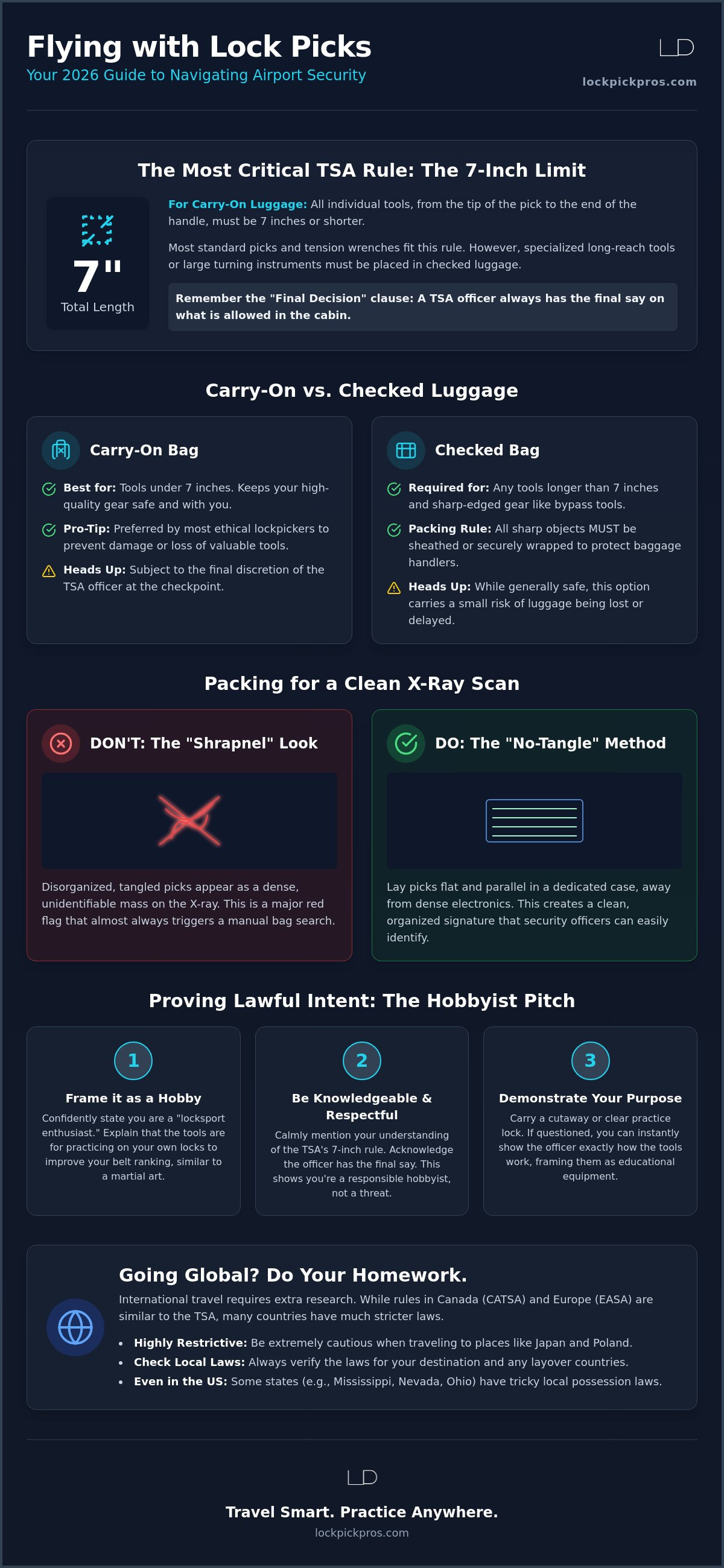
Traveling within the United States generally follows a standard protocol, but international trips require extra homework. In 2026, agencies like CATSA in Canada and EASA in Europe maintain similar "tool" definitions, but their interpretation of "locksmith tools" can be stricter than the TSA. Some countries, including Japan and Poland, have much more restrictive laws regarding the possession of these items. Even within the US, local laws in states like Mississippi, Nevada, or Ohio can be tricky. Always frame your gear as hobbyist equipment for sport. If you're moving toward an intermediate rank, carrying a professional set like the Carbon Fiber Gen 2 Pro Series helps establish you as a serious hobbyist rather than someone with ill intent.
The 7-Inch Rule: Measuring Your Kit Correctly
The most critical regulation to remember for 2026 is the TSA length limit. All tools in your carry-on must be 7 inches or less in total length. This measurement includes the entire tool from the tip of the pick to the very end of the handle. Most standard picks and tension wrenches easily fit within this window. If you use specialized long-reach tools or large turning instruments, they must go into your checked bag. When packing for checked luggage, the TSA requires any sharp objects to be sheathed or securely wrapped to prevent injury to baggage handlers. A dedicated carrying case is the best way to meet this requirement while keeping your kit organized. For those who extend this focus on durability to their main luggage, aleoncase.com offers insights into the latest trends in high-quality aluminum travel cases.
It's vital to remember the "Final Decision" clause. Even if your tools meet every metric, the individual TSA officer at the checkpoint has the final word on what enters the cabin. If an officer feels a specific tool is a security risk, you must be prepared to part with it or check the bag. Bypass tools and automotive wedges often face more scrutiny than standard picks because they look less like "hobbyist" gear. Stick to your core practice sets for the best results. By staying respectful and knowledgeable about the rules, you'll find that flying with lock picks is a routine part of the modern locksport lifestyle.
The Essential Compact Lock Pick Kit for Travel Checklist
You know the rules. Now you need to pack. Flying with lock picks is simple when your bag looks professional on the scanner. Avoid the temptation to dump your entire collection into a backpack. Instead, adopt a "Travel Light" philosophy. Bring only the tools required for your current belt rank. If you're working on your Orange Belt, you don't need a massive kit of dimple picks. Focus on the core tools that will keep your practice consistent while you're away from your main bench. This keeps your kit small, manageable, and easy to explain if security asks questions.
Packing for the X-Ray: The "No-Tangle" Method
Disorganized metal tools are a red flag for security officers. When picks are bunched together, they appear as a dense, unidentifiable mass of "shrapnel" on the X-ray screen. This often triggers manual bag searches. Use the "No-Tangle" method by laying your picks flat and parallel in a dedicated organizer. Keep your metal tools away from dense electronics like power banks or laptops. This reduces visual clutter on the scanner. A streamlined Gen 2 Pro Max Stealth Edition includes a carrying case designed specifically for this purpose. It ensures each tool has its own slot, presenting a clean and organized signature to the officer.
Practice Locks and Accessories Checklist
Choose your practice locks wisely for the road. While plastic training locks are great for beginners, they can crack in a pressurized cabin or under the weight of other luggage. Metal practice locks offer superior durability. Cutaway locks are particularly useful for travel. They allow you to show a security officer exactly how the pins work, which instantly frames your gear as an educational hobby. Avoid bringing loose pins, springs, or small parts. These can spill during a search and are nearly impossible to find on a plane. According to official TSA Regulations, your tools are allowed, but keeping them contained is your responsibility.
Selecting the right case is your final step. A hard-shell travel container provides the best protection for high-end tools against crushing. However, a slim soft-shell case often fits better in a crowded carry-on. If you want a kit that balances weight and strength, the Carbon Fiber Gen 2 Pro Series is an excellent choice for your next trip. It's built for the road and fits perfectly into a minimalist travel setup.
Follow this minimalist travel checklist to stay organized:
- 1 Hook: A standard short hook covers 80% of your locksport needs.
- 1 Rake: Perfect for quick opens and warming up your hands.
- 2 Tensioners: Bring one top-of-keyway and one bottom-of-keyway wrench.
- 1 Practice Lock: Use a cutaway or progressive lock matched to your current belt level.
Proving Lawful Intent: Communicating with Security
Even with a perfectly organized kit, a manual bag inspection can still happen. This is your opportunity to demonstrate that you are an ethical hobbyist. When an officer pulls your picks aside, your attitude is your most valuable tool. Approach the situation like a knowledgeable mentor sharing a passion. If you remain calm and transparent, the interaction usually ends with a smile and a "have a nice flight." The goal is to shift the perception of your gear from "burglary tools" to "sporting equipment" in seconds. Most officers are simply curious; they want to know that you're one of the many ethical lockpickers who treat these tools as instruments for skill progression rather than illicit gain.
Prepare a "Hobbyist Pitch" that lasts about 15 seconds. When asked what the tools are for, say something like: "I practice locksport, which is a competitive puzzle-solving hobby focused on lock mechanics. These are my practice tools, and I'm currently training to earn my next belt rank." This phrasing is intentional. Words like "locksport," "puzzle-solving," and "belt rank" align your activity with recognized sports like karate or chess. Referencing the TSA rules on flying with lock picks can be helpful, but your professional demeanor carries more weight than a printed regulation page.
Documenting Your Hobby
Carrying physical proof of your involvement in the community can end a debate before it starts. We recommend keeping a printed copy of the Lock Picking Belt Levels Explained guide in your carrying case. When an officer sees a structured ranking system, it legitimizes your presence in the hobby. You can also show "picks-in-action" photos or videos on your social media to prove you're part of a global community. For a deeper look at how to protect yourself legally, see our guide on Proving Lawful Intent with Lock Picks. These documents serve as a silent witness to your status as a dedicated student of the craft.
What to Do if Challenged
If an officer is hesitant about flying with lock picks, stay polite. Never argue or become defensive. If they claim the tools are prohibited, you can respectfully ask for a supervisor to clarify the current policy. However, you must recognize when to stop. If a supervisor insists the tools cannot go in the cabin, don't risk your flight or a permanent mark on your record. Use the "Checked Bag Backup" strategy. Ask if you can step back out of the security line to check the bag at the ticket counter. This preserves your expensive tools without causing a confrontation. Most of the time, a clear explanation of your hobby and a friendly smile will get you through the gate with your kit intact.
Selecting the Best Travel-Ready Tool Sets
Packing for a trip means making tough choices about your gear. While your home bench might be loaded with every rake and hook imaginable, flying with lock picks requires a "Minimalist Pro" mindset. You don't need twenty picks to keep your skills sharp during a week-long vacation. A streamlined 5-piece setup is usually plenty for maintaining your current belt rank. Aim for a kit that fits into a standard EDC pocket. This keeps your tools discreet and ensures they don't take up valuable space in your carry-on bag. For other discreet personal essentials that fit perfectly into a minimalist travel setup, you can discover YourCondomStore.com.
Modern materials have changed the game for mobile pickers. Carbon fiber handles are the gold standard for travel in 2026. They provide incredible feedback and durability without the weight of traditional metal handles. When every ounce matters in your luggage, switching to a lightweight set makes a noticeable difference. Many beginners find that their starter sets are actually the best travel companions. These kits are simple, effective, and less devastating to lose if a security officer decides to be difficult at the checkpoint.
Top Picks for Mobile Locksport
If you're serious about your progression, the Carbon Fiber Gen 2 Pro Series is the ultimate travel-ready choice. It offers professional-grade precision in a package that's built for the road. For those traveling to high-risk areas where tool confiscation is more likely, consider the Trainee 2.0. It's an affordable, high-quality "sacrificial" kit that performs well but won't break the bank if it goes missing. When choosing between standard steel and high-yield picks, high-yield is better for long trips. These picks resist bending and fatigue, ensuring your tools stay true throughout your entire journey.
Specialty Tools and Travel
Specialty gear requires a different strategy. If you're heading to Europe or Asia, you might encounter high-security locks that require Dimple Picks. These are generally safe for carry-on as long as they meet the length requirements. However, bypass tools and automotive wedges should almost always stay in your checked luggage. They often look more "tactical" on an X-ray and can trigger unnecessary questions. If you've upgraded your kit with Pro Series Expansion tools, make sure they are secured in a dedicated case to prevent them from rattling around. Ready to upgrade your travel game? Check out the Carbon Fiber Gen 2 Pro Series here.
The Black Belt Challenge: Progressing on the Go
Travel isn't just about the destination. It's about the hours in between. For a dedicated hobbyist, flying with lock picks turns a boring layover into a high-intensity "White Belt" practice session. Airport gates and airplane trays offer the perfect environment for focused, distraction-free picking. Instead of scrolling through your phone, you can refine your tension control and feel the subtle clicks of a security pin. This is how you bridge the gap between intermediate skill and true mastery. Every minute spent with a pick in your hand is an investment in your locksport ranking.
Refining your strategy for flying with lock picks is only half the battle. The real beauty of travel is the exposure to new hardware. Different regions often use local brands and lock designs you won't find at your neighborhood shop. Exploring a hardware store in a new city can yield unique padlocks that provide fresh challenges for your belt ranking progression. Just remember the golden rule of the ethical lockpicker: never pick a lock you don't own or a lock that is in use. Stick to the practice locks you brought in your kit to keep your skills sharp and your reputation clean. Hotel room practice on your own gear is the ultimate way to decompress after a long day of sightseeing.
Mobile Practice Strategies
Maximize your flight time with "blind picking." Since you're in a cramped seat, you often can't look directly into the keyway. This forces you to rely entirely on tactile feedback. It's a fantastic way to enhance your "feel" for the pins. Use the quiet hours of a long-haul flight to study pin stack theory or visualize the internal mechanics of a complex cylinder. Before you even leave for the airport, set a specific "Travel Goal." Maybe you want to master a specific rake pattern or finally crack that tricky spool pin before you land. Having a clear objective makes the time fly by and ensures you return home a better picker than when you left.
Join the Black Belt Challenge
We want to see your progress. Our community thrives on the "Share-to-Earn" loop, a system designed to reward your dedication. When you hit a new milestone at your destination, document it. Share your "picks-in-action" content on social media to earn exclusive rewards and community bounties. We've even set a community bounty for hitting specific social reach goals to foster engagement among our global members. It's a great way to stay motivated while you're away from your home workbench and connect with other pickers around the world.
The journey from a beginner to an expert is a marathon, not a sprint. Every flight and every hotel room session brings you one step closer to the top tier. Our free Black Belt Challenge is open to everyone, providing a structured path to help you upgrade your tools and your skills at every belt level. Don't let your practice stall just because you're on the move. Join our community of passionate hobbyists and start your Black Belt journey today.
Master the Skies with Your Locksport Gear
Traveling with your tools doesn't have to be a source of anxiety. By mastering the 7-inch rule and refining your "Hobbyist Pitch," you can ensure a smooth experience at any security checkpoint. Remember that flying with lock picks is a routine part of the modern locksport lifestyle when you prioritize transparency and organization. Your commitment to the ethical locksport community shows through your professional demeanor and your well-maintained kit.
It's time to turn those long layovers into productive training sessions with 2026 Belt Ranking compliant equipment. Our precision-engineered carbon fiber tools are trusted by enthusiasts worldwide for their durability and superior feedback. Don't let your skills fade while you're on the move. Whether you're a trainee or an expert, there's always a new lock to master and a new rank to earn. Take the next step in your progression and Join the Free Black Belt Challenge and Upgrade Your Travel Kit today. The world is full of locks; go find your next challenge and keep the spirit of the sport alive wherever you land.
Frequently Asked Questions
Is it illegal to carry lock picks on a plane in 2026?
It is not illegal to carry lock picking tools on a plane under federal law. Possession of these tools is perfectly legal for hobbyists as long as there is no intent to commit a crime. You should still check the local laws of your departure and arrival states, as a few regions have specific statutes regarding the possession of "burglary tools" without a professional reason.
Does TSA allow lock picks in carry-on bags?
TSA explicitly allows lock picks in carry-on luggage provided the tools are 7 inches or less in length. This is the standard measurement for most hand tools allowed in the cabin. When flying with lock picks, it's a good idea to measure your longest hooks and tension wrenches to ensure they fall within this limit before you head to the airport.
Can I bring a practice lock through airport security?
You can absolutely bring a practice lock through security checkpoints. Metal practice locks are durable enough for travel and actually serve as a great visual aid if an officer asks about your gear. Using a cutaway lock is especially effective because it clearly shows the internal pins and springs, immediately identifying your equipment as part of an educational hobby.
What happens if a TSA officer tries to confiscate my lock picks?
If an officer questions your tools, remain calm and explain that you are a locksport enthusiast. You can respectfully ask for a supervisor to verify the 7-inch tool rule if the initial officer is unsure. If they still won't allow the tools in the cabin, ask to step back and check your bag at the ticket counter so you don't have to surrender your kit.
Are there specific countries where flying with lock picks is prohibited?
Yes, international laws vary significantly and some countries like Japan, Poland, and Kuwait have very strict prohibitions on possessing these tools. While the TSA rules are clear for US domestic flights, international travel requires careful research into the penal codes of your destination. Always check the laws of any country where you will be landing or even just transiting through a terminal.
How should I pack my lock picks to avoid a bag search?
The best strategy is to lay your picks flat and organized inside a dedicated carrying case. Disorganized metal tools can look like a suspicious mass on an X-ray screen, which often triggers a manual bag search. Keep your pick kit in an easy-to-reach spot and separate it from dense electronics like laptops or large power banks to provide a clear image for the scanner.
Do I need a locksmith license to travel with lock picking tools?
You don't need a locksmith license to travel with these tools if you are an ethical hobbyist. The locksport community is distinct from the professional locksmith industry. As long as you are carrying your gear for personal practice on your own locks, you are viewed as a sport picker. Carrying your belt ranking documentation can help prove your status as a dedicated hobbyist.
Can I practice lockpicking during a long flight?
You can practice during a flight, but you should be discreet to ensure you don't alarm your seatmates. A quiet practice session on your tray table is a productive way to pass the time. Flying with lock picks offers a unique opportunity for "blind picking" practice, where you rely entirely on feel rather than sight to set the pins and progress toward your next belt level.