

Mastering the Turn: The Ultimate Guide to Types of Tension Wrenches in 2026
The difference between a stalled hobbyist and a master of the craft often comes down to a single, overlooked tool: the tensioner. While most newcomers focus entirely on their pick set selection, the real secret to advancing through the community belt ranks is mastering the turn. If you are struggling with beginner lockpicking, you have likely realized that generic tools often slip or mask the vital feedback needed to set security pins. Understanding the various types of tension wrenches is the definitive way to bridge the gap between "getting lucky" and developing true technical precision on your practice locks.
We know you are eager to stop bending tools and start earning your next rank. That is why we have designed this guide to help you choose the right gear for every keyway. We will explore the fundamental physics of the turn, the transition from bottom to top of keyway control, and the specialized tools required for advanced locksport challenges. By the end of this guide, you will have the knowledge to select the perfect tensioner to advance your skills and join the elite ranks of our ethical picking community.
Key Takeaways
- Learn why mastering the shear line is the foundational skill that turns a frustrated beginner into a precision picker.
- Understand the strategic shift from Bottom of Keyway (BOK) to Top of Keyway (TOK) tension as you climb from White to Green belt ranks.
- Explore specialized types of tension wrenches designed for high-security challenges like dimple and disc detainer mechanisms.
- Develop advanced finger sensitivity through specific drills designed to help you identify false sets and counter-rotation.
The Physics of Tension: Why the Wrench is Your Most Important Tool
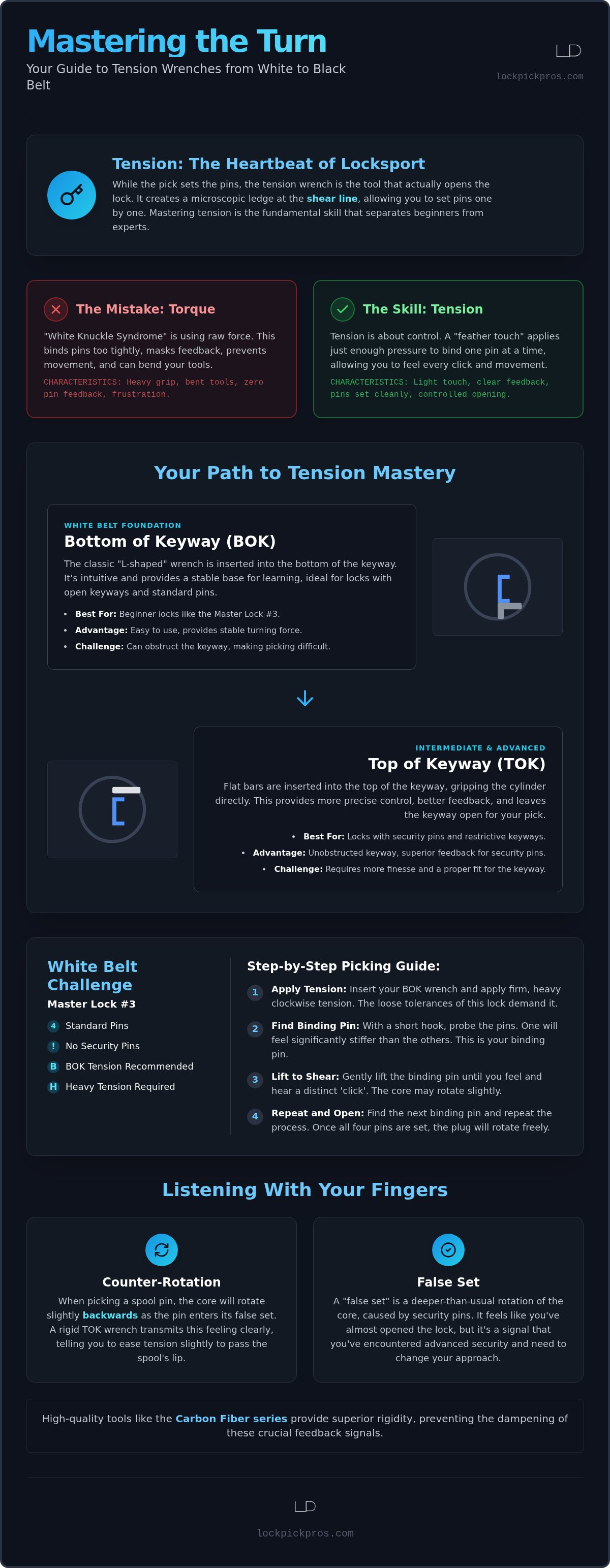
Tension is the heartbeat of locksport. While beginners often focus on the flashy hooks and rakes, experienced pickers know that the tension wrench is the tool that actually opens the lock. Think of your pick as the key's teeth, but the wrench is the hand that turns the cylinder. Without it, your picks are just pieces of metal poking at springs. By applying a slight rotational force, you create a ledge at the shear line where the driver pins can rest once they are lifted to the correct height. This fundamental concept is central to all Lock picking principles, as it allows you to set pins one by one until the plug finally rotates freely.
While you will encounter many types of tension wrenches on your journey, they all serve one primary purpose: controlling the plug. Precise tension is required because the tolerances inside a lock are incredibly small. If you apply too much pressure, you bind the pins so tightly they won't move. If you apply too little, the pins simply fall back down. Mastering this balance is the difference between a White Belt trainee and a Black Belt master. As you progress, you will learn that standard locks like the Master Lock #3 often require heavy tension, while high-security locks with delicate security pins demand a "feather touch."
Tension vs. Torque: The Beginner’s Most Common Mistake
New pickers often suffer from "White Knuckle" syndrome. This happens when you grip the wrench so hard your finger turns white, essentially trying to force the lock open through raw torque. Torque is about force; tension is about control. If you use too much force, you will bend your tools and prevent the pins from moving at all. It's a frustrating cycle that stops many hobbyists in their tracks. When you start with The Trainee 2.0, try the "light touch" test. Rest your finger on the wrench and use only its natural weight to apply pressure. You'll be surprised how little force is actually needed to bind a pin.
The Language of Feedback: Listening with Your Fingers
Choosing between different types of tension wrenches becomes easier once you understand the feedback they provide. Feedback is the vibration transmitted from the pins, through the plug, and into your wrench. Rigid materials like the Carbon Fiber series are excellent for intermediate ranks because they don't dampen these signals. When you hit a spool pin, the wrench will actually push back against your finger, a sensation known as counter-rotation. A high-quality, rigid wrench lets you "hear" these movements with your fingertips, allowing you to identify false sets and adjust your pressure accordingly.
Bottom of Keyway (BOK) Tensioners: The White Belt Foundation
Every locksport journey begins with the classic L-shaped wrench. Often called the "windshield wiper" style, this tool is the most recognizable of all the types of tension wrenches in a beginner's kit. It is the default choice for foundational practice because it's intuitive and provides a stable platform for learning how to bind pins. If you are just starting out, The Trainee 2.0 includes these essential BOK tools to help you secure your first "open" on community-standard entry locks.
Seating the wrench correctly is a skill you must master to understand the physics of lock picking. If the tip of your wrench is too long, it may rub against the stationary lock casing, which binds the plug and prevents it from turning. You want the wrench to touch only the rotating plug. A properly seated BOK wrench should feel like a solid extension of the plug, allowing you to feel the pins "talk" to you as you apply pressure.
Technical Guide: The Master Lock #3 (White Belt)
The Master Lock #3 is the quintessential White Belt challenge. This lock features a 4-pin stack consisting entirely of standard pins with no security pins present. Because the internal tolerances are quite loose, this lock requires heavy BOK tension to effectively bind the pins. For this lock, we recommend a standard short hook in 0.025" thickness or a basic rake for initial practice.
- Step 1: Insert your BOK wrench into the bottom of the keyway and apply heavy clockwise tension.
- Step 2: Use your hook to find the first binding pin; it will feel significantly stiffer than the others.
- Step 3: Lift the binding pin until you hear a loud, distinct click.
- Step 4: Repeat for the remaining three pins until the plug rotates freely.
Technical Guide: Brinks Brass Padlock (Yellow Belt)
The Brinks Brass padlock is a common step up to the Yellow Belt rank. It typically features a 4-pin stack, but unlike the Master Lock, it often contains one spool security pin to catch unwary pickers. This lock requires moderate BOK tension to avoid over-setting the delicate pins. We recommend using a precision short hook for better control.
- Step 1: Apply moderate clockwise pressure with your BOK wrench.
- Step 2: Identify and set the standard pins first.
- Step 3: If you hit a "false set" (where the plug turns slightly but the lock doesn't open), you have found the spool pin.
- Step 4: Lighten your tension slightly while lifting the spool; you will feel the wrench push back against your finger (counter-rotation) before the pin sets and the lock opens.
As you move beyond these foundational locks, you'll find that BOK wrenches can sometimes "eat up" valuable picking space. If you find your pick feels cramped, it's a clear signal to refine your kit with a professional series kit to handle more restrictive keyways.
Top of Keyway (TOK) Flat Bars: Precision for Intermediate Ranks
As you climb the ranks, the tools that served you well in the beginning might start to feel like they're holding you back. This is especially true when you encounter locks with restrictive keyways or complex security pin stacks. This is where Top of Keyway (TOK) flat bars, often called "pry bars," become essential. Unlike the BOK wrenches we discussed earlier, TOK tools are inserted into the top of the keyway, directly above the pins. This shift in positioning is one of the most significant upgrades you can make among the different types of tension wrenches in your kit.
Switching to TOK is a requirement for mastering Green Belt locks like the Master Lock 410 LOTO. These locks feature paracentric keyways that are incredibly cramped. If you use a bottom-tension tool, you effectively lock yourself out of the bottom of the keyway, leaving no room for your pick to maneuver. TOK provides the advantage of "Full Access." By clearing the bottom area, you can use deep hooks to reach high-set pins at the back of the lock without accidentally bumping into your wrench. For pickers ready to dominate these intermediate challenges, the Gen 2 Pro Max Stealth Edition offers the rigidity and slim profile needed for expert-level control.
Serrated vs. Knurled Tips: Keeping the Tool Seated
One of the biggest frustrations with TOK bars is their tendency to slip out of the lock at the worst possible moment. To combat this, professional-grade bars often feature serrated tips. These tiny teeth "bite" into the top of the keyway, providing a rock-solid anchor point. You should also follow the "Flush Fit" rule: always select a bar thickness that matches the keyway gap as closely as possible. A snug fit ensures that every bit of pressure you apply is transmitted directly to the plug. Technical resources like The MIT Guide to Lock Picking emphasize that understanding these mechanical forces is key to technical mastery. Knurled handles further improve your grip, allowing for steady pressure even during high-tension sessions.
Technical Guide: Master Lock 410 LOTO (Green Belt)
The Master Lock 410 LOTO is a rite of passage for intermediate hobbyists. It features a 6-pin stack: pin 5 is typically a standard pin, while pins 1, 2, 3, 4, and 6 are security spool pins. This lock has a "dead core," meaning there is no spring tension fighting your wrench. Because of the tight keyway, we recommend a thin hook in 0.015" or 0.020" thickness. To see how this fits into your journey, check out our guide on Lock Picking Belt Levels Explained.
- Step 1: Insert a 0.040" or 0.050" TOK flat bar into the top of the keyway. Apply very light clockwise tension.
- Step 2: Locate pin 5. Set this standard pin first to drop the lock into a "false set," where the plug rotates slightly but doesn't open.
- Step 3: Search for the spool pins. When you lift a spool, the plug will try to rotate counter-clockwise against your wrench. This is "counter-rotation."
- Step 4: Ease up on your tension just enough to let the pin move, but not so much that you drop previously set pins.
- Step 5: Once all five spools are set, the plug will rotate fully. Warning: Do not rotate the plug 180 degrees, or the pins may fall into the plastic body, "rattling" the lock.
Specialized Turning Tools for Advanced Belt Challenges
Advanced locksport is where the standard L-wrench or TOK bar finally meets its match. When you reach the upper tiers of the belt ranking system, you'll face Dimple, Disc Detainer, and Wafer locks that laugh at basic tools. High-security European cylinders often feature extremely tight, paracentric keyways where a standard wrench simply won't fit or provide enough leverage. For these challenges, you need specialized types of tension wrenches that can navigate complex internal geometry. If you're eyeing a high-security "open," the HUK 8pcs Kaba tools are designed specifically for the unique demands of dimple picking.
Automotive locks present another hurdle. Many car locks use a "Circular" or "Wheel" tensioner. These tools provide constant, even pressure across the entire plug, which is vital for maintaining the binding effect in shuttered keyways. Without this specialized pressure, the wafers won't stay set, and you'll find yourself starting over repeatedly. These advanced tools aren't just for show; they're the only way to communicate with the complex mechanisms found in modern security hardware.
Dimple Lock Tension: The Flag and the Turning Tool
Dimple locks are a different beast entirely. Instead of pins that move up and down, these pins move side-to-side or are arranged in multiple rows. This requires tensioning from the side or even the dead center of the keyway. Using the Honest Locksmith Supplier Tools for Kaba-style locks gives you the precision needed for these multi-axis challenges. To set your first pin in a high-security dimple lock, follow these steps:
- Insert your specialized tensioner into the center of the keyway to avoid binding the pins on the sides.
- Apply moderate pressure and use a "flag" pick to find the first binding pin.
- Lift the pin until you feel a distinct click; the tensioner should give a tiny lurch forward.
Wafer and Automotive Tension Techniques
Wafer locks, common in cabinets and older vehicles, often respond better to a "jiggling" technique. This requires a different tension rhythm. You aren't holding static pressure; you're pulsing the tensioner in sync with your jiggler tool. Double-ended tensioners are particularly useful here, as they can bypass the shutters found on many automotive keyways. You'll need to develop a "bounce" in your tension finger to let the wafers find their place. To see how these fit into a pro-grade setup, read The Ultimate Professional Locksmith Tool Kit Guide.
Ready to upgrade your feedback for these advanced locks? Grab the carbon fiber gen 2 pro series to feel every subtle movement inside the keyway.
Mastering Tension Control: Your Path to the Black Belt
Technical knowledge of the different types of tension wrenches is only half the battle. The final step in your journey toward a Black Belt rank is developing the muscle memory and finger sensitivity that turn a tool into an extension of your own body. Experienced hobbyists often use the "Two-Wrench" method when approaching a new lock. This involves testing both a TOK and a BOK wrench to see which provides the most stable fit with the least amount of "slop." A tighter fit means more direct communication from the pins, allowing you to feel the difference between a set pin and a stubborn security pin.
To sharpen your skills, try the "Pulse" drill. Apply heavy tension to bind a pin, then slowly release pressure until you hear the pin click into place. If you release too much, the pin will drop; if you hold too tight, it won't move. This exercise builds the "feather touch" required for high-security cylinders. Don't forget tool maintenance. Rust or grime on your wrench tips can dampen vibrations and lead to false readings. A quick wipe with a light oil keeps your gear in peak condition for your next practice session.
Selecting Your Progression Kit
As you move into intermediate tiers like the Purple Belt, your choice of equipment becomes critical. The Carbon Fiber Gen 2 Pro Series is the ultimate upgrade for pickers who need maximum feedback without the weight of traditional steel. For those who want to customize their approach for every keyway, the Pro Series Expansion allows you to build a modular set tailored to your specific needs. If you are just starting this journey, refresh your knowledge by reading our guide on What is in a Beginner Lock Pick Set? to ensure your foundation is solid.
The Black Belt Challenge: Share to Earn
Lockpicking is a community sport, and we want to celebrate your milestones. Our "Black Belt Challenge" is designed to help you progress through the ranks while earning rewards. The process is simple: document your "open" using our "Picks-in-Action" social media loop. Record a clear video of you picking a lock at your current rank, show the plug turning, and share it with our community of ethical lockpickers. Not only does this verify your rank, but it also qualifies you for community bounties. We offer rewards for hitting social reach goals, fostering a supportive environment where pickers help each other reach the next level. Join the challenge for free today, upgrade your tools at each tier, and show the world your skills.
Take Command of the Cylinder
Mastering the turn is about more than just applying force; it's about translating the internal language of the lock. You've seen how transitioning from BOK to TOK opens up the keyway for complex picking and how specialized tools tackle advanced dimple or automotive challenges. Understanding the different types of tension wrenches is your most direct path to technical mastery and higher belt ranks.
We're here to support your journey with precision carbon fiber tools that provide professional-level feedback. You can also earn rewards and community bounties by sharing your "picks-in-action" content on social media. Our ethical community is ready to help you verify your opens and celebrate every new belt you earn. It's time to put your skills to the test and show the community what you can do.
Ready to level up? Join the Free Black Belt Challenge and upgrade your tools today!
Keep practicing, stay ethical, and we'll see you at the Black Belt level!
Frequently Asked Questions
What is the difference between a tension wrench and a torque wrench?
A tension wrench is a tool used in locksport to apply rotational pressure to a lock plug, whereas a torque wrench is a mechanical tool used to apply a specific amount of force to a fastener. While they both involve turning, a torque wrench measures foot-pounds or Newton-meters for bolts. In lockpicking, you rely on tactile feedback rather than a gauge. Confusing the two is a common newcomer mistake; they serve entirely different industries.
Do I need a Top of Keyway (TOK) wrench for beginner locks?
You don't strictly need a TOK wrench for White Belt locks like the Master Lock #3, but it's a great habit to start early. Most beginners find Bottom of Keyway (BOK) tools easier to hold initially. However, learning TOK early prepares you for the restrictive keyways found in Green Belt challenges. It provides better visibility and more room for your pick, even on simple padlocks that don't technically require it.
Why does my tension wrench keep falling out of the lock?
Your wrench likely falls out because it doesn't match the thickness of the keyway or lacks serrated teeth to grip the metal. This is a common frustration when using generic types of tension wrenches that are too thin for a specific lock. To fix this, always select a tool that fits snugly without wiggling. If you're using a flat bar, ensure the serrations are facing the direction of the turn.
Can I make my own tension wrench from a windshield wiper blade?
Yes, many hobbyists create custom tools by repurposing the thin metal inserts from discarded windshield wiper blades. This is a fantastic way to experiment with different types of tension wrenches without spending a fortune. You can bend the steel into various L-shapes or twist-flex designs using pliers. Just ensure you sand down any sharp edges to prevent scratching the lock face or your fingers during your practice sessions.
What is the best tension wrench material for feedback?
High-carbon spring steel and carbon fiber are the best materials for clear feedback. While spring steel is durable and affordable, carbon fiber is incredibly rigid and transmits the vibrations of setting pins more effectively. This rigidity prevents the tool from absorbing the subtle clicks and counter-rotations you need to feel. For intermediate pickers pursuing higher belt ranks, moving to a carbon fiber wrench can significantly improve your success rate.
How much tension should I actually be using?
The amount of tension depends entirely on the lock's tolerances and the presence of security pins. A standard Master Lock often requires heavy tension to bind the pins, while a high-security lock with spool pins needs a very light feather touch. A good rule of thumb is to use just enough pressure to keep the wrench from falling out. If your pins feel stuck, you're likely using too much force.
Is it illegal to carry a tension wrench in my EDC kit?
The legality of carrying lockpicking tools varies significantly by state and country. In many regions, owning these tools is legal for hobbyists, but carrying them in public can be classified as possession of burglary tools if intent can't be proven. Always check your local regulations before adding a wrench to your EDC kit. At Lockpick Pros, we advocate for ethical locksport, which means only picking locks you own in a legal setting. For those who consider locksport a pillar of personal readiness, you can visit Hard Asset Security to explore comprehensive emergency food storage and survival gear.