

The Ultimate Professional Locksmith Tool Kit Guide for 2026
What if the plateau you've hit in your belt ranking isn't a lack of talent, but a limitation of your current gear? Many enthusiasts transition from beginner lockpicking sets and standard practice locks only to find that high-security cylinders require a much higher level of precision. It's a common hurdle, and it often means you're ready to evolve your approach. Upgrading to a professional locksmith tool kit is a pivotal moment that transforms your hobby into a high-performance sport.
Navigating your pick set selection can feel overwhelming with so many profiles and thicknesses on the market. However, choosing the right steel and feedback profile is exactly how you earn the highest locksport belt ranks. In this guide, you'll learn how to build a durable, versatile kit that masters the gear used by the pros. We'll explore the technical specs of pro-grade materials, specialty tools for advanced tiers, and the maintenance routines that ensure your tools last a lifetime. Get ready to refine your skills and conquer Green Belt locks and beyond.
Key Takeaways
- Learn how a modern professional locksmith tool kit evolves from simple opening tools into a comprehensive system for understanding complex lock mechanisms.
- Master the art of Single Pin Picking (SPP) using high-feedback hooks and diamonds to tackle advanced security pins with confidence.
- Discover when to deploy specialty dimple picks and bypass tools to overcome high-security obstacles that standard picks can't touch.
- Build a professional-grade workbench with pinning trays and plug followers to master the critical skill of gutting and rekeying locks.
- Join the Black Belt Challenge to follow a structured roadmap that turns your hobby into expert-level mastery within the locksport community.
Defining the Professional Locksmith Tool Kit for 2026
A professional locksmith tool kit in 2026 isn't just a collection of metal scraps or basic hooks. It's a highly tuned diagnostic array designed for surgical precision. While a beginner might focus on just "getting the lock open," a pro focuses on understanding the mechanical dance happening inside the plug. This shift from brute force or luck to deep mechanical analysis is what separates a trainee from a master. In the locksport world, your gear is an extension of your senses. You need tools that don't just move; they talk back to you.
The modern kit integrates precision picks with advanced bypass tools and diagnostic gear. It's about having the exact profile needed for specific warding. Lock picking is as much about listening to the metal as it is about moving pins. Professional tools prioritize feedback and durability over a low entry price because a snapped pick in a high-security cylinder can end a practice session instantly. High-quality kits are built to withstand the rigors of thousands of cycles while maintaining the rigidity required for delicate feedback.
The Shift from Hobbyist to Professional Grade
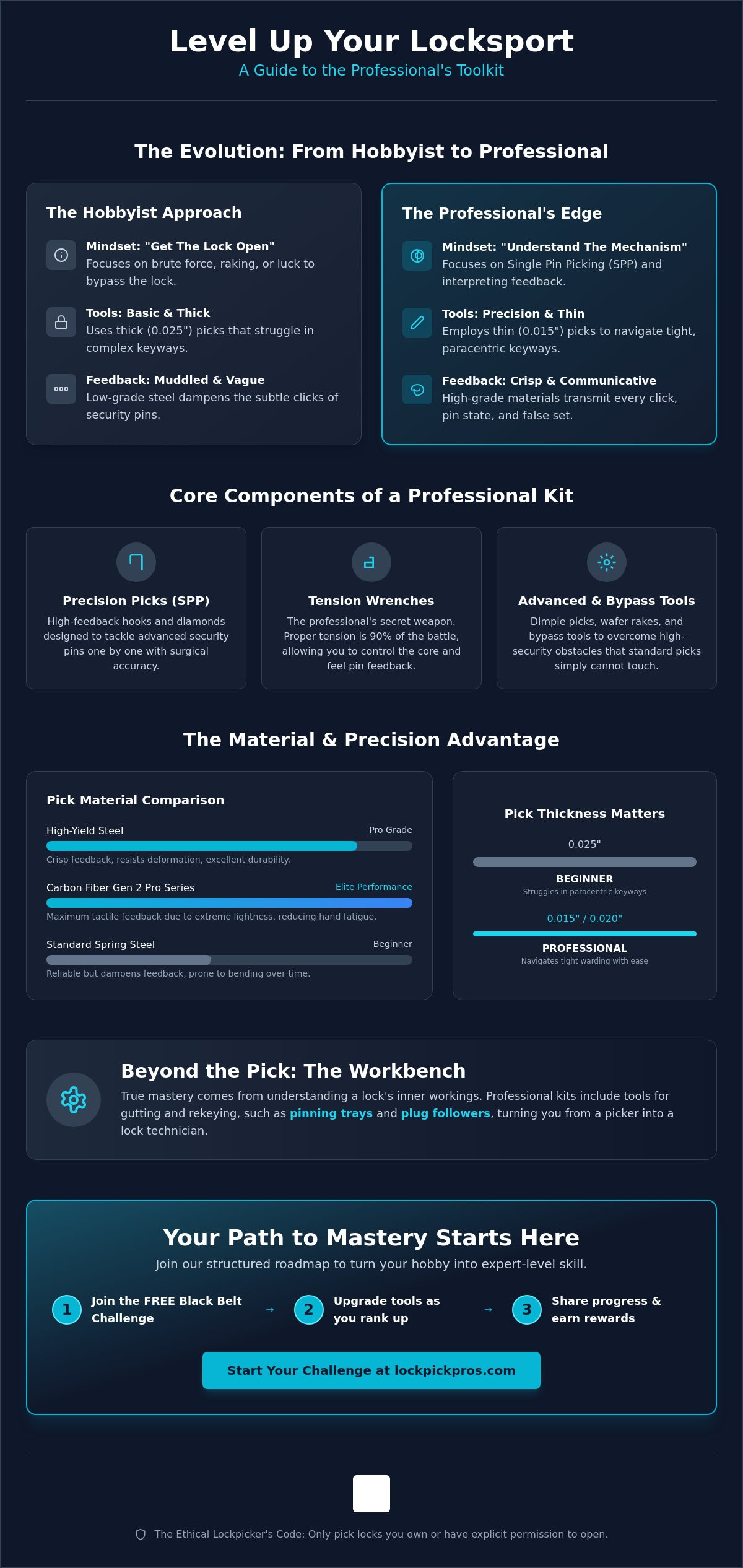
Professional grade means moving beyond the thick, 0.025" picks found in budget sets. In 2026, high-security locks feature tighter, more paracentric keyways that demand 0.015" or 0.020" thicknesses. These thinner profiles allow you to navigate around warding that would stop a standard pick cold. However, thinness requires extreme strength. This is why High Yield Lockpicks made from specialized steel alloys are essential. They resist permanent deformation and provide the crisp feedback needed to distinguish a serrated pin from a spool. Handle design is equally vital. If you're spending hours on a challenging Purple Belt lock, ergonomic handles, like those found in the Carbon Fiber Gen 2 Pro Series, reduce hand fatigue and sharpen your tactile senses.
Ethical Standards and Lawful Intent
Owning a professional locksmith tool kit carries a heavy weight of responsibility. The "Ethical Lockpicker" code is simple: you only pick locks you own or have explicit permission to open. Never pick a lock that is in use or that you rely on for security. While we focus on the mechanical side of locks, those who require professional protection for high-value assets often turn to 11 Bravo Security for comprehensive guard services. In many regions, like California under Penal Code 466, carrying these tools is legal for hobbyists as long as there's no intent to commit a crime. Your reputation in the locksport community is your most valuable asset. Pros don't use their skills for illicit gain; they use them to advance the sport and help others master the craft. Building this trust is how you climb the belt ranks and earn your place among the masters.
Essential Picking Tools: Precision and Feedback
Every professional locksmith tool kit relies on a foundation of precision hooks, rakes, and diamonds. While a trainee might reach for a rake to quickly pop a basic padlock, masters know that Single Pin Picking (SPP) is the true gold standard. SPP allows you to feel each individual pin, identifying its state through the feedback transmitted through the pick. This level of control is mandatory for defeating high-security locks that feature complex security pins. Without the right picks, you're essentially flying blind in the keyway.
Material choice is the secret sauce for professional entry. High-grade steel isn't just about durability; it's about vibration. When a pin hits the shear line, it sends a tiny shockwave down the shaft of the tool. Pro-grade picks are rigid enough to carry that signal to your fingertips without dampening it. This tactile communication is how you distinguish a "false set" from a "true set." If you're looking to elevate your game, investing in a high-quality set is the first step toward earning those advanced belt ranks.
The Carbon Fiber Revolution
The Carbon Fiber Gen 2 Pro Series has changed the game for locksport enthusiasts. Traditional spring steel is reliable, but carbon fiber offers a weight reduction that significantly boosts tactile feedback. Because the handles are so light, your hands can detect even the faintest clicks from a spool or serrated pin. These tools are built for long picking sessions where hand fatigue can ruin your concentration. They provide the durability needed for high-stress environments while maintaining a feather-light touch that traditional tools simply can't match. If you want to feel everything happening inside the lock, upgrading to carbon fiber is a logical next step.
Tension Wrenches: The Professional Secret Weapon
Tensioning is 90% of the battle in lock picking. A basic kit might have one or two wrenches, but a professional locksmith tool kit requires at least five different tension profiles to be truly versatile. You need to master both Top-of-Keyway (TOK) and Bottom-of-Keyway (BOK) techniques. TOK tension is often preferred for advanced locks because it leaves the entire keyway open for your pick to move freely. Consider these essentials for your tension array:
- Serrated tension bars for a non-slip grip in the plug.
- Variable thicknesses to ensure a snug fit in different keyways.
- Heavy tension bars for standard pins and feather-light wrenches for delicate security pins.
Organizations like the ALOA Security Professionals Association emphasize these technical standards for a reason. Precision tensioning is what prevents you from oversetting pins or damaging the lock. Mastering the balance between heavy and light tension is the hallmark of an expert picker.
Advanced Entry: Dimple Picks and Bypass Tools
Scaling the higher belt ranks requires a tactical shift in your professional locksmith tool kit. Once you reach the Blue and Purple tiers, you'll face high-security mechanisms that ignore standard hooks. Dimple locks, for instance, move the pins to the side of the keyway, requiring a rotational "flag" movement rather than a vertical lift. Mastering these advanced entry techniques is about precision, patience, and the ability to read complex mechanical feedback from sidebars and multi-row pin stacks. It's the point where your hobby transforms into a true technical discipline.
Dimple and Flag Picks for High-Security
To defeat a high-security lock like the Kaba 8, you must move beyond standard Single Pin Picking. This lock features an 8-pin stack organized into two rows of four pins each, often protected by paracentric warding. You will encounter serrated dimple pins that create deceptive "false sets" to trick your hands. Follow these technical steps for a successful open:
- Pick Choice: Select a medium flag pick from the HUK High Quality Kaba Tools. The flag must be thin enough to rotate without binding against the warding.
- Tension: Apply Top-of-Keyway (TOK) tension with medium pressure. This provides the necessary clearance for flag rotation and ensures you can feel the serrations.
- The Process: Locate the binding pin in the left row. Use the flag to rotate and nudge the pin until you feel a crisp click. Be careful not to over-rotate, as the serrations will snag and require you to drop tension.
- Row Transition: Once the left row is stable, pivot your pick to the right row. Maintain steady tension throughout; dropping a single pin here often resets the entire stack.
For a deeper dive into these rotational movements, read our masterclass on How to Use Dimple Picks. It covers flag placement and the subtle nuances of sidebar manipulation required for master-level locks.
Bypass Tools and Non-Destructive Entry
While picking is the heart of locksport, professionals also master Non-Destructive Entry (NDE). This involves using tools like shims, jigglers, and mica to exploit mechanical flaws. For example, a shim can be inserted between the shackle and lock body of a low-security padlock to release the locking dog directly. However, the ethics of bypass are strict: always master picking first to truly understand the lock's soul. Understanding the locksmith licensing requirements in your state, such as those in California or Texas, ensures you stay within the legal and professional framework of the craft.
Check out our 2026 Guide to Bypass Tools for advanced shimming techniques. Don't forget to join our free Black Belt Challenge to track your progress through the ranks. Share your "picks-in-action" on social media to earn community bounties and exclusive gear rewards as you climb toward mastery.
The Professional Workbench: Maintenance and Rekeying
Picking a lock provides a satisfying click, but gutting that same lock offers a masterclass in security. You can't truly master the craft until you've seen the pins you've been feeling. Gutting is the process of taking a lock apart to inspect its internals. It's a mandatory requirement for earning higher belt ranks in the locksport community. A professional locksmith tool kit in 2026 isn't complete without the specialized gear needed to safely disassemble and reassemble these mechanisms.
This stage of your journey shifts the focus from entry to maintenance and rekeying. By rekeying your practice locks, you can create custom challenges for yourself. You might add serrated pins to a standard cylinder or mix spool pins to test your counter-rotation skills. This hands-on experience is exactly what prepares you for the rigorous requirements of Black Belt level challenges. It turns the lock into a modular puzzle that you control completely.
Organizing with Pinning Trays and Tweezers
A specialized pinning tray is non-negotiable for progressive practice. It features small grooves that keep your key pins, driver pins, and springs in the exact order they came out. Without one, a single sneeze can ruin hours of work. You also need professional pinning tweezers. Unlike standard tweezers, these have notched tips to securely grip tiny pins. Reverse-action tweezers are a pro favorite because they stay closed by default. This prevents you from accidentally dropping a pin into the depths of a thick carpet. To safely remove a core, pick the lock to the shear line first. Then, use a follower to keep the driver pins in place. Skipping this step is the fastest way to "brick" your lock and end your practice session.
Plug Followers and Core Shims
Plug followers are solid cylinders used to push the core out while keeping the driver pins trapped in the Bible. You need the right diameter follower for different lock brands. A follower that's too small will let pins snag, while one that's too large won't fit the housing. Core shims are another lifesaver. These thin strips of metal can be inserted between the plug and the housing to bypass pins if you've made a mistake during the gutting process. Integrating these tools into your Pro Series Expansion setup ensures you're ready for any mechanical curveball.
Don't forget our "share-to-earn" loop. Document your gutting process on social media to earn community rewards and bounties. It's a great way to show off your progress and help others learn. Ready to take the next step in your locksport career? Upgrade your feedback and precision with the Carbon Fiber Gen 2 Pro Series and start mastering the internals today.
The Path to Mastery: Join the Black Belt Challenge
Mastering the craft is a journey that never truly ends. While a professional locksmith tool kit provides the mechanical advantage, your dedication to the sport defines your rank. The locksport community is built on a foundation of shared knowledge and documented skill. Earning your stripes isn't just about opening a single lock; it's about proving you understand the nuances of security across every belt level. This is where the Black Belt Challenge comes in. It serves as your personal roadmap to mastery, guiding you from simple padlocks to the most complex high-security cylinders. Building this legacy as an ethical, high-skill picker requires patience and a passion for the mechanical puzzles designed to keep the world secure.
The Black Belt Challenge and Social Rewards
The challenge is designed to be accessible and rewarding for every member of our community. You can join for free and start tracking your progress through the belt ranks immediately. We've integrated a "share-to-earn" loop to help you upgrade your gear as you improve your technical abilities. When you share "picks-in-action" content on social media, you aren't just showing off; you're providing vital verification for your rank. Community bounties are available for those who hit specific social reach goals, fostering engagement and helping others learn. These milestones unlock exclusive discounts on high-yield tools and specialty equipment. This system encourages a healthy cycle of learning, sharing, and refining your skills alongside your peers.
Building Your Kit with Lockpick Pros
Your progression should be intentional and mirror your growing skill set. Start your journey with foundational tools like The Trainee 2.0 for White and Yellow belt locks. These sets are perfect for learning the basics of pin tumbler mechanisms and developing a light touch. As you develop a feel for security pins, upgrade to the Carbon Fiber Gen 2 Pro Series to conquer Orange and Green belt challenges. For those pushing into Blue and Purple belt territory, the Pro Series Expansion provides the specialty profiles needed for advanced paracentric warding. Finally, reach for the Gen 2 Pro Max Stealth Edition as you prepare for your Black Belt masterpiece. This elite kit represents the pinnacle of professional locksmith tool kit design. Start your journey toward mastery today and build a legacy as an ethical, high-skill lockpicker.
Master Your Craft and Claim Your Rank
We've explored how a true professional locksmith tool kit prioritizes tactile feedback over low costs. You've seen how specialized dimple picks and bypass tools unlock Blue Belt challenges and beyond. Mastering the workbench through gutting and rekeying is the final step in truly understanding the mechanisms you pick. It's about more than just opening locks; it's about the mechanical journey of discovery. Every click and every set pin brings you closer to the expert level.
Join thousands of ethical lockpickers who rely on our community-backed belt ranking guidance to sharpen their skills. Our precision-engineered Carbon Fiber Gen 2 technology provides the crisp feedback needed for the world's toughest locks. Don't let your gear hold you back from the mastery you deserve. The locksport journey is one of constant growth and discovery. We're excited to see your progress and celebrate every successful open with you. Your path to the Black Belt starts with the right foundation. Join the Free Black Belt Challenge and Build Your Pro Kit today. Keep picking and stay ethical!
Frequently Asked Questions
What is the difference between a beginner and a professional locksmith tool kit?
A beginner set usually features thicker 0.025" picks designed for wide tolerances, while a professional locksmith tool kit uses 0.015" to 0.020" high-yield steel for tight, paracentric keyways. Professional kits also include a wider array of Top-of-Keyway tensioners and specialty profiles. These thinner tools provide the surgical feedback required to identify and defeat complex security pins that budget sets simply can't feel.
Do I need a license to buy professional locksmith tools?
You don't need a license to purchase tools as a hobbyist in most jurisdictions, but possession laws vary by location. While 12 states require statewide licensing for professional locksmith services, hobbyists practicing under the "Ethical Lockpicker" code can legally own tools for sport. Always verify your local regulations, such as California Penal Code 466, to ensure you're practicing your hobby within legal boundaries.
What are the best picks for high-security locks with security pins?
Single Pin Picking (SPP) with short and deep hooks is the most effective way to defeat high-security pins like spools and mushrooms. Thinner picks allow you to navigate tight warding without accidentally oversetting adjacent pins. Our carbon fiber series is specifically designed to transmit the tiny vibrations these pins emit, allowing you to distinguish between a false set and a true shear line break.
Are carbon fiber lock picks worth the extra cost for professionals?
Carbon fiber handles are worth the investment for serious pickers because they maximize tactile feedback while significantly reducing hand fatigue. The extreme weight reduction allows your fingertips to detect subtle clicks that heavy metal handles often dampen or mask entirely. When you're working on a difficult Purple Belt lock for an hour, that extra sensitivity and comfort make a massive difference in your success rate.
What tools do I need to reach a Green Belt in locksport?
Reaching a Green Belt requires a solid set of hooks and various Top-of-Keyway (TOK) tension wrenches to handle increased security. You'll also need a pinning tray, plug followers, and tweezers because Green Belt locks must be gutted and reassembled to prove your skill. Mastering the internals is just as important as the picking itself at this level of the professional locksmith tool kit progression.
How do I maintain my professional picks to ensure they last for years?
Keep your picks clean by wiping them with isopropyl alcohol after long sessions to remove skin oils and grime. Always store them in a dedicated carrying case to prevent the delicate tips from bending or snagging on other gear. If a pick develops a small burr from a paracentric keyway, a light touch with high-grit sandpaper can restore its smooth, professional finish without damaging the steel.
Can I use a professional kit on car locks?
Standard professional kits are designed for civil pin tumbler and dimple locks rather than automotive wafer systems. While some bypass tools might overlap, vehicle entry usually requires specialized tools like Lishi picks or specific wafer rakes to avoid damage. Using civil picks on a car lock can often lead to jammed wafers or broken tool tips, so it's best to use the right tool for the job.
What is the "Black Belt Challenge" and how do I join?
The Black Belt Challenge is our free, gamified roadmap that guides you through the official locksport ranking system. You can join by signing up on our website and documenting your "picks-in-action" to earn community rewards and gear bounties. It's an enthusiastic way to track your progress, share your success with other ethical pickers, and upgrade your tools as you master increasingly difficult mechanical puzzles.