

How to Use Dimple Picks: A Masterclass in Flag Techniques for Locksport
What if the secret to cracking high-security locks wasn't about lifting pins higher, but simply turning your perspective 90 degrees? Most hobbyists start their journey with beginner lockpicking kits, but standard hooks eventually hit a wall when faced with restrictive keyways. It's frustrating when your tools won't even fit into your practice locks, making it impossible to distinguish between a binding pin and the warding. Learning how to use dimple picks is the essential skill you need to bridge that gap and start tackling high-security targets like an ABUS or KABA.
This masterclass will help you navigate the complexities of pick set selection so you can identify which specialized flags are required for your current level. We'll master the rotation and tensioning techniques needed to defeat complex mechanisms and level up your belt ranks. From understanding the "flag" rotation mechanic to clarifying left versus right-hand directions, this guide provides the roadmap you need to join the ranks of elite ethical pickers.
Key Takeaways
- Master the unique "flag" rotation mechanic to navigate restrictive keyways where standard hooks simply won't fit.
- Learn the essential differences between left-hand and right-hand flags to ensure you're rotating in the correct direction for every pin.
- Discover how to use dimple picks alongside specialized tensioning strategies that keep your workspace clear for precise feedback.
- Level up your belt rank by moving from basic dimple locks to complex high-security targets like pin-in-pin mechanisms.
What is a Dimple Lock and Why Do You Need Flag Picks?
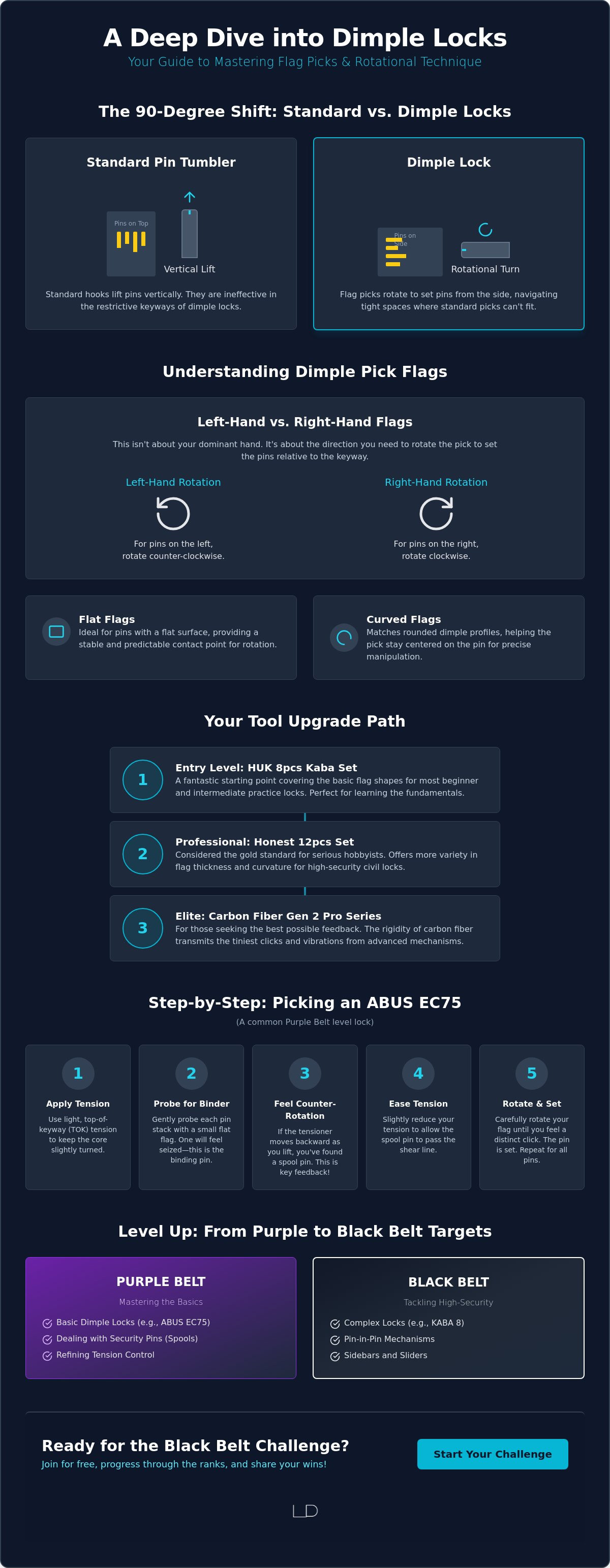
A dimple lock is essentially a pin tumbler lock mechanism that has been rotated 90 degrees. Instead of pins sitting on the narrow edge of the key, they interact with the flat face. This design renders your standard hooks useless because there's no room for vertical lifting in the restrictive warding. Learning how to use dimple picks is your gateway to the Purple Belt and beyond. It forces you to master rotational leverage within tiny spaces. This shift in physics is what makes the hobby so rewarding for advanced pickers.
Let's look at the ABUS EC75. This lock typically features a 5-pin stack, including several spool pins. You'll want a small flat flag and light tension for this model. First, apply light TOK tension and probe for the binder. When you feel counter-rotation, you've found a spool. Ease your tension slightly and rotate the flag until the pin sets with a click. For a KABA 8, you'll face two rows of radial pins with tight tolerances. Use a curved flag and medium tension. Map both rows to find the binding order. Rotate the flag firmly until you hear the sharp, metallic click that signifies a set pin.
Anatomy of a Dimple Keyway
Visualizing the horizontal pin orientation is key to your success. You aren't just dealing with standard pins; advanced models often feature pin-in-pin complexity. This means a smaller inner pin sits inside a larger outer one, requiring double the precision. High-security models might also include sliders or sidebars that interact with the pick. Understanding these internal components is vital when learning how to use dimple picks effectively in the field.
Hobbyist vs. Professional Dimple Tools
Specialized flags are required to get the tactile feedback you need to progress through the belt ranks. Cheap tools will bend under pressure, but professional series picks provide the rigidity required for narrow keyways. The HUK 8pcs Kaba Lockpick Tools are a fantastic entry point for beginners. If you're serious about your skill refinement, the Honest 12pcs Professional Set offers the variety needed for high-security civil locks.
Understanding the Dimple Pick: Flags and Profiles
The secret to mastering these locks lies in the "flag" design of the pick. Unlike a standard hook that moves up and down, a flag pick uses an offset head that pivots against the keyway wall. This rotation allows you to apply precise pressure to the pin without getting stuck in the warding. If you look at a technical patent for a dimple lock, you'll see how the pins are deeply recessed. The flag is the only tool shaped to reach under those pins and provide the necessary leverage to set them. Understanding this geometry is the first step in learning how to use dimple picks correctly.
Choosing between a right-hand and left-hand flag is a common point of confusion for trainees. It isn't about whether you are left-handed; it's about the direction of rotation. If you insert your pick and find the pins are on the right side of the keyway, you'll typically need a flag that rotates clockwise. If the pins are on the left, you'll rotate counter-clockwise. Always check which side of the pin has more clearance before you start picking. This simple check will save you from binding your tool against the lock body.
Profile shapes also play a huge role in your success.
- Flat flags: These are perfect for pins with a flat surface, providing a stable platform for rotation.
- Curved flags: These match the rounded profile of many high-security dimples, helping the pick stay centered on the pin.
- High-yield steel: This material is essential for feedback. It transmits the tiny clicks and vibrations of a setting pin much better than cheap alloys.
Choosing Your First Flag Set
For those just starting their dimple journey, the HUK 8-piece Kaba set is a fantastic entry point. It covers the basic flag shapes you'll encounter in most beginner practice locks. However, if you're aiming for higher belt ranks, the Honest 12-piece set is often considered the gold standard. It provides more variety in flag thickness and curvature, which is vital for navigating the narrow keyways of professional-grade civil Kaba locks.
Maintaining Your Flags
To get the most out of your tools, you must keep them in top shape. Use a high-grit sandpaper to polish the flag heads until they're mirror-smooth. This reduces friction and makes the rotation feel much cleaner. Always check the pick shaft for "snag points" that might get caught on the warding. In high-tension scenarios, watch for signs of metal fatigue like slight bends or discoloration. Catching these early prevents a pick from snapping inside your favorite practice lock.
Tensioning Strategies for Dimple Locks
Tensioning is the heartbeat of locksport. When you are learning how to use dimple picks, it's easy to assume the tension logic is identical to standard pin tumblers. It isn't. The most common mistake is using a tension wrench that obstructs the flag's swing path. Because dimple picks require a rotational movement, your tensioner must stay clear of the arc where the flag head travels. If your tool hits the wrench, you'll lose all tactile feedback and likely bind the pick.
Top of Keyway (TOK) tensioning is usually the best approach for these locks. By placing your wrench at the top, you leave the bottom of the keyway open for your flag to pivot. Bottom of Keyway (BOK) tension often creates a crowded keyway where the flag shaft rubs against the wrench. This friction masks the subtle clicks you need to hear. When you encounter security pins like spools or serrated dimples, your tension control becomes even more critical. You must learn to "feather" the wrench to allow for counter-rotation without dropping previously set pins.
Adjusting your pressure is a constant balancing act. If you apply too much tension, the pins will feel seized and won't move. If you apply too little, the pins will simply fall back down. High-security dimple locks often have very tight tolerances, meaning the window for perfect tension is much smaller than what you might be used to with a standard padlock. Practice finding the minimum amount of force required to keep a pin in its set position.
The Fulcrum Point Technique
Mastering the fulcrum point is a breakthrough moment for any trainee. Use the lock's internal warding as a natural pivot for your pick shaft. Instead of floating the pick in mid-air, rest the shaft against a ledge of the warding. This creates a stable fulcrum. It allows you to translate a small wrist twist into powerful, precise leverage on the pin. Finding this sweet spot ensures your pick doesn't slip off the pin and prevents you from binding the plug against the housing.
Feedback Differences
Feedback through a rotating flag is a unique sensation. A binding pin will feel stiff and resist your attempt to twist the pick. Once set, you'll often feel a distinct, sharp click that vibrates through the handle. If the pin feels "mushy" or soft, you're likely pressing against the warding or a pin that isn't ready to bind. Remember that rotational tension can shift the binding order unexpectedly compared to vertical lifting. Over-tensioning can mask a dimple's counter-rotation and make it impossible to feel the subtle feedback of a spool pin.
Step-by-Step: The Flag Rotation Technique
Mastering the physical movement of the flag is what separates a trainee from an expert. When you're learning how to use dimple picks, you have to resist the urge to lift. Standard pin tumblers reward vertical force. Dimple locks reward rotational precision. Refining how to use dimple picks effectively starts with understanding that you're twisting, not prying. Follow these steps to sharpen your technique.
- Step 1: Insert the flag and find the 'shelf' of the first pin. This is the flat area where your tool makes contact.
- Step 2: Apply light to medium tension to identify the binder. You're looking for the pin that resists movement.
- Step 3: Position the flag head directly under the pin's center. If you're off-center, the pick will likely slip off.
- Step 4: Rotate the pick handle. This is the "twist" mechanic. It uses the keyway wall as a pivot to move the pin.
- Step 5: Listen for the click and feel for the plug's slight rotation. This vibration tells you the pin has reached the shear line.
Finding the Binding Pin
Finding the right pin requires a "sliding" method to map the stack. Gently move your pick from the front to the back of the keyway. Springy pins aren't binding yet; they'll bounce when touched. A solid, unmoving pin is your target. Be careful not to get caught in warding traps. These are ledges in the lock body that feel like binding pins but won't budge. Probing every pin before you apply heavy force prevents oversetting and protects your tools.
The 'Twist' Mechanic
The direction of your twist depends on the flag's orientation. If the flag head points right, you'll rotate clockwise. If it points left, you'll go counter-clockwise. Controlling the arc of that rotation is vital to prevent oversetting. You only want to move the pin just enough to set it. Use your pick handle as a tactile indicator of pin depth. Its angle tells you exactly how far the pin has moved. For the best tactile response during this phase, many pros use the Carbon Fiber Gen 2 Pro Series picks because their rigidity transmits feedback clearly.
Advancing Your Skills: The Black Belt Challenge
Reaching the pinnacle of the belt ranking system requires more than just basic flag rotation. Once you've mastered how to use dimple picks on standard practice locks, the real challenge begins with high-security targets like the Mul-T-Lock Interactive. This lock is a favorite for those chasing Brown and Red belts because it features five pin-in-pin chambers, totaling ten pins that must be set independently. It's the ultimate test of your tactile sensitivity and tool control.
To defeat a Mul-T-Lock, start with firm TOK tension and a medium flat flag. Step 1: Identify the binding outer pins first. You'll often encounter spool or serrated outers that provide counter-rotation feedback. Step 2: Set all five outer pins until you feel a distinct plug shift, which signifies the outers are at the shear line. Step 3: Switch to a thinner, more precise flag to target the inner pins. Step 4: Feather your tension slightly to allow the inner pins to click into place without dropping the outer stack. This specialized application of how to use dimple picks is what separates the masters from the trainees.
Our community thrives on the "Share-to-Earn" loop. As you conquer these advanced mechanisms, we want to celebrate your success. You can earn rewards by documenting your journey and sharing your milestone openings with fellow hobbyists. Post your "picks-in-action" content on social media to verify your rank and contribute to the collective knowledge of the locksport world. It's a journey of mastery where every open counts toward the community bounty.
Next-Level Tools for Advanced Belts
Advanced tiers demand tools with zero flex and maximum feedback. When you're tackling high-security paracentric keyways, it's time to upgrade to the Gen 2 Pro Max Stealth Edition. These picks are designed for the narrowest tolerances where every fraction of a millimeter matters. For pickers who prioritize pure tactile response, the Carbon Fiber Pro Series offers unmatched rigidity. These professional tools ensure you feel the tiny vibrations of an inner pin setting, even under heavy tension.
Join the Black Belt Challenge
Are you ready to earn your black belt in lockpicking? Join our free community ranking challenge to start your official progression. The challenge provides a clear roadmap from White to Black belt, mapping out exactly which high-security targets you need to defeat. By sharing your progress, you don't just earn prestige; you also help hit community social reach goals that unlock rewards for everyone. Sign up today, upgrade your kit, and help your fellow ethical pickers succeed in their quest for skill refinement.
Master the Art of the Flag Twist
Mastering dimple locks is a pivotal moment in any picker's journey. You've learned that the secret isn't more force; it's a shift in physics. By focusing on the rotational "twist" mechanic and clearing your tensioning path, you can defeat keyways that once seemed impossible. Understanding how to use dimple picks correctly opens the door to high-security challenges and the prestigious upper tiers of the belt ranking system.
Our gear is precision-engineered for ethical locksport and trusted by LPU belt rank contenders across the community. When you're ready to tackle the next level, our Share-to-Earn rewards program is there to celebrate every milestone you reach. Don't let a restrictive keyway hold you back from your potential as a hobbyist.
Take the Black Belt Challenge and upgrade your kit today! Your journey to the top of the leaderboard starts with a single click. Keep practicing, stay ethical, and we'll see you at the next rank.
Frequently Asked Questions
Can I pick a dimple lock with a standard hook?
You generally can't pick a dimple lock with a standard hook because the keyway warding is too restrictive. Standard hooks are designed for vertical lifting in narrow, vertical keyways. Dimple keyways are horizontal and often have ledges that block a hook's reach. You'll find that a flag pick is necessary to navigate these tight spaces and apply the rotational force needed to set the pins.
What is the difference between a left-hand and right-hand dimple flag?
The difference lies in the direction the flag head extends from the shaft. A right-hand flag is designed to rotate clockwise, while a left-hand flag rotates counter-clockwise. When learning how to use dimple picks, you must check which side of the keyway the pins are located. This determines which flag direction provides the best leverage against the lock body without binding your tool.
Why is my dimple pick getting stuck in the keyway?
Your pick is likely getting stuck because the shaft is too thick for the paracentric warding of the lock. High-security dimple locks have very tight tolerances. Even a tiny burr on the metal can cause a snag. Try polishing your pick heads to a mirror finish. If it's still sticking, you might need to switch to a thinner profile designed for advanced keyways.
Do all dimple locks have security pins like spools or serrations?
Many beginner dimple locks use standard pins, but most models used for ranking use security pins. You'll frequently encounter spools and serrated pins in brands like ABUS or Mul-T-Lock. These security features provide counter-rotation feedback, which is much more pronounced when using a flag pick. Mastering these pins is a key milestone for any trainee moving toward intermediate belt ranks.
How do I know if I am oversetting a dimple pin?
You've likely overset a pin if the plug stops providing feedback and the pin feels completely seized. An overset pin is pushed past the shear line into the housing. When this happens, you'll lose the "springy" feel of other pins in the stack. It's best to release tension slightly and let the pin drop back down, though this often means resetting other pins you've already set.
What is a 'pin-in-pin' dimple lock and do I need special tools for it?
A pin-in-pin lock is a high-security variant where a secondary inner pin sits inside the main outer pin. You don't necessarily need special tools, but you do need very fine, precise flags. These allow you to manipulate the inner pin without accidentally touching the outer one. It's an advanced technique that requires a steady hand and a deep understanding of how to use dimple picks.
Is dimple picking harder than standard single pin picking?
It isn't harder; it's just different. Standard single pin picking relies on a vertical lifting motion, while dimple picking uses a twisting motion. Once you master the rotation mechanic, you might even find it more comfortable than traditional picking. The feedback is often very crisp. The challenge usually comes from the restrictive warding rather than the pin physics themselves.
Which belt rank requires knowledge of dimple picking?
Knowledge of dimple locks usually becomes essential once you reach the Purple Belt rank. While White, Yellow, and Green belts focus on standard pin tumblers and basic security pins, Purple Belt locks often introduce complex dimple mechanisms. Achieving this rank proves you've mastered the specialized tools and tensioning strategies required for high-security locksport. It's a major step in your journey to becoming an expert.