

When to Use a Rake Lock Pick: A 2026 Guide for Ethical Pickers
Raking is often dismissed as a "low-skill" shortcut by some purists, but in the world of competitive locksport, it is actually a high-speed diagnostic tool that every serious hobbyist needs to master. You likely started your journey with a Beginner Lockpick Set because you wanted to feel that satisfying pop of a shackle, only to find yourself stuck in the mud with slow single pin picking. It is frustrating when you are trying to earn your first belt rank but keep over-tensioning your tools or feeling lost in a simple keyway. We have all been there, and it is part of the learning curve for every ethical lockpicker.
This guide will teach you exactly when to use a rake lock pick to accelerate your White Belt progression without developing bad habits. You will learn to identify which rake shapes match specific lock types and how to use light tension to avoid bending your gear. We also cover the tactical transition point where you should swap your rake for a precision hook to tackle security pins. By the end of this article, you will have a clear roadmap for using speed to your advantage while maintaining the discipline of a true locksport pro.
Key Takeaways
- Learn how raking serves as a high-speed kinetic diagnostic tool to reveal lock tolerances and spring tension instantly.
- Discover exactly when to use a rake lock pick on low-security targets like the Master Lock #3 to secure your White Belt rank.
- Master the tool geometry of Bogotas and City Rakes to match your pick choice perfectly to the lock's bitting.
- Understand the "Rake Killers" like spool and serrated pins that signal it is time to switch to precision hooks.
- Explore the "Bitch Picking" hybrid method to bridge the gap between fast kinetic opens and technical single pin picking.
What is Raking and Why Does Every White Belt Need It?
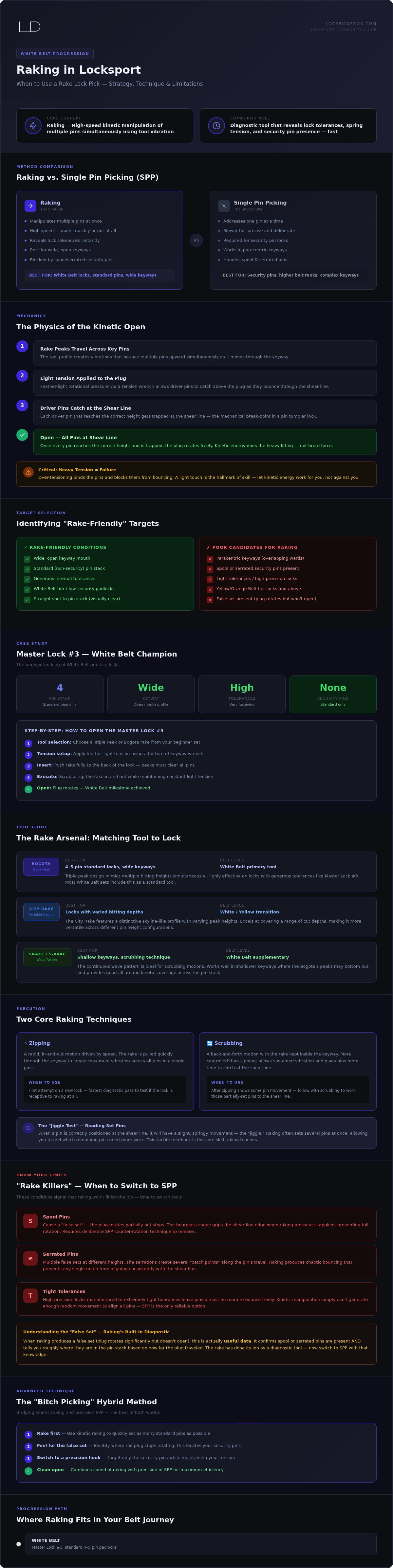
Raking is a kinetic picking method that manipulates multiple pins simultaneously. Instead of focusing on one pin at a time, you use the tool's profile to create movement across the entire pin stack. Understanding when to use a rake lock pick is one of the first major milestones for a new picker. This technique is a vital part of the locksport journey because it provides immediate feedback on lock tolerances and spring tension. When you're just starting out, raking helps you develop a "feel" for the plug's rotation and the resistance of the springs inside. It's a foundational skill that builds the muscle memory you'll need for more advanced techniques.
The White Belt philosophy isn't about taking the easy way out. It's about using rakes to understand the shear line before moving to high-precision single pin picking (SPP). By successfully raking a practice lock, you prove you can manage tension and tool depth. Before you start, always remember the ethical code of our community. Only use these techniques on locks you own and ensure they are not currently installed or in use. Keeping the sport ethical is what keeps our community strong and respected. Raking is a tool for sport and skill building, not for causing trouble.
Raking vs. Single Pin Picking (SPP)
Think of SPP as a sniper rifle and raking as a shotgun. Precision has its place, but sometimes speed is the better diagnostic tool. Knowing when to use a rake lock pick allows you to quickly assess if a lock has security pins or if it's a standard five-pin tumbler. Raking also teaches you the "jiggle test" for set pins. When a pin is correctly positioned at the shear line, it will have a slight, springy movement. Raking often sets several pins at once, allowing you to practice identifying that jiggle on the remaining stacks. To master both styles, starting with a quality beginner lock pick set is essential for your White Belt rank progression.
The Physics of the Kinetic Open
The magic of raking comes down to simple physics. As the peaks of your rake travel across the key pins, they create vibrations that bounce the pins upward. If you apply the correct amount of light tension, the driver pins will eventually catch above the plug. This creates an open once every pin reaches the right height. The shear line is the mechanical break-point in a pin tumbler lock. Success depends on your ability to let the pins move freely while maintaining just enough rotational pressure to trap them. If you use heavy tension, you'll simply bind the pins and prevent them from bouncing. A light touch is the hallmark of a skilled hobbyist because it allows the kinetic energy to do the heavy lifting for you.
Strategic Scenarios: When to Reach for Your Rake
Knowing when to use a rake lock pick effectively separates a lucky beginner from a calculated locksport hobbyist. It's about strategy, not just speed. Low-security padlocks are the obvious choice, but raking serves a deeper purpose as a diagnostic tool. By quickly scrubbing a lock, you can feel how the pins react and identify the binding order. Does it give you a "false set" where the plug rotates significantly but doesn't open? If so, you've likely encountered spool or serrated pins. This is the "False Set" trap; raking won't finish the job here, but it tells you exactly where the security pins are located. For professional locksmiths, this speed is vital for efficiency, but for us in the hobby, it's a lesson in pin-stack physics.
Identifying "Rake-Friendly" Keyways
Understanding when to use a rake lock pick starts with a visual inspection of the keyway. Look for keyways with a wide, open "mouth." If the keyway is paracentric, meaning the wards overlap significantly, your rake won't have the room it needs to bounce pins to the shear line. Standard pins are your best friends during these early stages. You can find a full list of these entry-level targets in our Lock Picking Belt Levels Guide. These White Belt locks are designed with generous tolerances that make kinetic manipulation highly effective. When you're choosing your next practice lock, check the keyway profile first. If it looks like a straight shot to the pins, it's a prime candidate for your rake arsenal.
Master Lock #3: A White Belt Case Study
The Master Lock #3 is the undisputed king of White Belt practice. It features a stack of four standard pins and wide internal tolerances that are very forgiving. To open it, you'll want a Triple Peak or Bogota rake from your set. Start by applying feather-light tension using a bottom-of-the-keyway wrench. Insert your rake all the way to the back of the lock, ensuring the peaks are facing the pins. "Zip" the tool outward quickly while maintaining steady, light pressure. If the lock doesn't pop on the first zip, reset your tension and try again. It's common to over-tension these locks, which binds the pins and prevents the open. For those moving beyond basic padlocks, using a Carbon Fiber Gen 2 Pro Series pick provides the high-yield feedback needed to feel exactly which pins are resisting your efforts.
The Rake Arsenal: Matching Tool Geometry to the Keyway
Selecting the right tool for the job is a core skill in locksport. Your choice of tool geometry depends entirely on the internal landscape of the lock you're facing. While a beginner might see a rake as a blunt instrument, an experienced picker sees a collection of specialized profiles designed for specific kinetic interactions. Understanding when to use a rake lock pick involves more than just speed; it requires a deep appreciation for tool geometry. If you match the tool's peaks to the lock's bitting requirements, your success rate will skyrocket.
The Bogota, also known as the Triple Peak, is the gold standard for kinetic energy transfer. Its three sinusoidal waves are designed to bounce pins with maximum efficiency. In contrast, the City Rake, or L-Rake, features a saw-tooth profile that mimics the look of a standard key. For shallow keyways where you have limited vertical room, the Snake Rake offers a gentle "C" curve that is perfect for a classic scrubbing motion. Each tool provides a different tactile experience, and mastering them is a key step toward your next belt rank. Knowing when to use a rake lock pick with a specific profile is what allows you to clear White Belt locks in seconds.
Bogota vs. City Rake: Which Geometry Wins?
The Bogota is your best friend for high-speed kinetic attacks, specifically the "zipping" technique. It works best when you need to create a lot of movement across all pins at once. The City Rake is a more subtle tool. Instead of zipping it, you use a "rocking" motion, pivoting the tool up and down like a see-saw. This mimics the action of a working key being jiggled in the plug. If you look at the key and see "low-high-low" bitting, reach for the City Rake. If the bitting is more aggressive or random, the Bogota's triple peaks are usually the superior choice.
The Carbon Fiber Advantage
Most entry-level tools are made of stamped steel, which is fine for learning the basics. However, as you progress toward intermediate levels, the material of your handle becomes critical. The Carbon Fiber Gen 2 Pro Series is designed specifically to transmit micro-vibrations from the pin stack directly into your fingertips. Steel handles tend to dampen these signals, but carbon fiber acts as a high-fidelity antenna. This increased feedback helps you sense exactly when a pin has set, even during a fast rake. It also reduces hand fatigue during long practice sessions, allowing you to focus on the subtle "clicks" that signal a successful open. These pro-series tools are the bridge to intermediate Green Belt ranks, where sensitivity is just as important as speed.
How to Execute the Perfect Rake: Zipping and Scrubbing
Executing a clean open with a rake is about rhythm and pressure. It's not about brute force. While beginners often try to "rake the hell out of it," seasoned ethical pickers know that finesse always wins. Understanding when to use a rake lock pick is only half the battle; you must also master the kinetic motion required to set those pins. Scrubbing involves a systematic back-and-forth manipulation, while rocking uses the tool like a see-saw to nudge stubborn pins that are nearly at the shear line. Each method requires a specific touch to be effective without damaging your gear.
Tension control is the most critical factor. If you apply too much pressure, you pin the stacks down and prevent them from bouncing. If you apply too little, the driver pins won't catch. You're looking for that "sweet spot" where the core has just enough rotational force to trap the pins at the shear line as they vibrate. It takes practice, but once you feel that first plug rotation, you'll understand why raking is such a beloved part of locksport.
Step-by-Step: The Zipping Method
Zipping is a high-speed extraction technique designed for instant opens on standard pin stacks. It's incredibly satisfying when done correctly. Follow these steps to master the zip:
- 1. Insert the Trainee 2.0 rake fully to the back of the keyway. Ensure it's seated properly against the last pin.
- 2. Apply "feather" tension with your wrench. This should be just enough to move the core about 1mm.
- 3. Pull the rake out quickly while lifting slightly against the pins. The peaks should "snap" against the pin tips as the tool exits.
- 4. Repeat this motion 3 to 5 times. If you don't get an open, reset your tension completely and try again.
Troubleshooting Common Raking Mistakes
The #1 reason raking fails for beginners is over-tensioning. The pins cannot jump if you are pinning them down with heavy rotational force. Lighten your touch until the tool moves smoothly. Also, check your angle of attack. You must ensure the rake peaks are actually hitting the pin tips rather than getting caught on the keyway warding. If you feel the tool dragging, you're likely out of alignment. Finally, watch out for tool fatigue. Don't scrub the lock for minutes at a time. Finesse beats force every single day. If you want to improve your success rate, use the Carbon Fiber Gen 2 Pro Series to get the high-yield feedback needed to feel exactly when a pin sets.
Limitations of the Rake: When to Switch to Single Pin Picking
Raking is a blast for clearing entry-level padlocks, but every hobbyist eventually hits a wall. Security pins are the ultimate "Rake Killers" of the locksport world. While standard pins fall easily to kinetic energy, security pins like spools and serrated stacks are designed to trap tools and provide misleading feedback. When you move beyond White Belt locks, you will find that a rake often gets you 90% of the way there, only to leave the plug stuck in a frustrating stalemate. Knowing when to use a rake lock pick is a vital skill, but knowing when to put it away is the true sign of an advancing picker.
Many pros use a hybrid technique often called "Bitch Picking." This involves using a rake to quickly set three or four standard pins and then switching to a hook to finish the final, stubborn security pins. This approach keeps your speed high while allowing for the precision needed to clear high-tolerance keyways. As you transition to Yellow and Orange Belt ranks, single pin picking (SPP) becomes mandatory. You simply cannot rake your way to a Black Belt. Mastery requires a deep understanding of how to manipulate each pin individually with total control.
Recognizing a False Set
You will know you have hit a rake's limit when you feel a false set. This happens when the core turns significantly, sometimes up to 15 degrees, but the lock refuses to open. It feels like a victory, but it is actually a trap. A spool pin has become caught on the shear line, and the random scrubbing of a rake will never provide the counter-rotation needed to set it properly. A false set is a clear sign you need to switch to the Pro Series Expansion hooks to identify the specific pin binding the core and lift it to safety. Attempting to force a rake during a false set usually leads to bent tools and damaged springs.
Your Path to Mastery
The journey from a curious beginner to a master picker is a marathon, not a sprint. We want to see you climb the ranks and earn your colors. Join our free Black Belt Challenge today to track your progress through the community-standard ranking system. It is a great way to stay motivated and connect with other ethical pickers who are tackling the same challenges. Share your "picks-in-action" photos and videos on social media to earn exclusive community rewards. We even have a community bounty for hitting social reach milestones, so your success helps the entire sport grow. Grab your tools, start practicing, and let's see how far you can go.
Master the Kinetic Open and Earn Your Next Belt
You now have the tactical knowledge to decide exactly when to use a rake lock pick during your practice sessions. Raking isn't just about speed; it's a diagnostic skill that reveals the inner physics of a lock. By mastering zipping and scrubbing on your first padlocks, you build the tension control necessary for the higher belt ranks. Remember that while rakes clear the path, precision hooks finish the job when security pins try to stop your progress. This balanced approach is what defines a truly skilled hobbyist in our community.
The repetitive scrubbing motion used in raking requires tools that can handle constant friction; similarly, for cat owners, Cat Scratcher Guy offers handmade, durable scratchers designed to withstand that same type of kinetic wear and tear.
Ready to master the rake? Upgrade to the Carbon Fiber Gen 2 Pro Series for maximum feedback. These tools are trusted by professional locksmiths and Black Belt hobbyists for their lightweight design and superior tactile response. They are a core part of our ethical locksport progression series. Keep practicing, stay ethical, and we'll see you at the top of the leaderboard as you conquer the Black Belt Challenge.
Frequently Asked Questions
Can you rake a lock with security pins?
You can rake a lock with security pins, but it rarely results in a complete open. Raking often sets the standard pins and drops the lock into a false set. This is actually a great diagnostic result. It tells you exactly where the spools or serrated pins are hiding. Once you hit that false set, you should stop raking and switch to a precision hook to finish the job.
Is raking a lock considered "cheating" in locksport?
Raking is a legitimate skill and a vital part of a well-rounded picker's toolkit. While higher belt ranks require single pin picking to prove precision, knowing when to use a rake lock pick is essential for speed and efficiency. It isn't cheating; it's a tactical choice. Every expert in the community knows how to use kinetic energy to clear simple targets before moving to advanced methods.
How much tension should I use when raking a padlock?
You should use feather-light tension when raking any padlock. If you apply too much pressure, you'll bind the pins against the cylinder wall and prevent them from bouncing. You only need enough rotational force to move the plug about 1mm. This tiny gap is enough to trap the driver pins at the shear line as your rake vibrates the pin stack during a zip.
Will raking a lock damage the internal pins or springs?
Raking won't damage a lock if you use proper technique and light pressure. However, aggressive scrubbing with heavy tension can wear down the tips of the pins or deform the delicate springs inside. This is why we emphasize finesse over force. Ethical pickers treat their practice locks with respect to ensure they remain functional for hundreds of training sessions without losing their tolerances.
What is the best rake for a beginner to start with?
The Bogota or Triple Peak rake is the best tool for a beginner to master first. Its sinusoidal geometry is incredibly effective at bouncing pins in locks with generous tolerances, like the Master Lock #3. It's a versatile tool that works well for both zipping and scrubbing. Most entry-level sets include this profile because it provides the most consistent results for those earning their White Belt.
What happens if I rake a lock too hard?
Raking too hard usually results in bent picks and a locked-up pin stack. If you use "gorilla" tension, you'll lose all tactile feedback and likely get your tool stuck in the keyway. You might even snap the tip of your pick if it catches on a ward. If you feel yourself straining or getting frustrated, take a breath and lighten your touch. Finesse always beats brute force.
How do I know if a lock is "unrakable"?
A lock is likely unrakable if it has a highly paracentric keyway or advanced security features like sidebars. If you've tried different rake profiles and reset your tension five times without success, the lock is telling you to switch tools. Some high-tolerance locks are specifically designed to defeat kinetic attacks. At that point, you'll need to use single pin picking to find the binding order manually.
Can I use a rake on high-security door locks?
Most high-security door locks are specifically designed to be rake-proof. They often use complex pin-in-pin designs or sidebars that require precise, individual manipulation. While you might get lucky on a low-quality cylinder, you'll generally need specialized tools for these targets. Knowing when to use a rake lock pick means recognizing that expert-level locks require the precision of a hook or a dimple pick instead.