

Lock Picking Belt Levels Explained: The 2026 Locksport Progression Guide
What if that stubborn padlock sitting on your desk isn't "unpickable," but simply a puzzle you haven't been given the map for yet? It's easy to feel overwhelmed when you first dive into the world of locksport. You might worry about buying tools that are too advanced or feel frustrated when a lock just won't budge. Having the lock picking belt levels explained is the secret to turning that frustration into a clear path of mastery. Whether you're in California navigating the latest October 2025 penal code updates or picking from a home workshop in New York, knowing your rank helps you pick with purpose and confidence.
We know that the jump from a basic practice cylinder to a high-security MIWA WR can feel like a mountain climb without a rope. This definitive 2026 guide is here to help you master the locksport roadmap from start to finish. You'll learn exactly which locks belong in each tier, from the foundational White belt to the legendary Black belt requirements. We'll preview the essential tool upgrades you need at each stage and show you how to gain recognition within our thriving community of ethical pickers. Let's start your journey toward that first belt today.
Key Takeaways
- Discover why having the lock picking belt levels explained is essential for choosing the right practice locks and avoiding the frustration of picking above your current skill level.
- Learn the specific requirements for each rank, from the foundational White belt to the expert-level Black belt, including the latest January 2026 community updates.
- Master the transition from basic cylinders to complex security pins by understanding the Gatekeeper skills required for Green and Blue belt tiers.
- Identify the professional-grade tools, like carbon fiber lockpicks and specialty dimple picks, needed to tackle high-security mechanisms at advanced levels.
- Understand the ethical standards of the locksport community and the exact steps to record a successful belt verification video.
What are Lock Picking Belt Levels in 2026?
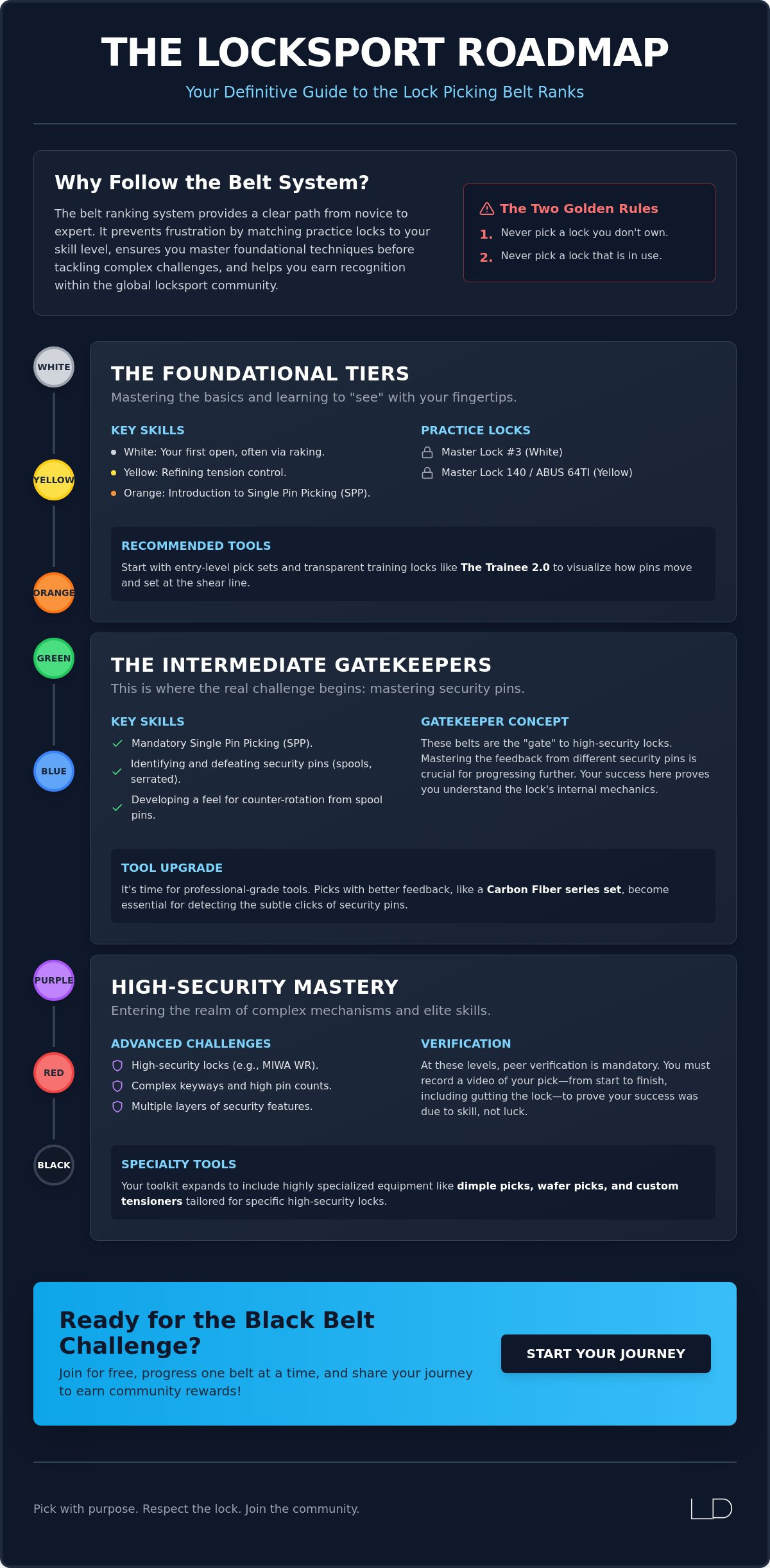
Lock picking belt levels are the martial arts rankings of the locksport world. Much like Brazilian Jiu-Jitsu or Karate, this system provides a standardized way to measure your technical proficiency. Organizations like Lock Pickers United (LPU) maintain these rigorous standards to ensure that a "Blue Belt" in Chicago means the same thing as one in New York. By having the lock picking belt levels explained, you gain a clear vision of your progress from a curious trainee to a master of mechanical security.
The Evolution of the Ranking System
In the early days of the hobby, locks were simply labeled "easy" or "hard." This was subjective and often led to beginners trying to pick high-security locks with zero success. Today, the community uses a nuanced 9-tier system ranging from White to Black. The 2026 standards place a massive emphasis on technical precision. While "raking" a lock might get you a White belt, higher ranks require Single Pin Picking (SPP). You must prove you understand exactly what is happening inside the core. For the upper tiers, peer verification is mandatory. You'll need to record your picks to show the community that your success was a result of skill, not luck.
The Benefits of Following the Belt Roadmap
Following the roadmap ensures a structured skill acquisition. You start with basic pin-tumbler locks, like those found in The Trainee 2.0, before ever touching a complex dimple lock. This prevents "The Wall." This is a common point of frustration where pickers attempt locks they aren't ready for. This usually leads to bent picks and a desire to quit the hobby. By sticking to the ranks, you build a foundation of feel and feedback that carries you through to the expert levels. Plus, earning your colors grants you recognition. It allows you to mentor others and contribute to the collective knowledge of the ethical lockpicking community. Key benefits include:
- Logical Progression: Master simple pin stacks before moving to security pins.
- Tool Longevity: Avoid breaking expensive picks on locks that require advanced tensioning.
- Community Status: Earn flair and respect on platforms like Reddit and Discord.
At its heart, locksport is about non-destructive entry. We treat the lock as a mechanical puzzle to be solved, not a barrier to be defeated. Our community operates on two golden rules: never pick a lock you don't own, and never pick a lock that is currently in use. This ethical framework is what separates a dedicated hobbyist from a criminal. We use precision tools to understand the vulnerabilities of security. We are pushing the boundaries of what is possible through patience and practice. Understanding the lock picking belt levels explained here is your first step toward becoming a respected member of this global community.
The Foundational Tiers: White, Yellow, and Orange Belts
Earning your first few belts is the most exhilarating part of the hobby. It's the phase where the mystery of the cylinder disappears and you start to "see" with your fingertips. Having the lock picking belt levels explained helps you realize that you aren't just opening a lock; you're learning to read the metal. For these three ranks, we recommend starting with The Trainee 2.0. It provides the essential feedback you need to master the basics without overcomplicating your tool kit.
White Belt Mastery: Master Lock #3 and Beyond
The White belt is the "Hello World" of locksport. The community standard for this rank is usually the Master Lock #3. This lock features a 4-pin stack with standard pins and very loose tolerances. Because the manufacturing is sloppy, you actually need a significant amount of tension to bind the pins. A clear practice padlock is an incredible visual aid at this stage. It allows you to watch the driver pins hit the shear line in real time. To secure your first open, follow these steps:
- Apply heavy clockwise tension using a standard wrench.
- Use a medium hook to probe each pin from front to back.
- Identify the "binding pin" that feels stiff and resists movement.
- Lift that pin until you hear a distinct click, then move to the next binder.
Yellow and Orange: Refining Your Feedback
Yellow belt locks, like the Master Lock 140 or the ABUS 64TI/30, introduce tighter manufacturing. You can no longer rely on brute force. You'll need to lighten your tension and listen for more subtle clicks. The Orange belt is where the real challenge begins. This is typically your first encounter with "security pins," specifically spools. In a lock like the Master Lock 150, these pins are designed to get caught on the shear line, creating a "false set."
When you hit a false set, the plug will turn slightly, but the lock won't open. This is where you learn counter-rotation. As you lift a spool pin, you'll feel the plug try to turn back toward the locked position. You must carefully allow that movement while maintaining enough control to set the pin. This technical leap is what separates "raking" from true Single Pin Picking (SPP). As your precision improves, you might find that upgrading to carbon fiber pro picks gives you the increased sensitivity needed for these more communicative locks.
Intermediate Skill Refinement: Green and Blue Belts
Moving into the intermediate tiers is where the hobby truly transforms into a sport. While the earlier ranks focus on basic mechanics, Green and Blue belts demand a surgical approach to tension. Having the lock picking belt levels explained helps you understand that this isn't just about harder locks; it's about a fundamental shift in technique. You'll move away from heavy-handed pressure toward "feather-touch" tensioning. To capture the subtle feedback required at this level, we recommend an upgrade to the Carbon Fiber Gen 2 Pro Series. These tools translate internal vibrations far better than standard steel picks.
Conquering the American Lock 1100 (Green Belt)
The American Lock 1100 is a rite of passage. It's often the first "real" lock a hobbyist encounters. This lock features a 5-pin stack filled with serrated and spool pins. The challenge here is distinguishing a "click" from a "set." Serrated pins provide multiple clicks as they move, but only one is the true shear line. If you apply too much tension, you'll trap the pin in a serration and never get an open.
Green belt is also where the "Gutting" requirement begins. To earn this rank, you must record a continuous video of you picking the lock and then disassembling it. This proves you understand the internal mechanics. You'll need to show the pins, springs, and core to the community. This step ensures that your success was based on technical skill rather than luck. It's a foundational step for anyone looking to reach the higher lock picking belt levels explained in this guide.
Blue Belt and the World of Precision
Blue belt marks your entry into high-precision picking. You'll face locks like the Yale 210C or the Magnum Mont Blanc, which was recently re-ranked to Blue in the January 2026 community update. These locks often feature paracentric keyways. These are narrow, winding paths that make it difficult to reach the pins without your pick getting stuck. You'll need to use thinner hooks and precise placement to navigate the core.
- Challenge Lock Requirement: To earn your Blue belt, you must build a "Challenge Lock." This involves modifying a standard lock with custom pins or core threading to stump other pickers.
- Technical Gutting: You must demonstrate advanced reassembly skills, including the use of shims to prevent "bricking" the lock.
- Skill Refinement: This tier is about consistency. You aren't just looking for an open; you're looking for total control over every pin in the stack.
The High-Security Mastery: Purple through Black Belts
Reaching the upper tiers of the lock picking belt levels explained in this guide is a rare feat. Only a small percentage of the global locksport community ever reaches the Purple belt. This is where simple pin-tumblers are replaced by sidebars, sliders, and rotating discs. Standard hooks often cannot reach these internal components. You'll need the extreme precision of the Gen 2 Pro Max Stealth Edition to navigate these tight tolerances and capture the minute feedback of a high-security core.
Introduction to Dimple and Wafer Picking
Standard hooks fail against dimple locks because these mechanisms require you to rotate the pick rather than lift it. You need flag picks to reach into the "dimples" on the side of the keyway. For advanced civil locks, we recommend using the HUK Kaba Tools. These are specifically designed for the rotating requirements of high-security wafer and dimple systems. At this level, you'll also encounter "False Gates." These are traps designed to feel like a set pin but actually keep the sidebar locked. Learning to feel the difference between a true gate and a shallow notch is the hallmark of a Purple belt picker.
The Black Belt Milestone
Black belt is the absolute pinnacle of the sport. As of the June 2026 standards, you must pick and gut two different locks from the Black Belt list. This includes mechanical monsters like the EVVA MCS or the newly added MIWA WR. It isn't just about the open. To earn this rank, you must prove you are a pillar of the community. The requirements include:
- Dual Lock Verification: Single-pin pick and gut two separate Black tier locks on camera.
- Community Mentorship: Successfully mentor at least two other pickers as they advance through the ranks.
- Epic Quests: Complete two high-level technical projects, such as a detailed lock analysis or a complex tool build.
The community requires high-quality "Picks-in-Action" video content for final verification. This ensures you've truly mastered the mechanical nuances of the world's most secure locks. Hitting this rank makes you a community legend. We even offer a community bounty for those who hit social reach goals with their Black Belt content. It's about sharing the passion and helping the next generation of ethical pickers. If you're ready to start your climb toward these elite ranks, ensure your kit is up to the task. You can upgrade to professional series tools to begin refining the delicate touch needed for high-security mastery.
Navigating Your Progression and Ethical Standards
Success in locksport isn't just about how many cylinders you can pop. It's about how you represent the community. As you've seen with the lock picking belt levels explained throughout this guide, each rank requires more than just mechanical skill. It requires a commitment to the ethical hobbyist lifestyle. We live by two golden rules. First, never pick a lock you don't own. Second, never pick a lock that is currently in use. Picking a door lock that you rely on for security is the fastest way to damage the core and leave yourself stranded. We treat locks as puzzles for practice, not as barriers to be defeated.
Understanding the legal landscape is just as important as mastering a spool pin. For instance, the Lock Pick Laws in California were updated on October 6, 2025. They clarify that possession of tools is legal for hobbyists as long as there is no intent to commit a crime. By pursuing official belt ranks, you're building a documented history of your intent as a legitimate sport picker. This recognition within the community serves as proof of your dedication to the craft and your status as an ethical picker.
Earning Your First Belt Today
Ready to get your name on the board? The process is straightforward and welcoming for newcomers. Follow these steps to earn your White belt flair:
- Step 1: Choose a White belt lock. The Master Lock #3 remains the classic choice for beginners.
- Step 2: Film your pick. You need a continuous, unedited take. Show the lock is locked, pick it until the core turns, and keep the camera on the lock the entire time. If the rank requires a "gut," you must disassemble the lock in that same take.
- Step 3: Submit your video. Post your link to the LPU or Reddit moderators. Once verified, you'll receive your official community rank.
The Lockpick Pros Black Belt Challenge
We want to reward your dedication to the sport. Our "Share-to-Earn" loop is designed to help you upgrade your kit as your skills grow. When you join our community challenge, you can progress through the ranks using our curated gear sets. We've even launched a Bounty Program for 2026. If you reach social engagement milestones by sharing your "picks-in-action" content, you can earn store credit toward our Advanced Lockpick Sets. It's our way of fostering a passionate, ethical community of pickers who push the boundaries of the sport.
Don't let that practice lock sit on your desk any longer. Start your journey toward mastery and earn the respect of pickers worldwide. Join the Black Belt Challenge for Free Today!
Claim Your Place in the Locksport Community
You now have the definitive roadmap for your growth as a picker. With the lock picking belt levels explained, you can stop guessing which lock to buy next and start training with purpose. You've learned how to transition from basic pin-tumblers to complex high-security sidebars while maintaining the highest ethical standards. This journey is about more than just mechanical puzzles; it's about the discipline of mastery and the support of a global community.
We are ready to gear you up for every milestone. Our precision carbon fiber tools are ethical community approved and designed to give you the feedback you need for those difficult security pins. We stand behind our equipment with a 100% satisfaction guarantee. Success in this sport comes down to having the right feel, and the right feel starts with professional-grade equipment.
Join the Black Belt Challenge and Start Your Journey to Mastery
The practice locks on your desk are just waiting for the right touch. Grab your tension wrench, find that first binding pin, and let's get you ranked. We can't wait to see your progress!
Frequently Asked Questions
Is lockpicking legal for hobbyists in the United States?
Lockpicking is legal for hobbyists in most U.S. states as long as you lack criminal intent. For example, California Penal Code 466 was updated in October 2025 to clarify that tools are legal for sport. Always check your local statutes, but the community focus is on ethical practice. Never pick a lock you don't own or one that is in use. Following these rules keeps the hobby fun and legal for everyone involved.
How long does it take to get a Black Belt in lockpicking?
Can I use a beginner lock pick set to earn a Green belt?
You can technically use a beginner set, but you'll likely struggle with the tight tolerances of Green belt locks. High-security pins like spools and serrations require much more feedback than a standard Master Lock. Upgrading to professional carbon fiber picks at this stage makes a massive difference. These tools transmit the subtle vibrations of the pins much better than entry-level steel. It's an investment in your skill refinement and overall success.
What happens if I break a pick inside a lock during a belt challenge?
Breaking a pick is a common rite of passage in locksport and doesn't end your challenge. It usually happens when you apply too much tension to a binding pin in a high-security lock. If this happens, use a broken key extractor to remove the tip. Don't get discouraged; it's a sign you're pushing your limits. Just replace the pick, refine your tension, and get back to the puzzle.
Do I need to buy a new lock for every single belt level?
You usually need at least one new lock for every rank to prove you've mastered specific mechanics. The belt list is curated to ensure you encounter different security pins and keyways at each stage. However, some locks with interchangeable cores can be re-pinned to meet different rank requirements. This is a great way to save money while still following the technical progression roadmap.
What is the "Challenge Lock" requirement for the Blue belt rank?
A Challenge Lock is a factory lock that you have modified to make it significantly harder to pick. To earn a Blue belt, you must create one and share it with another community member. This involves making custom security pins or threading the chambers of the core. It demonstrates that you don't just know how to open locks; you understand the engineering that keeps them secure.
Can I skip belt levels if I am already an experienced locksmith?
You can't skip ranks because the community requires video verification for every single level. Even if you're a professional locksmith, you must demonstrate the specific sport-picking techniques required for each belt. Your professional experience will certainly help you move through the foundational tiers quickly. Enjoy the process of documenting your skills and earning your place alongside other elite ethical pickers in the community.
How do I join the Black Belt Challenge on Lockpick Pros?
You can join the Black Belt Challenge by visiting our community hub and registering for our "Share-to-Earn" program. Once you're in, start posting your "picks-in-action" content on social media to earn rewards. We offer store credit bounties for reaching engagement milestones, which helps you upgrade your gear as you climb the ranks. It's an enthusiastic way to grow your skills while getting recognized by fellow hobbyists.