

Essential Tools for Lock Picking Beginners: Your 2026 White Belt Guide
That massive 50-piece lock picking kit you saw online is probably the worst investment you can make for your new hobby. Most of those sets are stuffed with filler tools that you'll never use, or worse, they're made of flimsy steel that snaps the moment you apply tension. We know it's frustrating to feel overwhelmed by technical jargon like shear lines or binding pins. You just want to understand the mechanics and hear that first satisfying click of a lock opening.
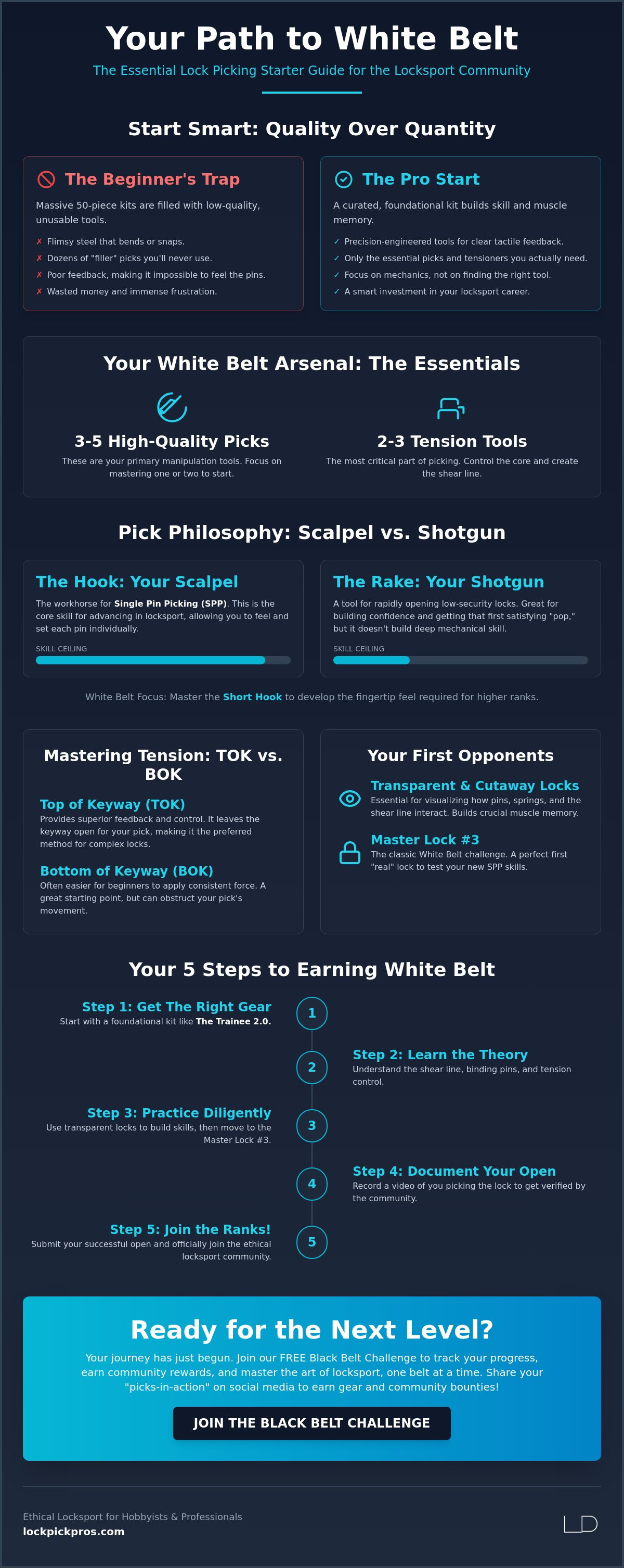
This guide identifies the exact essential tools for lock picking beginners that you need to earn your White Belt rank and join the ethical locksport community. We'll show you why a few precision-engineered tools are better than a bag of junk. You'll learn the specific function of every pick in a foundational kit, from hooks to tensioners. We're going to clear up the confusion so you can tackle your first practice lock and start your journey toward mastery in our Black Belt Challenge.
Key Takeaways
- Start your locksport journey with a curated foundational kit rather than bulky sets, focusing on the few essential tools for lock picking beginners that actually provide feedback.
- Master the 'scalpel' of the hobby by learning when to use a precise hook pick versus a speed-focused rake for different lock types.
- Gain control over the shear line by understanding the critical differences between Top of Keyway (TOK) and Bottom of Keyway (BOK) tensioning.
- Use transparent and cutaway practice locks to build the muscle memory and visualization skills needed for your first successful open.
- Prepare for your first community rank by learning how to document a verified White Belt open to join the ethical locksport community.
Building Your Foundational Kit: The White Belt Essentials
Ethical lockpicking is built on a foundation of respect for the craft and the law. Before you even touch a pick to a keyway, it helps to understand the history and legality of lock picking to ensure you stay within the community's strict ethical boundaries. True hobbyist-grade equipment is designed with specific tolerances for locksport, unlike novelty items that are often too thick to fit into standard keyways. Your goal as a White Belt is to master foundational locks like the Master Lock #3. Using a minimal, high-quality set will help you develop the "fingertip feel" required to earn that first rank.
Why a Minimalist Set Wins Every Time
Raking a lock can be a quick way to get an open, but Single Pin Picking (SPP) is where the real skill is born. By using a minimalist set, you reduce the "noise" in your learning process. You have fewer variables to worry about, allowing you to focus entirely on how each pin reacts to your touch. A White Belt starter kit is the most critical investment for a trainee because it establishes the muscle memory you will use for the rest of your locksport career. Learning to manipulate one pin at a time builds a deep understanding of the shear line that raking simply cannot provide.
The Trainee 2.0: A Modern Starting Point
We designed The Trainee 2.0 specifically for those pursuing their first community belt ranks. It isn't a bloated set; it is a curated collection of the exact hooks and tensioners you need for your first verified open. This kit focuses on the core tools that translate directly to the Master Lock series and other entry-level padlocks. As your skills grow, you can transition from the Trainee kit to our intermediate tools naturally without having to relearn your grip or tensioning style. It is the perfect gateway for anyone ready to stop guessing and start picking with purpose.
Hook Picks vs. Rakes: Selecting Your Primary Manipulation Tools
Hooks and rakes represent two completely different philosophies in locksport. While a rake acts like a shotgun to blast through low-security pins, the hook is your scalpel. It allows for Single Pin Picking (SPP), which is the core skill required for higher belt ranks. When selecting essential tools for lock picking beginners, your focus should always lean toward the hook. It is the only way to truly feel what is happening inside the keyway. Raking might get you a fast open on a cheap padlock, but it won't teach you the mechanics of the sport.
To master the physics of this hobby, the MIT Guide to Lock Picking explains how tension and pin movement interact at the shear line. Reading this classic text helps you visualize why the hook is so effective for precise manipulation. Beyond the metal itself, don't ignore handle ergonomics. A bare metal pick might look sleek, but it will cramp your hand during long practice sessions. Comfortable grips improve your endurance and help you focus on the subtle vibrations coming from the pins. For those looking for the ultimate tactile experience, the carbon fiber series offers incredible feedback while maintaining a lightweight, professional feel.
Mastering the Short Hook
The short hook is the workhorse of any beginner kit. Its specific geometry is designed to reach under pins without bumping neighboring pins out of place. Most trainees find that a thickness of 0.025 inches is the perfect starting point. It's thin enough to fit most North American locks but durable enough to withstand the "heavy-handed" phase every beginner goes through. Your technique should focus on "probing" the pin stack to find the binding pin, which is the one that resists movement most when you apply tension.
When to Use a Rake
Rakes are fantastic confidence builders. If you're struggling to get your first open on a basic lock, a Bogota or City Rake can provide that satisfying "pop" that keeps you motivated. However, raking is a "low-ceiling" skill that relies on probability rather than precision. It often fails when you encounter security pins like spools or serrated pins. Use rakes to understand the sensation of a lock turning, but don't let them become a crutch that prevents you from learning the art of SPP.
Mastering Tension: The Turning Tools You Actually Need
If the pick is the scalpel of locksport, the tension wrench is the steady hand that guides it. Most beginners focus entirely on their pick, but the tension tool is actually the most important item in your bag. Without it, you can't create the tiny ledge at the shear line where pins rest once they are set. Mastering tension is about more than just shoving a piece of metal into a keyway. It is about developing a "feather touch" that allows you to feel the internal components of the lock as they bind and click into place.
Understanding the physics of your tools starts with knowing how locks and keys work at a mechanical level. When you apply rotation to the plug, you are looking for that one "binding" pin that is caught between the plug and the housing. Too much pressure will jam the pins, making them impossible to move. Too little pressure will cause set pins to drop back down the moment you move your pick. These tensioners are truly the essential tools for lock picking beginners because they bridge the gap between your hands and the lock's internal state.
BOK vs. TOK: Which Should You Start With?
Bottom of Keyway (BOK) tension is the traditional starting point for White Belt locks like the Master Lock #3. It provides a stable platform and is generally easier for a trainee to keep in place. However, BOK tools can sometimes take up too much room, making it hard to maneuver your pick in tighter keyways. This is where Top of Keyway (TOK) tension becomes a game changer. TOK tools leave the entire bottom of the keyway open for your pick, which is vital as you progress toward advanced belts. You must identify the right width for your tensioner; a tool that is too wide can bind against the lock housing, making it feel like the pins are set when they aren't even moving.
Upgrading to Pro-Series Tension
As you move beyond the basics, the material of your turning tool starts to matter. Using Carbon Fiber Gen 2 Pro Series tools can significantly enhance the sensory feedback you receive. Rigid, high-yield materials don't flex or dampen the vibrations from the pins, giving you a crystal-clear picture of what is happening inside the plug. If you find yourself facing more complex or paracentric keyways, expanding your kit with the Pro Series Expansion ensures you always have the perfect fit. Having a variety of tension widths is the "secret sauce" that separates a frustrated beginner from a successful hobbyist.
Practice Locks: The Essential Training Partner
Practice locks are the essential training partner that turns abstract theory into a tangible skill. While you are gathering essential tools for lock picking beginners, a transparent cylinder is usually the first item in the cart. These acrylic tools serve a specific purpose: they reveal the hidden dance of driver pins, key pins, and springs. Seeing the shear line align in real time helps your brain connect the physical sensation in your hand to the mechanical reality inside the plug. It is the "aha!" moment every trainee needs to understand why tension is so vital.
However, don't let the visual feedback become a crutch. Some sources claim clear locks are all you need to learn, but they miss a critical point. Acrylic is much softer than the brass or steel found in real locks. This means the vibrations are dampened, and the "click" feels mushy. To advance toward your Yellow Belt, you must eventually transition to metal. A metal cutaway lock is a fantastic intermediate step. It provides the crisp, authentic feedback of a professional cylinder while still allowing a peek at the pins when you get stuck. To get the most out of your training, you need picks that don't mask these subtle vibrations. Our Carbon Fiber Gen 2 Pro Series picks are engineered to transmit maximum feedback, helping you move from visual learning to pure tactile mastery.
The Role of the Clear Practice Lock
Visualizing the pin-stack is the first major hurdle for any hobbyist. A clear lock lets you observe exactly how a "false set" looks when a spool pin gets caught on the shear line. It also teaches you the difference between a pin that is truly set and one that is overset. If you are unsure which version to start with, read our guide on How to Choose Your First Practice Lock to find the best fit for your learning style. Use the clear lock to calibrate your hands, then move on quickly to avoid developing bad habits.
Moving to Real Metal
Once you've popped the clear lock a dozen times, it's time to close your eyes. If you can't open it blind, you haven't mastered the lock; you've just mastered the puzzle. Moving to a real Master Lock #3 is the standard White Belt challenge. Real metal is grittier and far less forgiving than plastic. If the jump feels too big, try progressive pinning. Start with a practice lock that only has two pins installed. Once you can open that consistently without looking, add a third, then a fourth. This method builds the muscle memory needed for "blind" picking without the frustration of a full five-pin stack.
Earning Your Belt: Join the Black Belt Challenge
Locksport is more than just a solitary hobby; it's a structured path of mastery. The community belt ranking system provides a clear roadmap for every ethical lockpicker to follow. While you've already identified the essential tools for lock picking beginners, those picks and tensioners are just the beginning of your story. Earning your White Belt is your official entry into the sport, proving that you've moved past luck and started using real technique. It transforms your practice sessions into a mission to climb the ranks from a curious trainee to a master of the craft.
The "Share-to-Earn" loop is our way of celebrating your progress. We don't just want you to pick locks; we want you to show the world what you've achieved. By posting your "picks-in-action" content on social media, you can earn rewards and contribute to our community bounty. When the community hits specific social reach goals, everyone wins. It's a great way to stay motivated while connecting with other enthusiasts who are also working through the early belt levels. Joining the Black Belt Challenge isn't just about the tools; it's about the people you meet along the way.
The Black Belt Challenge Roadmap
To get started, your first step is simple: grab your foundational tools and a Master Lock #3. This lock is the gold standard for White Belt verification. Once you're confident, set up your camera for a continuous, unedited shot. You need to show the lock is functional, pick it on camera, and then show the open core. For higher ranks, you'll eventually need to "gut" the lock to show the pins inside. Once your video is ready, join the Lockpick Pros community to submit your footage and claim your rank.
Tool Progression for Higher Ranks
As you climb toward Yellow, Orange, and Green belts, your requirements will change. You'll eventually outgrow your starter set and need more specialized equipment. Moving from The Trainee 2.0 to the Carbon Fiber Special series gives you the refined feedback necessary for security pins. Advanced ranks like Purple and Brown require specialty tools like dimple picks or wafer jigglers. To see exactly what you'll need for each stage, check out our guide on Lock Picking Belt Levels Explained. It's time to stop practicing in the dark and start earning your place in the community.
Start Your Journey to Black Belt Mastery
You've seen that success in locksport isn't about how many picks you own; it's about the precision of your foundational kit. By focusing on quality over quantity, you avoid the frustration of broken tools and muffled feedback. Mastering the relationship between the short hook and proper tension is what separates a lucky open from a skilled hobbyist. These essential tools for lock picking beginners are the only things standing between you and your first community rank.
Our team is ready to act as your mentor, providing the community-verified tools and enthusiastic support you need to progress. Every kit includes free entry into our Black Belt Challenge, giving you a clear roadmap from your first padlock to high-security mastery. It's time to stop watching and start doing. Ready to earn your White Belt? Grab The Trainee 2.0 and start picking today! We can't wait to see your first verified open on social media.
Frequently Asked Questions
Is it legal to own lock picking tools in the US?
Possession of lock picks is legal in the vast majority of states. The critical legal factor is your intent; as long as you aren't using them to commit a crime, you're fine. In states like Indiana, North Dakota, and Pennsylvania, there are no specific statutes at all. California updated its Penal Code 466 in 2025 to clarify that possession is a misdemeanor only if the prosecution proves criminal intent.
Can I really learn to pick a lock with a bobby pin or paperclip?
You can technically open a lock with improvised tools, but it's an exercise in frustration. Bobby pins lack the strength and geometry found in essential tools for lock picking beginners. Real picks are designed to transmit subtle vibrations from the pins to your fingertips. Using a paperclip often results in a "mushy" feel that prevents you from actually learning the mechanics of the sport.
How long does it take for a beginner to pick their first lock?
Most trainees can open a transparent practice lock within five to ten minutes of their first attempt. Moving to a real metal lock, like a Master Lock #3, usually takes between thirty minutes and an hour of practice. The timeline depends on how quickly you develop a feel for the binding pin and master your tension pressure. Success is about patience, not speed.
What is the easiest lock for a beginner to start with?
The Master Lock #3 is the undisputed king of beginner locks. It is the official standard for the White Belt rank because it has a simple four-pin stack and wide internal tolerances. These features make it very forgiving for those who are still learning how to find the shear line. It provides clear, loud feedback that helps you understand when a pin is successfully set.
Should I buy a large 50-piece set or a smaller kit?
Always choose a smaller, high-quality kit over a massive set full of filler. Most 50-piece sets contain dozens of useless rakes and novelty tools that you'll never touch. A focused set like The Trainee 2.0 gives you the exact hooks and tensioners you need for your first community ranks. This prevents you from feeling overwhelmed and ensures every tool in your bag serves a purpose.
What is the difference between lock picking and lock bumping?
Lock picking is a skill-based method involving the manipulation of pins using hooks or rakes. Lock bumping is a kinetic attack that uses a specially cut "bump key" and a mallet to bounce all the pins simultaneously. While bumping is fast, it requires very little skill and can easily damage the lock. Picking is the preferred method for locksport hobbyists because it focuses on precision and finesse.
Do I need any special lubricants or maintenance tools for my picks?
Your picks don't need much maintenance beyond a quick wipe with a dry cloth after use to remove skin oils. For your practice locks, you should use a dedicated dry lubricant like Houdini or a graphite-based spray. Avoid using standard WD-40 or heavy greases. These substances attract dust and grime over time, which can gum up the springs and make the pins feel sluggish during practice.
What happens if I break a pick inside a lock?
Breaking a pick is a rite of passage for every new hobbyist. If a tip snaps off inside the keyway, you can usually pull it out using a broken key extractor or a thin hook pick. If the fragment is jammed deep, try tapping the lock face down on a hard surface to shake it loose. This is why using high-quality steel is so important; it bends before it snaps.