

How to Use a Ball Pick: The Complete 2026 Locksport Guide
That strange, round tool in your beginner kit isn't a manufacturing mistake; it's actually the secret weapon for locks that make standard hooks feel useless. Many new hobbyists assume the ball pick is just a "bad hook" or a filler piece. However, if you've ever struggled with a stubborn cabinet or desk lock, you know that standard tools often fail to provide the right feedback. It's frustrating when you're stuck on a foundational lock, and the fear of damaging your equipment is real.
We've all been there, staring at a wafer lock that refuses to open despite our best efforts. This guide will teach you exactly how to use a ball pick to master these specialized mechanisms and progress through your locksport belt ranks with confidence. By understanding the mechanical difference between ball and hook picks, you'll stop guessing and start opening. We will cover the specific "scrubbing" technique required for success, the best practice locks for your skill level, and how to select the right tool from your pick set selection to ensure you earn that next belt.
Key Takeaways
- Identify the ball pick as a specialized tool designed specifically for wafer tumblers found in office furniture and cabinets.
- Master the "scrubbing" technique and learn how to use a ball pick with the right tension to defeat stubborn double-sided wafers.
- Compare single and double ball designs to understand which profile offers the best mechanical advantage for your target lock.
- Progress through your locksport belt ranks by successfully opening common White Belt wafer locks found in foundational practice sets.
- Upgrade your tactile feedback with the Carbon Fiber Gen 2 Pro Series to feel the subtle movements of wafers as they set.
What is a Ball Pick? Understanding This Essential Locksport Tool
The ball pick is often the most misunderstood tool in a starter kit. While beginners usually gravitate toward the classic hook, the ball pick serves a specific, vital role in the locksport community. It features a perfectly circular or oval tip, designed specifically to interact with wafer tumblers. Unlike pin tumbler locks that require precise, individual lifting, wafer locks often respond better to the broad, rounded surface area of a ball pick. Many hobbyists call it the "jiggler's best friend" because of its versatility in specific low-security environments.
Ethical lockpicking is about mastery and respect for the craft. We use these tools on our own practice locks or in a legal, competitive setting to sharpen our skills. When you're learning how to use a ball pick, you're not just trying to open a lock; you're learning the unique mechanical feedback of wafer-based security. It's a foundational skill that bridges the gap between simple raking and precision single-pin picking.
The Anatomy of a Ball Pick
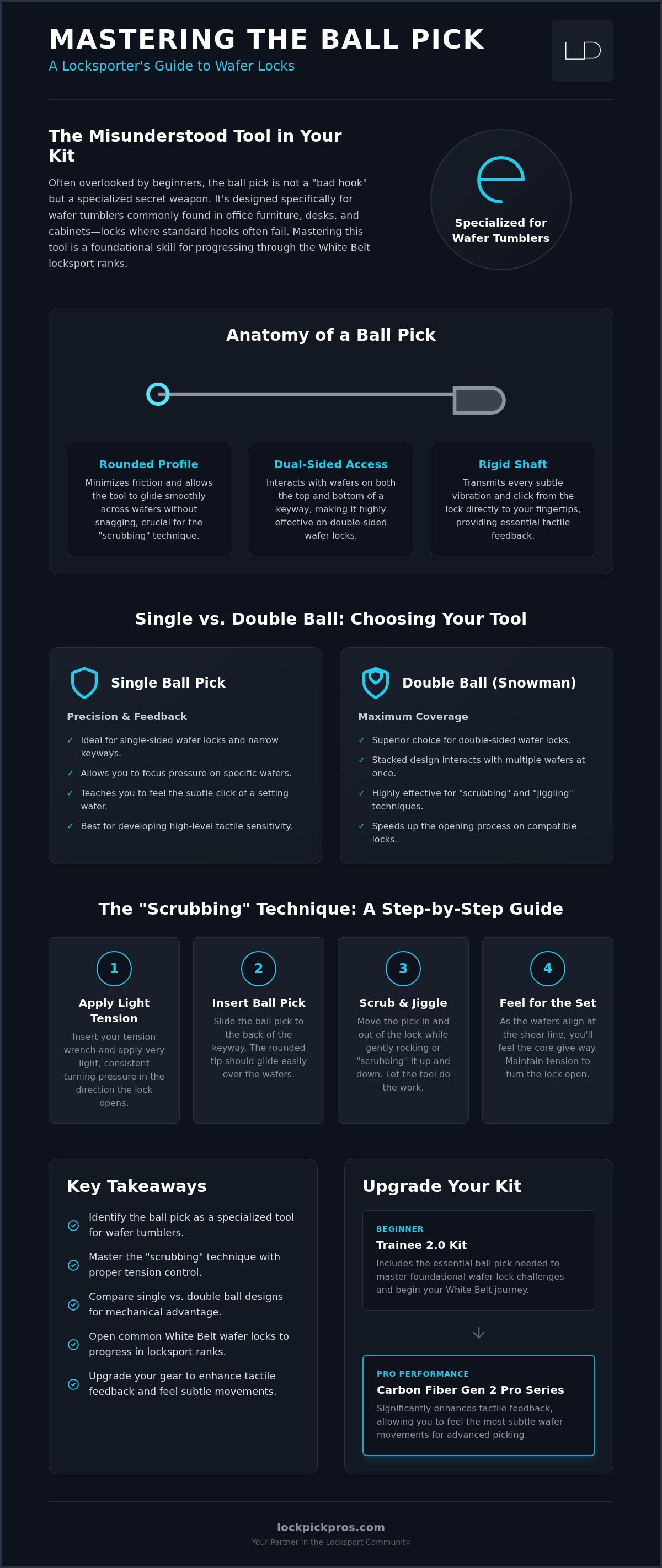
The design is deceptively simple. The rounded tip lacks the sharp points or steep angles found on hooks or gems. This geometry is intentional. It allows the tool to glide smoothly across the surface of wafers without snagging or binding prematurely. Because wafer locks often require a technique known as "scrubbing," this smooth profile is essential for moving multiple components simultaneously. Key features of a well-made ball pick include:
- Rounded Profile: Minimizes friction against the lock body and allows for 360-degree interaction.
- Dual-Sided Access: Allows for interaction with wafers on both the top and bottom of the keyway without flipping the tool.
- Rigid Shaft: Provides the tactile feedback necessary to feel when a wafer has reached the shear line.
A high-quality ball pick also features a sturdy shaft. While you'll mostly use light tension, the ability to apply consistent vertical pressure without the tool flexing excessively is what separates professional gear from cheap imitations. This rigidity ensures that every vibration from the lock is transmitted directly to your fingertips.
Why Every Beginner Set Needs One
Mastering this tool is a key step in your White Belt progression. Many foundational locks found in community ranking lists utilize wafers because they are inexpensive to manufacture. By learning how to use a ball pick early in your journey, you diversify your skill set and ensure you don't get stuck when a standard hook fails to provide the right reach or feedback. It's about having the right tool for the specific mechanical challenge in front of you.
This principle of matching the right equipment to the task extends beyond locksport; for instance, if you're looking for precision in your other hobbies, you can learn more about Golf Ball Monkey to find high-quality gear that matches your skill level.
Single Ball vs. Double Ball Picks: Choosing the Right Tool
Choosing between a single and double ball pick is about matching your tool's geometry to the lock's internal gates. While both use the same basic physics, the surface area changes how you interact with the wafers. When you're learning how to use a ball pick, your goal is to manipulate the wafers to the shear line without oversetting them. The size of the ball determines how many wafers you're touching at once and how much movement you can tolerate within the keyway. Understanding these mechanical advantages is the first step toward earning your next belt rank.
The Single Ball: Precision and Feedback
Single ball picks offer the highest level of precision in the wafer-picking world. They are ideal for single-sided wafer locks where space is tight and the keyway is narrow. If you're working on a lock with deep gates, a single ball allows you to focus pressure on a specific area without disturbing adjacent wafers. This is why many mentors suggest starting with this profile; it teaches you to feel the subtle click of a setting wafer. For those pursuing higher belt ranks, mastering this tactile sensitivity is non-negotiable. You'll find that using Carbon Fiber Gen 2 Pro Series tools significantly enhances this feedback, allowing you to hear with your hands.
The Double Ball (Snowman): Maximum Coverage
The double ball pick, often called the "Snowman," is a different beast entirely. Its stacked design provides maximum coverage, making it the superior choice for double-sided wafer locks. These are common in older automotive doors or high-security cabinets where wafers are staggered on both the top and bottom of the keyway. The Snowman profile allows you to interact with both sides simultaneously. It effectively doubles your chances of hitting the right height while scrubbing. While it offers less individual feedback than its single-ball cousin, it's often the fastest way to get an open on a complex, double-sided mechanism. Knowing how to use a ball pick of this size means recognizing when speed and coverage outweigh the need for surgical precision.
Ultimately, your tool choice should reflect the lock's internal complexity. If the wafers are standard and single-sided, reach for the single ball. If you're facing a double-sided challenge with unknown gate heights, the Snowman is your best bet. Switching between them as you learn will help you understand the nuances of wafer security and prepare you for more advanced locksport challenges. This versatility is exactly what separates a trainee from an expert picker.
Step-by-Step: How to Use a Ball Pick on Wafer Locks
Unlike the static hunt for a binding pin, wafer picking is a rhythmic dance. Many beginners fail because they treat wafers like pins; they try to lift them one by one with too much force. Learning how to use a ball pick effectively means shifting your focus from individual components to the collective movement of the stack. This technique is often the fastest way to secure your White Belt and move toward more complex challenges. It requires a blend of tactile sensitivity and rhythmic consistency that standard hooks simply don't demand.
Setting the Tension
Wafers are delicate. They don't have the same robust springs as high-tier pin tumblers found in heavy-duty padlocks. If you apply heavy tension, you'll jam the wafers against the lock body, making them impossible to move. Start with "feather" tension, which is just enough pressure to keep the wrench from falling out. Place your tension wrench at the bottom of the keyway to leave plenty of room for the pick's circular tip to reach the top wafers. If you feel the tool grinding or resisting your movement, you're likely over-tensioning. Back off until the pick moves freely again.
Follow this five-step sequence for a successful open:
- Step 1: Insert your tension wrench and apply very light pressure.
- Step 2: Slide the ball pick all the way to the back of the keyway.
- Step 3: Initiate a steady, rhythmic scrubbing motion as you pull the pick toward the front.
- Step 4: Slightly vary the vertical angle of the pick to ensure you contact staggered wafers.
- Step 5: Maintain tension and repeat the motion until the plug rotates.
The Scrubbing Motion
The scrubbing motion is a controlled, rhythmic movement of the pick across the wafer faces under light tension. It isn't a frantic jiggle. Instead, it's a deliberate in-and-out stroke that mimics the action of a key sliding into the lock. You should feel the rounded tip of the ball pick riding over the wafers like a car driving over speed bumps. Each bump you feel is a potential set point. If the lock doesn't open after several passes, reset your tension and try again with a slightly different angle.
Listening is just as important as feeling. As you scrub, listen for a distinct, metallic "click." This sound indicates that a wafer has reached its shear line and is no longer blocking the plug. Once you hear that sound, keep your tension steady. Any sudden drops in pressure can cause the wafers to fall back into their resting positions, forcing you to start over. Mastery of this auditory feedback is what separates a trainee from a true locksport enthusiast.
Mastering Specific Targets: Cabinet Locks and Double-Sided Wafers
Once you've grasped the basics, it's time to apply your skills to real-world targets. Many hobbyists start their journey by consulting our Lock Difficulty Reference Guide to find accessible "White Belt" challenges. You'll notice that many of these foundational locks are wafer-based. However, don't make the mistake of trying this tool on a standard pin tumbler door lock. Because ball picks have a large, rounded surface area, they can't isolate a single pin without accidentally bumping others. They are precision instruments for wafers, not universal keys for every lock you encounter.
Office and Desk Locks
Office furniture locks are the ideal training ground for anyone learning how to use a ball pick. These locks are often single-sided, meaning the wafers only protrude from one side of the plug. Your first task is identifying that orientation. Insert your pick and gently feel for resistance on the top or bottom. If the "bumps" are only on the top, you'll focus your scrubbing motion there. In tight cabinet keyways, space is at a premium. You might need to use a thinner tension wrench to ensure your ball pick has enough vertical room to move. These locks provide immediate, satisfying feedback that builds the muscle memory needed for more complex security systems.
Advanced Wafer Challenges
Contrary to what some casual observers claim, not all wafer locks are low security. Some advanced models incorporate security wafers that feature "false gates." These work similarly to spool pins in a pin tumbler lock; they trap your pick and make the lock feel like it's set when it isn't. When you encounter a false gate, you'll need to "hunt" for the specific binding wafer that's holding the plug. This requires a much lighter touch and a more deliberate scrubbing rhythm. If you find that your beginner tools aren't providing enough tactile detail to distinguish between a true set and a false gate, it's likely time to transition to our Pro Series Expansion tools.
Mastering these advanced targets is about refining your sense of touch. You'll learn to feel the difference between the springy resistance of an unset wafer and the rigid, metallic stop of one that's properly trapped at the shear line. For the most demanding wafer challenges, upgrading to the Carbon Fiber Gen 2 Pro Series will give you the unmatched feedback necessary to navigate these subtle mechanical traps. Every successful open on a double-sided or high-security wafer lock brings you one step closer to earning your next belt rank and joining the elite ranks of the locksport community.
Upgrading Your Kit: From Beginner to Pro Performance
As you move from basic desk locks to high-security double-sided wafers, your equipment must keep pace with your evolving skills. Standard tools are great for learning the basics of how to use a ball pick, but advanced locksport requires a level of sensitivity that basic materials simply can't provide. When tolerances get tighter and false gates become more common, the difference between a successful open and a frustrating reset often comes down to the feedback transmitted through your tool's handle. Upgrading your kit isn't just about buying more picks; it's about enhancing your ability to "hear" what is happening inside the keyway.
The Carbon Fiber Advantage
Feedback is the lifeblood of an expert picker. Carbon fiber handles allow the picker to feel the minute vibrations of a wafer dropping into its gate. Unlike plastic or dipped handles that often absorb and dampen these critical signals, carbon fiber acts as a high-fidelity transmitter. This material is exceptionally rigid, ensuring that every subtle click is felt directly in your palm. This isn't just about luxury; it's about accuracy. When you're refining your technique on how to use a ball pick, you need to distinguish between the mushy resistance of an unset wafer and the sharp stop of a set one. Our Carbon Fiber Gen 2 Pro Series offers this unmatched tactile feedback while remaining lightweight and ergonomic for those long practice sessions at your workbench.
Join the Black Belt Challenge
Mastery is a journey best shared with a community of fellow ethical lockpickers. Our Black Belt Challenge is designed to reward your dedication as you climb the belt ranks from White to Black. Registration is completely free and gives you access to our community bounty program. We want to see your progress. We encourage you to record your "picks-in-action" and share your successful opens on social media. This is the heart of our community-focused mission.
By posting your progress, you participate in our share-to-earn loop. Hitting specific social reach goals earns you exclusive rewards and discounts on future tool upgrades. Whether you're showing off a quick open on a cabinet lock or a technical victory over a security wafer, your content inspires the next generation of trainees. Start your journey with the Trainee 2.0, master the ball pick, and document your rise through the ranks. We're here to provide the tools and the support you need to earn your black belt in locksport.
Take Your Locksport Skills to the Next Level
Mastering the ball pick opens up a whole new world of wafer-based security challenges. You've learned that the rounded profile isn't a filler tool; it's a precision instrument for scrubbing and jiggling office furniture locks and double-sided wafers. By focusing on light tension and rhythmic movement, you've gained the foundational knowledge of how to use a ball pick to secure your White Belt and beyond. These skills are essential for any hobbyist looking to round out their technical repertoire.
The locksport community thrives on sharing progress and refining technique. Join our free Black Belt Challenge to track your journey and earn rewards through our share-to-earn program. To truly feel the difference in high-security wafer gates, you need gear that communicates with your fingertips. Master your feedback with the Carbon Fiber Gen 2 Pro Series and experience the unmatched tactile sensitivity of professional-grade tools. We're excited to see your successful opens on social media. Keep practicing, stay ethical, and enjoy the climb toward your Black Belt.
Frequently Asked Questions
Can I use a ball pick on a standard door lock?
No, you shouldn't use a ball pick on a standard pin tumbler door lock. The rounded tip is designed to interact with the flat surface of wafer tumblers rather than the individual pins found in household deadbolts. Using the wrong tool can lead to jammed pins or a damaged pick. Stick to hooks or rakes for your household practice locks.
Why is my ball pick getting stuck inside the lock?
Your pick is likely getting stuck because you're applying too much tension. Heavy tension binds the wafers against the lock body, trapping the pick's rounded tip between them. If you're learning how to use a ball pick, try lightening your touch until the tool glides freely. Resistance usually means the wafers are jammed rather than set.
Is ball picking the same as raking?
Ball picking and raking share a rhythmic motion, but they aren't identical. Raking is a broad, aggressive technique for pin tumblers. Ball picking is a more localized "scrubbing" method specifically for wafer locks. It requires a finer touch to ensure the rounded tip hits the wafer faces without oversetting them during the rhythmic in and out movement.
What is a "Snowman" pick used for?
A "Snowman" or double ball pick is used for double-sided wafer locks. These mechanisms have wafers on both the top and bottom of the keyway. The stacked design of the Snowman allows you to interact with both sides simultaneously. This makes it a staple for older automotive locks and high-security office furniture found in many beginner kits.
Do ball picks work on Master Lock padlocks?
Most standard Master Lock padlocks use pin tumbler mechanisms, so a ball pick won't work on them. However, some Master Lock utility or cabinet locks use wafers. Always check the internal mechanism before choosing your tool. If you see flat wafers instead of round pins, your ball pick is the right choice for that specific lock.
How much tension should I use when ball picking?
You should use very light "feather" tension when ball picking. Wafer locks have delicate springs that are easily overwhelmed by heavy pressure. If you apply too much force, you'll prevent the wafers from sliding into their gates. Start with just enough pressure to hold your tension wrench in place and adjust based on the feedback you feel.
Are ball picks legal to own as a hobbyist?
Yes, lock picks are legal to own in most U.S. states for hobbyist use as long as there's no criminal intent. For example, California Penal Code § 466 makes possession a misdemeanor only if intent to break and enter is proven. States like Ohio and Virginia consider possession prima facie evidence of intent, so always check your local regulations first.
Can a ball pick open a car door?
A ball pick can technically open older car doors that use wafer locks, but this is strictly for your own practice vehicles. Modern cars use much more advanced security systems that require specialized bypass tools. In the locksport community, we focus on ethical picking of locks we own or have explicit permission to use for skill progression.