

Best Lock Picks for Kwikset: 2026 Locksport Ranking Guide
The rattling feedback of a Kwikset deadbolt is either your biggest frustration or your best teacher in the world of locksport. You probably know the feeling of a pin binding so hard it won't move, usually because of over-tensioning or a lack of clear vibration through a low-quality handle. It's a common struggle for many hobbyists, but it's also the perfect opportunity to refine your touch. This guide will show you how to master these cylinders by selecting the best lock picks for Kwikset locks and applying professional single-pin picking strategies.
We promise to help you successfully open your first deadbolt while teaching you how to distinguish a standard cylinder from a complex SmartKey. You'll also learn exactly where these locks sit within the LPU belt ranking system so you can track your progress as an ethical picker. We're going to preview the professional-grade toolsets, like our carbon fiber series, that provide the high-fidelity feedback you need for progressive practice. Let's get started on your journey toward earning that next belt rank.
Key Takeaways
- Understand why the Kwikset cylinder is the foundational lock for White Belt progression and how its loose tolerances provide a perfect training ground for beginners.
- Learn how to select the best lock picks for Kwikset locks by focusing on 0.025-inch profiles and high-feedback handle materials that amplify pin vibrations.
- Master the "light to medium" tensioning technique required to navigate the unique mechanical feedback loop of a standard five-pin deadbolt.
- Identify the technical differences between a standard pin-tumbler and a SmartKey cylinder to ensure you use the correct technical single-pin picking strategy.
- Discover how upgrading to the Carbon Fiber Gen 2 Pro Series can reduce hand fatigue and improve your success rate during long practice sessions.
Understanding Kwikset Lock Anatomy and Belt Rankings
Standard Pin-Tumbler Kwikset (White Belt)
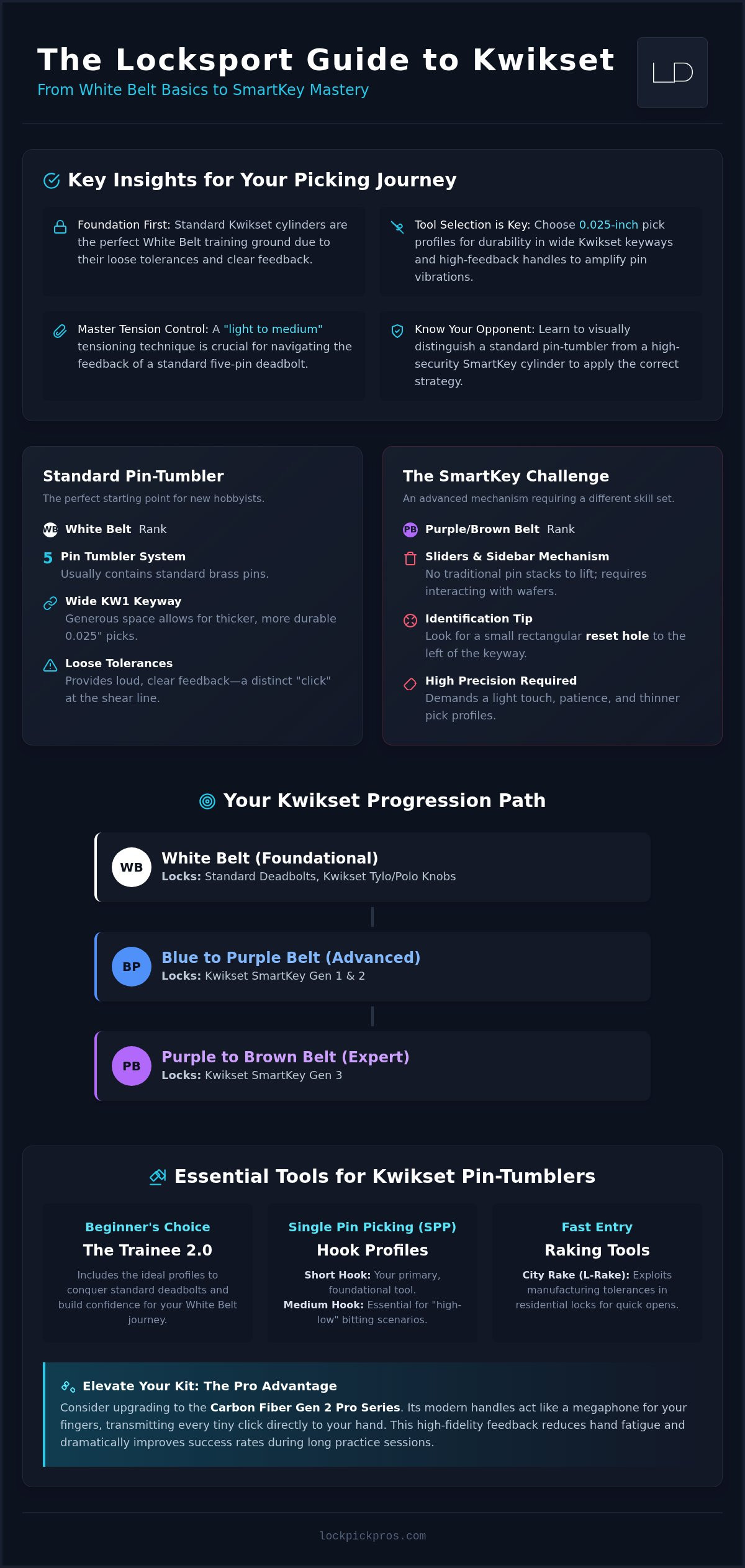
The classic Kwikset uses a five-pin tumbler system. It's famous for its wide, open keyway. This generous space is exactly why finding the best lock picks for Kwikset locks is easier for newcomers. You can use thicker picks, like 0.025-inch profiles, without getting stuck. The pins are usually standard brass. Because the tolerances are relatively loose, the mechanical feedback is loud and clear. When a pin hits the shear line, you'll feel a distinct "click" that helps you build muscle memory. You can identify these by the classic "KW1" keyway shape. It looks like a wide, jagged lightning bolt. It's the perfect environment to practice your first single-pin picking (SPP) techniques.
The Kwikset SmartKey Challenge
Don't let the brand name fool you into thinking everything is easy. The Kwikset SmartKey system is a completely different beast. While it looks similar from the outside, the internals use sliders and a sidebar instead of traditional pins. This design jump takes the lock from a White Belt to a Purple or even Brown Belt ranking. Identifying these is simple. Look for a small rectangular hole to the left of the keyway. That's the reset cradle. If you see that hole, your standard picking strategy has to change.
SmartKey Gen 1 and 2 were tough, but Gen 3 introduced a massive difficulty spike. Standard hooks often fail here because there are no traditional pin stacks to lift. Instead, you're interacting with wafers that must align with a sidebar. If you're using tools like the Carbon Fiber Gen 2 Pro Series, you'll need to learn how to feel for the subtle binding of those sliders. Selecting the best lock picks for Kwikset locks in the SmartKey category requires thinner, more precise profiles to navigate the sidebar pressure. It's a technical challenge that rewards patience and a light touch.
Mapping these to your progression helps you set clear goals:
- Standard Deadbolts: White Belt (Foundational)
- Kwikset Tylo/Polo Knobs: White Belt (Foundational)
- SmartKey Gen 1/2: Blue to Purple Belt (Advanced)
- SmartKey Gen 3: Purple to Brown Belt (Expert-level)
This progression allows you to grow as a hobbyist without ever leaving a familiar brand. You can start with a basic deadbolt and eventually work your way up to the master-level sliders of a Gen 3 SmartKey.
Essential Tool Selection for Kwikset Pin-Tumblers
Picking a Kwikset is a rite of passage for every ethical picker. Its wide KW1 keyway is a playground for hobbyists because it doesn't require the surgical precision of ultra-thin picks. You can comfortably use 0.025-inch tools without worrying about them getting stuck or snapping. This thickness provides the durability you need while you're still learning how much force to apply. When searching for the best lock picks for Kwikset locks, pay close attention to the handle material. Traditional steel handles work, but they often dampen the subtle vibrations coming from the pins. Modern carbon fiber handles act like a megaphone for your fingers. They transmit every tiny click and binding sensation directly to your hand, which is vital for developing your "feel" for the lock.
Hook Picks for Single Pin Picking (SPP)
Standard Kwikset pins are predictable, but the right profiles make the job much easier. The Short Hook is your primary tool for most sessions. It is the foundational pick for SPP. Sometimes you'll encounter "high-low" bitting, where a very deep pin sits right behind a shallow one. A Medium Hook becomes essential here. It allows you to reach over the front pins without accidentally oversetting them. If you're just starting your White Belt journey, The Trainee 2.0 is an ideal starter set. It includes the exact profiles you need to conquer standard deadbolts and build your confidence.
Raking Tools for Fast Entry
Raking is a fun way to exploit the manufacturing tolerances of residential locks. The City Rake, often called the L-rake, is incredibly effective on the Kwikset platform. Its saw-tooth profile mimics common key bitting and can often pop a standard cylinder in seconds. Another community favorite is the Bogota profile. It's perfect for "zipping," a technique where you pull the pick out quickly to bounce the pins to the shear line. While raking is fast and satisfying, it won't help you earn higher belt ranks. Use it to understand how the lock feels, then switch to SPP for true skill refinement.
As you move beyond the basics, you'll find that better tools lead to faster opens. Upgrading to the Carbon Fiber Gen 2 Pro Series provides the professional-grade feedback you need to master more difficult cylinders. It's a smart investment for any hobbyist looking to scale their kit with their growing skill level.
Tensioning Techniques: The Secret to Kwikset Success
Tension is the engine of any successful open. In the locksport community, we often say that picking is 10% lifting pins and 90% tension control. Kwikset locks are famous for their generous tolerances, but this can be a trap for beginners. Because the plug has so much "slop," it's easy to apply too much force. You only need a light to medium touch to find the binding order. If you crank on the wrench, you'll create a friction lock that masks the very sensations you're searching for. Selecting the right tension wrench from your Pro Series Expansion kit is the first step toward mastering this delicate balance.
Top of Keyway (TOK) vs. Bottom of Keyway (BOK)
Bottom of Keyway (BOK) tensioning is usually the first technique a trainee learns. It's intuitive and holds the wrench securely. In the spacious KW1 keyway, however, a BOK wrench can sometimes twist and bind the plug against the housing. This "plug bind" makes it feel like pins are set when they aren't even touching the shear line. Transitioning to Top of Keyway (TOK) tensioning solves this. TOK placement provides a more direct mechanical feedback loop. It also leaves the entire bottom of the keyway open, allowing the best lock picks for Kwikset locks to reach the back pins without interference.
Feedback Sensitivity and Carbon Fiber Advantages
Once you have your tension set, you need to listen to what the lock is telling you. This isn't about sound; it's about the "crunch" and "click" felt through your tools. Carbon fiber handles are the gold standard for high-sensitivity picking because they transmit mechanical feedback without the dampening effect found in traditional plastic or heavy rubber grips. When you pair a high-quality TOK wrench with the best lock picks for Kwikset locks, you create a clear communication line between the lock and your hands.
You can use the "jiggle test" to verify your progress. Gently poke each pin with your hook while maintaining tension. A pin that feels springy is not yet binding. A pin that is rock solid is your current binder and needs to be lifted. If a pin has a tiny amount of movement but feels distinct from a springy pin, it's likely set. Learning to distinguish these three states is the hallmark of an advanced hobbyist. Practice this feedback loop on a standard deadbolt before moving on to security pins or SmartKey systems.
Step-by-Step Guide: Picking Your First Kwikset Deadbolt
Ready to feel that plug turn? Start by cleaning the cylinder with a bit of compressed air if it feels gritty. A clean lock provides the best feedback. It ensures you don't miss the subtle mechanical cues that even the best lock picks for Kwikset locks can't amplify through layers of old grease. Insert your tension wrench and apply that light pressure we discussed in the previous section. Move your hook pick to the back of the keyway and slowly pull forward, touching each pin stack. You're looking for the one that doesn't budge. That's your first binder. Choosing the best lock picks for Kwikset locks is only half the battle; you also need a clean cylinder and a patient hand.
Setting the Binding Order
Kwikset locks rarely bind in a straight 1-2-3-4-5 line. You'll likely find that pin 3 or 4 binds first. This is the "binding order," and it's unique to every lock. Test each pin repeatedly. When you find the binder, give it a firm but gentle lift. You'll feel a "click" as it reaches the shear line. If it feels rock solid or mushy, you might have overset it. If that happens, don't panic. Slowly release tension until you hear one pin drop, then try again. Using high-quality tools like the Carbon Fiber Gen 2 Pro Series makes it much easier to feel these tiny shifts in the plug.
Dealing with Security Pins (Spools)
While most standard Kwikset deadbolts use basic pins, some newer models or "re-pinned" practice locks include spools. You'll know you've hit a spool when the plug turns slightly but the lock doesn't open. This is known as a "false set." As you lift the pin, you'll feel the tension wrench push back against your finger. This is counter-rotation. Don't fight the lock. Ease up on your tension slightly and "walk" the pin up until it clicks into place. You can dive deeper into these advanced mechanics in our guide on Lock Picking Belt Levels Explained.
If you get stuck, simply reset the lock by releasing all tension and start over. Every failed attempt is a lesson in feedback. Focus on the "Click, Bind, Set" cycle. Your goal is to map the internal state of the lock in your mind. With practice and the right tools, you'll be popping deadbolts with total confidence. It's a journey of skill refinement that gets more rewarding with every open.
Elevating Your Kit with the Carbon Fiber Gen 2 Pro Series
You've mastered the basic feedback of a standard deadbolt. Now it's time to talk about the gear that separates a trainee from a seasoned hobbyist. While standard steel tools are great for starting out, they often struggle to transmit the high-frequency vibrations needed for technical single-pin picking. This is where the Carbon Fiber Gen 2 Pro Series becomes your most valuable asset. It's designed to be the ultimate companion for anyone chasing higher belt ranks. The rigidity of the handle ensures that every micro-movement of the pins is felt directly in your fingertips, eliminating the "mushy" sensation often found in rubber-coated tools.
Why Carbon Fiber Excels on Kwikset Keyways
Material science plays a massive role in how we interpret lock data. Carbon fiber is incredibly stiff. This rigidity means that the energy from a setting pin isn't absorbed by the handle; it's reflected into your hand. When you are looking for the best lock picks for Kwikset locks, you want tools that won't flex or bend under the pressure of a stubborn cylinder. These picks maintain their profile shape even when navigating the tight sidebar pressure of a SmartKey system. This durability allows you to practice for hours without hand fatigue. It turns a frustrating session into a rewarding learning experience. You'll find that more data leads to faster opens and a deeper understanding of internal mechanics.
Join the Black Belt Challenge
We believe lockpicking is a journey best shared with others. That's why we created the Black Belt Challenge. It's a community-driven roadmap that encourages you to document your progress and earn rewards along the way. Once you've popped your first Kwikset deadbolt, don't just keep it to yourself. Join our "share-to-earn" loop by posting your "picks-in-action" content on social media. It's a great way to connect with other ethical pickers and get feedback on your technique. We even have a community bounty for hitting social reach goals, which helps us grow the sport together.
Are you ready to take the next step in your locksport career? Earning your next belt rank is about more than just luck; it's about having the right tools for the job. Upgrade to the Carbon Fiber Gen 2 Pro Series and start the challenge today! We can't wait to see your first successful open video and welcome you further into our community of passionate hobbyists.
Master Your Next Open
Mastering Kwikset cylinders is the first major milestone for any aspiring locksport hobbyist. You now understand that while a standard deadbolt is a welcoming White Belt challenge, the SmartKey system requires a much more technical approach to single-pin picking. Success in this sport comes down to balancing light tension with the high-fidelity feedback provided by the best lock picks for Kwikset locks. By focusing on the "Click, Bind, Set" cycle and using tools specifically designed for vibration transmission, you'll significantly shorten your learning curve and avoid common pitfalls like over-tensioning.
Our professional Carbon Fiber series is trusted by LPU community members for its lifetime durability and unmatched sensitivity. It's time to put your new knowledge to the test and start climbing the community belt ranks. Claim your Carbon Fiber Gen 2 Pro Series and start the Black Belt Challenge! We're excited to watch your progress and welcome you into our growing community of ethical pickers. Keep practicing, stay curious, and we'll see you at the next belt level.
Frequently Asked Questions
Are Kwikset locks easy to pick for beginners?
Standard pin-tumbler Kwikset locks are the gold standard for beginners entering the locksport community. Their wide keyways and loose manufacturing tolerances make them very forgiving while you learn the basics of single-pin picking. Most hobbyists start with these cylinders to earn their White Belt because the feedback is loud and easy to interpret. They are the perfect training ground for building foundational skills before moving to more complex security pins.
What is the best pick profile for a standard Kwikset deadbolt?
A standard short hook is the most effective profile for almost every Kwikset cylinder you will encounter. Because the KW1 keyway is so spacious, you can easily use 0.025-inch thick hooks to get clear mechanical feedback. These are widely considered the best lock picks for Kwikset locks due to their durability and reach. You might occasionally need a medium hook if the bitting is particularly aggressive, but the short hook remains the primary tool.
Can I pick a Kwikset SmartKey lock with a standard beginner set?
You generally cannot pick a SmartKey cylinder using traditional hooks and rakes found in beginner kits. These locks use sliders and a sidebar mechanism rather than traditional pin-tumblers. Navigating a Gen 3 SmartKey requires advanced tools and a specialized technical strategy. If you try to use standard picks, you won't feel the usual binding pins because the internal wafers interact with the sidebar in a completely different way.
Do Kwikset locks have security pins like spools or serrated pins?
Most standard residential Kwikset locks contain only standard brass pins, but some newer "security-rated" models include two or three spool pins. You'll know you've hit a spool if the plug turns slightly into a false set and then provides counter-rotation as you lift the pin. These are excellent for practicing intermediate skills. Identifying these pins is a key step in progressing through the community belt ranking system.
Is it legal to own lock picks for Kwikset locks in my state?
Lock pick ownership is legal in the vast majority of jurisdictions as long as there is no intent to commit a crime. We always advocate for the "ethical lockpicker" code: only pick locks you own and never pick a lock that is in use. While most states view picks as common tools, some have specific regulations. It's your responsibility to check your local statutes to ensure you are practicing your hobby legally.
Why is my Kwikset lock not opening even though I feel the pins setting?
You are likely oversetting a pin or caught in a false set caused by a spool pin. If you lift a pin too high, it binds above the shear line and prevents the plug from turning. This is a common mistake when beginners use too much force. Try reducing your tension slightly to let the overset pin drop back down. This delicate touch is why choosing the best lock picks for Kwikset locks with high-feedback handles is so important.
What tension tool should I use for a Kwikset keyway?
Top of Keyway (TOK) tension wrenches are the preferred choice for Kwikset locks because they provide the most direct mechanical feedback. While Bottom of Keyway (BOK) tools are common in starter sets, they can sometimes bind the plug against the housing in the spacious KW1 keyway. Using a TOK wrench leaves the entire bottom of the keyway open. This gives you maximum room to maneuver your pick and feel each pin individually.
How can I tell if my Kwikset is a standard pin-tumbler or a SmartKey?
Check the face of the lock for a small, rectangular "reset hole" located to the left of the keyway. If that hole is present, you are looking at a SmartKey cylinder that uses wafers and a sidebar. If the face only contains the keyway itself, it is a traditional five-pin tumbler lock. Knowing the difference is vital because your picking strategy will change completely depending on which internal mechanism you are attacking.