

Cutaway vs. Clear Practice Locks: The 2026 Beginner’s Guide to Locksport
That shiny, transparent lock in your starter kit might actually be the biggest hurdle standing between you and your first legitimate "open." It's a counterintuitive reality in locksport: the more you can see, the less you might be learning about the delicate internal mechanics of a pin tumbler system. Many newcomers find themselves stuck in a cycle of frustration. They can pop a plastic cylinder in seconds but struggle the moment they touch a real metal padlock.
We understand the fear of damaging expensive hardware or wasting money on toy-quality gear that doesn't provide real feedback. You deserve a clear path from a curious Trainee to a master of the craft. This guide settles the cutaway vs clear practice locks debate to help you build the tactile foundation required for your White Belt and beyond. You'll learn which training aid translates best to real-world scenarios, how to avoid developing "visual" bad habits, and exactly which tools will help you master the internal dance of pins and springs as you begin your journey toward Black Belt excellence.
Key Takeaways
- Understand how clear acrylic locks reveal the inner workings of pin tumbler mechanisms; this gives you a foundational "X-ray" view of your tools in action.
- Master the cutaway vs clear practice locks debate to choose the right training aid that develops genuine tactile feedback rather than visual reliance.
- Learn the technical differences between driver pins and key pins so you can diagnose exactly why a lock isn't opening during your first sessions.
- Discover how to align your practice sessions with the locksport belt ranking system to track your progress from your first open to Black Belt mastery.
- Unlock the path to our free Black Belt Challenge where you can earn community rewards by sharing your "picks-in-action" milestones on social media.
The Role of Practice Locks in Your Locksport Journey
Locksport isn't about breaking in. It's about breaking down the mechanics of a complex puzzle. It's a competitive, ethical hobby that turns everyday hardware into a game of skill and patience. While picking is an essential skill for the legitimate profession of locksmithing, our community focuses on the mental challenge of the open. We follow a strict Golden Rule: never pick a lock you don't own, and never pick a lock that is currently in use. Choosing between cutaway vs clear practice locks is your first real decision as an ethical lockpicker, and it sets the stage for your entire training experience.
Picking a door lock you rely on for security is a recipe for a costly locksmith bill. You might drop a pin or brick the cylinder entirely. Dedicated practice locks avoid these headaches. They allow you to focus on the mechanics without the risk of locking yourself out of your own home.
This level of focus on internal mechanics is a trait shared by many hobbyists who enjoy working with complex, small-scale systems. If you appreciate the patience required for intricate builds, you might also want to check out Mon-cirque-Pinder to see how precision is applied in the world of miniature circus modeling.
The Ethics of the Pick: Staying Within the Law
Ethical lockpickers distinguish themselves through transparency and responsibility. We pick on practice stands or loose cylinders to ensure we never compromise anyone's security. This journey is structured through a community-driven belt ranking system. It provides a clear roadmap from your first day to master-level status. To understand how to climb these ranks, check out our Lock Picking Belt Levels Explained: The 2026 Locksport Progression Guide. Using dedicated practice locks is always superior to scrounging old hardware from a junk drawer. Old locks often contain grit, corrosion, or damaged springs that can mask the feedback you need to learn. A clean practice cylinder ensures you're learning the skill, not fighting a broken mechanism.
Why Your First Open Matters
There's nothing quite like the feeling of your first open. That sudden click and the rotation of the plug is a massive psychological win for any trainee. It validates your effort and transforms abstract theory into a physical reality. When deciding between cutaway vs clear practice locks, remember that both serve to provide that vital "aha!" moment for visual learners. A clear lock lets you see the pins move in real time. A cutaway provides the metallic feel of a real cylinder while still showing the shear line. Setting a goal to earn your White Belt in your first week is completely realistic with the right gear, like The Trainee 2.0. This foundational step builds the confidence you'll need as the tolerances get tighter and the security pins get trickier in higher tiers. Success breeds success. Once you feel that plug turn, you'll be hooked on the pursuit of mastery.
Clear vs. Cutaway vs. Real Locks: Choosing Your Training Wheels
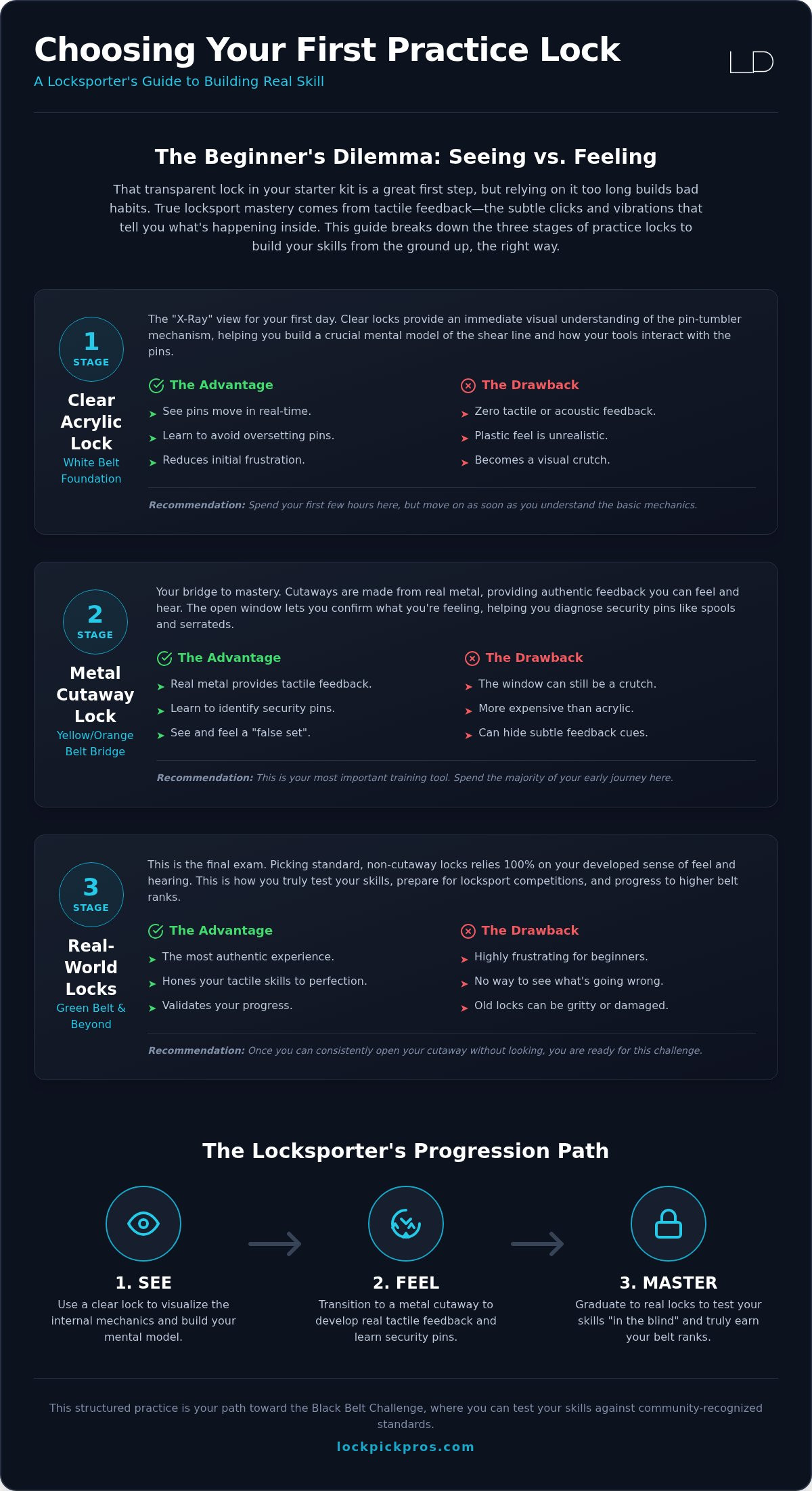
Choosing your first training tool is a pivotal moment in your locksport journey. The debate over cutaway vs clear practice locks usually comes down to where you are in your progression. For absolute beginners, clear acrylic locks act like an X-ray view. They provide an immediate understanding of the pin tumbler mechanism. You can see the driver pins, key pins, and springs react to your pick in real time. This visual aid is crucial for building a mental model of the shear line. It also helps you identify oversetting before it becomes a bad habit. We recommend spending your first hour with a transparent lock to reduce the initial frustration of "picking in the dark."
The Transparent Advantage for White Belts
Visualizing the internal dance of a lock is the fastest way to learn. When you use a clear lock, you aren't just guessing where your pick is. You're watching the pins reach the shear line. This helps you understand exactly how much tension is required to bind a pin. It's the perfect environment to practice your "jiggle test" without the stress of a blind keyway. Most trainees find that this visual confirmation prevents the common mistake of using too much force early on.
Metal Cutaways: Real Feedback, Open Secrets
Once you understand the basic mechanics, metal cutaway locks become your bridge to mastery. While acrylic is great for seeing, it's terrible for feeling. Plastic absorbs vibration and sound. Metal cutaways use real brass or steel components, providing the acoustic and tactile feedback you'll need for real-world hardware. These locks often include security pins like spools or serrated pins. Seeing how a spool pin causes a "false set" while simultaneously feeling the counter-rotation in your hand is an invaluable lesson. It's the moment you transition from looking to feeling, while still keeping a visual safety net.
Progressive Training: From 2 Pins to 6
The ultimate way to grow is through progressive training. Instead of fighting all six pins at once, you start with two or three. This allows you to master Single Pin Picking (SPP) without the "noise" of a full pin stack. As your sensitivity improves, you add pins until you're comfortably opening the full cylinder. The Trainee 2.0 is specifically designed for this progression, making it a staple for anyone chasing their first belt. As you advance, you'll find that having a high-quality Lock-picking tool and method matters as much as the lock itself. Precision tools translate the tiny movements inside the keyway directly to your fingertips. If you're ready to feel every subtle click in a metal cutaway, consider upgrading to our professional carbon fiber series to sharpen your tactile senses. Eventually, you'll put the practice locks aside and move to real padlocks, relying entirely on the "blind" feedback you've cultivated.
Technical Specs: Pin Stacks, Tolerances, and Feedback
The mechanics of a lock aren't just about metal parts; they're about the interaction of physics and touch. Every practice cylinder contains a pin stack consisting of three main parts: the driver pins, the key pins, and the springs. In a standard setup, the driver pins sit across the shear line, preventing the plug from turning. When you choose between cutaway vs clear practice locks, you're deciding how you want to witness this interaction. Clear locks show the springs compressing in real time, while metal cutaways let you hear the sharp, metallic snap of a driver pin falling into place.
Manufacturing tolerances are the secret sauce of a high-quality practice lock. Low-quality "toy" locks often feel mushy because the holes for the pins are drilled with poor precision. This leads to a sloppy binding order where pins might set just by moving the pick around. High-precision tools and locks, such as those used by the Longhorn Lockpicking Club, offer crisp, clear feedback. When a pin hits the shear line in a well-made cylinder, you feel a distinct, unmistakable click through your tension wrench that signals success.
Mastering the Feedback Loop
Your tension wrench is your primary sensor. It tells your fingers exactly which pin is binding and which is moving freely. By applying light, consistent pressure, you can identify the "binding order"-the specific sequence in which pins must be set to open the lock. Once a pin is correctly positioned at the shear line, it will often pass the "jiggle test." This means the pin feels slightly springy because it's no longer being pinched between the plug and the housing. Using high-precision practice locks is essential during this stage. They prevent you from developing "brute force" habits where you simply jam a pick into the keyway and hope for the best.
Standard vs. Security Pins
Most White Belt locks, like The Trainee 2.0, feature standard pins for foundational learning. These are simple cylinders with flat tops that make learning the basics of pin placement straightforward. As you progress toward higher ranks, you'll encounter security pins designed to trick your senses. The most common is the spool pin, which is narrowed in the middle to catch on the shear line prematurely. This creates a specific phenomenon known as a false set. A false set is the plug rotating slightly without the lock opening. In the cutaway vs clear practice locks debate, seeing this false set happen visually helps you understand why your tension wrench is suddenly giving you counter-rotation. Mastery of these technical specs is what separates a lucky opener from a skilled locksport athlete.
Matching Your Practice Lock to Your Pick Set
Success in locksport depends on the synergy between your tools and your practice cylinder. A pick is a sensor, not a pry bar. When you are navigating the cutaway vs clear practice locks landscape, you must align your pick set selection with the tolerances of the lock. For White Belt trainees, entry-level hooks and rakes are perfect for transparent models. These tools are often thicker and more robust. This helps you learn the layout of the keyway without worrying about bending a delicate professional pick. As you move to metal cutaways and eventually real padlocks, your gear must evolve to match the tighter spaces and subtler feedback.
A mismatched kit can stall your progress. If your pick is too thick for a narrow keyway, you'll spend more time fighting the warding than feeling the pins. Conversely, using ultra-thin professional picks on a wide-open beginner lock can lead to accidental damage. Balance is key. Your goal is to develop a "feel" for the metal that carries over to every lock you encounter.
Entry-Level Hook Selection
The short hook is the undisputed MVP of beginner lockpicking. It allows you to reach individual pins with precision while maintaining enough surface area to feel the state of the spring. In your first sessions with a transparent lock, you'll see how the tip of the hook interacts with the pin stack. Pick thickness is a critical factor here. Thicker picks are great for wide-open practice keyways, but they can get stuck in advanced hardware. To dive deeper into tool specifics, read our guide on How to Choose Your First Beginner Lock Pick Set: The Ultimate 2026 Guide.
Advanced Tools for Precision Locks
When you graduate to metal cutaway locks, the "mushy" feel of plastic disappears. You need tools that can transmit the high-frequency vibrations of metal pins. Using the Carbon Fiber Gen 2 Pro Series offers a massive advantage for intermediate tiers. Carbon fiber handles are incredibly lightweight and rigid. They don't dampen the feedback like rubber or plastic grips do. This sensitivity is vital for identifying the tiny clicks of a serrated pin or the counter-rotation of a spool. Matching your tension wrenches to the specific keyway is equally important. A snug fit ensures that every micro-movement of the plug is felt in your fingertips.
As your collection grows, organization becomes a priority. A dedicated carrying case protects your investment from bending or rusting. You'll eventually add specialty gear like dimple picks or wafer rakes for advanced practice locks. Every tool has a purpose. High-quality gear ensures that your progress through the belt ranks is limited only by your skill, not your equipment. If you're ready to feel the difference that precision engineering makes, upgrade your kit with the Carbon Fiber Gen 2 Pro Series today.
The Path to Black Belt: Join the Challenge
Mastering your first cylinder is a massive milestone. In the world of locksport, that first open is just the beginning of a lifelong pursuit of skill and precision. We created the Lockpick Pros Black Belt Challenge to turn your practice sessions into a structured journey of mastery. This is a free community rewards program designed to support you from your very first click to the day you tackle high-security cylinders. Whether you began your journey debating cutaway vs clear practice locks or jumped straight into metal cylinders, we want to celebrate your progress. Every rank you earn brings you closer to the elite tiers of our sport.
Earning Your White Belt Today
The path to your first rank is simple and encouraging. Once you can reliably open your practice lock, record a video of the process to submit for verification. To maintain our standards as ethical lockpickers, your video must show the lock is not in use or installed in a functional door. Clearly demonstrate the "open" and show the plug rotating fully. You can submit these videos through our community Discord for real-time coaching and verification from our advanced pickers. This isn't just about showing off your skill. It's about joining a global network of hobbyists who value precision, patience, and ethics.
The Share-to-Earn Loop
We believe that sharing your progress should be rewarding for everyone involved. By using the hashtag #LockpickProsChallenge on social media, you join a vibrant conversation of enthusiasts. This share-to-earn loop allows you to earn points toward your next gear upgrade every time you hit a new milestone. Many of our trainees use these rewards to fund their Pro Series Expansion kit as they move into the Green and Blue belt tiers. It's a powerful way to grow your toolset while spreading awareness of locksport as a legitimate, puzzle-solving hobby. Sharing your "picks-in-action" content helps others see the accessibility of the sport.
Our community also features monthly bounties for those who go above and beyond as mentors. We reward the most helpful posts in our forums and social channels with store credit. If you discover a specific trick for tensioning a tricky cutaway or find a better way to feel a serrated pin, share it. Helping a fellow trainee overcome a hurdle is the fastest way to sharpen your own technical understanding. These bounties provide credit that can be applied to high-yield lockpicks or professional pinning trays. Your journey from White Belt to Black Belt is a marathon. Every open brings you closer to mastery. Grab your tools, record your progress, and let's see that plug turn.
Earn Your Ranks and Master the Craft
Join a thriving community of over 10,000 members who are all Ethical Locksport Certified. Whether you're starting with foundational sets or upgrading to our Precision Carbon Fiber Tools, we're here to support every click and rotation. It's time to put your knowledge into practice, record your progress, and start climbing the belt ranks today.
Join the Free Black Belt Challenge and Get Your First Practice Lock Today!
We can't wait to celebrate your first open in the community. Grab your tools, stay ethical, and enjoy the journey toward mastery.
Frequently Asked Questions
Is it illegal to own a practice lock in the United States?
It's legal to own practice locks in the vast majority of U.S. states. Most jurisdictions view lockpicks and training aids as legal hobbyist tools as long as there is no intent to commit a crime. A few states have specific laws regarding "locksmith tools," so it's always smart to check your local statutes. As ethical lockpickers, we focus strictly on the sport and never carry tools for illicit purposes.
Can I use a clear practice lock to learn how to pick real door locks?
You shouldn't expect a clear lock to teach you how to pick every door in your house. Clear locks are excellent for visualizing the pin tumbler mechanism, but they lack the tight tolerances and metallic feedback of real hardware. Use them to build your mental model. Once you understand the shear line, transition to metal cutaways to develop the tactile sensitivity needed for authentic locksport challenges.
What is the difference between a cutaway lock and a standard padlock?
The main difference is the visible window milled into the side of a cutaway cylinder. A standard padlock is completely enclosed, forcing you to rely entirely on feel. In the cutaway vs clear practice locks debate, the cutaway is the superior bridge because it uses the same brass or steel components as a real lock while still allowing you to peek at the pins if you get stuck.
Do I need a specific pick set to use with my first practice lock?
You don't need a massive kit to start, but your pick choice should match your lock's difficulty. A basic short hook and a couple of tension wrenches are perfect for your first transparent lock. As you advance to metal cutaways with security pins, you'll want to upgrade to more sensitive tools like our Carbon Fiber series to capture the subtle vibrations of the binding order.
How long does it typically take to earn a White Belt in lockpicking?
Most dedicated trainees can earn their White Belt within their first week of practice. It only requires a basic understanding of Single Pin Picking (SPP) and a successful open of a simple lock. If you spend 30 minutes a day with a tool like the Trainee 2.0, you'll likely feel that first plug rotation and submit your verification video before the weekend is over.
What happens if I break a pick inside my practice lock?
Don't panic if a pick snaps; it happens to everyone eventually. You can usually remove the broken tip using a specialized broken key extractor or even a pair of thin tweezers. Breaking a pick is often a sign that you're using too much tension. Treat it as a learning moment to lighten your touch and focus more on the feedback than the force.
Are re-pinnable practice locks worth the extra cost for beginners?
Re-pinnable locks are absolutely worth the investment because they grow with your skill level. Instead of buying ten different locks, you can swap out the pins to create thousands of different combinations. This allows you to introduce security pins like spools or serrated pins whenever you're ready for a new challenge, making them a cost-effective way to reach higher belt ranks.
How do I know when I am ready to move from a clear lock to a metal one?
You're ready to move to metal when you can open your clear lock without looking at the pins. If you can feel the binding order and set every pin purely by touch, the transparent shell has served its purpose. Transitioning to metal is a key step in the cutaway vs clear practice locks journey. It forces you to trust your fingers and prepares you for the tighter tolerances of competitive locksport.