

2026 Guide to Building an EDC Lock Pick Set
Your current carry might be holding you back more than it's helping. Many enthusiasts believe that more tools equal more capability, but the reality of building an EDC lock pick set in 2026 is that less is almost always more. You've likely felt the frustration of a bulky case digging into your leg or, worse, a low-quality pick snapping just as you felt the final pin set. We agree that your gear should be an extension of your skill, not a burden that sits unused in your pocket.
This guide promises to help you curate a high-performance, compact kit that handles everything from basic padlocks to complex security pins without the unnecessary weight. We will explore the "Rule of Three" for essential tool selection, the feedback advantages of the Carbon Fiber Gen 2 Pro Series, and how to match your picks to specific lock types. Whether you are a White Belt beginner or chasing your Black Belt in the locksport community, you will learn to assemble a kit that is as professional as it is portable. Let's refine your carry and focus on the precision tools that actually matter for ethical lockpickers.
Key Takeaways
- Learn why the "Rule of Three" is the secret to a minimalist kit that outperforms bulky, redundant sets.
- Discover how the Carbon Fiber Gen 2 Pro Series provides the ultimate foundation for building an EDC lock pick set that amplifies tactile feedback.
- Explore tiered loadouts tailored to your specific belt rank, from foundational White Belt tools to expert-level specialty picks.
- Understand the material science behind high-yield steel and carbon fiber to ensure your tools never bend or fail in the field.
- Find out how to join the Black Belt Challenge and use our share-to-earn loop to turn your locksport progress into community rewards.
The EDC Lockpicking Philosophy: Why Portability Matters
EDC isn't just a buzzword; it's a commitment to your craft. For the locksport community, Lock picking is a skill that requires constant refinement and a portable mindset. Building an EDC lock pick set allows you to practice on your own locks whether you're at a friend's house or waiting at a bus stop. It's about having the right tools for the job without the unnecessary bulk of a full master set. You want gear that fits into your life seamlessly.
Most hobbyists start with a massive kit containing fifty different picks. You'll quickly find that you only use three or four of them. A master set belongs on your workbench, but in the field, a compact kit is superior because you'll actually carry it. If your tools are too heavy, they stay home. If they stay home, you aren't picking. The "Rule of Three" is your best friend here. It suggests carrying one hook, one rake, and a couple of tensioners. This minimalist approach ensures you have the capability to handle most common locks without the clutter of redundant tools. Precision beats variety every time.
Ethical lockpickers follow a strict code. Never pick a lock you don't own or don't have explicit permission to pick. Carrying tools is a responsibility, and you must demonstrate lawful intent at all times. By focusing on your own practice locks, you keep the hobby fun and legal. Your EDC kit should be a symbol of your dedication to the sport, not a source of trouble.
The Difference Between a Bench Set and an EDC Kit
Your bench set is for exploration; your EDC kit is for execution. Every millimeter of space in your pocket is prime real estate. Focus on the 20% of tools that open 80% of locks. This usually means a short hook and a versatile rake. Using the Carbon Fiber Gen 2 Pro Series helps keep your footprint small while maximizing feedback. These tools translate the tiny vibrations of a setting pin directly to your fingertips. A slim carrying case is also essential. It protects your high-yield steel picks from bending or snapping during daily movement.
Legal and Ethical Carry in 2026
Understanding the legalities of your hobby is vital. In 2026, the locksport community is more visible than ever, but you must still act responsibly. Always be prepared to explain your tools. Frame it as a puzzle-solving hobby. Use the locksport framework to highlight the skill and patience involved. Avoid clandestine language. When you talk about building an EDC lock pick set, emphasize that these are precision instruments for a legitimate sport. Staying within the ethical guidelines of the community ensures that the sport remains accessible. It also protects the reputation of fellow pickers. Demonstrate lawful intent by only carrying what you need for your own practice locks.
Core Components: What Goes in a Professional EDC Set?
This focus on legal and practical preparedness often leads enthusiasts to explore other forms of self-reliance. Just as you might search for Krav Maga classes near me to develop practical self-defense techniques, curating your EDC kit is about being ready for life's challenges with the right knowledge and tools.
Building an EDC lock pick set requires a ruthless eye for utility. You can't carry every tool in your workshop, so you must choose the ones that offer the widest range of capability. The short hook is the undisputed king of Single Pin Picking (SPP). It provides the precision needed to navigate individual pin stacks with surgical accuracy. To master the mechanics of these interactions, the MIT Guide to Lock Picking remains the gold standard for technical theory. This knowledge ensures you aren't just poking at metal, but actually understanding the binding order and physics of the cylinder.
Selecting Your Primary Hooks
Profile thickness is a critical decision for your pocket kit. A .025 inch pick is your primary workhorse. It's robust enough to handle heavy-handed beginners and tough, weathered locks. As you advance through the belt ranks, you'll eventually need a .015 inch profile for tight, paracentric keyways. For a solid start, The Trainee 2.0 is an excellent foundational EDC choice. It balances durability with enough flexibility to learn the subtle nuances of pin movement without snapping your tools.
Raking Tools for Efficiency
Efficiency matters in the field. A Triple Peak or Bogota rake allows for a quick bypass on low-security locks, often providing an open in seconds. The City Rake is also valuable for its specific rocking motion, which can be a lifesaver on certain pin configurations. You don't need a dozen rakes in your pocket. One or two high-quality profiles are enough to handle the majority of quick-entry scenarios before you commit to the slower SPP process.
Mastering Tension in a Small Footprint
Tension is where most pickers fail. Top of Keyway (TOK) tensioners are mandatory because they maximize the space available for your pick and provide superior feedback. While Bottom of Keyway (BOK) wrenches are still necessary for some specific lock geometries, TOK should be your primary focus. To save space, look for flat pry bar tensioners. These 'Ghost' tools offer incredible rigidity in a slim profile that won't bulk up your case. For the best tactile response, we recommend the Carbon Fiber Gen 2 Pro Series to anchor your kit and amplify the vibrations from every set pin.
Material Science: Why Carbon Fiber is the EDC Gold Standard
Picking a lock is a constant conversation between your hands and the internal components of the cylinder. When building an EDC lock pick set, the materials you choose dictate how clear that conversation will be. Carbon fiber offers a weight-to-strength ratio that traditional plastic or heavy metal handles simply can't match. It significantly reduces hand fatigue during long practice sessions, which is vital when you're working through a difficult new puzzle. The Carbon Fiber Gen 2 Pro Series isn't just about a sleek, professional aesthetic; it's an engineering choice designed for the rigors of locksport.
High-yield steel provides the necessary flexibility to avoid a permanent "set" or bend in your pick profile, while the carbon fiber handle ensures that every tiny vibration is preserved. This level of precision is exactly what's required in the high-stakes world of competitive lockpicking, where every micro-second of feedback can be the difference between an open and a reset. By investing in premium materials, you ensure your portable kit performs with the same reliability as your full-sized bench tools.
Feedback: The Secret to Faster Opens
Think of your pick as a tuning fork for the lock's internals. Plastic or rubber handles tend to absorb vibrations, creating a "mushy" feeling that mutes the signals you need to identify a spool pin or a serrated driver. Carbon fiber is incredibly rigid. It amplifies those signals, sending a crisp, clean click directly to your fingertips. When you pair this rigidity with high-yield steel, you create a tool that speaks clearly. This clarity allows you to identify the binding pin faster, leading to more consistent opens and a more rewarding experience as you climb the belt ranks. For enthusiasts who also value visual clarity during these high-precision tasks, finding the right frames at Entrepôt de la lunette can ensure your eyes are just as prepared as your hands.
EDC tools live in a surprisingly harsh environment. They're often pressed against your body, exposed to moisture, and subjected to varying temperatures throughout the day. Cheap steel picks will corrode or lose their springiness over time when carried daily. Carbon fiber is naturally resistant to corrosion and maintains a neutral temperature, so it won't feel freezing or sweltering when you pull it out to use. This resilience ensures your kit remains in peak condition for years. For a deeper dive into these advantages, read The Benefits of Carbon Fiber Lock Picks: A Professional Guide for 2026. Building an EDC lock pick set with these advanced materials means you're carrying tools that are as tough as they are sensitive.
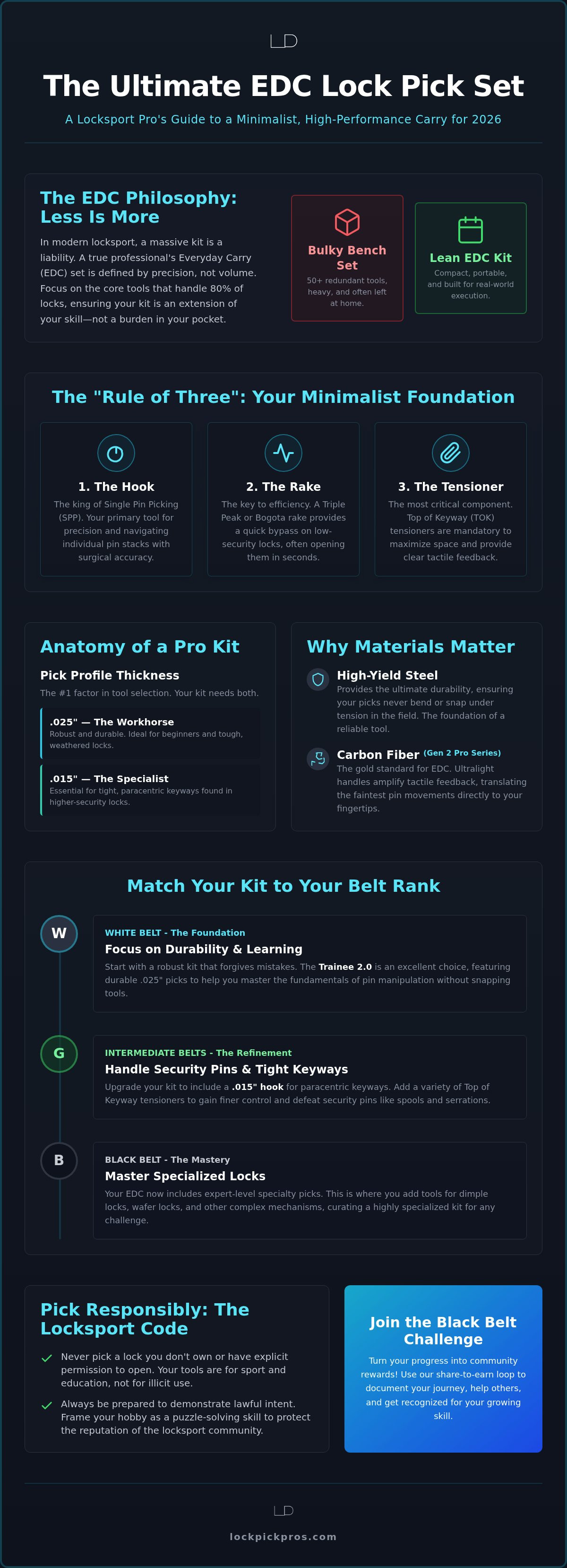
Tiered EDC Loadouts: Matching Your Kit to Your Belt Rank
Your journey through the locksport community is a path of constant skill refinement, and your gear should reflect your current mastery. Building an EDC lock pick set is not a static task; it is an evolving process where tools are added or swapped as you conquer new belt ranks. To understand the milestones ahead, start with our Lock Picking Belt Levels Explained: The 2026 Locksport Progression Guide. This sequential approach ensures you aren't overwhelmed by advanced security features before you've mastered the basics.
The White Belt EDC: Foundations of Feedback
For those at the White Belt level, the goal is to bridge the gap between theory and tactile sensation. We recommend starting with transparent training sets and The Trainee 2.0. These tools allow you to visualize pin movement while developing your internal "map" of the lock. Your primary target at this stage is the Master Lock #3.
Technical Breakdown: Master Lock #3
This lock features a 4-pin stack of standard pins with no security drivers. The keyway is wide and forgiving, making it perfect for a .025 Short Hook.
- Tension: Heavy Bottom-of-Keyway (BOK) tension is recommended to overcome the strong spring.
- Step 1: Insert your BOK wrench and apply firm clockwise pressure.
- Step 2: Use your .025 hook to find the binding pin (the one that resists movement).
- Step 3: Lift the binder until you hear a distinct, heavy click.
- Step 4: Repeat for the remaining three pins until the core rotates.
The Green Belt EDC: Navigating Security Pins
As you progress toward Green Belt, you will face restrictive keyways and "trap" pins. This is where building an EDC lock pick set with premium materials becomes mandatory. The Carbon Fiber Gen 2 Pro Series is essential here to detect the micro-vibrations of the American Lock 1100.
Technical Breakdown: American Lock 1100
This 5-pin lock is famous for its "crunchy" feel, containing a mix of serrated key pins, serrated drivers, and spool pins.
- Tension: Use "feather" light Top-of-Keyway (TOK) tension. Too much pressure will bind the serrations.
- Pick Choice: A .015 Slim Hook is required to navigate the paracentric keyway without touching the warding.
- Step 1: Apply TOK tension and test each pin. Serrated pins will give tiny, sharp clicks.
- Step 2: If you hit a "false set" (the core turns slightly), you have encountered a spool.
- Step 3: Ease off tension slightly to allow counter-rotation as you lift the spool pin.
- Step 4: Be aware that the core spring is very heavy; the lock may be open even if it hasn't turned yet. Give the tensioner an extra nudge once you think all pins are set.
Advanced EDC: The Black Belt Challenge
At the highest tiers, standard hooks are no longer enough. You must incorporate specialty tools like HUK Kaba Tools for dimple and high-security cylinders. Your carry should also include the Pro Series Expansion to handle complex sidebars and sliders. Ready to prove your mastery? Upgrade your kit and join the Black Belt Challenge to earn rewards as you share your picks-in-action with the community.
Join the Black Belt Challenge: Testing Your EDC Loadout
Building an EDC lock pick set is only the first step in your locksport journey. The true test of your kit lies in its performance when you face a new, challenging cylinder. We created the Black Belt Challenge to provide a structured path for your progression. This program takes you from a foundational Trainee level all the way to Master status. It’s a community-driven way to sharpen your skills and ensure your compact carry is actually up to the task. By participating, you join a dedicated group of ethical lockpickers who value precision over bulk.
Our "Share-to-Earn" loop turns your practice sessions into tangible rewards. We believe that your dedication to the sport should be recognized. When you hit specific social reach goals with your content, you unlock community bounties. These bounties include exclusive gear and expansion tools that help you tackle higher belt ranks. It’s a cycle of learning, sharing, and upgrading that keeps the locksport community vibrant and growing. Your EDC kit isn't just a collection of metal; it’s your ticket to a global network of enthusiasts.
How to Enter the Challenge
Getting started is simple and designed to mirror your natural progression. Follow these three steps to begin your journey toward the Black Belt leaderboard.
- Step 1: Secure your foundational kit. You need tools that offer professional-grade feedback. We recommend starting with the Carbon Fiber Gen 2 Pro Series to ensure you can feel every pin set.
- Step 2: Record a successful pick. Choose a lock that matches your current belt tier. Ensure the video clearly shows the lock being turned to prove a successful open.
- Step 3: Share your "Picks-in-Action" on social media. Use our community hashtags to join the conversation. This documentation serves as proof of your ethical mastery and helps others learn from your technique.
Earning Your Way to the Top
As you share your progress, you earn points that can be redeemed for tool upgrades. This allows you to grow your kit as your skills demand it. For example, hitting a reach goal might earn you a credit toward the Pro Series Expansion. This system ensures that every ethical lockpicker has access to the best tools regardless of their starting point. The 2026 community leaderboard tracks the most active and skilled pickers, fostering a healthy sense of competition. High-quality content helps prove that lockpicking is a legitimate, skill-based sport. Join the challenge today and turn your EDC practice into a rewarding path toward mastery.
Master Your Carry and Claim Your Rank
Mastering the art of building an EDC lock pick set is a defining moment for any ethical lockpicker. You've learned that true portability isn't about carrying every tool; it's about selecting a minimalist kit that balances the "Rule of Three" with professional-grade materials. By focusing on tiered loadouts that match your current belt rank, you ensure your gear grows alongside your technical skills. Whether you're just starting your journey or chasing an expert-level certification, the tools in your pocket should never be the bottleneck to your success.
Professional locksport competitors choose their gear based on performance and reliability. The right kit is engineered for maximum tactile feedback, allowing you to read every pin with surgical precision. Lightweight carbon fiber ensures daily carry comfort without sacrificing the rigidity needed for complex security pins. It's time to put your skills to the test and join a community that celebrates mastery and ethics.
Ready to elevate your locksport game? Upgrade to the Carbon Fiber Gen 2 Pro Series and Start the Black Belt Challenge today. We can't wait to see your picks-in-action as you climb the ranks toward your Black Belt!
Frequently Asked Questions
Is it legal to carry an EDC lock pick set in 2026?
Yes, it's generally legal in most regions provided you have lawful intent and follow ethical guidelines. You should always check your local 2026 statutes to be certain. Within the locksport community, carrying tools is seen as a commitment to a skill-based hobby. By only using your equipment on locks you own, you uphold the reputation of the sport while staying on the right side of the law.
What are the three most essential tools for a minimalist EDC set?
Your pick set selection should prioritize a short hook, a versatile rake, and a Top of Keyway (TOK) tensioner. This trio handles the majority of pin tumbler locks you'll encounter when building an EDC lock pick set. While larger kits offer variety, these three tools provide the maximum capability with the smallest footprint. Mastering these essentials ensures you are prepared for most locksport challenges without the bulk of redundant instruments that rarely see use.
Why should I choose carbon fiber handles over standard steel or plastic?
Carbon fiber handles are superior because they don't absorb the subtle vibrations produced by pins hitting the shear line. Unlike plastic, which can feel "mushy," or bare steel, which can be uncomfortable during long sessions, carbon fiber amplifies tactile feedback. This clarity allows you to feel the difference between a set pin and a binder instantly. It's a high-performance material that turns your pick into a precision instrument for better accuracy.
Can I pick high-security locks with a basic EDC kit?
While a basic kit is great for standard pins, high-security locks often require specialized profiles or thinner steel. As you move into advanced belt ranks, you'll find that paracentric keyways or sidebars demand tools with more reach or specific geometries. A basic EDC set is perfect for building foundational skills, but you should eventually expand into professional series tools to handle the complex security features found in world-class cylinders.
How do I know what belt rank my current practice lock is?
The locksport community maintains comprehensive spreadsheets that categorize locks by their difficulty and security features. You can cross-reference your specific model against these community standards, which are updated for 2026 requirements. These rankings help you choose the right practice targets and ensure you are using tools appropriate for your skill level. If a lock isn't listed, fellow hobbyists are usually eager to help you identify its likely rank.
What is the best way to carry lock picks without damaging them?
A dedicated slim carrying case is the only way to ensure your tools don't bend or snap while in your pocket. High-yield steel is tough, but constant pressure from daily movement can eventually fatigue the metal. A case also keeps your tensioners from scratching other items and ensures your picks stay clean. This level of protection is vital for maintaining the precise tips needed for effective Single Pin Picking over the long term.
Do I need to be a professional locksmith to buy these tools?
No, these tools are designed for anyone interested in beginner lockpicking as a legitimate hobby or sport. You don't need a professional license to explore the mechanics of locksport, provided you use your gear ethically. We focus on providing precision equipment for hobbyists who view lockpicking as a series of mechanical puzzles. As long as you follow the rules of the sport, you are welcome to purchase and use professional-grade tools.
How does the Share-to-Earn loop work for the Black Belt Challenge?
The Share-to-Earn loop rewards you for documenting your progress and engaging with the community. When you record a successful open and share it using community hashtags, you earn points toward tool upgrades and exclusive gear. This system encourages a supportive environment where pickers help each other improve. It's our way of fostering a vibrant locksport culture while helping you build a professional kit as you climb the belt ranking system.