

Lock Pick Laws in California: The 2026 Hobbyist’s Guide
What if the line between a rewarding technical skill and a legal headache was as thin as a tension wrench? For many in the locksport community, the fear of being arrested just for owning a set of tools is a constant shadow. This anxiety often stems from a misunderstanding of how lock pick laws in California actually function. While the state recently expanded its list of potential burglary tools, the core of the law still centers on your behavior and purpose rather than the mere presence of steel in your pocket.
We agree that you should be able to focus on the tactile click of a setting pin without worrying about a cell door. You deserve to practice your craft with total peace of mind. This guide provides a clear roadmap to the 2026 legal landscape, ensuring you can carry your tools and progress through the community ranks with confidence. We'll explore the specifics of "lawful intent," offer practical tips for legal transport, and show you how to frame your hobby as a legitimate sport.
Are you ready to turn your curiosity into technical mastery? Join our free Black Belt Challenge today and start earning your stripes as an ethical lockpicker!
Key Takeaways
- Understand the 2026 updates to California Penal Code 466 and why possession alone does not constitute a crime for ethical hobbyists.
- Learn how to provide "affirmative evidence" of your hobby by using a dedicated Carrying Case and proper vehicle storage techniques to show lawful intent.
- Navigate the legal gray areas of the state by strictly adhering to the two golden rules of the locksport community.
- Discover how participating in the Black Belt Challenge helps you stay compliant with lock pick laws in California while you master new skills.
Understanding California Penal Code 466: Is Possession Legal?
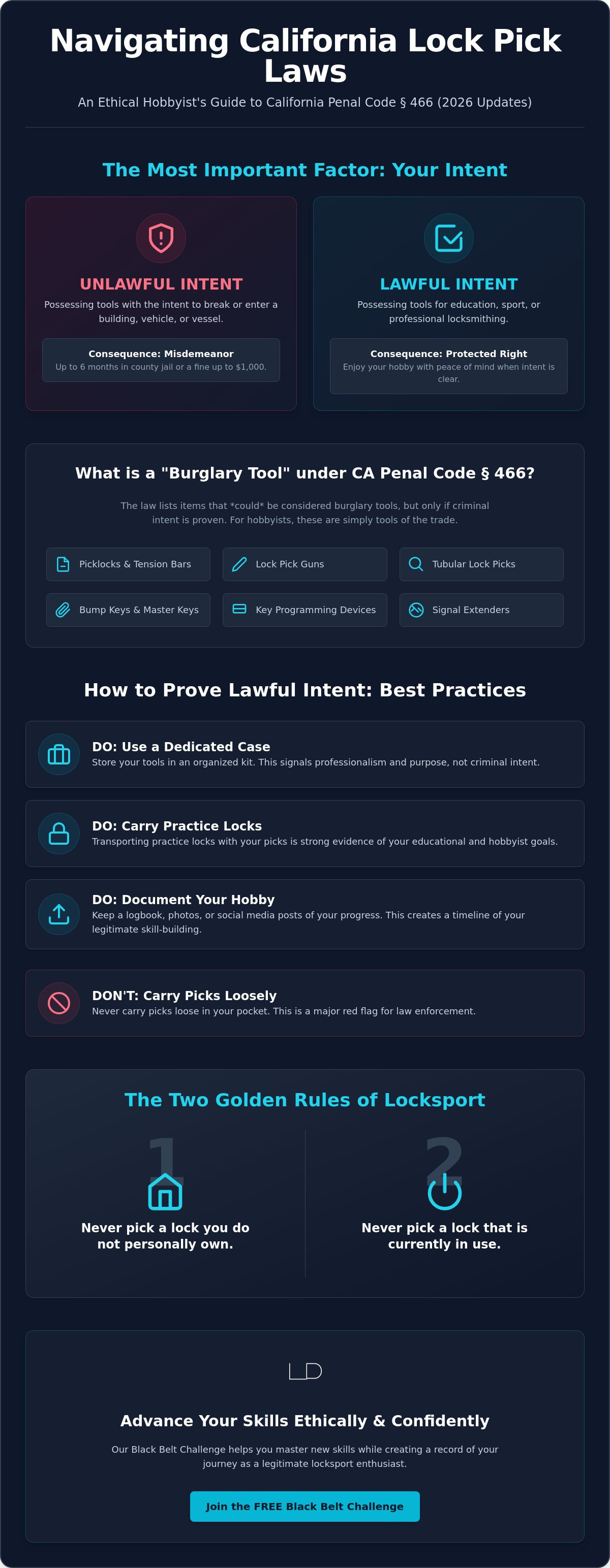
California’s legal code can look intimidating at first glance. If you read the text of CAL. PEN. CODE § 466, you’ll see a long list of items that law enforcement might consider "burglary tools." Following the passage of Assembly Bill 486 on October 6, 2025, this list grew even longer to address modern technology. However, the most important thing for any aspiring hobbyist to know is that lock picks are not illegal per se in the Golden State. It's your intent, not the metal in your kit, that determines the legality of your gear.
The law specifically names several tools that many ethical lockpickers use every day for practice. These include:
- Picklocks and tension bars
- Lock pick guns and tubular lock picks
- Bump keys and master keys
- Modern additions like key programming devices, signal extenders, and specialized laser defense systems (to learn more about these technologies, click here)
Violating this code is classified as a misdemeanor. If a person is convicted under PC 466, they could face up to six months in county jail or a fine of up to $1,000. But don't let those numbers scare you away from the sport. A violation only occurs if the tools are possessed with the specific intent to break or enter into a building, vehicle, or vessel. For those focusing on the technical mastery of their craft, possession remains a protected right.
The "Intent" Requirement Explained
Why is one person with a pick set a criminal while another is just a dedicated hobbyist? The answer is intent. Under the lock pick laws in California, the prosecution must prove you intended to commit a crime. This is the "magic ingredient" that protects the locksport community. Lock picking as a technical challenge is a legitimate pursuit when practiced on your own property or with locks you own. If you are using a set like The Trainee 2.0 to improve your tactile feedback and pin-setting skills, you are demonstrating educational intent rather than felonious intent.
Who is Exempted from These Concerns?
Licensed locksmiths and professional service members have clear legal standing to carry these tools as part of their trade. As a hobbyist, your goal is to align your behavior with these professional standards to avoid any confusion. While the law mentions "master keys," which are often restricted, standard hobbyist picks are viewed differently in a legal context. Ethical lockpickers distinguish themselves by never carrying tools loosely in their pockets or using them on locks that are currently in use. Understanding the nuances of lock pick laws in California is the first step toward enjoying this challenging sport without the fear of legal trouble.
Proving Lawful Intent: How to Carry Your Tools Safely
Since the lock pick laws in California hinge so heavily on your mindset, you need to be proactive about showing your "lawful intent." This concept is central to California Penal Code 466. If you're stopped by law enforcement, the burden often falls on the context of the situation. Think of this as building a resume for your hobby. Carrying "affirmative evidence" like a membership card to a locksport group or a logbook of your progress can make a world of difference in a split second interaction.
Time and place are your best friends or your worst enemies. Having your picks in a clear, organized kit while sitting at a local coffee shop is vastly different from having them loose in your pocket while walking through a dark alley at 3 AM. If you ever find yourself in a conversation with an officer, stay calm. Explain that you're a locksport enthusiast. Show them your practice locks. These physical items prove you're focused on the technical puzzle, not the property. Most officers appreciate honesty and a clear explanation of your sport.
The "Locksmith-in-Training" Mindset
Treat your hobby with the same respect a professional would. When you carry a beginner set like The Trainee 2.0 alongside dedicated practice locks, you're sending a clear signal. You aren't looking for a door to open; you're looking for a pin to set. We also recommend keeping a digital record of your journey. Photos of your "open" locks and videos of your technique serve as a timeline of your skill-building. It's hard to argue with a library of social media posts showing you tackling the White Belt challenge as a legitimate student of the craft.
What to Avoid: Red Flags for Law Enforcement
Certain behaviors will raise eyebrows regardless of your true intentions. Understanding the lock pick laws in California means knowing that suspicious concealment is a major red flag. Never carry tools "on your person" in a way that looks like you're trying to hide them from a casual observer. Similarly, avoid having your tools out near any property you don't own. Even if you're just showing a friend how a rake works, doing it near a neighbor's gate is asking for trouble. Keep your practice sessions confined to your own space or recognized community meetups.
As you move into more advanced territory, your kit will naturally grow. Upgrading to a professional set like the Carbon Fiber Gen 2 Pro Series shows a commitment to high-quality tools, further reinforcing that you're a serious student of the sport rather than someone looking for trouble. Stay smart, stay ethical, and keep the focus on the challenge of the lock itself.
Locksport vs. Burglary: Navigating the Legal Gray Areas
The most effective way to separate yourself from illicit activity is to treat your hobby as a formal discipline. In beginner lockpicking, your pick set selection should mirror your current skill level to keep your practice focused and professional. By following the established belt ranks of the locksport community, you demonstrate that your interest is in the mechanical puzzle, not unauthorized entry. This distinction is vital for staying on the right side of lock pick laws in California, as it provides a clear narrative of technical education.
To see this in action, let's look at a White Belt classic: the Master Lock #3. This is one of the most common practice locks for new enthusiasts. It features a 4-pin stack with all standard pins and no security pins. Because of its wide tolerances, it requires a specific technical approach:
- Recommended Pick: Short Hook or Triple Peak Rake.
- Tension Level: Heavy tension using a bottom-of-the-keyway wrench.
- Step 1: Apply heavy clockwise tension to overcome the thick internal spring.
- Step 2: Use your hook to find the first binding pin. In a #3, this is often the third or fourth pin.
- Step 3: Lift the binder until you feel a solid click. Standard pins in these locks provide a very tactile "shelf" when set.
- Step 4: Maintain tension and move to the next binding pin. Repeat until the core rotates.
The Belt Ranking System as a Credibility Tool
The community belt system acts as a badge of legitimacy. When you can explain your gear through the lens of a "White Belt" or "Yellow Belt" progression, you're showing you belong to a rule-following community. This structure helps clarify your standing by proving your tools are for a recognized sport. If you're just starting, check out our guide on How to Choose Your First Beginner Lock Pick Set to begin your journey with the right mindset.
High-Security Tools and California Law
As you advance, you'll eventually need professional-grade gear like the Carbon Fiber Gen 2 Pro Series. These tools are precision-engineered for high-security locks. Because these tools are more effective, they carry a higher ethical responsibility. Owning them is legal, but you must be even more diligent about following community standards. For those ready to level up, we've put together a resource on Mastering the Advanced Lock: A Guide to High-Security Picking.
Ready to earn your stripes? Join our free Black Belt Challenge today and start documenting your progress as an ethical lockpicker!
Practical Tips for Transporting Your Lockpicking Gear in CA
Understanding the lock pick laws in California is only half the battle. You also need to master the art of the "professional carry." How you store and move your tools provides immediate context to anyone who sees them. If your picks are rattling around loose in your pocket, they look like contraband. If they're secured in a professional Carrying Case alongside a practice lock, they look like the specialized equipment of a dedicated hobbyist. Always choose the latter to ensure your intent is never questioned.
Your vehicle storage habits matter just as much as the tools themselves. Never store your lock pick set in the glove box or center console. These areas are designed for quick access. Instead, place your gear in the trunk. This physical separation demonstrates that you don't intend to use the tools impulsively. We also recommend keeping a printed copy of the "Locksport Code of Ethics" inside your kit. It's a small detail that speaks volumes about your commitment to the community's standards. Keep your tools clean and well-maintained. Rusty or bent picks look suspicious; polished, high-quality steel looks like a craftsman's kit.
Organizing for Transparency
An organized workspace is a sign of a serious student. When you're at a meetup, using a Pinning Tray to manage your springs and drivers shows you're focused on the technical "gutting" process. Label your larger kits as "Locksport Training Equipment." This simple step removes ambiguity for anyone glancing at your bag. Try to separate your everyday carry items from your primary practice bench. Your main kit should stay at home or in your trunk, while only the essentials for a specific session travel with you.
Traveling with Picks in California
Traveling within the state requires extra care. If you're flying between San Francisco and Los Angeles, remember that while the TSA doesn't explicitly ban lock picks, local law enforcement at the airport might have questions. Always pack your tools in checked luggage to avoid unnecessary delays at security checkpoints. When attending "pick-nics" or community meetups in public parks, be mindful of private security. If a mall guard or park ranger asks about your gear, be polite and offer a quick demonstration on a transparent practice lock. For a closer look at how professional protection services are managed in Southern California, visit Security Guard Pros. Most people are fascinated by the skill once they realize it's a legitimate sport.
Ready to upgrade your transport game? Investing in a professional-grade setup like the Carbon Fiber Gen 2 Pro Series ensures your tools are as sleek and organized as your technique. Stay prepared, stay professional, and keep your hobby protected.
Advancing Your Skills Ethically: The Black Belt Challenge
How do you turn a legal curiosity into a lifelong passion for mechanical puzzles? The answer lies in joining a community that values mastery and ethics above all else. We created the Lockpick Pros Black Belt Challenge to give you a structured path from curious beginner to expert-level picker. This challenge isn't just about popping cylinders; it's a commitment to the sport's highest standards. By participating, you join a movement of ethical lockpickers who prove every day that this skill is a legitimate technical pursuit.
This structured progression is actually your best shield when it comes to lock pick laws in California. When you follow the belt ranks, you create a documented history of your skill-building journey. This public record of your progress serves as powerful evidence of your educational intent. It shows that your interest in tools like tension wrenches and hooks is about the "click" of a successful open, not gaining unauthorized entry. We've also introduced a "Share-to-Earn" loop to reward your dedication. By documenting your opens and sharing your journey, you can earn rewards while helping to grow the locksport community. Keep an eye on our community bounty, too. We offer rewards for hitting social reach goals that help us bring more responsible hobbyists into the fold.
Your Ethical Roadmap
Success in locksport is a marathon, not a sprint. You should start with the foundational basics and progress one belt at a time. Earning your stripes the right way means never skipping the ethical lessons that come with each tier. When you post "picks-in-action" content to earn rewards, it's vital that the locks are clearly your own. This transparency reinforces the boundary between a hobbyist and a security threat. By showing the community that you only practice on your own gear, you uphold the reputation of the entire sport and stay firmly on the right side of lock pick laws in California.
Join the Movement
Are you ready to test your limits? You can join the Black Belt Challenge for free today and start your journey toward mastery. As you climb the ranks and tackle more complex security pins, your tool requirements will change. We recommend upgrading to the Pro Series Expansion as you move into the intermediate tiers. These precision tools are designed to provide the feedback you need for higher-level locks. Always remember our final rule: ethical picking is legal picking. Stay focused on the challenge, respect the law, and enjoy the journey of becoming a master of the craft.
Master the Art of Ethical Locksport
Your journey into the world of locksport shouldn't be clouded by legal uncertainty. By focusing on the "intent" requirement of lock pick laws in California, you can practice your craft with total confidence. Your behavior is your best defense. Keep your tools organized in a Carrying Case, store them in your trunk, and always stick to locks you own. These simple habits separate a dedicated hobbyist from a security threat and demonstrate your commitment to the craft.
Joining the Lockpick Pros family means more than just buying gear. You get enthusiastic community support and access to our free Black Belt Challenge to track your mastery. Our precision ethical tools are designed to help you progress through every tier of the sport. Don't let fear hold you back from a rewarding new skill. Start your journey today and earn your stripes alongside thousands of other ethical pickers. We're here to help you every step of the way.
Start your ethical locksport journey with our Trainee 2.0 Set!
Frequently Asked Questions
Is it a felony to have lock picks in California?
No, possession of lock picks is not a felony in California. Under California Penal Code 466, it's a misdemeanor if the prosecution proves you had the intent to commit a crime. For ethical locksport hobbyists, owning these tools for skill-building and technical challenges is a legal activity. Just keep your focus on your own practice locks and stay within the community’s ethical guidelines.
Do I need a locksmith license to own a pick set in CA?
You don't need a locksmith license to own or use a pick set as a hobbyist in California. Licenses are required for those providing professional locksmith services for hire. As long as you're practicing locksport for personal enjoyment and technical mastery, you're free to pursue your belt ranks without a state license. It's all about the sport, not the trade.
Can I carry my lock picks in my pocket in California?
While it isn't strictly illegal to have tools in your pocket, doing so can look suspicious to law enforcement. lock pick laws in California rely heavily on intent. Carrying picks loosely in your pocket, especially at night or near private property, could be used as evidence of "burglary intent." We always recommend using a dedicated Carrying Case to keep your gear organized and professional.
What happens if the police find lock picks in my car?
If an officer finds tools in your car, the outcome depends on how and where they're stored. Tools kept in the glovebox or center console might look like you intend to use them quickly. Storing your kit in the trunk alongside practice locks proves you're a hobbyist. Always be honest about your involvement in locksport and show them your progress in the Black Belt Challenge.
Are "bump keys" legal to own in California?
Yes, bump keys are legal to own in California for recreational use on your own locks. However, they are explicitly listed as potential burglary tools under PC 466. This means if you're caught with them while committing a crime, they add to the charges. Ethical pickers usually avoid bump keys in public because they are designed for rapid entry rather than technical manipulation.
Does California require a background check to buy lock picks?
No, California doesn't require a background check to purchase lock picking tools. You can order sets like the Carbon Fiber Gen 2 Pro Series online without any special permits. While federal law has some restrictions on mailing locksmithing devices, these are rarely enforced for hobbyist sales. Your main responsibility is ensuring you use those tools ethically once they arrive at your door.
Is it legal to pick my own front door lock if I am locked out?
It's legal to pick your own lock, but the locksport community strongly advises against it. Picking a lock that is "in use" can damage the internal components, potentially leaving you stranded with a broken door. It also looks very suspicious to neighbors or passing officers. Always practice on dedicated practice locks or cylinders that aren't protecting your home or property.
Are transparent practice locks considered "burglary tools"?
Transparent practice locks are generally viewed as educational toys rather than burglary tools. Their design makes them useless for actual security because you can see the internal pins. These are perfect for demonstrating your "lawful intent" to anyone who asks about your hobby. They show that you're interested in the mechanical science of lock pick laws in California rather than gaining unauthorized entry.