

Single Pin Picking for Beginners: The Path to Your White Belt Mastery
What if the most complex mechanical puzzle in your pocket could be solved by nothing more than a gentle touch and a bit of focused listening? For many new hobbyists, the inside of a cylinder feels like a total mystery. You might feel frustrated because you can't feel what is happening inside the lock, or perhaps you're tired of over-setting pins and getting stuck. Mastering single pin picking for beginners is the moment everything changes. It's the bridge between random jiggling and the intentional, precision skill that defines true locksport enthusiasts.
We know how intimidating those first few attempts can be when you're just staring at a keyway. You want to feel that core turn, but right now, it just feels like you're poking metal in the dark. This guide is here to change that. We promise to help you develop the foundational skills needed to pop your first practice lock and understand the mechanical language of the binding order. We'll walk you through the exact steps to identify binding pins, apply the right amount of tension, and gain the confidence you need to join the community ranking system and earn your White Belt.
Key Takeaways
- Discover why single pin picking is the surgical "gold standard" of locksport and how it builds a foundation for advanced skills.
- Learn how to identify the binding order and navigate the shear line to unlock your first practice cylinder.
- Master our 5-step method for single pin picking for beginners to develop the "feel" required for consistent, intentional opens.
- Identify the essential tools for success, including why a 0.025" hook pick is the best choice for your first kit.
- Find out how to document your success on a Master Lock #3 and officially join the community belt ranking system.
Why Single Pin Picking is the True Path to White Belt Mastery
Single pin picking (SPP) is the surgical art of manipulating every individual pin stack within a lock. While other methods rely on speed or kinetic energy, SPP demands focus and sensory feedback. It's the gold standard for anyone serious about the sport. Learning single pin picking for beginners isn't just about popping a shackle; it's about understanding the mechanical soul of the lock. This skill is your entry ticket to the 2026 locksport season and the essential first step toward earning your community White Belt. By choosing to master this technique, you're deciding to become a precision picker rather than a lucky one.
The Ethical Lockpicker Code
Before you tension your first core, you must commit to the Ethical Lockpicker Code. The locksport community thrives on trust and responsibility. There are two golden rules you must follow to stay on the right side of the law and the community. First, only pick locks that you own or have explicit permission to open. Second, never pick a lock that is "in use." This means you should only practice on locks that are removed from doors and not providing actual security. While the practice of lock picking has deep historical roots, our hobby is about the puzzle, not the profession. We are here to solve challenges, not bypass security for gain. Following these rules ensures our sport remains respected and accessible to everyone.
SPP vs. Raking: Why Precision Wins
Raking is often the first thing people try because it's fast. You jiggle a tool across the pins and hope for the best. It's a low-skill technique that provides very little feedback and relies mostly on luck. In contrast, SPP is a high-reward discipline. It teaches you to "feel" the internal state of the cylinder. As you progress through the belt ranks, you'll find that raking rarely works on high-security locks. Yellow Belt locks and above often feature security pins that make raking nearly impossible.
By starting with a quality set like The Trainee 2.0, you'll learn to earn your open through precision. You'll know exactly which pin moved, which one is binding, and why the core finally turned. This intentionality is what separates a dedicated hobbyist from someone just playing with tools. Mastering single pin picking for beginners ensures you have the technical foundation to tackle any challenge the community throws your way. You aren't just opening a lock; you're solving a mechanical riddle with your fingertips.
The Mechanics of Manipulation: Understanding the Binding Order
To master single pin picking for beginners, you have to look past the metal and visualize the mechanical dance happening inside the cylinder. Every standard pin tumbler lock relies on three main components: key pins, driver pins, and springs. The key pins sit at the bottom and touch your pick; the driver pins sit above them, blocking the rotation of the plug. Springs keep everything pushed down in a resting state. Your goal is to move those driver pins out of the way so the plug can turn freely. This isn't magic. It's physics.
The boundary between the rotating plug and the stationary housing is called the shear line. This is the gatekeeper of the lock mechanism. When the lock is closed, the driver pins cross this line, physically pinning the plug to the housing. If you want to understand the deep theory behind these mechanics, The MIT Guide to Lock Picking offers a brilliant technical breakdown of these forces. In short, your mission is to lift every driver pin until its bottom edge meets the shear line, allowing the plug to rotate.
Why don't all the pins just stay up once you lift them? The answer lies in manufacturing tolerances. No lock is perfect. Due to tiny variations in the drilling process, the holes for the pin stacks are never perfectly aligned. When you apply tension to the plug, it rotates a fraction of a millimeter until one specific pin stack hits the side of its hole first. This is the binding pin. It's the only pin stack currently preventing the plug from turning, and it's the only one you can "set" at this moment.
Visualizing the Shear Line
Imagine a driver pin trapped between the plug and the housing. When you apply tension, you're pinching that pin. As you lift it with your hook, you'll eventually reach a point where the driver pin clears the plug and enters the housing. Because you're applying constant tension, the plug rotates just a tiny bit further the instant the pin clears. This creates a microscopic ledge. The driver pin now sits on top of the plug, held in place by that tiny shelf of metal. You've successfully "set" a pin. To feel these tiny shifts more clearly, many hobbyists prefer the feedback provided by the Carbon Fiber Gen 2 Pro Series tools.
The Secret of Binding Order
Every lock has a unique binding order. You can't just pick pins 1 through 5 in a straight line. You have to find the sequence the lock dictates, such as 3-1-5-2-4. Finding the binder is a game of "springy vs. stiff." When you probe a pin stack that isn't binding, it feels springy. You're only pushing against the spring. However, a binding pin feels stiff and solid. It won't budge easily because it's physically wedged. This is the pin you must lift. Once it clicks into place, the next pin in the sequence will become stiff. This hunt for the next binder is the core of single pin picking for beginners. Your fingers become your eyes. You're learning to read the lock stack by stack.
Selecting Your Starter Kit: Essential Tools for SPP
Starting your journey into locksport doesn't require a massive roll-up bag filled with dozens of mysterious shapes. In fact, most experts agree that a cluttered kit actually slows down your progress. To master single pin picking for beginners, you only need two fundamental tools: a hook pick and a tension wrench. These are the instruments that will take you from your first open to your eventual Black Belt. When you're just starting, pick thickness is vital. We recommend a 0.025 inch thickness for White Belt locks. This gauge provides maximum durability and resists bending while you're still learning how much force is required to move a pin. Our Trainee series is built for this exact purpose, offering a clear path for your sequential belt progression.
The Short Hook: Your Precision Instrument
The short hook is the most versatile tool in any locksport kit. It allows you to navigate the keyway with surgical precision. Unlike rakes that hit multiple pins at once, the hook lets you isolate a single pin stack to feel its state. We recommend starting with a comfortable handle like the one found on The Trainee 2.0. A good handle isn't just about comfort; it's about feedback. A solid grip transmits the tiny vibrations from the lock directly into your hand. Use the tip of the hook to hunt for individual pins. Slide it along the bottom of the pins until you feel the distinct hump of a pin stack. This tactile mapping is how you build a mental map of the lock's interior.
Tension Wrenches: The Secret to Feedback
Many beginners focus entirely on the pick, but the tension wrench is actually the most important tool in your hand. It's the tool that provides nearly all the information you need to succeed. For absolute beginners, Bottom of the Keyway (BOK) tension is usually the best place to start. It provides a stable platform for your wrench and keeps it out of the way of your pick in most standard White Belt locks. As you advance, you'll eventually explore Top of Keyway (TOK) tensioning, which offers more room in the keyway. If you want the best possible start, tools like the Carbon Fiber Gen 2 Pro Series offer superior tactile transmission. Carbon fiber handles are incredibly stiff. This stiffness ensures that every tiny click or rotation of the core is felt instantly, helping you identify that crucial binding pin faster.
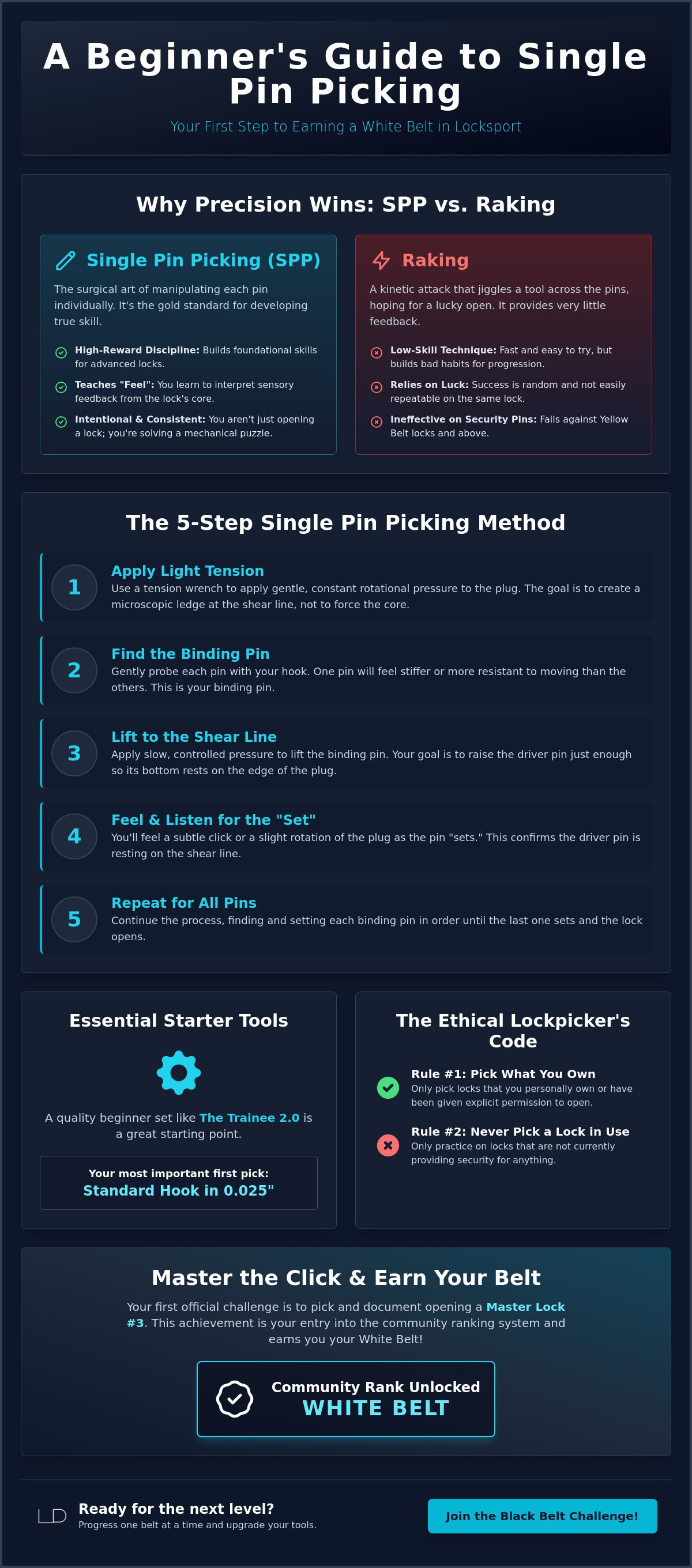
The 5-Step Single Pin Picking Technique for Beginners
Mastering single pin picking for beginners is a process of sensory refinement. It's about developing a mechanical conversation with the lock. Once you've grasped the theory of binding orders, it's time to put your tools to work. Follow these five steps to translate those internal whispers into a successful open.
- Step 1: Tension. Insert your tension wrench into the bottom of the keyway. Apply feather-light pressure. You only need enough force to keep the pins from falling back down once they are set.
- Step 2: Mapping. Before you apply real pressure, move your hook through the lock without tension. Feel the humps of each pin stack. This helps you locate exactly where to place your pick later.
- Step 3: Probing. Apply consistent tension and probe each pin. Most pins will feel springy. You are hunting for the one pin that feels stiff and resistant. This is your binder.
- Step 4: Lifting. Gently lift the binding pin. Move it slowly until you feel and hear a distinct click. This indicates the driver pin has cleared the shear line.
- Step 5: The Loop. Repeat this process. Go back to step three and find the next pin that has become stiff. Continue until the plug rotates and the lock pops open.
Finding the Right Tension
Getting the tension right is the hardest part of single pin picking for beginners. Think of "light tension" as the weight of a penny resting on your finger. It's just enough force to hold a piece of paper against a wall without it slipping. If you use heavy tension, you'll bind all the pins at once, making the lock feel "crunchy" and potentially bending your tools. To confirm a pin is set, use the Jiggle Test. A set pin will have a tiny amount of springy play. If it's rock solid or completely loose, it isn't set correctly. For the best tactile feedback during this stage, we recommend using the Carbon Fiber Gen 2 Pro Series picks to feel every microscopic movement.
Identifying the Sensory Cues
Your hands are your eyes inside the keyway. A successful set is usually accompanied by a "Click," which is both an audible snap and a physical vibration felt through the pick. However, be careful of "Over-setting." This happens when you push the key pin itself into the housing. An over-set pin feels mushy and won't jiggle. If the lock feels stuck and no pins are binding, you've likely over-set a pin. Simply release tension, let the pins reset, and start again. Don't get discouraged. Every reset is just more data for your next attempt. If you find no pins are binding at all, try increasing your tension slightly until one pin finally resists your hook.
The core has turned. You've heard the click. Now what? Achieving your first open using single pin picking for beginners is a massive milestone. In the locksport community, this is the moment you transition from a curious observer to a ranked hobbyist. To claim your White Belt, you simply need to document your open. Most community platforms require a photo or video showing the core in a turned position with your pick still inside. It's a badge of honor that proves you've mastered the basics of tension and pin manipulation.Your First Practice Locks
Many newcomers start with Clear Practice Padlocks because they let you see the pins move in real-time. These are excellent for confirming the theory of the shear line. However, they lack the gritty, realistic feedback of a metal lock. Once you understand the mechanics, move to a standard Master Lock #3 as soon as possible. This is the quintessential White Belt lock. It features four standard pins and generous manufacturing tolerances, making it the perfect first "blind" challenge. To ensure you're getting the best tactile data from these metal cylinders, check out our guide on How to Hold Lock Picks Correctly. Proper ergonomics prevent hand fatigue and sharpen your ability to feel those tiny, crucial clicks.
The Black Belt Challenge & Community Bounty
Lockpicking is a journey of sequential progression. As you move toward Yellow and Orange belts, you'll encounter security pins like spools and serrations. These require more sensitive equipment. This is the time to consider upgrading your tools. Moving from entry-level sets to our carbon fiber series ensures your gear evolves as fast as your skills. We want to celebrate that growth with our free Black Belt Challenge. This is a structured roadmap designed for 2026 mastery, guiding you through every tier of the sport.
We also foster an active "Share-to-Earn" loop. When you pop a new lock, post your "picks-in-action" content on social media. Tag our community and share your success to earn store credit for your next tool upgrade. We even offer a community bounty for hobbyists who hit specific social reach goals on TikTok or Instagram. Whether you're just starting single pin picking for beginners or you're already chasing that elusive Black Belt, you're part of a global community of ethical pickers. Grab your picks, join the challenge for free, and show us that first open.
Master the Click and Earn Your Belt
You've now uncovered the core mechanics of the shear line and the secret of the binding order. Mastering single pin picking for beginners is the most rewarding way to enter the world of locksport. It turns a frustrating mechanical puzzle into a clear, tactile language. By choosing precision over luck, you're building a technical foundation that will carry you through every level of the sport. You've seen how the right tension and a steady hook can make even a stubborn Master Lock #3 yield to your skill.
Ready to pop that first shackle? Join over 10,000 ethical hobbyists currently participating in our 2026 Black Belt Challenge. We offer a satisfaction guarantee on all foundational toolkits and provide sequential tool upgrades for every belt rank. This ensures you always have the precision instruments needed for your next challenge. Start your journey with The Trainee 2.0 Beginner Set today and claim your community White Belt. We're excited to welcome you to the community and see your first successful open.
Frequently Asked Questions
Is single pin picking legal for beginners?
Owning lock picking tools is legal in the vast majority of U.S. states and many other countries as long as you don't have criminal intent. Ethical hobbyists follow two rules: only pick locks you own and never pick a lock that is in use. Check your local laws, but most communities welcome beginners as long as they stick to practice cylinders on their own workbench.
What is the easiest lock for a beginner to single pin pick?
The Master Lock #3 is widely considered the best starter lock for anyone learning single pin picking for beginners. It has four standard pins and very loose manufacturing tolerances, which makes the binding order easy to identify. It's the classic entry point for earning your White Belt. Once you can pop this one consistently, you're ready for more precise challenges.
Why do my pins feel mushy when I try to pick them?
Mushy pins usually indicate that you've over-set a pin or aren't using enough tension to bind the stack. If a pin feels like it has no springiness and isn't clicking, it's likely pushed too high. This mushiness is a signal to reset. Let go of your tension wrench, listen for the pins to drop, and try again with a lighter touch and more focus on each individual click.
How long does it take to learn single pin picking?
Most beginners can achieve their first successful open within a few hours of focused practice. However, developing a consistent feel for the pins usually takes a few weeks of regular sessions. Locksport is a skill of muscle memory and sensory refinement. Don't rush the process. Every lock you open builds the intuition you'll need for higher belt ranks and more complex security pins.
Do I need a clear practice lock to learn SPP?
You don't strictly need a clear lock, but it's a fantastic tool for visualizing the internal mechanics. Seeing the pins reach the shear line helps you connect the physical sensation to the mechanical reality. Once you understand the movement, you should quickly transition to standard metal locks. This helps you develop the blind tactile skills required for the community ranking system and future challenges.
What is the difference between SPP and raking?
Single pin picking for beginners focuses on manipulating one pin at a time with precision, while raking uses a tool to bounce all pins simultaneously. Raking is faster for simple locks but relies heavily on luck. SPP is the gold standard of locksport because it works on high-security locks that raking can't touch. It's the difference between using a master key and solving a mechanical puzzle.
How much tension should I actually use?
You should use roughly the same amount of force you'd use to hold a piece of paper against a wall. If your finger is turning white or your wrench is bending, you're pressing too hard. Heavy tension binds all the pins at once and masks the feedback you need to find the binder. Start with feather-light pressure and only increase it if the pins feel too loose to bind.
What should I do if I over-set a pin?
The only reliable way to fix an over-set pin is to completely release your tension wrench and start the lock over. You'll hear the pins drop back into place. Over-setting is a natural part of the learning curve. If you feel the lock seize up and no pins are binding, just reset. It's better to start fresh than to struggle with a dead keyway that won't give you any feedback.