

Single Pin Picking: Your 2026 White Belt Guide
Have you ever stared at a practice lock and wondered if you're actually feeling the pins, or just poking around in a dark metal tunnel? It's the most common frustration for anyone starting single pin picking for beginners. You've heard about the "click," but all you feel is a mushy mess or a stuck pick. You might even be over-tensioning until your tools bend, wondering why it feels nothing like the videos you've watched online.
We've all been there. It's completely normal to feel "nothing" inside the cylinder when you're just starting out. This guide is here to change that. Mastering this foundational skill is the moment you stop guessing and start communicating with the mechanical puzzle in your hand. Our goal is to help you master the fundamentals, earn your first belt, and finally join the vibrant locksport community.
In this 2026 guide, we'll break down the difference between a satisfying "click" and a deceptive "thud." You'll learn why light tension is your best friend and how to navigate beginner lockpicking without damaging your gear. We're mapping out exactly how to handle your first practice locks so you can climb the belt ranks with confidence.
Key Takeaways
- Learn why single pin picking is the gold standard of locksport and how it provides more precision than simple raking.
- Master the foundational mechanics of single pin picking for beginners to navigate pin stacks and find the shear line.
- Identify the specific "White Belt" tools you need to start, focusing on essential hooks and transparent practice locks.
- Develop the tactile skills required to feel binding order and interpret the mechanical feedback of every "click."
- Find out how to join the Black Belt Challenge and use our "Share-to-Earn" loop to get rewarded for your progress.
The Gateway to Locksport: What is Single Pin Picking?
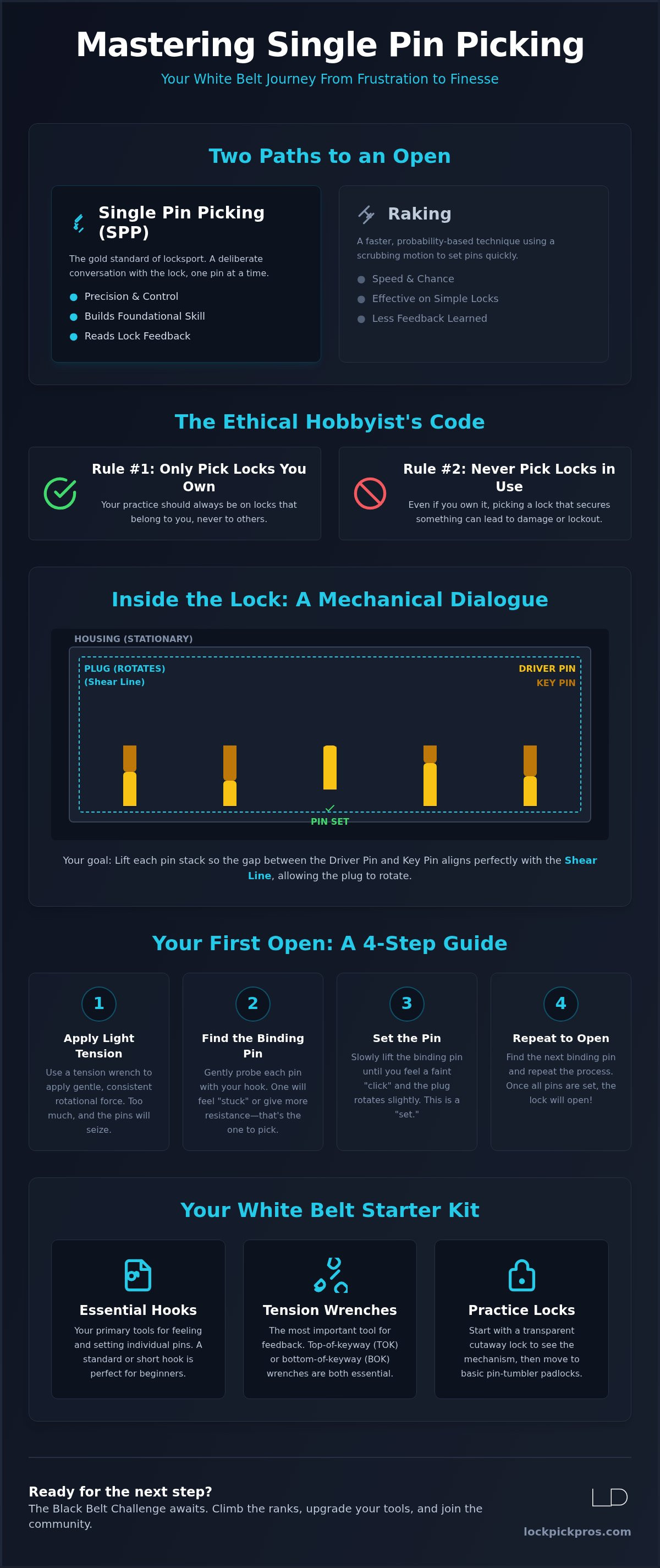
Single Pin Picking (SPP) is the "purest" form of the craft. It's the technical heart of locksport because it relies on deliberate feedback rather than luck. While raking involves a fast, scrubbing motion to bounce pins into place, SPP requires you to manipulate each individual pin stack one by one. Think of raking as a game of probability; SPP is a conversation with the lock. Understanding What is Lock Picking? starts with this distinction. If you want to tackle high security cylinders eventually, you must master the precision that only SPP provides.
Developing the "White Belt" mindset is your first step. This stage isn't just about getting an open; it's about learning to listen with your fingers. You'll encounter pins that feel "mushy" or "binding." Learning single pin picking for beginners means developing the patience to identify these states without rushing. This skill forms the foundation for every advanced technique you'll learn later in your journey. Without a solid SPP foundation, you'll hit a wall the moment you encounter security pins like spools or serrated drivers.
Ethical Lockpicking: The Hobbyist Code
Before you insert your first tension wrench, you must understand the ethical boundaries of our sport. Locksport hobbyists follow two golden rules. First, never pick a lock you don't own. Second, never pick a lock that is currently in use. If you pick the lock on your front door and accidentally break a spring, you're locked out. Treat every lock as a mental puzzle rather than a way to bypass security. Joining the community of ethical hobbyists means respecting these rules to keep our sport legitimate and welcoming for everyone.
Why Start with the White Belt?
The belt ranking system, managed by the LockPickers United (LPU) community, acts as a roadmap for your progression. Starting with the White Belt gives you a clear, achievable goal for your first week. It's about securing that first psychological win. When you feel the plug rotate for the first time on a basic padlock, the rush of dopamine is incredible. Using a dedicated set like The Trainee 2.0 helps you focus on these early victories. Mastering single pin picking for beginners at this level proves you have the mechanical empathy needed to advance toward your Yellow Belt and beyond.
Understanding the Internal Dialogue: Pin Stacks and Binding Order
To master single pin picking for beginners, you must first visualize the mechanical conversation happening inside the cylinder. A lock isn't a solid block of metal; it's a series of moving parts working in a specific sequence. When you insert your pick, you're interacting with pin stacks. Each stack consists of a spring, a driver pin on top, and a key pin at the bottom. Your pick pushes the key pin, which in turn moves the driver pin. The goal is to move the gap between these two pins to the shear line, which is the invisible boundary between the rotating plug and the stationary housing.
Visualizing this process is essential because you can't see what's happening. You have to rely on tactile feedback. For a comprehensive look at the mechanical principles involved, you can explore How Locks Work. When you apply tension, you're essentially trying to trap the driver pins above the shear line. This is the "internal dialogue" of picking. Every click and every bit of resistance tells you a story about what's happening inside the core.
The Anatomy of a Pin Stack
In most White Belt locks, you'll find standard pins. These are simple, cylindrical pins without any extra grooves or serrations. They are the best teachers because they provide honest, clear feedback. The spring tension in these locks is usually consistent, pushing back against your pick with a predictable force. As a beginner, you want to focus on how the plug feels against the housing. The plug is the part that rotates when the correct key is inserted, while the housing remains fixed. Understanding the relationship between these two components is the first step in learning single pin picking for beginners.
Cracking the Binding Order Code
Why don't all the pins move at once? It comes down to manufacturing tolerances. No lock is perfectly machined. The holes for the pin stacks are always slightly out of alignment, even if only by a fraction of a millimeter. When you apply rotational force with a tension wrench, the plug hits one specific pin first. This is the "binding pin." It takes the brunt of the force and becomes stuck against the housing. Identifying this pin is the "secret sauce" of locksport.
- Probing: You'll move your pick from pin to pin. Most will feel springy.
- The Bind: One pin will feel rock solid. This is your target.
- The Set: When you lift the binding pin to the shear line, the plug rotates slightly. You'll feel a distinct "click" as the driver pin clears the plug.
Once a pin is set, it will feel loose or "rattly." You then move on to find the next pin in the binding order. As your hands become more sensitive to these subtle mechanical shifts, upgrading to professional picks can help translate that internal dialogue even more clearly to your fingertips.
Selecting Your Starter Kit: Hooks, Tension, and Practice Locks
While understanding the theory of the shear line is vital, you won't make progress without the right steel in your hands. To successfully practice single pin picking for beginners, you don't need a massive kit filled with filler tools. You need a focused selection of high quality hooks and tensioners. Starting with a set like The Trainee 2.0 provides the exact foundational tools required for White Belt success without the clutter of professional level specialty picks.
Your first teacher should always be a clear practice padlock. These transparent locks allow you to see exactly how your pick interacts with the pin stacks. You can watch the pins reach the shear line as you feel the feedback through your pick. Once you've mastered the visual aspect, transition to metal cutaway locks. These offer the realistic friction of a standard lock while still providing a small window to verify your progress when you get stuck.
The Hook: Your Primary SPP Tool
The hook is the heart of single pin picking. Most beginners start with a short hook and a medium or deep hook. A short hook allows for maximum precision when pins are easily accessible. A deep hook is necessary when you have a "high low" bitting, where a short pin is hidden behind a very tall one. The short hook is the most versatile beginner tool. To get the most tactile feedback, hold your pick like a pencil. Don't grip it too tightly; you want the vibrations of the pins to travel through the metal and into your fingertips.
Tension Wrenches: The Most Important Tool
Many hobbyists say that lockpicking is 90 percent tension and 10 percent picking. Your tension wrench is your primary communication device. There are two main styles: Bottom of Keyway (BOK) and Top of Keyway (TOK). BOK tension is standard for beginners because it's easy to keep in place. TOK tension often provides more room for your pick but requires a steadier hand.
- Light Tension: Beginners usually press way too hard. Light tension is often no more than the weight of a sheet of paper.
- Feedback: If you press too hard, the pins will bind so tightly they won't move. If you're too light, they won't stay set.
- Communication: The wrench will tell you when a pin sets by giving a tiny "jump" or rotation in your hand.
Mastering single pin picking for beginners requires learning this delicate balance. Your tension tool doesn't just turn the lock; it tells you exactly what's happening at the shear line before your eyes can even see the plug move.
Your First Open: A Step-by-Step Guide to SPP Success
It's time to put your tools into the keyway. Success in single pin picking for beginners comes down to sensory awareness. First, insert your tension wrench. Apply a "feather" touch. This means barely any pressure at all. If your finger starts turning white, you're pushing too hard. Next, map the lock. Glide your pick from the front to the back without any tension. Count each pin as you go. You need to know exactly how many stacks you're dealing with before you start picking.
Now, apply that light tension. Probe each pin. Most will feel springy; they'll push back against your pick. Eventually, you'll find one that resists. This is your binding pin. Gently lift it until you feel a mechanical shift. When the driver pin clears the shear line, you'll hear a "click" and feel the plug rotate a fraction of a millimeter. Repeat this search for the next binder until the core fully rotates and the lock pops open. If you're struggling to feel these differences, upgrading to a carbon fiber pro series pick can significantly amplify the feedback through the handle.
The Three Sounds of Picking
Learning the language of the lock is vital for your progression. A crisp "click" usually means a successful set at the shear line. If you hear a dull "thud," you've likely over-set the pin, pushing the key pin into the housing. This prevents the lock from opening. A "crunchy" sensation often indicates grit or low quality internals. Recognizing these sounds early helps you adjust your technique on the fly.
Troubleshooting the Common "No-Open"
If the pins feel mushy, your tension is likely inconsistent. Adjust your pressure and try again. You might also be hitting the warding, which is the metal shelf of the lock body. Ensure your pick is actually on the pin and not just scraping the side of the keyway. If you feel stuck, don't be afraid to reset. Dropping your tension and letting all the pins reset is a core part of single pin picking for beginners. It's better to start fresh than to fight a lock that's already in a false state.
- Mushy Pins: Check your tension; it's usually too light or too heavy.
- Warding: Reposition your pick to ensure you're hitting the pin center.
- Over-setting: If you hear a thud, let off tension and start over.
Earn Your White Belt: The Black Belt Challenge and Community Bounty
You've felt that first core rotate. You've heard the click. Now, it's time to make your progress official. In the locksport community, the White Belt is your entry into a world of ethical hobbyists and technical mastery. This isn't just a digital flair; it's a sign that you've moved past the basics of single pin picking for beginners and are ready for the long road to mastery. To see how this fits into the bigger picture, read our guide on Lock Picking Belt Levels Explained.
We believe in celebrating every "open." That's why we created the "Share-to-Earn" loop. When you successfully pick your first White Belt lock, don't keep it to yourself. Post a photo or a short "pick-in-action" video on social media. By sharing your success, you earn rewards that help you fund your next set of tools. It's a way to give back to the community while fueling your own hobby. It also proves you've mastered the foundational mechanics before moving to more complex security pins.
Join the Black Belt Challenge
Upgrading Your Arsenal
As you eye that Yellow or Orange belt, the technical difficulty spikes. You'll start encountering tighter tolerances and the first hints of security pins. While "The Trainee" set is perfect for the basics, intermediate ranks require more sensitivity. This is the ideal time to transition to the Carbon Fiber Gen 2 Pro Series. Carbon fiber handles are incredibly lightweight and rigid, which means they don't damp the tiny vibrations coming from the pin stacks. This superior feedback is the edge you need to master single pin picking for beginners and move into the professional tiers.
Don't stop now. The community is waiting to see your first official open. Upgrade to the Gen 2 Pro Series and start your Yellow Belt journey today.
Unlock Your Potential in the Locksport Community
Mastering single pin picking for beginners is about more than just opening a lock; it's about developing the technical empathy to understand exactly what's happening behind the keyway. You've learned how to identify the binding order, listen for the telltale click, and use light tension to navigate standard pin stacks. These skills are the essential building blocks for every advanced rank in the locksport world. By focusing on ethical practices and mechanical feedback, you're already ahead of the curve.
As you progress toward your Yellow and Orange belts, your tools need to keep pace with your growing sensitivity. The Carbon Fiber Gen 2 Pro Series provides the expert-level feedback required to tackle tighter tolerances and complex security pins. These picks are used by LPU belt seekers worldwide because they translate every mechanical movement directly to your fingertips. Don't let your journey stall at the first gate. Join the Black Belt Challenge and Get Your Pro Tools to continue your climb. Your first White Belt open is just the beginning of a lifelong pursuit of precision. Keep practicing, stay ethical, and we'll see you in the community.
Frequently Asked Questions
Is single pin picking legal for hobbyists?
Lock picking legality depends entirely on your location and intent. In 2026, most U.S. states consider possession of tools legal as long as you don't have criminal intent. However, states like Mississippi, Nevada, Ohio, and Virginia have "prima facie" laws where possession itself can be used as evidence of intent. Always check your local statutes. Ethical hobbyists only pick locks they own or have explicit permission to use.
What is the easiest lock for a beginner to pick with SPP?
The Master Lock #3 is widely considered the best entry point for single pin picking for beginners. It features a four pin stack with very loose manufacturing tolerances, which makes it easier to feel the binding order. This lock is a staple of the LPU White Belt rank. Because the mechanical feedback is so loud and clear, it helps you build the muscle memory needed for more difficult hardware.
How much tension should I use when single pin picking?
You should use very light tension, often compared to the weight of a single sheet of paper. Most beginners make the mistake of using too much force, which binds the pins so tightly they won't move. If you're pressing hard enough to turn your fingertip white, you're overdoing it. Start with minimal pressure and slowly increase it until you feel a pin start to bind against the housing.
Can I pick a lock with a bobby pin instead of a professional set?
What happens if I over-set a pin while picking?
Over-setting occurs when you accidentally push the key pin past the shear line and into the lock housing. This completely blocks the plug from rotating. You'll usually feel a dull "thud" and the pin will feel stuck or frozen. The best solution is to let off your tension slowly to drop the over-set pin. If that doesn't work, you'll need to release all tension and start your binding order from scratch.
How long does it take to learn the basics of single pin picking?
Most hobbyists can learn the basics of single pin picking for beginners and get their first open within an hour or two of focused practice. Reaching a consistent White Belt level of proficiency usually takes a few evenings of work. Mastery is a longer journey. It takes regular practice to develop the tactile sensitivity required to feel the difference between a set pin and a binding pin without looking.
Do I need a clear practice lock to learn SPP?
You don't strictly need a clear lock, but it's the fastest way to understand the pin tumbler mechanism. Seeing the pins move as you lift them helps bridge the gap between theory and feel. Once you understand the visual cue of a pin hitting the shear line, you should move to a metal cutaway or a standard padlock. This transition ensures you aren't relying on your eyes instead of your fingertips.
What is the difference between a hook pick and a rake?
A hook pick is designed for precision, allowing you to manipulate one specific pin at a time. This is the primary tool for single pin picking. A rake is designed to manipulate multiple pins simultaneously using a scrubbing or vibrating motion. Raking relies on speed and probability to bounce pins into place. While raking is faster for simple locks, the hook pick is required for any lock with security pins.