

Carbon Fiber vs Steel Lock Picks: The 2026 Professional Guide to Feedback and Durability
What if the reason you can't feel that stubborn serrated pin in an American Lock 1100 isn't your skill level, but the very metal in your hand? You've spent hours practicing, yet high-security locks still feel like you're reading Braille through a winter glove. When you're debating carbon fiber vs steel lock picks, you're really asking how to clear the "noise" from your tactile feedback loop.
We've all been there. You're pushing for your Green or Blue belt, but your trusty steel tools are bending under the pressure of tight tolerances. It's a common hurdle in our locksport community. You want to feel every click with absolute precision, but standard materials can sometimes muffle the subtle vibrations that signal a successful set during a long single-pin picking session.
This guide will help you master the technical differences between these materials so you can identify when your progression demands an upgrade. We'll explore how carbon fiber acts as a mechanical amplifier for feedback and compare long-term durability against traditional steel. You'll finish knowing exactly when to stick with foundational steel and when it's time to reach for the Carbon Fiber Gen 2 Pro Series to conquer high-rank challenges.
Key Takeaways
- Understand why high-yield steel remains the foundational choice for trainees while carbon fiber serves as the mastery material for expert level picking.
- Learn how the carbon fiber vs steel lock picks debate centers on vibration transmission, specifically how carbon fiber acts as a mechanical amplifier for security pins.
- Discover the truth about durability and why modern resin bonding makes carbon fiber resilient enough for the tightest lock tolerances.
- Identify the exact moment in your locksport journey, typically around the Green Belt rank, when upgrading your tools becomes essential for skill refinement.
- Find out how to join the Black Belt Challenge and use our share-to-earn loop to turn your picking success into community rewards.
The Material Science of Picking: Steel vs. Carbon Fiber
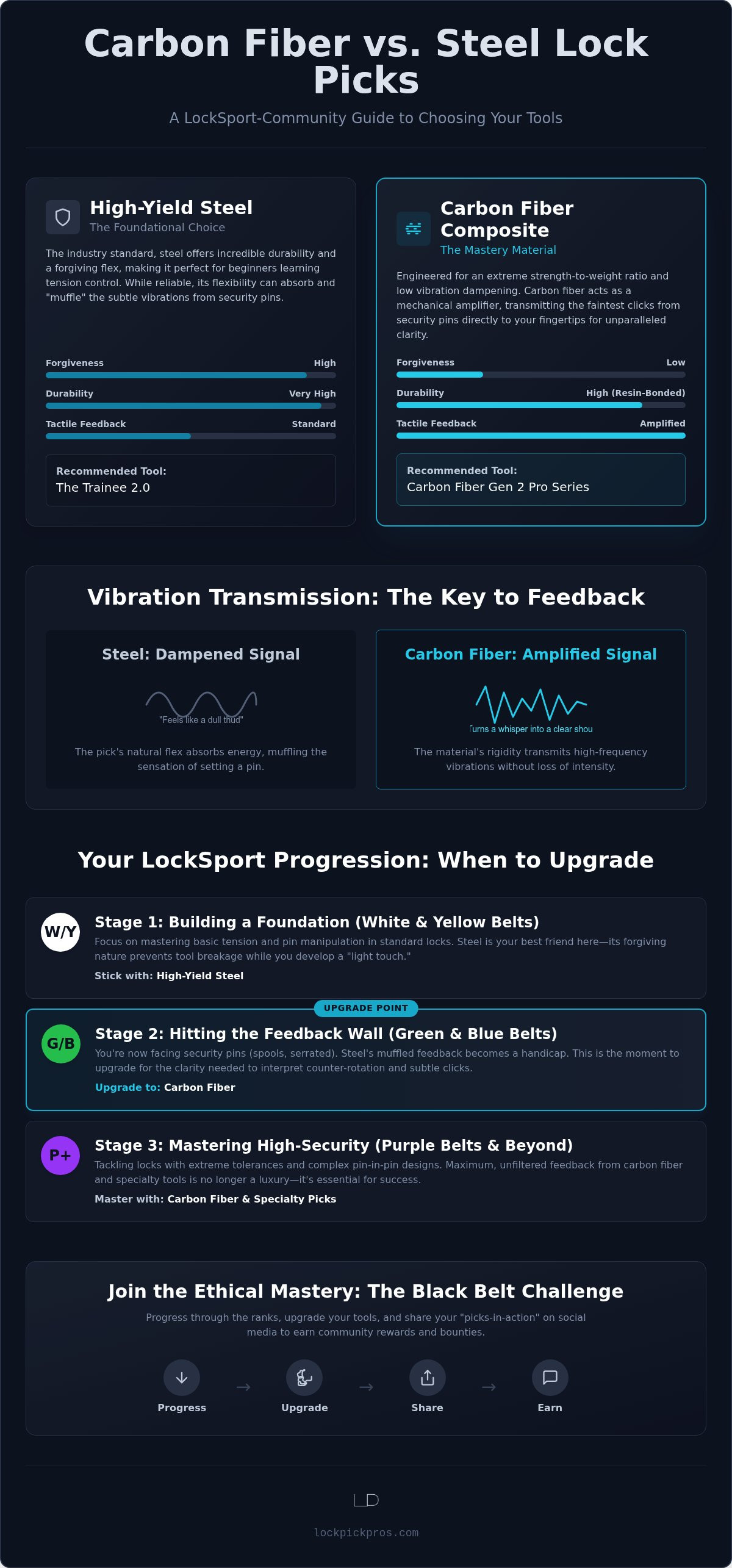
High-yield steel has long been the industry standard for locksport tools. It offers incredible durability and a natural "spring-back" that allows a pick to return to its original shape after being stressed. However, as we move into 2026, the technology behind carbon fiber vs steel lock picks has evolved. While steel is reliable, it often hits a "feedback wall." This happens when the metal's natural flexibility begins to absorb the tiny vibrations caused by security pins. Instead of feeling a crisp click, the picker feels a dull thud.
Modern locksport enthusiasts are moving toward reinforced composites to solve this. Carbon fiber is a composite material designed for an extreme strength-to-weight ratio. Unlike steel, it features incredibly low vibration dampening. This means it doesn't "swallow" the energy of a pin setting. It passes that energy directly to your fingertips. By moving beyond naked steel picks, manufacturers can now create tools that are both lighter and more communicative.
The Steel Foundation: Reliability for Beginners
Every hobbyist starts with the basics. For those just beginning their journey, The Trainee 2.0 is the gold standard. This set uses high-yield steel because it is incredibly forgiving. Beginners often use too much tension or pry too hard on pins. Steel's natural flex prevents the tool from snapping during those early learning sessions. It's a foundational material for a reason.
In the White and Yellow belt tiers, locks usually have standard pins with wide tolerances. You don't need surgical precision yet. Mastering the essential skill for the legitimate profession of locksmithing starts with learning how steel behaves under pressure. It's the perfect teacher for developing a "light touch" before you move on to more rigid materials. Steel is your training wheels; it's durable, reliable, and keeps you in the game while you're still refining your technique.
Carbon Fiber: The Mechanical Amplifier
As you progress toward Green belt locks and beyond, the game changes. You'll encounter serrated pins and spools that require instant communication. The Carbon Fiber Gen 2 Pro Series is engineered to act as a mechanical amplifier. By using rigid carbon fiber handles, these picks eliminate the "muffling" effect found in plastic-wrapped steel handles.
This rigidity translates into crisper, more immediate feedback for the picker. Feedback is the tactile communication between the lock's pins and the picker's hand. When a pin hits a shear line, the vibration travels through the shaft and is amplified by the carbon fiber handle. It turns a faint whisper into a clear shout. This makes identifying the exact state of a pin much easier during intense SPP sessions. When you're fighting tight tolerances, that extra clarity is often the difference between an open lock and a reset.
Tactile Feedback: Why You Feel More with Carbon Fiber
Most hobbyists focus on the weight of their tools, but in the world of locksport, weight is secondary to vibration transmission. When you're comparing carbon fiber vs steel lock picks, the real winner is the material that talks back to you. Every time your pick tip touches a pin, it creates a tiny shockwave. In a standard steel pick with a rubber or plastic handle, that vibration has to travel through the metal and then through a layer of soft material. This creates a dampening effect. It's like trying to listen to a conversation through a thick pillow; the sound is there, but the clarity is gone.
Carbon fiber changes the physics of the pick. Because it is Stronger than steel and lighter than aluminum, it doesn't need thick, soft padding for structural integrity. Its crystalline structure is incredibly rigid. This rigidity allows high-frequency vibrations to travel from the tip, through the shaft, and into the handle without losing intensity. When you hit a spool pin, the counter-rotation feels like a distinct mechanical "shove" rather than a vague suggestion. This clarity is what separates a guess from a confirmed set.
Vibration Transmission and Pin States
In high-security cores, the difference between a "mushy" set and a "sharp" set determines your success rate. Steel picks can sometimes feel spongy when you're dealing with tight tolerances or serrated pins. Carbon fiber picks provide a crisp, immediate response. This helps you identify a false set much faster. Instead of wondering if you've overset a pin, you get a sharp tactile "click" that confirms its state. This immediate data helps you build an accurate mental map of the pin stack, allowing you to move through the lock with surgical intent rather than random probing.
Reducing Hand Fatigue for Long Picks
Intermediate pickers often struggle with the "death grip" reflex. When feedback is muffled, your brain tells your hand to squeeze harder to "hear" the lock better. This tension kills your fine motor skills and leads to hand fatigue during long single-pin picking sessions. Lighter tools naturally encourage a lighter touch. By using the Carbon Fiber Gen 2 Pro Series, you're holding a tool that weighs significantly less than traditional steel counterparts. The ergonomic handle geometry also supports a relaxed grip, ensuring your fingers stay sensitive to the lock's movements for hours of practice. If you're pushing for a higher belt rank, keeping your hands fresh is just as important as your picking technique.
Durability and Precision: A Head-to-Head Comparison
When we look at the structural side of the carbon fiber vs steel lock picks debate, we have to talk about tensile strength. Standard 301 stainless steel is the workhorse of the industry, but aerospace-grade carbon fiber operates on a different level. Many hobbyists worry about the "brittleness" myth often discussed in community forums. While early composites could snap, modern 2026 resin bonding has changed the game. These tools are engineered to handle the specific lateral stresses of locksport. For a deeper look at these advancements, check our guide on The Benefits of Carbon Fiber Lock Picks.
Understanding the technical material properties of carbon fiber and steel helps explain why professionals are making the switch. Steel is tough, but it has a lower modulus of elasticity compared to high-end composites. This means carbon fiber can maintain its shape under loads that would cause other materials to deform. In high-security picking, precision isn't just a luxury; it's a requirement for success.
Resistance to Bending and Deformation
Steel picks have a tendency to develop a "permanent set" over time. If you've ever noticed your favorite hook has a slight, permanent curve after a tough session, you've seen this in action. This deformation ruins your accuracy. Carbon fiber has a binary nature: it stays perfectly straight or it breaks. This ensures your tool geometry is exactly the same every time you pick up the tool. For consistent Single Pin Picking (SPP), having a straight pick is vital. It allows you to trust your muscle memory when navigating complex pin stacks without second-guessing your tool's alignment.
Profile Thickness and Keyway Navigation
Navigating paracentric keyways requires a tool that is both thin and rigid. If a steel pick is too thin, it becomes "floppy," losing the ability to transmit force to the pins. Carbon fiber's extreme stiffness allows us to manufacture picks in the 0.015" to 0.020" range that still feel like a solid bar of metal. This is a massive advantage in tight European cylinders or high-security locks with restrictive warding.
Using the Pro Series Expansion allows you to slide into gaps where traditional tools would get stuck. Because the material doesn't flex away from the target, you can apply maximum lift even at the back of a long keyway. This precision ensures that your energy goes into the pin, not into the bending of the pick shaft.
The Progression Roadmap: When to Switch Materials
Your journey through the ranks is a path of constant refinement. Choosing between carbon fiber vs steel lock picks isn't just a matter of price; it's about matching your gear to your current skill level. We recommend aligning your tool upgrades with the Lock Picking Belt Levels to ensure you're always using the right tool for the job. Your kit should grow alongside your ability as you move from foundational locks to high-security puzzles.
At the White and Yellow belt stages, steel is your best friend. Beginners often struggle with tension control and "heavy-handed" picking. Foundation tools like The Trainee 2.0 provide the forgiveness you need. Steel flexes when you push too hard. This prevents you from snapping a pick while you're still learning the "feel" of a standard pin tumbler. It's better to bend a steel pick than to shatter a high-end composite before you've mastered the basics.
Orange and Green belt tiers represent the real shift. This is where you encounter tighter tolerances and security pins that require delicate manipulation. This is the critical transition point for carbon fiber vs steel lock picks. Feedback becomes your primary bottleneck. If your steel tools feel like they're muffling the lock, it's a sign that your skill progression is ready for a material upgrade. Ready to move past the feedback bottleneck? Upgrade your kit with the Carbon Fiber Gen 2 Pro Series and start feeling the difference in your next practice session.
Earning Your Carbon Fiber Upgrade
Identifying the moment you've outgrown your starter set is easy. Watch for "ghost" clicks or frequent oversetting of pins. This usually means your tools aren't transmitting the subtle counter-rotation data you need to succeed. Moving to the Carbon Fiber Gen 2 Pro Series provides the rigidity required to overcome these Green belt hurdles. There's a massive psychological boost when you rank up your gear. It marks your transition from a trainee to a serious hobbyist who understands the value of precision equipment.
The Specialty Tool Exception
High-security locks often require more than just a standard hook. When you move into advanced territory, you'll need Dimple Picks for Kaba or Mul-T-Lock systems. In these cases, the pick's profile and tip shape matter more than the handle material. However, for Single Pin Picking (SPP) on traditional keyways, the material remains king. Raking is less dependent on fine feedback, so feel free to use steel for speed and carbon fiber for precision. Building a hybrid kit allows you to tackle any challenge the community throws your way. It's the best way to prepare for our free Black Belt Challenge. Progress one belt at a time, upgrade your gear as you go, and share your picks-in-action on social media to earn rewards through our community bounty program.
Join the Ethical Mastery: The Black Belt Challenge
Lockpicking is more than a solo hobby; it's a thriving sport built on skill, patience, and a shared set of values. Our community thrives when we push each other to improve. This is why we created the Black Belt Challenge. It's the ultimate roadmap for anyone looking to transition from a curious beginner to a master of the craft. Whether you're still weighing the pros of carbon fiber vs steel lock picks or you've already started your kit, this challenge provides the structure you need to earn your rank.
Ethical lockpicking rests on two golden rules. First, never pick a lock you don't own or have explicit permission to pick. Second, never pick a lock that is currently in use or relied upon for security. These rules protect our sport and ensure we remain a community of trusted hobbyists. To document your progress, you'll need to film your successful "opens" according to the community standards. Each video should clearly show the lock being picked and then gutted to verify the pin stack. It's a transparent way to prove your mastery and claim your next belt rank.
Community Bounties and Rewards
We believe in rewarding your dedication. Our "Share-to-Earn" loop allows you to turn your progress into exclusive perks. When you post your carbon fiber "picks-in-action" on social media, you aren't just showing off a cool skill. You're helping the ethical lockpicker movement grow. Every "open" shared is a step toward the community reach goal. As we hit these milestones, we unlock community bounties for everyone. This includes earning deep discounts on expert level gear like the Gen 2 Pro Max Stealth Edition. Your success helps the entire community level up.
Final Gear Selection Checklist
Before you dive into your next session, take a moment to evaluate your setup. Your choice in carbon fiber vs steel lock picks should always reflect your current goals. Use this checklist to ensure you're ready for the challenge:
- Assess Your Rank: Are you still mastering White belt basics or are you ready for Green belt security pins?
- Identify Your Targets: Ensure you have the right practice locks for your specific belt requirements.
- Verify Local Laws: In 2026, owning picks is legal in all 50 states, but some areas like California have specific intent clauses in Penal Code 466. Always stay informed.
- Check Your Tools: Ensure your picks aren't bent or deformed. Consistency is key to muscle memory.
Ready to prove your skills? Upgrade to the Carbon Fiber Gen 2 Pro Series and start the Black Belt Challenge today! We can't wait to see your first submission and welcome you into the higher ranks of the locksport community.
Ready to Master High-Security Locks?
We've explored the technical landscape of carbon fiber vs steel lock picks, showing that your choice depends on where you stand in your locksport journey. High-yield steel offers the forgiveness needed for trainees. Carbon fiber provides the surgical precision required for advanced pin manipulation. You've learned how aerospace-grade handles act as mechanical amplifiers. They turn dull thuds into crisp, actionable feedback that guides your hands through restrictive keyways.
Aligning your gear with your belt rank ensures you aren't fighting your tools while you're learning the lock. By moving to composites when you hit the Green Belt hurdle, you eliminate the noise that holds back many intermediate pickers. It's about having the right equipment to match your growing expertise and your passion for the sport. This transition is a vital step for anyone serious about reaching the higher tiers of locksport mastery.
This focus on quality is universal; just as athletes in precision sports rely on high-performance equipment from Pro Pickleball GmbH to gain a competitive edge, choosing the right tools in locksport is essential for overcoming technical plateaus.
If you're ready to clear the feedback bottleneck and tackle high-security challenges, it's time to refine your kit. Upgrade to the Carbon Fiber Gen 2 Pro Series and take your first step toward the 2026 Black Belt Challenge today. Every open is a victory for our ethical lockpicking community. Keep practicing, stay curious, and we'll see you at the next rank.
Frequently Asked Questions
Is carbon fiber better than steel for lockpicking?
Neither material is universally better; they serve different purposes based on your current skill level. High-yield steel is the foundational standard for durability and forgiveness during early practice sessions. Carbon fiber is a mastery material designed for experts who need maximum feedback. Choosing between carbon fiber vs steel lock picks depends on whether you value tool flexibility or extreme tactile clarity.
Do carbon fiber lock picks break easily?
Modern carbon fiber picks are incredibly resilient thanks to 2026 resin-bonding technology. While older composites had a reputation for brittleness, the Gen 2 Pro Series is designed to handle significant lateral stress without snapping. Unlike steel, which bends and takes a permanent set, carbon fiber stays perfectly straight until its breaking point. This ensures your tool geometry remains consistent for precise picking.
When should I upgrade from a steel set to carbon fiber?
You should consider an upgrade when your skill progression hits a feedback wall, typically around the Green or Blue belt levels. If you find yourself oversetting pins or missing subtle counter-rotation in high-security locks, your steel tools might be muffling the data. This is the perfect moment to explore the carbon fiber vs steel lock picks debate by testing a more rigid composite tool.
Are carbon fiber lock picks legal to own in 2026?
Yes, owning lock picks is legal in all 50 states as of August 2026. Most states allow possession as long as you don't have intent to use them for unlawful purposes. Even in states with specific statutes, like California's Penal Code 466 updated in January 2026, picks are only classified as burglary tools if possessed with criminal intent. Always check your local regulations to stay informed.
Does carbon fiber actually improve tactile feedback?
Yes, carbon fiber acts as a mechanical amplifier for vibrations within the lock. Its rigid crystalline structure doesn't dampen energy like plastic-wrapped steel handles do. When a pin hits the shear line, the shockwave travels directly through the shaft to your fingertips. This clarity makes it much easier to identify pin states and counter-rotation in locks with extremely tight tolerances.
What is the best material for a beginner lock pick set?
High-yield steel is the best material for beginners because it's forgiving of mistakes. Trainees often apply too much tension or pry too hard on pins, which can damage more rigid tools. A foundational steel set allows the pick to flex without snapping during your early learning sessions. This durability lets you focus on refining your technique without worrying about immediate tool failure.
Can I use carbon fiber picks on high-security locks like Abus or American Lock?
Absolutely, these picks are specifically engineered for high-security cylinders with restrictive keyways. The extreme stiffness of the material allows for thinner profiles that don't flop or bend when you're navigating paracentric warding. This provides the precision needed to set the serrated pins and spools found in American Lock 1100 series or advanced Abus models with total confidence.
What is the 'Black Belt Challenge' in the locksport community?
The Black Belt Challenge is our community-driven roadmap to mastery. It encourages hobbyists to progress through the belt ranks by documenting their successful opens and sharing them with the community. By participating, you join a group of ethical pickers who share their "picks-in-action" content to earn rewards. It's the best way to stay motivated while you refine your skills and upgrade your gear.