

Best Beginner Lock Pick Sets: 2026 Locksport Guide
What if that massive 50-piece pick set you saw online is actually the biggest obstacle to your first successful open? It's a common trap for new hobbyists. You're likely feeling overwhelmed by dozens of mystery tools and worried about wasting money on gear that doesn't offer the tactile feedback you need to learn. We've all been there, staring at a Master Lock #3 and wondering why the pins won't budge. Finding the best lock pick set for beginners isn't about quantity; it's about choosing precision-engineered tools that grow with you as an ethical lockpicker.
You're about to discover how to select a foundational kit that matches the official locksport belt-ranking system. This guide simplifies the process by focusing on the high-quality hooks and tensioners you'll actually use to earn your first rank. We'll explore why starting with professional-grade materials like high-yield steel helps you understand the "language" of a lock. By the end of this article, you'll know exactly which tools to put in your carrying case to start your journey toward a Black Belt in locksport.
Key Takeaways
- Learn how to identify the best lock pick set for beginners by prioritizing high-feedback tools like short hooks over bloated kits with low-quality filler.
- Discover why The Trainee 2.0 is the gold standard for White Belt candidates who want to master Single Pin Picking on a Master Lock #3.
- Understand the community belt-ranking system and how to map your technical progress using our 2026 Lock Difficulty Reference Guide.
- Find out why metal cutaway locks are superior to clear plastic locks for developing the muscle memory needed for real-world friction.
- Join the free Black Belt Challenge to track your skills and earn community rewards by sharing your progress on social media.
What Defines the Best Lock Pick Set for Beginners in 2026?
In 2026, the world of locksport has evolved. It's no longer about having a massive roll of tools that looks like something out of a movie. If you're hunting for the best lock pick set for beginners, you need to prioritize feedback over a high piece count. While professional locksmithing is a service focused on rapid entry, locksport is a community-driven hobby centered on the technical challenge of lock picking as a sport. It's about adopting the "White Belt" mindset. This means you're committed to learning the internal mechanics of a pin-tumbler lock. You aren't just trying to "defeat" a lock; you're trying to understand it. You're learning to visualize what's happening inside the keyway through your fingertips.
The 'Quality Over Quantity' Trap
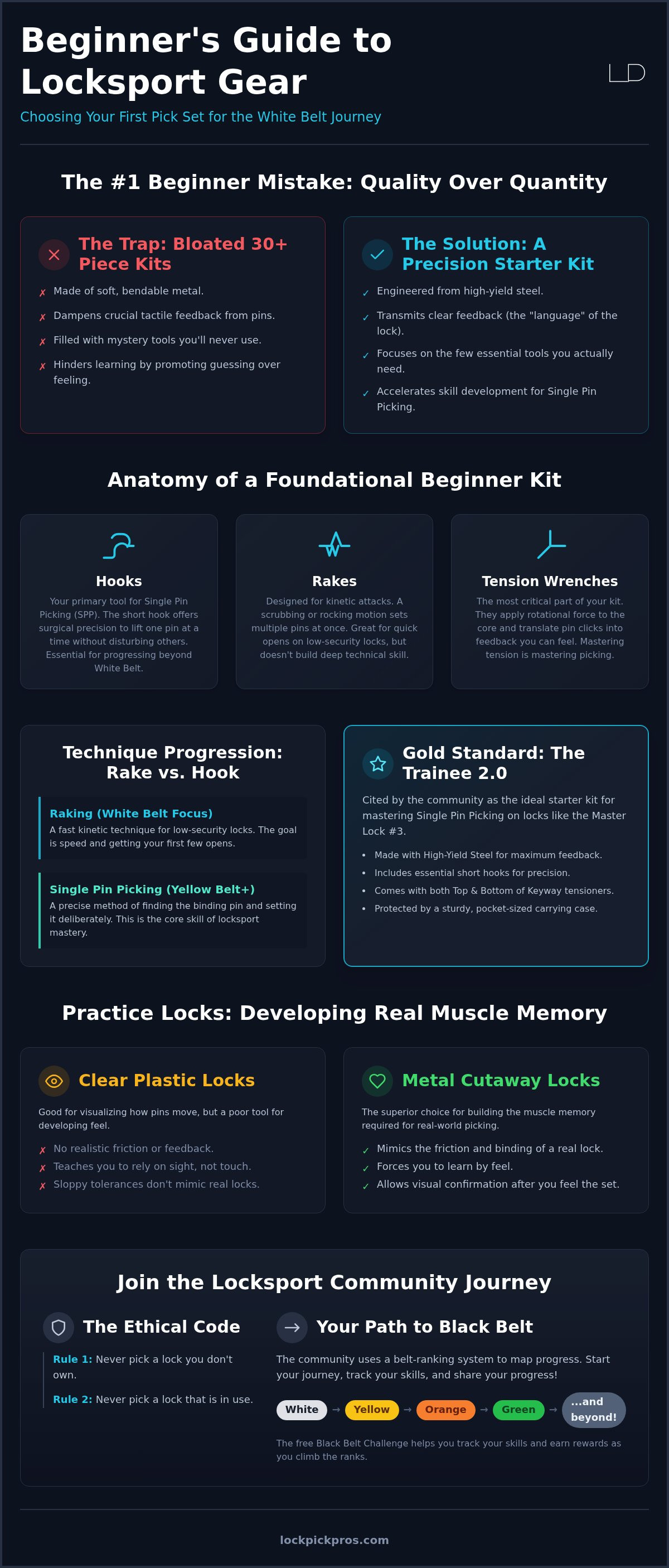
A common mistake is buying those massive 30-piece sets from generic online retailers. These kits are a trap. They're usually made of soft metal that bends easily and dampens the subtle clicks of the pins. A quality starter kit like The Trainee 2.0 is often cited as the best lock pick set for beginners because it uses high-yield steel. This material acts as a conductor for information. Feedback is the tactile vibration felt through the pick. When you use high-quality tools, you can actually feel when a pin hits the shear line. You'll learn to distinguish between a "set" pin and one that's just binding. This clarity is the difference between guessing and knowing. A few precision-engineered hooks will teach you more in an hour than a bag full of low-quality rakes will in a month.
Ethical Locksport: The Hobbyist Code
Joining the locksport community means picking up more than just tools. You're adopting an ethical code. We live by two golden rules: never pick a lock you don't own, and never pick a lock that is in use. This distinction separates us from illicit activities and keeps the sport focused on skill refinement. The community fosters this growth through a belt ranking system that rewards technical mastery. It's a supportive environment where everyone from "White Belts" to "Black Belts" shares tips and successes. To see the full roadmap of your new hobby, read our guide on Lock Picking Belt Levels Explained. This structure ensures you're always working on locks that match your toolset and your talent.
The Anatomy of a Foundational Beginner Kit
Selecting the best lock pick set for beginners isn't about buying a roll of 50 mystery tools. It's about curation. A foundational kit focuses on the core instruments you'll use daily: hooks, rakes, and tensioners. Each tool has a specific job in your journey from a White Belt to more advanced locksport ranks. These tools are your sensors. They allow you to visualize the internal physics described in the classic MIT Guide to Lock Picking. Without the right anatomy in your kit, you're just poking around in the dark.
The Short Hook is your primary instrument for Single Pin Picking (SPP). It's the most-used tool in the sport. Its design allows you to reach deep into the keyway and lift individual pins without disturbing the others. Conversely, the Triple Peak Rake is built for "kinetic" picking. It uses a scrubbing motion to set multiple pins simultaneously. While raking is a fast way to open low-security padlocks, SPP is the skill that truly builds your technical foundation. To keep these precision tools safe, a sturdy carrying case is essential. It protects your picks from bending and metal fatigue, ensuring they remain "true" during long practice sessions.
Hooks vs. Rakes: When to Use Which
Raking is often the first technique a newcomer masters. It's perfect for the "White Belt" phase where speed and quick opens are the goal. However, to achieve "Yellow Belt" mastery, you must learn to use a hook. SPP requires you to feel for the "binding pin" and set it at the shear line with a controlled lift. For a standard 5-pin tumbler lock, a short or medium hook is your most reliable choice. It offers the surgical precision needed for locks that resist simple raking.
Tension Control: The Secret Ingredient
Tension wrenches are the most critical part of the best lock pick set for beginners. They translate the "click" of a set pin into a vibration you can feel. While beginners often start with Bottom of Keyway (BOK) wrenches, Top of Keyway (TOK) tension is superior. It leaves the bottom of the keyway open, giving your pick more room to move. You'll need to learn the difference between "heavy" tension for finding a binder and "feather" tension for setting a pin. For a deeper look at these components, read our guide on what is in a beginner lock pick set. Once you've mastered the basics, you might find that upgrading to a pro-grade carbon fiber series provides the enhanced tactile sensitivity needed for security pins.
Matching Your Tools to the Lock Difficulty Reference Guide
Your journey through the 2026 Hub begins with the realization that tools are only as effective as the locks they're matched against. The best lock pick set for beginners acts as a bridge between your current skill and the next belt rank. We use a community-standardized roadmap to help you progress. Think of this guide as a syllabus for your hands. You'll start at the White Belt level, focusing on basic pin-tumbler mechanics, before graduating to the complex internal puzzles of higher tiers. Each lock you encounter will demand a slightly different approach and a more refined touch.
Master Lock #3 Difficulty Comparison
The Master Lock #3 is the universal "First Open" for almost every hobbyist in the locksport community. It features a 4-pin stack with standard pins and no security features. To successfully pick this lock, apply medium tension to your wrench and use a standard short hook, like the one included in The Trainee 2.0. You'll notice the feedback feels "mushy" or "gritty" compared to high-end precision locks. This is actually a great teacher. It forces you to be deliberate with your pick placement and pressure. If you can identify a set pin through that grit, you're developing the tactile sensitivity required for the ranks ahead.
The Yellow Belt Jump
Once you've mastered the basics, the jump to Yellow Belt often involves locks like the ABUS 64TI/30. This is where things get interesting. You'll encounter tighter keyways and security pins, specifically spools. Spools are designed to trap your pick in a "false set," where the plug rotates slightly but the lock remains closed. You'll need to learn the art of counter-rotation to set these pins without dropping the ones you've already placed. This transition is usually when pickers realize they need thinner tools. Navigating restricted keyways often requires picks in the .015 or .020 gauge to avoid over-setting pins. Knowing how to choose your first beginner lock pick set involves planning for these tighter tolerances from day one.
Before you start your first practice session, it's vital to understand the legal landscape of your new hobby. Organizations like TOOOL offer comprehensive guides on Lockpicking Laws to keep you informed and responsible. As your skills grow, you'll naturally want tools that provide even sharper feedback. Many intermediate pickers upgrade to the Carbon Fiber Gen 2 Pro Series to better sense the subtle movements of security pins. Every click you feel is a step closer to your next belt, and every lock is a puzzle waiting to be solved.
Practice Locks: Clear Padlocks vs. Metal Cutaways
Owning the best lock pick set for beginners is only half the equation. You also need a training environment that builds genuine muscle memory. Many hobbyists start with transparent locks, but these can quickly become a "Visual Crutch" that stalls your progress. To earn your higher belt ranks, you must learn to translate internal mechanical events into tactile sensations in your fingers. This is where the choice between clear plastic and metal cutaways becomes critical for your technical development as an ethical lockpicker.
The Role of the Clear Practice Padlock
Clear locks serve as an excellent introductory tool for visualizing the "Shear Line." They're perfect for your first ten minutes in the sport. You can see exactly how a pick interacts with the pin stack and why the plug won't turn if a pin is over-set. But don't linger here. Follow the 1-hour rule: once you've opened it ten times, put it in your carrying case and don't look back. Relying on sight prevents you from learning the "binding order," which is the heartbeat of locksport. Common mistakes include looking at the pins to time your tension, which is a habit you'll have to break later.
Cutaway Locks for Training
Metal cutaway locks are the gold standard for serious trainees. Because they're made of real brass and steel, they simulate the actual friction and binding orders you'll encounter on a real padlock. The best versions are re-pinnable, allowing for "Progressive Practice." You can start with just one or two pins to understand the feel of a set, then slowly add more pins to increase the difficulty. This method is the fastest way to prepare for mastering the advanced lock. These tools provide the metal-on-metal feedback that plastic simply cannot replicate.
The ultimate goal is the "Blind Test." This is where you pick a standard, non-cutaway lock using only your sense of touch. It's a major milestone in the locksport community. To succeed here, you need tools that don't dampen the signal. High-yield steel picks like those in The Trainee 2.0 provide the clarity you need to feel those tiny internal movements. When you're ready to tackle serrated or spool pins, upgrading to the Carbon Fiber Gen 2 Pro Series will give you the edge needed for a professional open.
Earning Your Belt: Join the Lockpick Pros Black Belt Challenge
Lockpicking is more than a technical skill; it's a journey through a vibrant, ethical community. The Lockpick Pros Black Belt Challenge provides a free, structured roadmap to guide you from your very first open to master-level technical proficiency. By joining the challenge, you aren't just buying tools. You're entering a ranking system that tracks your progress through every tier. This is why many consider our curated kits the best lock pick set for beginners, as they're specifically designed to help you hit these milestones without the frustration of low-quality gear.
Our "share-to-earn" loop is designed to foster this growth. When you successfully pop a new lock, record it and share your "picks-in-action" on social media. This allows you to earn rewards and discounts on future gear as you level up. We also offer monthly community bounties for the most helpful mentor posts. If you explain a tricky binding order or a specific tension trick to a newcomer, you contribute to the collective knowledge of the sport. It's about giving back as much as you gain.
Your First Goal: The White Belt
Earning your White Belt is your official entry into the sport. To get verified, you'll need to submit a clear video of yourself picking a qualifying lock from our difficulty guide. Because of its precision and tactile feedback, The Trainee 2.0 is the perfect "White Belt" companion. It ensures your first submission is a success by providing the clarity needed to navigate basic pin stacks. Be sure to join our mailing list to receive the "Belt Roadmap 2026" PDF, which details every qualifying lock for the upcoming year.
The Professional Path
As you move into the intermediate and expert tiers, your requirements will change. You'll eventually need to move toward expert-level picking with tools like the Carbon Fiber Special series. These picks offer the extreme sensitivity required for high-security locks and complex pin configurations. The "Black Belt" mindset is defined by mastery, unwavering ethics, and a commitment to mentorship. It's about pushing the boundaries of what's possible while respecting the hobbyist code. If you're ready to start your journey and find the best lock pick set for beginners to launch your hobby, Start the Black Belt Challenge Today!
Master the Art of Ethical Locksport Today
You've seen that the path to a Black Belt starts with the right foundation. Instead of getting lost in a sea of unnecessary tools, you now understand that precision and tactile feedback are your best allies. Finding the best lock pick set for beginners is the first step in this exciting journey. By choosing a kit crafted from precision high-yield steel and following the community belt system, you're setting yourself up for a rewarding lifelong hobby. Remember to move beyond clear visual aids quickly to embrace the challenge of real metal-on-metal friction. This is how you develop the professional-level sensitivity that defines an expert picker.
We're here to support your growth every step of the way with a 100% satisfaction guarantee and free shipping on beginner bundles. It's time to stop guessing and start feeling the pins. Claim Your Trainee 2.0 Starter Set & Join the Black Belt Challenge to begin your progression toward locksport mastery. We can't wait to see your first verified open in the community!
Frequently Asked Questions
Is it legal to own a lock pick set for beginners?
Ownership is legal in most jurisdictions as long as you don't intend to use the tools for illicit activities. You should always check your local and state statutes to stay informed about specific regulations in your area. Ethical lockpickers follow a strict code: only pick locks that you own and never pick a lock that is currently in use.
What is the best first lock to practice on?
The Master Lock #3 is the gold standard for your first practice session. It features a simple 4-pin stack with standard pins, making it the perfect entry point for the White Belt rank. Once you can reliably open this lock using the best lock pick set for beginners, you'll have the confidence to move on to more restricted keyways.
Do I need a clear practice lock to learn?
You don't strictly need a clear lock, and many seasoned pickers suggest skipping them entirely. While they're great for a five-minute lesson on how a shear line works, they don't provide the realistic metal-on-metal feedback you need. A metal cutaway lock is a far better tool for developing the tactile sensitivity required for the sport.
How long does it take to learn how to pick a lock?
You can often learn to rake a basic padlock open in less than ten minutes. However, mastering Single Pin Picking (SPP) takes more time and patience. Most beginners spend a few weeks of consistent practice to develop the muscle memory needed to reliably open their first few belt-ranked locks.
What is the difference between a hook and a rake?
A hook is a precision tool used for Single Pin Picking, allowing you to lift one pin at a time. A rake is a multi-peaked tool designed to vibrate or "scrub" all the pins simultaneously for a quick open. Hooks are the most important tools in your kit because they're required for high-security locks that resist raking.
Can I pick my own front door lock if I lose my keys?
No, you should never pick a lock that you rely on for security. Lock picking is a non-destructive entry method, but there's always a risk of damaging the internal springs or pins. If you "brick" your front door lock while trying to get inside, you'll face a much more expensive repair bill than a simple locksmith call-out. To better understand the professional side of the industry, you can explore Per-Job Service Call Fees for Automotive, Residential, and Commercial Locksmith Work before attempting any risky DIY repairs on critical security hardware.
What is 'locksport' and how do I get started?
Locksport is the social and competitive hobby of picking locks as a technical challenge. To get started, you just need to pick up the best lock pick set for beginners and join a community like ours. You can track your progress through the belt ranking system and share your successful opens with other ethical hobbyists around the world.
Interestingly, the fascination with technical puzzles and community-driven mastery isn't limited to the physical world; many hobbyists also explore these themes in digital environments like Project Securo, a community hub for immersive RPG roleplay where technical systems are a key part of the experience.
What tools do I need to get a Yellow Belt in lockpicking?
Earning a Yellow Belt usually requires thinner picks and Top of Keyway (TOK) tension wrenches. As you move away from basic Master Locks and toward brands like ABUS, the keyways become tighter and more restrictive. Having a variety of tension tools ensures you can apply the right amount of pressure without blocking your own access to the pins.