

How to Pick American Lock 1100: The Ultimate Green Belt Guide
The American Lock 1100 is the official "Welcome to the big leagues" moment for every aspiring locksport enthusiast. It's widely considered the boss fight of the intermediate tiers. You've probably spent hours listening to those tiny, frustrating clicks, only to realize you've over-set every single serrated pin in the stack. We've all been there. Learning how to pick american lock 1100 isn't just about moving pins; it's about developing a professional level of touch and understanding exactly what the metal is telling you.
You're likely struggling with the heavy spring tension or the confusing feedback between serrated and spool pins. That's perfectly normal for this stage of your journey. This guide promises to help you master these technical hurdles with a breakdown of the internal components and specific tensioning strategies. We'll walk through the pin stack details, tool selection, and a progressive practice method designed to get you that first satisfying "thunk" of the core turning. By the end, you'll have the skills needed to claim your Green Belt rank and join the ranks of advanced ethical lockpickers.
Key Takeaways
- Discover why the American 1100 is the legendary "Gold Standard" for earning your Green Belt rank in the locksport community.
- Master the technical nuances of how to pick american lock 1100 by decoding the feedback from serrated driver pins and heavy spring tension.
- Learn the progressive practice technique of gutting your lock to isolate pins, making the "boss fight" of intermediate locks manageable.
- Identify the ideal tensioning strategy using Top of Keyway (TOK) tools to avoid over-setting pins and find the true shear line.
- Upgrade your gear with professional carbon fiber lockpicks and thin-gauge tools designed to navigate the restrictive keyways of Green Belt locks.
The American Lock 1100: Your Gateway to Green Belt Mastery
Every serious hobbyist remembers the day they finally popped their first American Lock 1100. It's widely considered the "Gold Standard" for intermediate locksport. Within the Lockpickers United (LPU) community, this padlock serves as the primary gatekeeper for the Green Belt rank. Successfully learning how to pick american lock 1100 marks your transition from a trainee to a skilled picker. It represents a massive leap in difficulty from the entry-level locks you've likely mastered. You're moving beyond basic pin-tumbler mechanics and into the world of advanced security features.
This lock is a significant milestone because it demands a high level of "feedback-heavy" picking. You can't just bully your way through the core. You have to listen to the metal. The 1100 forces you to refine your tension control and your ability to distinguish between different types of pin movement. It's a technical challenge that rewards patience and precision over raw force. Once you can reliably open an 1100, you've proven you have the "touch" required for high-security locks.
Why the 1100 is a "Boss Fight" for Hobbyists
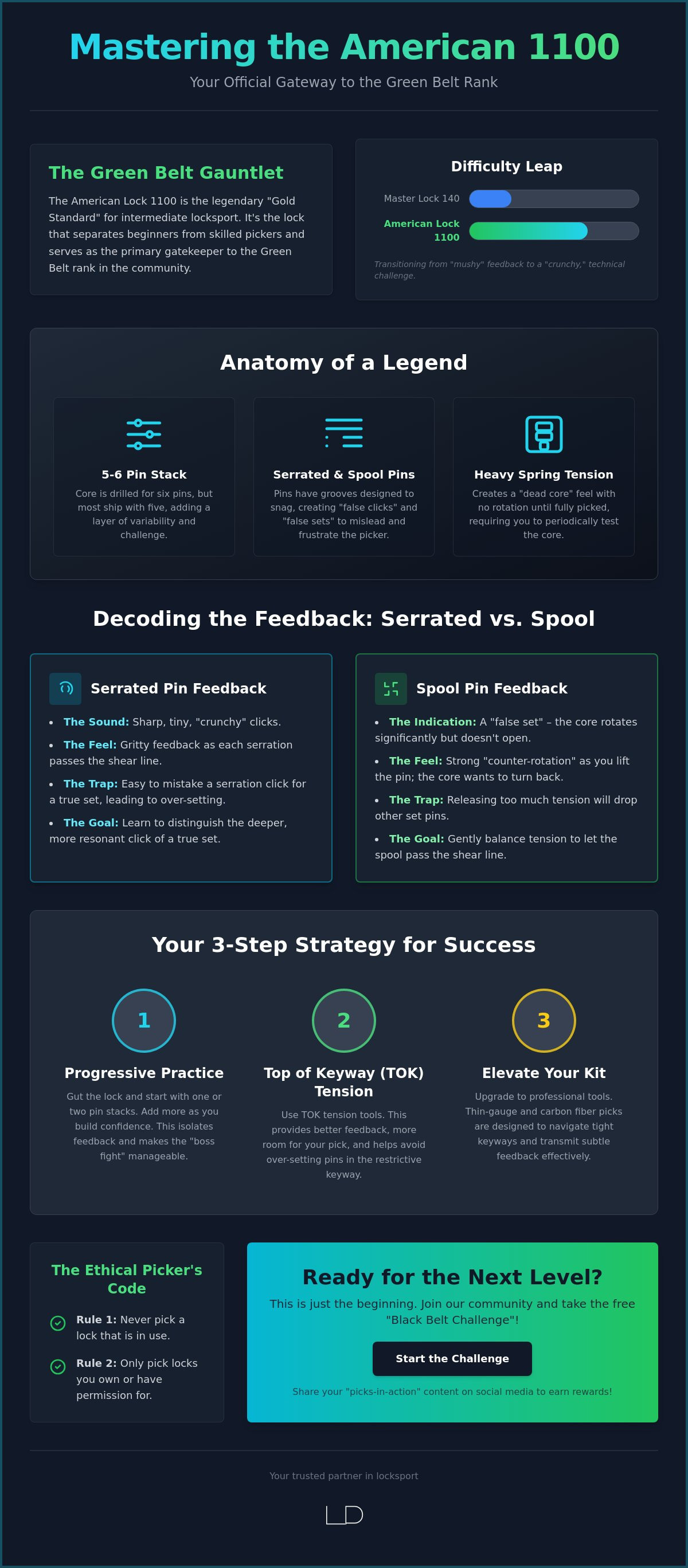
If you've spent your time on the Master Lock 140, the American 1100 will feel like an entirely different beast. The 140 offers mushy, forgiving feedback. The 1100 is "crunchy." This is because of its Anatomy of a Legend: Serrated Pins and Spring Tension. Most 1100s come with a five-pin stack, though some have six. These stacks are packed with serrated driver pins and even serrated key pins. These tiny notches catch on the shear line, creating a "click" that feels like a set pin. It’s easy to get lost in the clicks and over-set everything. Mastering this lock requires learning the difference between a "serrated click" and a "true set."
The Ethical Locksport Mindset
As you progress toward your Green Belt, remember our community's core values. We are ethical lockpickers. This means we follow two non-negotiable rules. First, never pick a lock that is currently in use or protecting something. Second, only pick locks that you own or have explicit permission to pick. The American 1100 is the perfect practice lock for this because it's designed to be gutted and rekeyed. It's a tool for learning, not for illicit entry.
We love seeing the community grow. When you finally get that core to turn, share your "picks-in-action" content on social media. It’s a great way to earn rewards and encourage others who are stuck on their own "boss fight." This journey doesn't end at Green Belt. We want to see you push all the way to the "Black Belt Challenge." That's where you'll face the most complex locks in the world, but it all starts with mastering the fundamentals of the 1100 right here.
Anatomy of a Legend: Serrated Pins and Spring Tension
The internal makeup of the American 1100 is what makes it a legend in the world of Locksport. Most of these locks ship with a 5 pin stack, though the core is drilled for six. This means you might occasionally encounter a 6 pin version that adds an extra layer of complexity. Every driver pin in a standard 1100 is typically serrated. These tiny grooves are designed to snag on the shear line. They create a "false click" that mimics the sound and feel of a pin being set. When you're learning how to pick american lock 1100, you have to train your ears to hear the difference between a shallow serration click and the deeper, more resonant click of a true set.
The "dead core" feel is another signature trait. In many locks, the core will rotate slightly when you're close to an open. The 1100 doesn't give you that luxury. It uses a very heavy actuator spring that resists the rotation of the core. It's incredibly common for a picker to actually have the lock picked but not know it. They keep picking until they over-set a pin because they didn't realize the core was ready to turn. You have to periodically "test" the core with slightly more tension to see if you've already won the fight.
Serrated vs. Spool Feedback
Identifying the feedback is the hardest part of the process. A serrated pin will give you a sharp, tiny click as each ridge passes the shear line. If you hit a spool pin, you'll experience a false set where the core rotates significantly but doesn't open. When you try to lift that spool, you'll feel "counter rotation," which is the core trying to turn back toward the locked position. Learning to balance your tension during this counter rotation is vital. For a deeper dive into these sensations, check out our guide on Mastering Serrated Pins: The Locksport Guide to Defeating False Clicks (2026).
Understanding Keyway Restrictions
The 1100 series features a paracentric keyway. This means the warding (the metal ridges inside the keyhole) extends past the center line. If you're using a standard .025" thick pick, the keyway will feel cramped. You'll likely find your pick getting stuck or rubbing against the warding, which kills the feedback. Moving to a thinner .015" or .020" pick allows you to navigate these tight bends without touching the sides. To get the best possible "read" on those tiny serrations, we recommend using the Carbon Fiber Gen 2 Pro Series. The rigid handles transmit vibrations directly to your fingertips, making it much easier to tell when you've hit a true set.
Mastering the 1100 via Progressive Practice Techniques
If you're struggling with how to pick american lock 1100, the biggest mistake is trying to tackle all five pins at once. Most hobbyists fail because they get lost in a sea of false clicks. Progressive pinning is the secret weapon of the locksport community. This method involves stripping the lock down to its bare essentials and learning its personality one pin at a time. The American 1100 is a classic Pin tumbler lock, but its security pins make it feel like a complex puzzle box. By isolating the stacks, you turn a "boss fight" into a series of manageable training sessions.
- Step 1: Gut the lock and remove all but the first two pin stacks. This lets you feel exactly how the serrations interact with the shear line.
- Step 2: Pick the 2-pin configuration until you can open it in under ten seconds. You're training your brain to ignore the "crunch" and find the true set.
- Step 3: Gradually add pins back. Move to three pins, then four, and finally the full five-pin stack.
This systematic approach builds the specific muscle memory needed for high-security hardware. If you're still working on your foundational touch, The Trainee 2.0 is an excellent starting point before you dive into the deep end with the 1100 series.
How to Gut an American 1100 Safely
You'll need a few essential tools to do this right: a plug follower, a pinning tray, and a steady hand. Start by removing the screw inside the shackle hole to release the cylinder. Use your key to turn the core about 45 degrees. Never turn the core 180 degrees without a follower, or the driver pins will fire into the bottom of the keyway and brick your lock. Keep your pins organized in your tray from front to back. If you mix up the order, the key will no longer work, and you'll have a much harder time reassembling the unit.
Building Your Progressive Practice Lock Set
The 1100 is the best candidate for a DIY progressive set because it's designed for easy maintenance. Unlike cheaper locks that are crimped shut, the 1100 uses a removable core that encourages exploration. As you add pins back into the stack, you'll notice how the feedback changes. A four-pin 1100 feels significantly more crowded than a two-pin version. Progressive pinning accelerates muscle memory by allowing you to master the specific resistance of each individual spring and pin before they're combined into a full-security stack.
Step-by-Step: Single Pin Picking (SPP) the American 1100
Single pin picking is the most rewarding way to tackle this lock. To start your journey on how to pick american lock 1100, you need the right setup. I highly recommend using a Top of Keyway (TOK) tensioner. Bottom of Keyway tools often cramp the workspace or accidentally bind the core against the lock body. Once your tensioner is in place, you need to master the "Light Tension" Rule. In the locksport community, "light" means the weight of a feather. If you press too hard, those serrations will lock up tight and you'll never find the shear line.
Move your pick through the stack and look for the binding pin. A pin that "jiggles" or has a slight springy feel is not your target yet. Leave it alone. You are looking for the pin that feels rock solid. Give it one gentle click. If it stays solid, give it another. If it starts to jiggle, you've likely set it or hit a serration that's high enough for now. Move on to the next binder. This methodical "searching" is what separates the experts from the beginners.
Tensioning for Serrations
Serrated drivers are designed to trick you. Every time you hear a click, you'll be tempted to think you've succeeded. Take a "one click at a time" approach. If you lift a pin and the core doesn't move at all, check if you've over-set it. An over-set pin will feel completely dead and might even drop other pins when you release tension. If you're unsure what you're feeling, our guide on How to Tell if a Lock Has Security Pins: The Locksport Diagnostic Guide can help you decode those confusing vibrations.
The Open Verification
The "Ghost Open" is the most famous trap of the American 1100. Because the actuator spring is incredibly heavy, the lock won't just pop open when you hit the last pin. It will feel like a very deep false set. Many pickers think they're stuck and keep picking, which leads to over-setting and frustration. This is why you must periodically apply "Heavy Open Tension." This means cranking on your tension wrench with significant force. If you've picked it correctly, the core will suddenly give way. There's no feeling quite like the loud "clunk" of the shackle finally popping after a long battle.
To feel those tiny serration clicks with maximum clarity, you need a tool that doesn't dampen the feedback. Our Carbon Fiber Gen 2 Pro Series picks are engineered for exactly this kind of high-precision work. The rigid handles ensure every vibration from the pin stack reaches your hand, giving you the edge you need for a Green Belt open.
Elevate Your Kit: Precision Tools for Advanced Locksport
Mastering how to pick american lock 1100 is 50% technique and 50% having the right sensory input. When you're dealing with the microscopic serrations of a Green Belt lock, your tools shouldn't get in the way. Most beginner sets use thick steel that dampens the vibrations from the pin stack. To truly feel the difference between a false click and a shear line set, you need materials that favor rigidity. Carbon fiber handles are the industry favorite for a reason. They act like a tuning fork, transmitting every tiny skip and pop directly into your palm.
The paracentric keyway of the 1100 series is notoriously tight. If you use a standard .025" pick, you'll spend more time fighting the warding than the pins. We recommend the Carbon Fiber Gen 2 Pro Series for this exact scenario. These picks provide the thin .015" and .020" profiles needed for tight tolerances without sacrificing strength. If you're just starting your progressive journey and need a solid foundation, The Trainee 2.0 offers the perfect balance of durability and feedback for your first few guts and re-pins.
Upgrading Your Tension Game
Top of Keyway (TOK) tension is essentially non-negotiable for the 1100. It clears the bottom of the keyway, giving your pick more room to maneuver and preventing the tool from binding against the lock body. High-quality tensioners often feature serrated ends that bite into the core. This prevents the wrench from slipping out during the heavy "open tension" phase required to overcome the actuator spring. You can find a variety of these specialized tools in our Pro Series Expansion kit, which is designed to help you bridge the gap between intermediate and expert levels.
Join the Black Belt Challenge
Conquering the American 1100 is a massive achievement, but it's only one stop on your journey. We want to help you reach the top of the LPU rankings. Join our Free Black Belt Challenge to track your progress and connect with a community of passionate hobbyists. Sharing your 1100 "picks-in-action" on social media isn't just about bragging rights; it's a way to earn community rewards and inspire others who are still stuck on their first serrated pin.
Ready for the next step? Blue Belt locks are waiting, and they bring even more complex security pins and tighter tolerances. Prepare for those advanced challenges with the Gen 2 Pro Max Stealth Edition. This set is engineered for maximum sensitivity and reach, ensuring you have the precision required for the most difficult cores. The locksport journey is a marathon, and we're here to provide the gear and guidance you need to cross the finish line.
Take the Next Step Toward Your Green Belt
You've now got the technical blueprint for defeating one of the most iconic challenges in locksport. By mastering the delicate balance of light tension and learning to navigate the "crunchy" feedback of serrated pins, you're well on your way to earning that Green Belt rank. Remember that progressive pinning is your best friend. It turns a confusing mess of clicks into a clear, technical lesson. Mastering how to pick american lock 1100 is a rite of passage that proves you have the patience and precision of a true hobbyist.
Don't let subpar gear hold you back when you're this close to a breakthrough. Our tools are used by ethical lockpickers worldwide and are precision engineered for high-security feedback. We provide secure shipping on all specialty tools to ensure your kit arrives ready for the workbench. Start your journey to Green Belt with our Carbon Fiber Pro Series! Keep practicing, stay ethical, and we can't wait to see your "picks-in-action" post when that shackle finally pops.
Frequently Asked Questions
Is the American 1100 a good lock for a total beginner?
No, the American 1100 is not a good choice for a total beginner. It is a significant step up from foundational locks like the Master Lock #3. Starting here often leads to frustration because of the complex security pins. We suggest mastering basic pin tumbler mechanics on simpler locks first before you tackle this intermediate Green Belt challenge.
What is the best pick to use for an American 1100?
The best pick for this lock is a short or medium hook in a thin profile like .015 or .020 inches. The keyway is paracentric and tight, so standard thick picks often get stuck on the warding. Using a thinner pick allows you to reach the pins without rubbing against the sides. This ensures you receive clear feedback from the serrated pins.
Why does my American 1100 feel like it is stuck or "crunchy"?
That crunchy sensation is caused by the serrated pins catching on the shear line. Each tiny notch creates a click that feels like a set pin. Learning how to pick american lock 1100 requires distinguishing these false clicks from a true set. It takes patience to feel each individual serration pass the shear line as you work through the stack.
Do I need Top of Keyway (TOK) tension to pick the 1100?
Top of Keyway (TOK) tension is highly recommended for the 1100 series. It provides much more room in the keyway for your pick to move freely. Bottom of Keyway tools often bind against the core or block your access to the first pin. Using TOK tensioners makes the picking process much smoother and helps you avoid accidental over-sets.
What is a "Ghost Open" in lockpicking?
A Ghost Open happens when you've successfully picked all the pins, but the lock stays closed. This occurs because the American 1100 has an exceptionally heavy actuator spring. You might think you're still stuck in a false set when the lock is actually open. Always apply extra tension periodically to check if the core is ready to turn.
How many pins does an American Lock 1100 have?
Most American Lock 1100 series padlocks contain a 5-pin stack. However, the core is almost always drilled for 6 pins. This design allows hobbyists to easily upgrade the lock by adding a sixth pin for an extra challenge. It is a versatile tool for anyone looking to refine their intermediate skills and move toward advanced ranks.
Can I pick the American 1100 with a standard beginner lock pick set?
It is possible, but standard beginner sets often struggle with the tight tolerances of this lock. Most entry-level picks are .025 inches thick, which can feel very cramped in a paracentric keyway. If you want to master how to pick american lock 1100, we recommend using thinner picks. They provide the precision needed to navigate the warding without losing crucial feedback.
What belt rank is the American 1100 in locksport?
The American 1100 is firmly established as a Green Belt lock in the LPU ranking system. It is considered a major milestone for every hobbyist in the community. Successfully opening this lock and documenting the gutting process is the standard requirement for moving past the foundational tiers. It proves you've mastered the basics of security pin feedback.