

Mastering Serrated Pins: The Locksport Guide to Defeating False Clicks (2026)
What if every satisfying click you hear inside the keyway is actually a trap designed to stall your progress? It's a frustrating reality for many hobbyists as they move into the intermediate belt ranks. You feel the pin move, you hear the snap, and yet the plug refuses to turn. Picking locks with serrated pins often feels like a game of one step forward and two steps back. Those tiny grooves are specifically engineered to mimic a successful set, leading you straight into a false set that is often difficult to escape.
We've all felt that moment of confusion when the lock seems to be fighting back. This guide will show you how to turn that frustration into a diagnostic tool. You'll learn the precise techniques needed to feel the difference between a shallow serration and a true shear line. We will explore the secrets of finesse tension and explain why heavy hands are your worst enemy. By the end of this tutorial, you'll have the technical foundation to master these security pins and earn the higher belt rankings you've been working toward.
Key Takeaways
- Identify the mechanical traps of serrated pins and learn why those satisfying clicks are often designed to deceive you.
- Master the "Ultra-Light" tension sweet spot to ensure security pins move freely without getting stuck in false sets.
- Apply the Jiggle Test as a precise diagnostic tool for picking locks with serrated pins to confirm a true set versus a shallow serration.
- Recognize the dangers of over-setting and how serrated key pins can mask the binding order of the rest of the stack.
- Upgrade to professional Carbon Fiber Lockpicks and thin-profile hooks to maximize the tactile feedback required for complex security features.
The Serrated Pin Paradox: Why Your Clicks are Lying to You
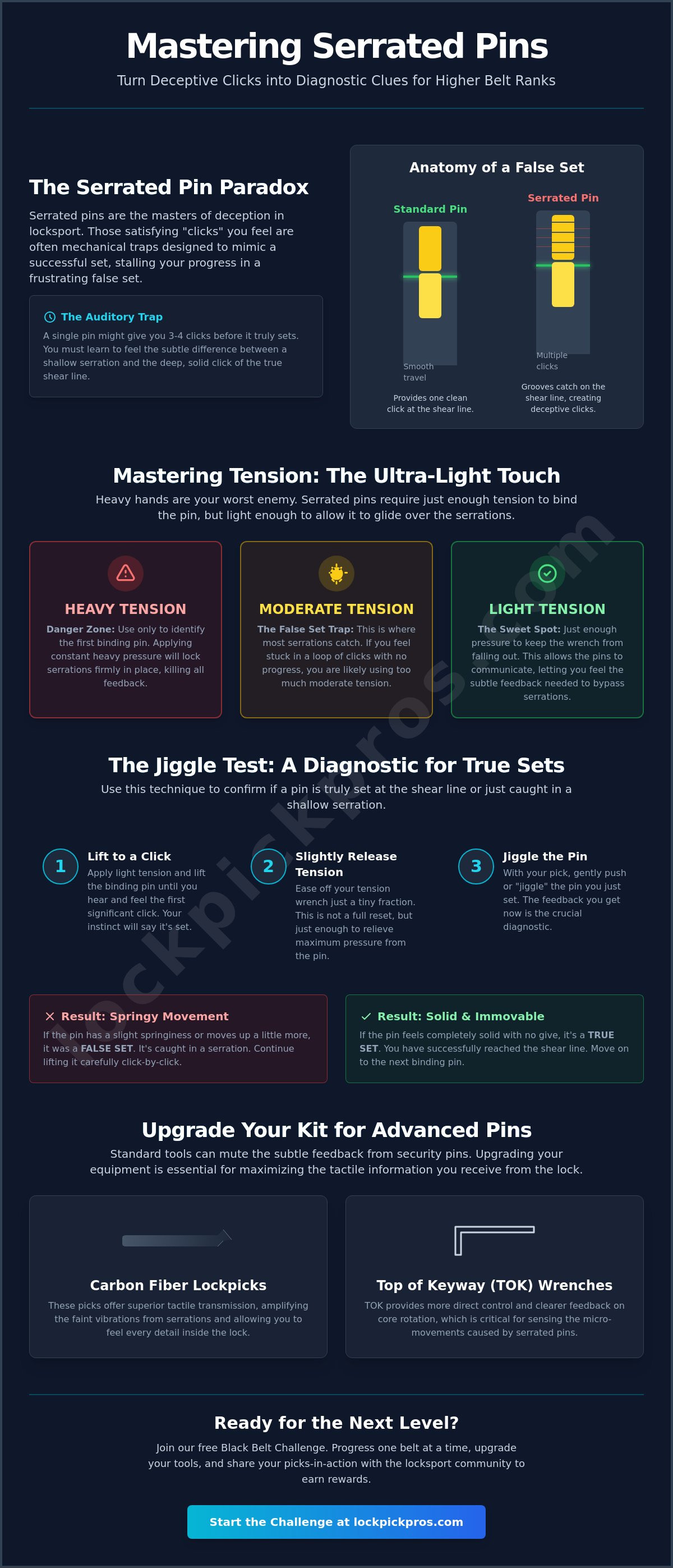
The serrated pin is the master of deception. Unlike a standard pin that moves smoothly until it hits the shear line, a serrated pin features tiny horizontal grooves cut into its circumference. These grooves are mechanical traps. When you are picking locks with serrated pins, these grooves catch on the edge of the plug. This creates a sharp click and a tiny bit of core movement that feels identical to a successful set. It sounds right. It feels right. But the lock stays shut. Understanding the fundamental mechanics of a pin tumbler lock is vital before tackling these advanced security features.
Serrated pins require a different mental model than spool pins. Spools are famous for counter-rotation; they physically push back against your tension wrench as you lift them. Serrated pins don't offer that feedback. Instead, they give you a series of false promises. In the locksport community, these pins are the gatekeepers of the Green Belt rank. Moving past them proves you've developed the "finesse" tension required for high-security locks. You can't bully these pins. If you try to force them, the serrations will simply bite harder into the shear line, stalling your progress and leaving you stuck in a perpetual false set.
Anatomy of a False Click
Visualizing the stack is the first step toward victory. In many high-security cylinders, both the driver pin and the key pin can have serrations. When you lift the stack, the plug rotates just a fraction of a degree as each groove passes the shear line. This is the "auditory trap." A single click doesn't mean the pin is set; it often means you've just moved to the next serration. You might hear three or four clicks before the pin actually reaches the true shear line. Ethical lockpickers learn to listen for the subtle difference in pitch and feel that signals a genuine set versus a trap.
Serrated Pins in Common Practice Locks
The American Lock 1100 series is the most famous example of this challenge. It's a favorite among hobbyists because it often contains a mix of serrated drivers and serrated key pins. Another excellent training tool is the Master Lock 410 LOTO. These locks are specifically designed to punish heavy-handed pickers. If you apply too much tension, the serrations will lock the pin stack so tightly that you won't feel any feedback at all. Before you start your next practice session, check out our Locksport Diagnostic Guide to help you identify these security features before you even insert your pick.
Mastering Tension: The Secret to Defeating Serrated Security Features
Tension is the heartbeat of locksport. While beginners often try to crank the wrench as hard as possible, picking locks with serrated pins requires a far more delicate touch. If you apply too much pressure, you're essentially pinning the serrations against the shear line with enough force to prevent them from ever moving. It's a common roadblock on the path to higher belt ranks. The secret lies in finding the sweet spot where the pin is held just enough to bind, but not so much that it's physically locked in place.
The choice between Top of Keyway (TOK) and Bottom of Keyway (BOK) tension wrenches is critical here. TOK is almost always preferred for serrated stacks because it provides much clearer feedback. When you use a TOK wrench, you're interacting more directly with the plug rotation. This allows you to feel those tiny micro-clicks as a Security pin moves through its serrations. You can also pulse your tension; this involves briefly letting off just a fraction of pressure to help a pin skip past a stubborn serration and reach the true shear line. To get the most out of these subtle vibrations, many experts prefer using Carbon Fiber Lockpicks for their superior tactile transmission.
Tension Adjustment Framework
- Heavy Tension: Use this only at the very beginning to identify which pin is binding first. Once you find it, back off immediately.
- Moderate Tension: This is the danger zone. Most serrations will catch here, giving you false clicks that feel like sets. If you're stuck, you're likely using moderate tension.
- Light Tension: The goal for serrated pins. It should be just enough to keep the wrench from falling out. This allows the pin to glide over the serrations until it hits the deep click of the shear line.
The Two-Finger Tension Technique
How you hold your tools determines how much you "hear" from the lock. Instead of using your whole hand, try placing only the tips of your index and middle fingers on the tension wrench. This reduces the amount of dampening your hand provides, letting the feedback travel clearly into your fingertips. Reducing friction within the plug is the only way to feel the difference between a pin that is truly set and one that is just caught on a groove. This technique also helps manage hand fatigue during long sessions. When you're working on high-security locks with multiple serrated stacks, keeping your grip light ensures you don't lose the "feel" of the lock after twenty minutes of picking.
The Jiggle Test: A Step-by-Step Diagnostic for Serrated Pins
Once you've mastered your tension, you need a reliable way to verify if a pin is actually set or just trapped. This is where the Jiggle Test becomes your best friend. When picking locks with serrated pins, you can't trust your ears alone. You need to feel the state of the pin stack through your pick. This diagnostic process is a standard technique for those pursuing higher belt ranks because it removes the guesswork from complex security stacks. It's the most effective way to determine if you've actually reached the shear line.
- Step 1: Apply light tension. Use your hook to probe the stack and find the pin that feels the most resistant. This is your binding pin.
- Step 2: Lift the binding pin slowly. You'll hear a single, sharp click. Stop your upward movement immediately.
- Step 3: Perform the Jiggle Test. Place the tip of your pick on the pin and tap it lightly with almost zero upward force.
- Step 4: Analyze the feedback. Does the pin feel rigid and immobile, or does it have a tiny bit of vertical "play"?
- Step 5: If it's rigid, it's still binding on a serration. Lift it again until the next click and repeat the test until the pin feels springy.
Interpreting Pin Feedback
Learning to read the "language" of the pins is what separates trainees from experts. A "Dead" pin is completely immobile; it's the current binder and needs to be lifted. A "Clicky" pin might move slightly but hits a hard stop almost immediately. This indicates the pin is trapped on a serration and isn't finished yet. Your ultimate goal is the "Springy" pin. A set pin will have a very small amount of free movement, often described as a "bounce." This happens because the key pin is no longer being pressed down by the driver pin at the shear line.
Auditory Cues and Click Counting
Sound is a helpful secondary indicator. Shallow serrations often produce a higher-pitched, metallic "tink." In contrast, a true set at the shear line usually results in a deeper, more muffled "thud." Be wary of "ghost clicks." These happen when you accidentally drop a previously set pin while struggling with a stubborn serrated one. To catch these subtle signs, many pros use a carbon fiber pick to amplify micro-vibrations that plastic handles might dampen. This level of precision is often required for high-security hardware, such as the devices detailed in a Physical Security Equipment Guide, where advanced security pins are a standard defensive feature.
Common Mistakes and Over-Setting Traps
Over-setting is the silent killer of many successful opens. When you're picking locks with serrated pins, pushing a pin just a hair too high can ruin your entire progress. The most devious version of this is the serrated key pin. In standard locks, key pins are smooth. However, in high-security cylinders, key pins often have their own serrations. If you lift the key pin into the shear line, its serrations will catch. This makes you believe you've set the driver pin when you've actually over-set the stack. This mistake creates a "masking" effect. The over-set pin binds so tightly that you lose the ability to feel the binding order of any other pins in the lock.
Recovery doesn't always require a full reset. You can try the "Controlled Drop" technique. This involves slowly, almost imperceptibly, releasing tension. You're listening for a single, tiny click as the over-set pin drops back into the plug while hoping the other set pins stay in place. It's a high-stakes move that requires incredible finger control. Many trainees find that raking is a shortcut to failure with these locks. Raking provides zero feedback. It almost always forces serrated pins into an over-set state, essentially locking the plug against itself and ending your attempt.
Diagnostic: Is the Lock Over-Set?
You'll know you've over-set when the feedback goes "mushy." If the plug feels spongy and you can't find a single binding pin, you've likely pushed something too far. Try the "Ping" test. Flick your tension wrench lightly with your finger. If you don't hear the sharp, metallic rattle of pins vibrating, the stack is seized. At this point, a full reset is usually the fastest path back to a successful open. Don't let it discourage you; every reset is a lesson in tension control.
Managing Progressive Difficulty
Mastering these traps takes time. Start by pinning a practice lock with only two serrated stacks. This allows you to focus purely on the sensation of the serrations without getting lost in a five-pin mess. Once you're comfortable, graduate to the American Lock 1100. Community members often call this "Minesweeper" picking because one wrong move ends the run. To handle these tight tolerances, you'll need professional tools like those in our Pro Series Expansion. If you want the ultimate advantage in tactile feedback, upgrade your setup with the Carbon Fiber Gen 2 Pro Series picks to feel every micro-click before an over-set happens.
Upgrading Your Kit: Professional Tools for Advanced Security Pins
Standard picks are often too thick for high-security keyways. When you're picking locks with serrated pins, every thousandth of an inch matters. Most beginner sets use .025 inch steel, which can rub against the warding and dampen the feedback you need. Transitioning to thin-profile hooks, specifically those between .015 and .020 inches, allows you to navigate tight spaces without touching the sides of the plug. This clearance is essential for feeling the difference between a pin binding on a serration and one hitting the true shear line. You'll also want to diversify your hook profiles. A deep hook is necessary for reaching behind low-set pins, while a flat-top hook provides a more stable platform for lifting serrated stacks without slipping.
Material science plays a massive role in your success. While plastic or rubber handles are comfortable, they act as shock absorbers that soak up micro-vibrations. Carbon Fiber Lockpicks are the preferred choice for intermediate and advanced hobbyists because the material is incredibly rigid. This rigidity transmits the tiny "taps" and "clicks" of a serrated pin directly into your fingertips. Combined with a flat bar tension wrench for Top of Keyway control, these tools transform the lock from a mystery into a clear mechanical puzzle. TOK flat bars provide more room in the keyway and prevent the wrench from binding against the plug walls, which is a common issue with standard BOK tools.
The Trainee to Pro Roadmap
Every hobbyist starts somewhere. Most of our community members begin their journey with The Trainee 2.0, which is perfect for learning foundational skills. However, as you move toward Green and Blue belt locks, you'll need more specialized equipment. The Gen 2 Pro Max Stealth Edition is widely considered the gold standard for navigating complex security features. To keep your tools in peak condition, use a high-grit sandpaper to polish the sides of your picks. A mirror-like finish reduces friction and "drag," ensuring that the only thing you feel is the state of the pin stack.
Join the Black Belt Challenge
Ready to show the locksport community what you can do? Mastering serrated pins is a major milestone on the path to the prestigious Black Belt rank. We invite you to join our free Black Belt Challenge to track your progress and earn rewards. It's a simple "share-to-earn" loop. Just progress one belt at a time, upgrade your tools as the difficulty increases, and share your "picks-in-action" content on social media. When you tag us in your successful serrated pick videos, you help hit our community goals. Once the community reach goals are met, we release a bounty of rewards and exclusive gear for our active members. Join the challenge today and start your journey toward lockpicking mastery.
Earn Your Next Belt Rank Today
You've now unlocked the precise diagnostic techniques needed to stop guessing and start opening. By combining ultra-light tension with the technical "Jiggle Test," you can finally distinguish between a deceptive trap and a true shear line set. Remember that picking locks with serrated pins is a test of finesse rather than force. It's about listening to the metal and trusting your tactile feedback.
As you progress through the belt rankings, your equipment needs to keep pace with your growing skills. Our belt-ranking aligned guides and ethical locksport community focus ensure you have the support needed for every stage of your journey. Don't let standard tools dampen the micro-vibrations you've worked so hard to identify. Ready to prove your mastery? Join the Black Belt Challenge and Upgrade Your Kit with our precision carbon fiber tools. We can't wait to see your "picks-in-action" videos on social media as you claim your rewards. Keep practicing, stay ethical, and enjoy the click!
Frequently Asked Questions
How can I tell the difference between a spool pin and a serrated pin?
Spool pins provide distinct counter-rotation while serrated pins provide multiple sharp clicks. When you lift a spool, the core physically turns back against your wrench as the pin enters the shear line. Serrated pins just snap into the next groove without pushing back. This requires you to count clicks or perform the jiggle test to verify the state of the stack. Spools are about movement; serrations are about sound and resistance.
What is the best tension for picking locks with serrated pins?
Ultra-light tension is the gold standard for picking locks with serrated pins. You need just enough pressure to keep your wrench from falling out of the keyway. This feather-light touch allows the pins to jump over the serrations rather than binding them so tightly that they seize against the plug wall. If you feel no feedback, you're likely using too much force.
Why do I keep over-setting pins in my American Lock 1100?
Over-setting in the American Lock 1100 usually happens because of serrated key pins. These high-security locks often feature serrations on both the driver and the key pin itself. If you lift the key pin past the shear line, its grooves catch on the plug. This makes you think the pin is successfully set when you've actually pushed the stack way too far.
Do I need special picks to defeat serrated pins?
While not strictly mandatory, thin-profile hooks between .015 and .020 inches are highly recommended for advanced security pins. Standard .025 inch picks often drag against the keyway warding in tight locks. This friction masks the subtle tactile feedback needed to distinguish a serration click from a true shear line set. Professional tools ensure every vibration reaches your fingertips clearly.
What is the "Jiggle Test" in lockpicking?
The Jiggle Test is a diagnostic method used to confirm a pin's state by tapping it lightly with your pick. A set pin will feel springy with a tiny amount of free vertical movement. If the pin feels stiff or "clicky," it's still trapped on a serration and needs further lifting. This test is the most reliable way to avoid over-setting complex security stacks.
Can I rake a lock that has serrated pins?
Raking is generally ineffective against serrated pins and often leads to massive over-sets. Because raking lacks the precision of single pin picking, it forces multiple pins into their highest serrations simultaneously. This seizes the core and prevents the lock from opening. For these locks, single pin picking is the only consistent way to reach the true shear line.
Why does the plug rotate slightly but the lock wont open?
Slight plug rotation without an open indicates you're in a false set. When picking locks with serrated pins, this means one or more pins are trapped in a groove rather than resting at the shear line. You must probe the stack to find the binding pin and lift it until you hear the deeper click of a true set. This minor rotation is a sign you're close.
How many serrations are typically on a single pin?
Most security pins feature between two and four horizontal grooves depending on the manufacturer. For example, American Lock drivers typically have three deep serrations. This creates multiple "false clicks" that can easily trick a hobbyist who isn't carefully counting their progress. Each groove is a trap designed to stall your pick as you move toward the shear line.