

How to Tell if a Lock Has Security Pins: The Locksport Diagnostic Guide
Have you ever felt a definitive "click" and waited for the core to turn, only to find the plug still stubbornly stuck? It's the classic "false set" moment that every hobbyist faces when moving beyond basic practice locks. If you're currently exploring beginner lockpicking, you've likely felt that confusing mix of core rotation and a jammed cylinder. Understanding how to tell if a lock has security pins is the first real bridge toward mastering the community belt ranks and tackling high-security hardware.
We've all been there, and it's actually a great sign that your skills are advancing. This guide will show you how to read the subtle mechanical signals that your pick set selection is trying to send you. We'll teach you the precise physical feedback and mechanical cues used to identify spool, serrated, and mushroom pins. By the end of this diagnostic walkthrough, you'll have the confidence to turn those confusing clicks into successful opens.
Key Takeaways
- Master the "false set" to recognize exactly when a spool pin's narrow waist has crossed the shear line.
- Discover how to tell if a lock has security pins by analyzing the degree of plug rotation and specific counter-rotation feedback.
- Learn to distinguish between the sharp, singular clicks of spools and the multiple, gritty "false clicks" characteristic of serrated pins.
- Follow a professional 4-step diagnostic checklist to map out binding orders and identify security traps in unknown locks.
- Understand why upgrading to professional Carbon Fiber Lockpicks provides the feedback and precision necessary for high-belt mastery.
What Are Security Pins and Why Do They Exist?
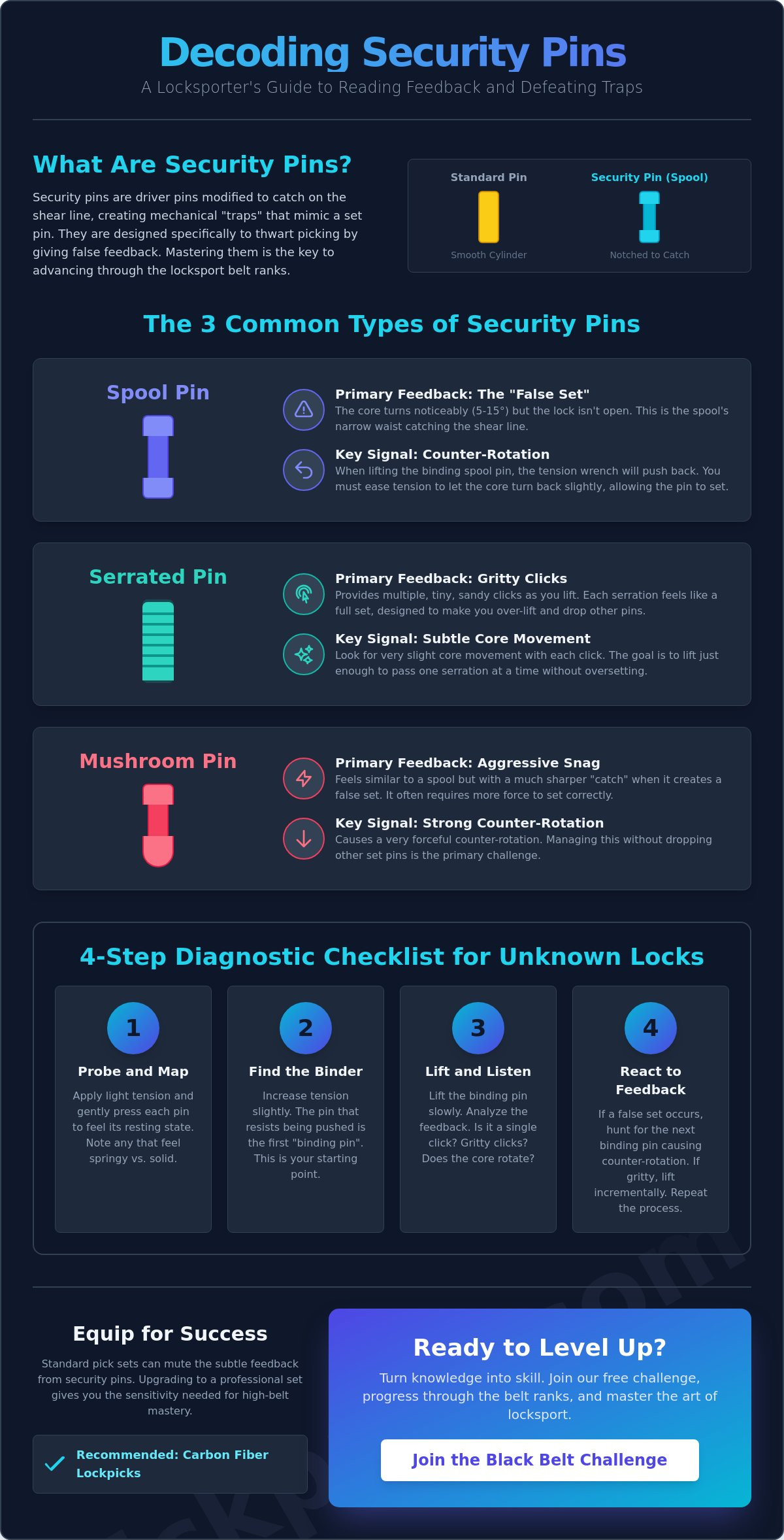
Security pins are the clever modifications that turn a simple lock into a genuine locksport puzzle. While a standard pin is a smooth, brass cylinder, a security pin is a driver pin that's been notched, grooved, or narrowed to catch on the shear line. Manufacturers don't include these to help the key work better. In fact, they have no impact on daily use. They are specifically designed to thwart non-key manipulation by creating mechanical "traps." These traps mimic the feeling of a set pin, but they actually block the plug from turning. It's a game of deception played between the lock manufacturer and the picker.
Once you move into Yellow Belt locks and beyond, you'll find these pins almost everywhere. Learning how to tell if a lock has security pins is the ultimate gatekeeper skill. It's the moment you stop guessing and start listening to the feedback through your tools. Understanding these pins is what separates a casual hobbyist from someone capable of opening high-security hardware.
The Role of the Driver Pin
To understand the trap, you need to visualize the pin tumbler lock mechanism in action. In a standard lock, the driver pin sits above the key pin. When you pick it, you push the driver pin entirely into the Bible, which is the upper part of the lock housing. Security pins change this physics. Because they have "waists" or "lips," they get caught on the edge of the plug. You think you've reached the shear line, but the pin is actually wedged in place. This prevents the open while giving you a false sense of progress.
Common Security Pins You'll Encounter
There are three main types you'll face as you progress through the belt ranks. Each one communicates through your pick in a different way.
- Spool pins: These look like a thread spool with a narrow center. They are the most common cause of a "false set," where the core rotates slightly but the lock remains closed.
- Serrated pins: These have tiny rings or grooves cut into them. They provide multiple, tiny clicks that feel exactly like setting a pin. It's a psychological trick to make you over-lift and lose your progress.
- Mushroom pins: These are a variation of the spool with a flared, mushroom-shaped top. They offer a very aggressive counter-rotation that can be tricky to manage without dropping other pins in the stack.
If you're just starting to feel these sensations, practicing on a clear or cutaway lock like The Trainee 2.0 is the best way to match your tactile feedback with visual proof. It's much easier to learn how to tell if a lock has security pins when you can actually see the spool catching on the edge of the plug while you feel that core movement.
The Dead Giveaway: Identifying a False Set
You're picking along, feeling standard resistance, and suddenly the core clicks and rotates significantly. You haven't reached the open yet, but the plug has turned about 5 to 15 degrees. Welcome to the false set. This is the most definitive way regarding how to tell if a lock has security pins, specifically spools. It happens because the narrow center, or "waist," of a security pin has fallen into the shear line. This allows the plug to rotate partially while the wider rims of the pin still block the actual open. It's a clever trap, but for a trained hobbyist, it's a massive clue about what's happening inside.
When you're in a false set, the feedback from the other pins changes. Most of the pins in the stack will feel unusually springy or completely loose, as if they've lost all tension. The one pin you actually need to find will feel trapped. It won't give you a standard click. Instead, it will resist your pick while simultaneously trying to move the core. If you see that significant plug rotation but the lock won't budge, you've successfully diagnosed the presence of spool or mushroom pins.
Counter-Rotation: The Secret Signal
Counter-rotation is the secret language of a spool, or mushroom pin. When you find the pin that's causing the false set and begin to lift it, you'll feel the tension wrench actually push back against your finger. The core wants to turn backwards toward the locked position. This is a critical moment in your progression toward higher belt ranks. Don't fight the movement. You have to "listen" through your tension wrench and carefully lighten your pressure.
The goal is to allow the core to rotate back just enough for the wide top of the pin to clear the shear line. If you maintain too much tension, you'll likely bend your pick or snap the pin back into a deeper trap. It's a delicate balance. You're essentially letting the lock reset itself slightly so the security pin can finally slide into the Bible where it belongs.
Differentiating False Sets from Standard Binding
Standard binding pins feel like a solid wall. When they set, they give a crisp, singular click, and the core stays exactly where it is. Security pins in a false set feel like they're actively fighting your tension wrench. A false set is the primary diagnostic for identifying spool pins in any lock. To catch these subtle core movements, you need tools that translate every vibration. Upgrading to a set like the Carbon Fiber Gen 2 Pro Series gives you the high-fidelity feedback necessary to feel that counter-rotation before you accidentally drop the whole stack. This tactile clarity is exactly how to tell if a lock has security pins when you're working with tighter tolerances in intermediate locks.
Mushroom vs. Serrated: Differentiating Feedback
Serrated pins are the subtle tricksters of the locksport world. While a spool pin gives you that obvious, satisfying core rotation, serrated pins are much more deceptive. They provide multiple, tiny clicks as you lift them toward the shear line. This creates a gritty sensation through your pick. If you're looking for how to tell if a lock has security pins that are serrated, listen for the "click-click-thud" pattern. The tiny clicks are the serrations catching, and the "thud" is the pin finally reaching the shear line or, more likely, over-setting because you applied too much force.
Mushroom pins are the aggressive cousins of the spool. They induce a false set just like spools, but the counter-rotation is much more pronounced. Because the "head" of the mushroom is flared, it creates a more violent kickback against your tension wrench. Most security modifications happen to the driver pins because they are the primary obstacle for Single Pin Picking (SPP). Understanding these mechanical interactions is a core part of the MIT Guide to Lock Picking, which remains a foundational resource for hobbyists learning to decode complex feedback.
Picking Locks with Serrated Pins
Heavy tension is usually your worst enemy when dealing with serrated stacks. If you crank on the wrench, those tiny grooves will bite into the plug and refuse to move. You'll just keep clicking until you've over-set the pin and trapped it in the Bible. Try the "jiggle test" instead. A truly set pin will have a tiny bit of springy movement, while a pin caught on a serration will feel rock solid. Using a standard hook from The Trainee 2.0 is perfect for this stage. The feedback is crisp and unmasked, helping you learn to distinguish a false click from a real set.
Defeating the Spool and Mushroom Trap
When you're stuck in a false set, you need to master "pulsing" tension. Don't just let go of the wrench. Slowly ease your pressure while applying steady upward force with your pick. You'll feel the core try to rotate back. This is where high-quality tools shine. Advanced picks like the Carbon Fiber Gen 2 Pro Series enhance your tactile sensitivity. The rigid material transmits those tiny vibrations that tell you exactly when the pin is about to clear the trap. Learning how to tell if a lock has security pins becomes much easier when your tools aren't dampening the signals the lock is trying to send you.
The 4-Step Diagnostic Checklist for Unknown Locks
Every lock is a conversation. When you're diving into beginner lockpicking, you need a reliable roadmap to decode the internal secrets of a new keyway. This checklist is your definitive guide for how to tell if a lock has security pins when you don't have the luxury of a clear practice lock. Applying the right pick set selection is only half the battle; you must also listen to the feedback through your tension wrench to map the belt ranks accurately.
- Step 1: Probe for binding order. Apply light tension and move your pick through the stack. Identify which pin resists movement first.
- Step 2: Note false clicks. As you lift the binder, listen for multiple tiny clicks. This "gritty" feedback is a classic indicator of serrated pins.
- Step 3: Watch the core. If the plug rotates 5 to 15 degrees after a click, you've hit a "false set," which is the definitive signal for spool pins.
- Step 4: Perform the jiggle test. Test every pin you think you've set. A pin at the shear line will have a tiny bit of springy play, while a trapped security pin feels rock solid.
Technical Breakdown: Master Lock 140
The Master Lock 140 is a staple for those moving through the early belt ranks. It features a 4-pin stack consisting of one standard pin (usually at position 1) and three spool pins. To open it, apply medium Bottom of Keyway (BOK) tension. Use a standard short hook from The Trainee 2.0. First, set the standard binder at pin 1 to drop the lock into a false set. Once the core rotates, probe pins 2, 3, and 4 to identify which one provides counter-rotation. Lighten your tension slightly as you lift the spool to clear the shear line without dropping your previous sets.
Technical Breakdown: Master Lock 410 LOTO
The 410 LOTO is a significant step up in beginner lockpicking, often categorized as a Green Belt lock. It contains a 6-pin stack with five spools and one serrated pin (usually at position 5). This lock has a "dead core," meaning there's no spring tension on the plug. Use Top of Keyway (TOK) tension and a slim, high-reach hook from the Carbon Fiber Gen 2 Pro Series. Start by finding the serrated binder at pin 5. You'll hear multiple clicks before it sets. Once set, the lock will fall into a deep false set. Carefully hunt for counter-rotation on the remaining five spools, being extremely careful not to over-rotate the core, which can "rattle" the lock and dump the pins into the bottom of the housing.
Mastering these practice locks is the fastest way to refine your tactile sensitivity. If you're ready to prove your skills and earn rewards for your progress, join our free Black Belt Challenge. Upgrade your tools at each tier, share your "picks-in-action" on social media, and help us reach our community bounty goals! For more brand-specific difficulty rankings, check our guide on how to choose your first beginner lock pick set.
Equipping for the Security Pin Challenge
Mastering the theory of counter-rotation is a massive milestone, but your gear needs to keep up with your growing expertise. Learning how to tell if a lock has security pins is only half the battle. You also need tools that can communicate that information accurately to your fingertips. Standard beginner picks often feature thicker profiles and softer steel. While these are great for learning the basics on White Belt locks, they often lack the "reach" or tactile "feel" required for deep security pins in restrictive, paracentric keyways. When you're fighting a stubborn spool pin, you need a pick that won't flex or dampen the feedback.
Tension is your primary way of communicating with the lock core. As you move into intermediate and advanced tiers, the choice between Top of Keyway (TOK) and Bottom of Keyway (BOK) Tension Wrenches becomes critical. TOK tension is generally preferred for security pins because it leaves the entire bottom of the keyway open for your pick. This prevents your tools from rubbing against each other and masking the subtle counter-rotation signals you're looking for. Professional-grade steel tools with thinner profiles allow you to navigate tight spaces without accidentally over-setting adjacent pins.
The Pro-Series Edge
If you're finding that your current tools feel "mushy" when you hit a false set, it's time to look at the Gen 2 Pro Max Stealth Edition. These tools are engineered for maximum feedback. The rigid construction ensures that every tiny vibration from a serrated pin or a mushroom head travels directly to your hand. Long "spool-fights" can be taxing on your grip, which is why carbon fiber handles are a game changer. They significantly reduce hand fatigue while maintaining high tactile sensitivity. For those targeting high-security locks with complex pin stacks, the Pro Series Expansion provides the specialized profiles needed to reach those high-cut pins hiding behind deep security traps.
Join the Black Belt Challenge
The journey from a trainee to an expert-level picker is a path of constant skill refinement. Ready to prove your skills to the community? Sign up for our free Black Belt Challenge. This is the ultimate ranking reference for ethical lockpickers. The progression is simple: join the challenge for free, progress one belt at a time, and upgrade your tools as the difficulty increases. We love seeing our community in action. Share your "picks-in-action" content on social media to earn exclusive rewards. We even have a community bounty for hitting social reach goals to foster engagement and support new hobbyists. Check out our guide on Mastering the Advanced Lock to see exactly what's waiting for you at the higher tiers. Your journey toward mastery starts with knowing how to tell if a lock has security pins, and it ends with the satisfying turn of a Black Belt core.
Ready to Conquer Your Next Belt Rank?
You now have the diagnostic roadmap to identify spools, serrated pins, and mushroom heads by feel alone. You've learned that a false set isn't a failure but a massive clue. Mastering how to tell if a lock has security pins is the defining moment in your locksport progression. It turns a frustrating click into a clear mechanical signal that you're ready for the shear line. By using the 4-step diagnostic checklist, you'll stop guessing and start picking with true technical precision.
Precision-engineered for locksport feedback, our tools are used by ethical lockpickers worldwide to master sequential challenges. Whether you're chasing your Green Belt or aiming for the top, having the right gear makes every session more rewarding. Take the Black Belt Challenge and Upgrade Your Kit! We've designed our sequential tools for every belt rank to ensure you always have the reach and feel required for high-security success. Keep practicing, stay ethical, and we'll see you at the next rank.
Frequently Asked Questions
How can I tell if a Master Lock has security pins?
You can identify security pins in a Master Lock by checking the model number and testing the core's movement. Entry-level models like the No. 3 or No. 1 use standard pins. However, intermediate locks like the Master Lock 140 usually contain at least one spool pin. If you feel the core rotate significantly without the lock opening, you've found a security pin.
What is the difference between a spool pin and a serrated pin?
The primary difference is the shape and the tactile feedback they provide during picking. Spool pins have a narrow center that causes the core to rotate into a false set. Serrated pins have multiple tiny grooves that produce several small, gritty clicks. While spools try to trick you with core movement, serrated pins deceive you with false "set" sensations.
Why does the lock core turn a little bit but then stop?
This phenomenon is called a false set, and it's the most common way regarding how to tell if a lock has security pins. It happens when the narrow waist of a spool pin falls into the shear line. The plug rotates partially, but the wider top of the pin prevents a full open. It's a definitive sign you're dealing with spool or mushroom pins.
Do all high-security locks have security pins?
Most high-security locks incorporate security pins, but they often use additional complex mechanisms as well. While security pins are a standard defense, advanced locks frequently add sidebars, telescopic pins, or rotating discs. Security pins are usually just the first layer of protection you'll encounter as you progress toward higher belt ranks in the locksport community.
Can I pick security pins with a beginner lock pick set?
You can certainly pick security pins with a beginner set, though it's more challenging. Beginner tools are typically thicker and can dampen the subtle vibrations you need to feel. As you move into intermediate locks, upgrading to professional-grade tools will provide the tactile clarity required to master counter-rotation and deep false sets without accidentally dropping your progress.
What is counter-rotation and how do I feel it?
Counter-rotation is the core's attempt to turn back toward the locked position as you lift a trapped pin. You'll feel this through your tension wrench as it pushes back against your finger. This is a critical signal telling you to lighten your tension. It allows the wide portion of a spool pin to slide past the shear line and into the Bible.
Is it possible to have both spool and serrated pins in the same lock?
Yes, many intermediate and advanced locks mix different types of security pins to increase difficulty. Locks like the American 1100 often feature both serrated drivers and serrated spools in the same stack. This creates a complex diagnostic environment where you'll experience both gritty false clicks and deep false sets during a single picking session.
How do I know if I've overset a security pin?
An overset security pin will feel rock solid and completely immobile under tension. If you were in a false set and it suddenly vanishes without the lock opening, you've likely pushed a pin too high. A correctly set pin will have a tiny amount of springy "jiggle," while an overset pin feels like it's jammed against a wall.