

Mushroom Pin Picking Techniques: Mastering Security Pins in 2026
What if the reason you keep dropping set pins isn't your pick choice, but a fundamental misunderstanding of the tapered edges inside your lock? Many hobbyists mistake the subtle feedback of a mushroom pin for a standard spool, leading to the dreaded "false-false set" and a total reset of the pin stack. It's a common hurdle when you're moving into the intermediate belt ranks, but it doesn't have to be a source of frustration. By refining your mushroom pin picking techniques, you can turn these mechanical traps into predictable milestones.
This guide promises to transform your approach through expert feedback recognition and the specialized pulse-tension technique favored by high-ranking locksport pros. We'll explore the mechanical differences between mushroom and spool pins, providing the technical clarity you need to defeat high-security cylinders like the Abus 82/70. Whether you're aiming for your next belt or just want to focus on skill refinement, you'll gain the precision required to feel every counter-rotation and earn your place among the experts in the community. Let's master the subtle art of security pins together.
Key Takeaways
- Learn to distinguish the tapered geometry of mushroom pins from standard spools to avoid the "mushy" feedback trap.
- Master specialized mushroom pin picking techniques like pulse-tension to navigate counter-rotation without dropping your set pins.
- Discover why thin 0.015" or 0.018" Carbon Fiber lockpicks are essential for transmitting the subtle vibrations needed for high-security feedback.
- Identify the specific practice locks, such as the Abus 72/40 and Master Lock 410 LOTO, that will help you earn your Green and Blue belt ranks.
Mushroom Pin vs. Spool Pin: Understanding the Geometry
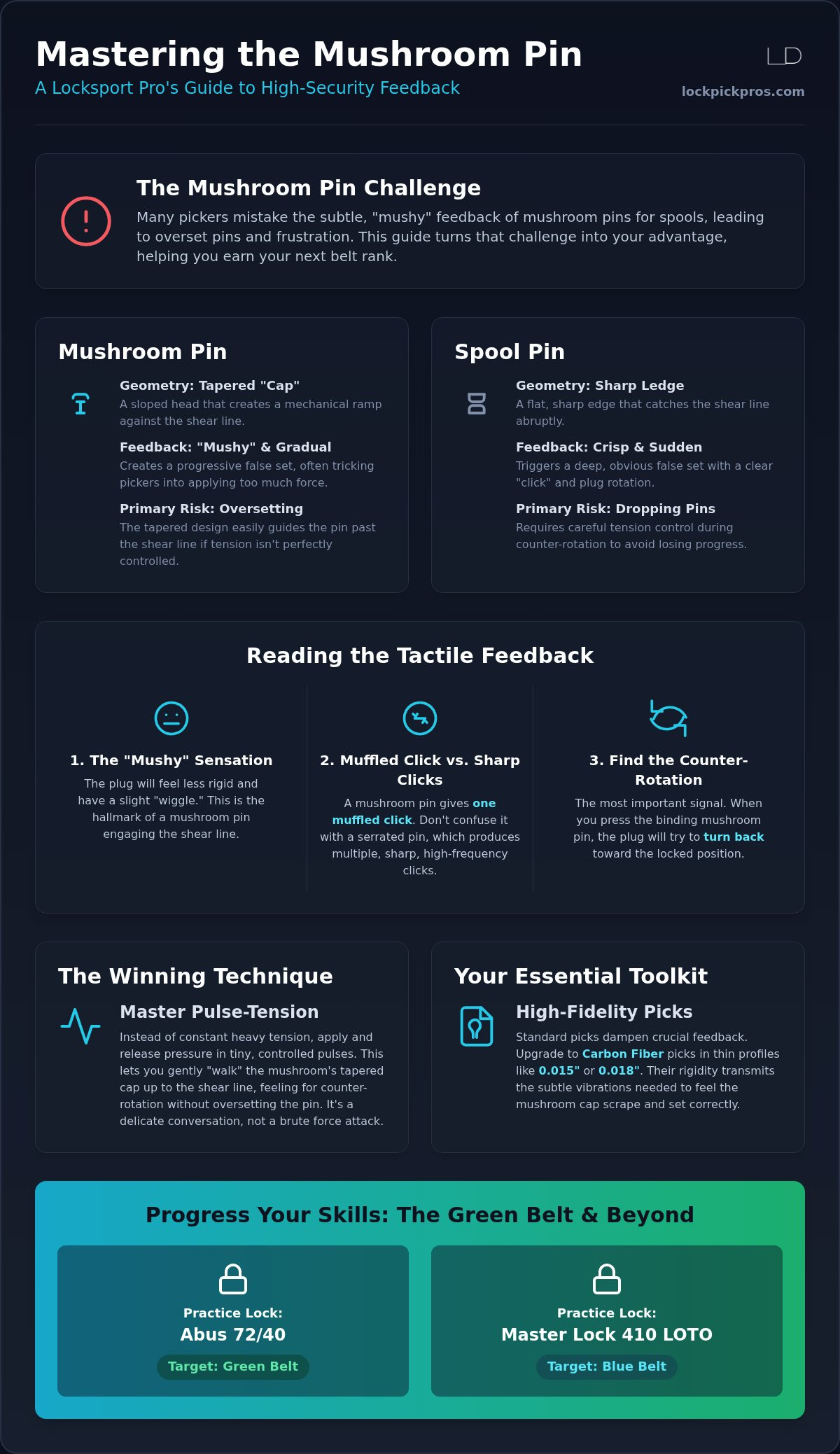
Mushroom pins are a unique challenge in the locksport community. While many newcomers group them with spool pins, the mechanical reality is quite different. A spool pin features a flat, sharp ledge that catches the shear line abruptly. In contrast, the mushroom pin utilizes a tapered "cap" that leads into a thinner "stem." This specific geometry changes everything about how the lock talks back to you. Understanding these shapes is the first step in mastering advanced mushroom pin picking techniques.
The tapered head interacts with the Pin tumbler lock mechanism in a way that creates a "progressive" false set. Instead of a sudden, deep rotation of the plug, you feel a gradual shift as the pin moves. This makes the feedback feel "mushy" compared to the crisp stop of a spool. The physics of the shear line are less about a hard catch and more about a sliding trap. The mushroom's taper allows the plug to rotate deeper and deeper as you move the pin, which often tricks pickers into oversetting.
Mechanical Differences and Shear Line Interaction
Visualize the tapered head as it enters the shear line. As you apply tension, the slope of the mushroom head wedges against the edge of the plug. This creates a mechanical ramp. If you apply too much force, the taper guides the pin right past the shear line into an overset position. The driver spring tension plays a vital role here. It provides the resistance you need to feel the edge of that cap before it slips too far. Mastering this requires a delicate touch that recognizes the difference between a pin that is setting and one that is simply sliding up a slope.
Identifying the Pin in the Stack
How do you know you're dealing with a mushroom? Look for specific tactile signatures. You will often feel a distinct "slop" or wiggle in the plug that feels less rigid than the feedback from standard pins. There is often a light, distinctive "click" when the head of the mushroom passes the shear line, but the plug won't give you a full open immediately. Using a Mastering the Advanced Lock approach helps you map these pins early in your picking session. To feel these tiny vibrations, professional tools like the Carbon Fiber Gen 2 Pro Series are essential. The rigid handle material transmits the subtle scraping of the mushroom's taper that traditional plastic handles often dampen.
Recognizing the False Set and Feedback
A false set is your first sign of progress when tackling security pins. It happens when the narrower stem of the driver pin crosses the shear line, allowing the plug to rotate a few degrees. While a spool pin usually drops you into a deep, sudden rotation, mushroom pins trigger a more gradual shift. This is where many hobbyists get confused. Because of the tapered cap we discussed in the previous section, the plug feels less rigid. It wiggles. This "mushy" sensation is the hallmark of a mushroom pin waiting to be set.
Identifying which pin is binding during a false set is the core of effective mushroom pin picking techniques. You aren't just looking for a pin that won't move. You're looking for the one that causes counter-rotation. When you press on the correct pin, the plug will actually try to turn back toward the locked position. If a pin feels rock solid and offers no movement or counter-rotation, it's likely already trapped on the mushroom head or overset. Learning to read these subtle movements is a skill that separates intermediate pickers from the pros.
Tactile Feedback Analysis
To master this, try the "pencil lead" test. Imagine the vibrations traveling through your pick like a pencil scratching on paper. The MIT Guide to Lock Picking explains that tactile feedback is a conversation between the pin and your hand. You need to feel the taper of the mushroom cap sliding against the cylinder walls. If you use standard plastic handles, this conversation is often muffled. Upgrading your gear to Carbon Fiber Lock Picks allows those high-frequency vibrations to reach your fingertips with much higher fidelity.
Common Misidentifications
Don't fall into the "click trap." Beginners often mistake the single click of a mushroom cap for the multiple clicks of a serrated pin. A serrated pin will give you several tiny, sharp clicks as it moves. A mushroom pin usually gives one muffled click followed by that signature mushy counter-rotation. If your tools are too thick or lack precision, they might mask these differences entirely. Using a professional locksmith tool kit ensures your hooks are thin enough to reach the back of the keyway without bumping other pins, which keeps your feedback clean. To truly feel the difference in your next practice session, consider the enhanced feedback of the Carbon Fiber Gen 2 Pro Series picks.
Step-by-Step Mushroom Pin Picking Technique
Mastering the physical movements required to defeat these pins is a major milestone in your locksport journey. Once you've identified the "mushy" feedback, you need a repeatable process to move the pin past the shear line without losing your progress. These mushroom pin picking techniques rely on a delicate balance between your tension hand and your pick hand. Follow these steps to refine your approach.
- Step 1: Establish a light-to-medium tension. You want enough pressure to bind the pins but not so much that you seize the plug. This helps you find that initial, shallow false set.
- Step 2: Probe each pin slowly. Look for the specific pin causing counter-rotation. Your tension wrench should move slightly against your finger as you lift the binder.
- Step 3: Ease off your tension pressure slightly. At the same time, apply steady upward pressure on the pin. You're creating space for the tapered cap to slide.
- Step 4: Use the "Pulse" method. This involves tiny, rhythmic releases of tension. It allows the pin to "dance" past the mushroom head.
- Step 5: Re-tension quickly. As soon as you feel the pin clear the shear line, increase your tension to lock it in place and prevent other pins from dropping.
The Pulsing Tension Method
The pulse method is the controlled release of tension to bypass tapered security features. It's a foundational skill for high-ranking pros. Instead of a static hold, you modulate your finger pressure in tiny increments. This prevents the "all-or-nothing" drop that happens when you let go of tension completely. After you think the pin is set, perform a "Jiggle Test." Gently tap the pin. If it feels springy or has a slight rattle, it's successfully set at the shear line. If it feels rock hard, you've likely overset it and need to pulse again to let it drop back down.
Advanced Hook Placement
Standard hooks can sometimes struggle with the tight tolerances found in high-security locks. If you have a low-setting pin in front of a deep mushroom pin, a standard hook might bump the front pin and cause an overset. Deep hooks are essential for reaching behind the stack. The "Rock and Roll" technique is also helpful for wide mushroom heads. This involves slightly tilting your pick tip to "roll" the pin up the ramp of its own taper. Leveraging tools like the Pro Series Expansion set gives you the variety of profiles needed for these precise reaches. These thinner, specialized hooks provide the clearance required to navigate complex keyways while maintaining clear feedback.
Tool Selection for High-Security Feedback
Your tools act as the bridge between your fingertips and the internal mechanics of the lock. When applying advanced mushroom pin picking techniques, the quality of your equipment directly dictates how much information you receive from the pin stack. Standard, bulky picks often mask the subtle vibrations of a mushroom's tapered cap. To master these security features, you need a kit designed for high-fidelity feedback and precision movement.
Pick thickness is your first consideration. In high-security cylinders with tight tolerances, a standard 0.025" pick often drags against the warding, creating "noise" that hides the counter-rotation you're looking for. Professional pickers prefer 0.015" or 0.018" picks. These thinner profiles provide the necessary clearance to navigate restricted keyways while maintaining enough rigidity to lift heavy driver springs. Combined with a flat-top hook, which provides a larger surface area to "feel" the mushroom's ramp, these tools make identifying binder pins significantly easier.
Tension wrench selection is equally vital. Top of Keyway (TOK) tension is almost always superior for security pins. Unlike Bottom of Keyway (BOK) wrenches, TOK tools don't bind against the plug walls or block your pick's path. This clear access allows you to apply the pulsing tension method with much greater control. By removing the friction of a BOK wrench, you can feel the exact moment the mushroom head clears the shear line.
The Carbon Fiber Advantage
The material of your pick handle plays a massive role in vibration transmission. Traditional plastic or rubber-dipped handles tend to dampen the high-frequency "clicks" and "scrapes" of security pins. The Carbon Fiber Gen 2 Pro Series solves this by using a rigid, lightweight handle that amplifies counter-rotation signals. This allows you to detect the "mushy" feedback of a mushroom pin much earlier in the picking process. Pros choose high-yield steel for the business end because it offers the perfect balance of durability and sensitivity, ensuring your tools don't flex and give you false readings.
Recommended Specialty Profiles
Specific profiles can give you a mechanical advantage. The Gem profile, with its slight point, is excellent for precise pin placement on the center of a mushroom head. If you're dealing with extremely restricted keyways, the Gen 2 Pro Max Stealth Edition offers the reach and thinness required for surgical precision. For those just starting their locksport journey, we recommend mastering the basics with The Trainee 2.0 before moving on to complex security pins. Ready to elevate your game? Upgrade your feedback today with the Carbon Fiber Gen 2 Pro Series.
Progressing Your Skills: The Green Belt and Beyond
Successfully navigating your first mushroom pin is more than just a win; it's your entry ticket to the intermediate tiers of locksport. In the 2026 belt ranking standards, mastering these tapered pins is often the key to securing your Green or Blue belt. Locks like the Abus 72/40 and the Master Lock 410 LOTO are community favorites for this stage. They offer a perfect training ground to apply your new mushroom pin picking techniques in a real-world scenario. These locks require the precise tension control you've been practicing to avoid dropping the entire pin stack.
One vital step in your skill refinement is "gutting" your practice locks. Once you get that plug to turn, don't just reset it. Use a pinning tray and followers to take the lock apart. Seeing the actual mushroom pins inside confirms that what you felt during the pick, the mushy feedback and the counter-rotation, matches the physical reality of the pin stack. This verification loop builds the deep muscle memory you'll need for even tougher challenges. It's a satisfying way to prove your technical understanding of the mechanism.
The Black Belt Challenge
Are you ready to show the community what you've learned? You can join the Lockpick Pros Black Belt Challenge for free today. It's a structured way to track your progress from Trainee to Expert-level. To earn your next rank, you'll need to record a clear, continuous video of your pick. Make sure your lighting is bright and the lock stays in the frame the entire time. We love seeing our members succeed, which is why we've created a share-to-earn loop. Post your "picks-in-action" content on social media, tag us, and hit community reach goals to earn rewards like high-yield picks or exclusive gear. There's even a community bounty for those who help grow the sport through their content.
Sequential Mastery Roadmap
Mushroom pins are just the beginning of your journey. As you move toward Blue belt and beyond, you'll encounter serrated pins, complex dimple locks, and the legendary rotation of Medeco cylinders. Understanding the tapered feedback of a mushroom pin gives you a foundational advantage for these advanced mechanisms. For a full breakdown of the path ahead, check out our Lock Picking Belt Levels Explained guide. It maps out exactly which locks and tools you need for every milestone. Join our community of ethical lockpickers, share your progress, and start your journey to Black Belt today!
Level Up Your Locksport Journey
Mastering the tapered geometry of the mushroom pin is a major milestone for any ethical lockpicker. You've learned how to distinguish the mushy feedback of a mushroom cap from the sharp catch of a spool and how to apply the pulsing tension method to navigate those ramps. Refining your mushroom pin picking techniques is about more than just opening one lock; it's about developing the precision and tactile sensitivity required for the Green Belt and beyond. By understanding the mechanical interaction at the shear line and choosing tools that amplify every vibration, you're setting yourself up for long-term success in the hobby.
Our Precision Carbon Fiber Series is used by ethical lockpickers worldwide to tackle these high-security challenges with confidence. Don't let a "false-false set" hold you back from your next ranking. Take what you've learned here, apply it to your practice locks, and join a community of passionate hobbyists dedicated to skill refinement. Join the Black Belt Challenge and Upgrade Your Gear! You'll get a free Black Belt Challenge entry with your purchase to help you track your progress. Keep practicing, stay ethical, and we'll see you at the next belt level!
Frequently Asked Questions
What is a mushroom pin in lockpicking?
A mushroom pin is a specialized security driver pin with a tapered head and a thinner stem. This geometry is designed to trigger a false set, which makes the picker believe the pin is at the shear line when it's actually trapped on the pin's ramp. It's a classic security feature that adds a layer of complexity to standard pin tumbler locks.
How do I tell the difference between a mushroom pin and a spool pin?
You can distinguish them by the specific feedback they provide during counter-rotation. Spool pins usually drop the plug into a deep, sharp false set with crisp movement. Mushroom pins feel "mushy" because of their tapered edges, providing a more gradual rotation as you lift the pin toward the shear line. The sensation is less about a hard stop and more about a sliding ramp.
Why do I keep dropping other pins when I try to set a mushroom pin?
You're likely releasing too much tension during the counter-rotation phase. When the mushroom head fights back, it's tempting to let go of the tension wrench completely. This causes previously set pins to fall back into the plug. Mastering the pulse-tension method is the best way to maintain just enough pressure to keep the stack stable while clearing the security pin.
What tension is best for picking mushroom pins?
Light-to-medium tension is ideal for finding the initial binder and entering the false set. Constant heavy pressure will seize the tapered head against the cylinder wall, which masks the feedback you need. Successful mushroom pin picking techniques rely on your ability to modulate this pressure, easing off just enough to allow the pin to "dance" past the shear line without losing your progress.
Can I pick mushroom pins with a standard beginner lock pick set?
You can pick them with basic tools, but beginner sets often have thicker profiles that dampen the feedback. Thicker metal scrapes against the keyway, creating "noise" that hides the subtle vibrations of the mushroom's taper. Upgrading to professional carbon fiber handles will amplify these signals, making it much easier to feel the counter-rotation required for intermediate and advanced locks.
What happens if I overset a mushroom pin?
An overset occurs when you push the key pin and driver pin too far into the Bible. The plug will feel rock solid, and you'll lose all tactile feedback on that specific pin. Because mushroom pins are tapered, they are actually easier to overset than spools. If this happens, you'll usually need to release tension slightly to let that pin drop, though this often resets other pins in the stack.
Are mushroom pins common in residential door locks?
They are less frequent than standard pins but appear in many high-security residential cylinders and padlocks. Brands like Abus and Yale often use them to increase pick resistance. While you might not find them in every hardware store deadbolt, they are a staple challenge for hobbyists moving into the intermediate belt ranks of the locksport community.
How do I earn my Green Belt in the locksport community?
You earn your Green Belt by picking and gutting a qualified lock, such as the Abus 72/40, on video. This rank demonstrates that you can handle security pins and understand the internal mechanics of the cylinder. Recording your progress for the community is a great way to verify your skills and get feedback from more experienced mentors as you work toward your Black Belt.