

Lock Picking Tools: 2026 Beginner's Guide to Locksport
Most people think lockpicking is a skill reserved for the movies, but it's actually a fast-growing community of ethical hobbyists known as locksport. You've probably asked yourself, "what tools do I need to start lock picking" after seeing a cheap, flimsy set online that looks like it would snap in a stiff breeze. It's frustrating to feel excited about a new challenge only to be met with technical jargon or low-quality gear that hinders your progress. We understand that starting out can feel intimidating, especially when you're worried about the legality or just don't want to waste money on tools that won't last through your first practice session.
We're here to help you earn your first White Belt and start your journey with total confidence. This guide cuts through the noise to reveal the essential, high-quality tools every trainee needs to succeed. You'll discover how to build a foundational kit that lasts, starting with our specialized Trainee 2.0 starter sets. We'll also break down the difference between single pin picking and raking so you can pick your first lock today. By the end, you'll have a clear roadmap to mastering the basics and joining a community that celebrates every successful click of a pin.
Key Takeaways
- Identify exactly what tools do I need to start lock picking by focusing on the essential "Big Three": a tension tool, a short hook, and a triple peak rake.
- Start your journey toward a White Belt with the Trainee 2.0 kit, specifically engineered to build the muscle memory and precision required for ethical locksport.
- Master the "Ethical Lockpicker" code of conduct and use clear practice locks to gain an "X-ray" view of pin stacks in action.
- Learn why "thin" isn't always better and how to avoid heavy-handed tension that masks the feedback you need to feel for a successful pick.
- Join our Black Belt Challenge to follow a structured roadmap that rewards your progression from your first Master Lock #3 to expert-level mastery.
Your White Belt Foundation: The Essential Starter Kit
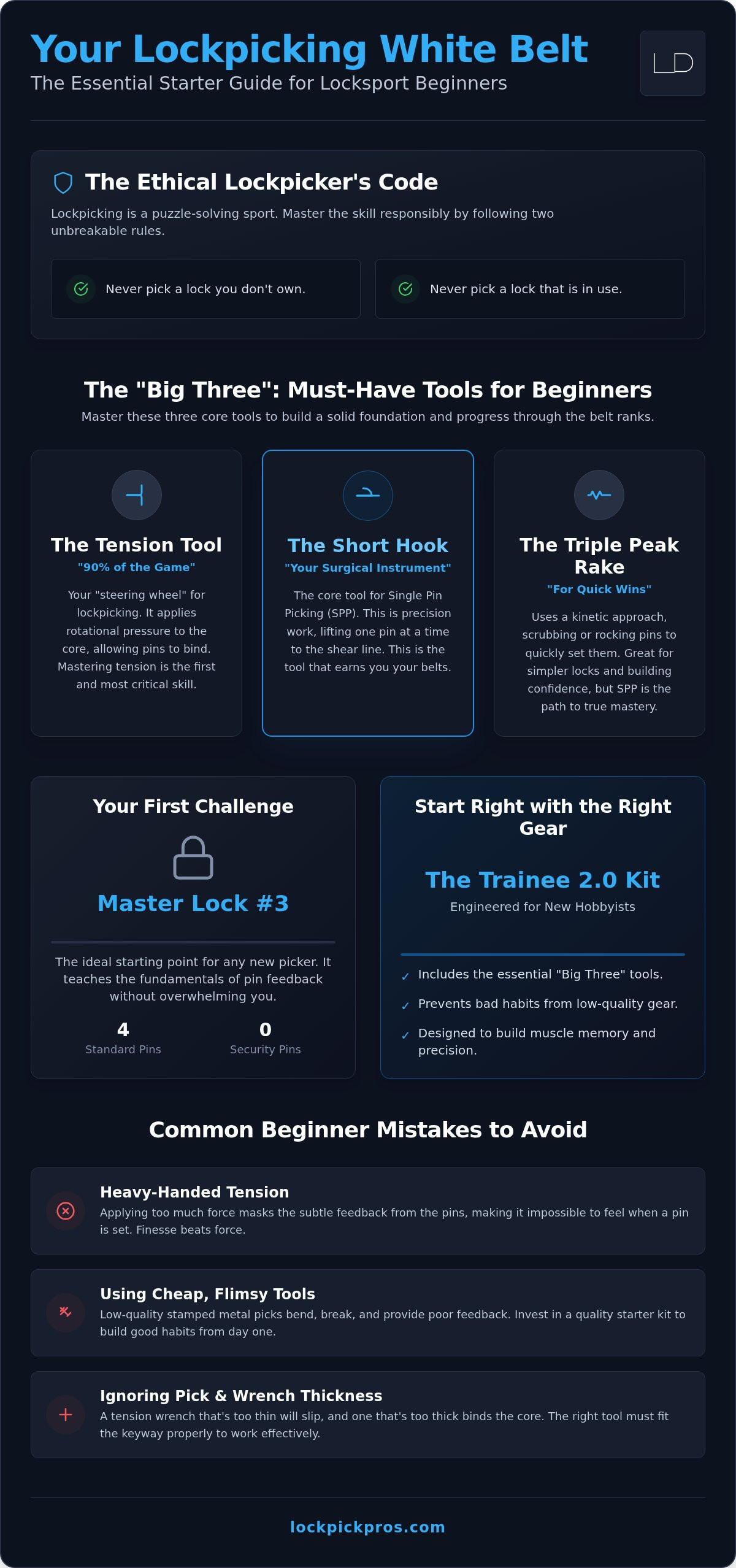
Starting your locksport journey is like entering a new gym. You need the right gear to train properly. Many beginners ask "what tools do I need to start lock picking" and end up with a bag of cheap, stamped metal that snaps on the first pin. A solid foundation consists of three things: a tension tool, a hook, and a rake. These are the building blocks of every picker's kit. Without these three, you're just guessing in the dark.
Starting with a dedicated kit like The Trainee 2.0 is vital. It prevents the bad habits that come from using oversized or poorly finished tools. In the locksport community, we focus on the "White Belt" mindset. This means you aren't just trying to get the lock open. You're learning to listen to the feedback the lock gives you. While picking is an essential skill for the legitimate profession of locksmithing, for us, it's a puzzle to solve. Ethical picking starts with two rules. Never pick a lock you don't own, and never pick a lock that is in use. Buy your own practice locks, like a Master Lock #3, to build your skills safely. This lock features a standard four-pin stack with no security pins. Use a standard hook and light tension. Simply apply tension, find the binding pin, lift it until it clicks, and move to the next until the core turns.
The Role of the Tension Wrench
Tension is 90% of the game. Without it, the pins just fall back down. You'll encounter Bottom of the Keyway (BOK) and Top of the Keyway (TOK) tools. BOK is common for beginners. It involves placing the wrench at the bottom where the key's teeth usually go. TOK often provides better feedback and more room for your pick. It sits at the top, right where the pins are. Learning to feel that binding pin through the wrench is your first real hurdle. Your tension tool is your steering wheel. It tells you where the lock is going.
Hook Picks vs. Rake Picks
Hooks are for Single Pin Picking (SPP). This is surgical work where you lift one pin at a time. It's the core of the sport. Rake picks are different. They use a kinetic approach. They vibrate or scrub the pins to find the shear line quickly. While raking feels great for a fast win, every trainee needs a Standard Hook to truly progress through the belt ranks. If you're still wondering "what tools do I need to start lock picking" to reach the higher tiers, remember that the hook is your most important ally. It's the tool that will earn you your first official belt.
Building this foundation isn't about having a hundred picks. It's about having high-quality tools that you understand deeply. When you feel that first click of a binding pin, you'll realize that lockpicking is about finesse, not force. Focus on the feedback, respect the ethics, and let your tools do the talking. Ready to start your journey? Join our free Black Belt Challenge today. Progress through the tiers, upgrade your gear, and share your success with the community to earn exclusive rewards.
The Big Three: Must-Have Tools for Every Beginner
Standing at the threshold of the locksport world is exciting, but the sheer variety of gear can be overwhelming. You're likely wondering, "what tools do I need to start lock picking" without filling a drawer with useless scrap. The answer lies in the "Big Three." These aren't just gadgets; they're extensions of your hands. Mastering them is the fastest way to move from a curious observer to a belted hobbyist.
The Standard Short Hook is your primary instrument for the White and Yellow belt tiers. It allows for Single Pin Picking (SPP), where you manipulate each pin individually. This is the "surgical" approach that builds true skill. For those moments when you want a quick win, the Triple Peak Rake is your go-to. It's the most effective beginner-friendly rake for kinetic picking, using a scrubbing motion to find the shear line. Finally, a Universal Tension Set is non-negotiable. Keyways come in different widths. A wrench that's too thin will slip, while one that's too thick will bind the core. You need multiple thicknesses to adapt to every lock you encounter. Don't overlook handle ergonomics. If your hand cramps after ten minutes, you won't develop the finesse needed for higher ranks. Comfortable grips allow for longer practice sessions and better control.
Why Material Quality Matters in 2026
In 2026, the debate between steel and carbon fiber is settled by performance. While spring steel is a classic choice, the Carbon Fiber Gen 2 Pro Series offers a massive advantage in sensitivity. Carbon fiber transmits vibrations more efficiently than metal, allowing you to "hear" the lock through your fingertips. Avoid "pot metal" tools from generic marketplaces. They bend under pressure and muddy the signals the lock is trying to send you. High-quality materials ensure your tools last as long as your passion for the hobby.
Anatomy of a Professional Grade Pick
A professional pick has a smooth profile with no burrs or sharp edges. This prevents the tool from snagging on the warding inside the keyway. Handle design is equally critical. Grips like those found in the Stealth Edition provide a non-slip surface for precise movements. Feedback is the distinct vibration felt through the tool when a pin successfully hits the shear line. For a deeper technical dive into these mechanics, the MIT Guide to Lock Picking remains a gold standard for understanding tool interaction. If you want to feel every click with maximum clarity, upgrading to the Carbon Fiber Gen 2 Pro Series is a natural next step for any serious trainee.
Setting Up Your Practice Station: Locks and Environment
Creating your practice space is just as important as the picks you hold. Before you dive into the mechanics, you must commit to the Two Golden Rules of locksport: never pick a lock you don't own and never pick a lock that is currently in use. Damaging a door lock can leave you stranded or facing expensive repairs. It's also vital to understand the legal landscape, so check the state-by-state laws on lock pick possession to ensure you're practicing within the law. Once you've cleared the ethical hurdles, you can focus on the fun part: picking your first core.
Clear acrylic practice locks are the ultimate "X-ray" for your brain. They let you see exactly how the pins react to your tension and pick placement. While these don't provide the same tactile feedback as metal locks, they are essential for understanding the internal mechanics of a pin tumbler system. As you gain confidence, you'll want to transition to metal "cutaway" locks. These offer a realistic feel while still allowing a peek at the pin stacks. This progression is a core part of the Lock Picking Belt Levels, where each tier introduces more complex security features.
You've likely wondered, what tools do I need to start lock picking without cluttering my desk? Your practice station should be lean and focused on the next belt rank. As you move from clear plastic to real metal, your tool requirements will evolve. For your White Belt, you'll focus on standard pin stacks. As you move toward Yellow and Orange, you'll need higher precision tools to handle tighter tolerances and more restrictive keyways.
Your First Target: The Master Lock #3
This lock is the universal graduation ceremony for White Belt seekers. It features a standard four-pin stack with relatively wide tolerances and no security pins. To get your first open in seconds, use a Triple Peak Rake. Apply light tension and scrub the pins with a rhythmic motion. Once you've felt that satisfying turn of the core, switch to Single Pin Picking (SPP). Identify each of the four pins. Start from the back, find the one that resists movement (the binding pin), and lift it until you hear a click. Repeat this until the lock opens.
Organizing Your Gear for Progression
Protecting your investment is key to long-term success. A dedicated carrying case prevents your pick tips from bending or snagging when not in use. We also recommend keeping a "picking journal." Documenting which pins bind first or how much tension a specific lock requires helps turn luck into skill. For a deeper look at your gear, read our guide on What is in a Beginner Lock Pick Set? to ensure your station is fully equipped for the journey ahead.
Common Mistakes: Why Beginners Fail (and How Tools Help)
Every trainee eventually hits a wall where a lock simply won't budge. Most of the time, this isn't due to a lack of talent; it's a lack of finesse. The most frequent mistake is heavy-handedness. When you apply "Heavy Tension," you bind the pins so tightly that they can't move freely to the shear line. This brute force masks the subtle vibrations you're trying to feel. Instead of a clear, satisfying click, you'll just feel a jammed core. Learning to lighten your touch is the first real step toward your Yellow Belt.
Another common hurdle involves pick selection. You might ask, "what tools do I need to start lock picking to avoid breaking my gear?" The answer isn't necessarily the thinnest pick on the market. While .015 "slim" picks are excellent for restrictive European keyways, they're often too fragile for a beginner's hands. Starting with a .025 pick provides the stability you need to learn pin placement without bending your tools. Neglecting tool maintenance is also a silent killer of accuracy. A pick with even a slight bend won't hit the center of the pin, leading to missed sets and unnecessary frustration.
Many hobbyists fall into the "Scrubbing" trap. Raking is a fantastic way to get a quick open on a White Belt lock, but relying on it exclusively will stall your progress. To advance through the community ranks, you must master Single Pin Picking (SPP). Raking is like using a shotgun, while SPP is like using a scalpel. If you don't develop the ability to feel individual pins, you'll never defeat the security pins found in higher-tier locks.
The 'Feedback' Problem
Feedback is the language of the lock. High Yield Lockpicks are specifically engineered to translate pin movement directly to your fingertips. Beginners should always start with wider .025 picks to build foundational sensitivity before moving to .015 "slim" picks. The extra thickness helps you identify the "Ghost Click" associated with spool pins. These security pins create a false set, where the core turns slightly but remains locked. High-quality tools help you feel the counter-rotation required to set these pins and earn your next belt.
Oversetting Pins: The Beginner's Curse
Oversetting happens when you push a driver pin too far past the shear line, causing it to bind the plug. It's a frustrating mistake because the lock feels "stuck" for no apparent reason. You can use your hook pick to "feel" an overset pin; it will feel completely rigid with no springiness at all. Oversetting is often caused by pick-heavy tension. By focusing on light tension and precise pick placement, you'll avoid this curse and progress much faster through the ranks.
To avoid these common pitfalls and sharpen your sensitivity, we recommend upgrading to the Carbon Fiber Gen 2 Pro Series for superior feedback.
The Roadmap to Mastery: Join the Black Belt Challenge
Mastering the art of locksport isn't about luck or brute force. It's about a structured progression that turns a curious trainee into an expert. If you're still asking what tools do I need to start lock picking, the answer starts with your first official rank. The journey to the legendary Black Belt begins with a single click and a solid plan to improve your skills one tier at a time. This roadmap is designed to guide you through the community ranks while providing the tools you need to succeed at every level.
Your first step is securing high-quality foundational gear. We recommend starting with The Trainee 2.0. This kit provides the precision and feedback needed to tackle your White Belt graduation lock: the Master Lock #3. This lock features a standard four-pin stack with no security pins, making it the perfect entry point. Once you've successfully picked it, record your open and share it with the locksport community to claim your first rank and join the ranks of belted pickers.
As your skills sharpen, you'll eventually reach the Green Belt tier. This is a significant milestone where security pins like spools and serrated pins become the standard. These pins are designed to give false feedback and trap your pick. To defeat these advanced internal mechanics, you'll want to upgrade to the Pro Series Expansion. This set offers the varied profiles and thinner gauges required for more restrictive keyways and complex pin stacks.
The Share-to-Earn Rewards Program
We believe in rewarding progress and fostering a supportive community. Our Share-to-Earn program allows you to document your journey and earn store credit as you level up. By recording your successful picks and sharing them, you can earn exclusive gear and discounts. We also feature a "Community Bounty" where reaching collective social milestones unlocks site-wide discounts on high-security tools. Remember, being an "Ethical Lockpicker" is the core requirement for all rewards. We only celebrate those who practice the craft legally and responsibly on locks they own.
Your Next Milestone: The Yellow Belt
After you've conquered the White Belt, your next target is the Yellow Belt. For this rank, we recommend the ABUS 64TI/30 or Brinks Brass padlocks. The ABUS uses a Titalium body that provides unique acoustic feedback, while the Brinks often contains a spool pin to test your ability to identify false sets. If you're wondering what tools do I need to start lock picking for these specific challenges, the Carbon Fiber Special set is the answer. These picks offer the sensitivity required to feel the subtle counter-rotation of a spool pin, allowing you to set it without dropping other pins in the stack.
The path to mastery is open to anyone with patience and the right gear. Each belt you earn represents a new level of understanding and a more refined touch. Don't rush the process; enjoy the challenge of every new lock you encounter. Join the Black Belt Challenge today and claim your free starter roadmap!
Master the Click and Earn Your First Belt
Your journey into the world of ethical lockpicking is just beginning. By now, you know that success isn't about force; it's about the delicate feedback between your pick and the pins. You've learned how to avoid the common pitfalls of heavy tension and why starting with a dedicated practice station is vital for your progress. If you're still wondering what tools do I need to start lock picking, remember that quality always beats quantity. A focused kit with a standard hook, a triple peak rake, and reliable tension wrenches is all you need to defeat your first Master Lock #3.
Join over 10,000 ethical lockpickers who are already climbing the ranks in our Black Belt Challenge. We stand behind our gear with a 100% satisfaction guarantee on all trainee sets, ensuring you have the support you need to succeed. For those who want the most sensitive feedback possible, our precision-engineered Carbon Fiber Series is designed to transmit every tiny movement within the keyway. It's time to stop watching from the sidelines and start hearing those satisfying clicks for yourself. Start Your Journey: Grab The Trainee 2.0 Starter Kit and take your first step toward mastery today. We can't wait to see your first open!
Frequently Asked Questions
Is it legal to own lockpicking tools in the United States?
It's legal to own these tools in the vast majority of U.S. states. The law generally focuses on intent. If you're using them for ethical locksport on your own property, you're usually in the clear. However, some states have specific prima facie evidence rules regarding their possession. Always check your local statutes before carrying tools in public. We focus on the Ethical Lockpicker code to keep the hobby safe.
What is the difference between a rake and a hook pick?
Rakes and hooks serve completely different purposes. A rake is a kinetic tool used to scrub or jiggle multiple pins into place quickly. It's great for fast opens on low-security locks. A hook is a precision tool used for Single Pin Picking (SPP). When you're figuring out what tools do I need to start lock picking for skill building, the hook is your most important asset for long-term mastery.
Do I need a license to become a locksport hobbyist?
You don't need a license to enjoy lockpicking as a hobby. Professional licenses are required for locksmiths who perform commercial services or security installations for the public. As a locksport enthusiast, you're practicing a skill on your own hardware for personal satisfaction. It's a legitimate sport, not a professional service. Just ensure you follow the community rules and keep your practice ethical and legal.
Can I use these tools to open my own house if I'm locked out?
You should never use your hobby tools on a lock you rely on for security. Picking a lock can cause internal damage, such as bending a spring or scratching the plug. If you're locked out, call a professional locksmith. Locksport is about picking locks that are not in use. Stick to your practice station to avoid a costly door repair or an accidental permanent lockout.
Which lock pick material is best for beginners: Steel or Carbon Fiber?
High-yield steel is the standard because it's durable and takes a lot of abuse from new hands. However, carbon fiber is the gold standard for feedback. It transmits vibrations from the pins to your fingertips much more clearly than metal. Beginners often start with steel picks to learn the basics without worrying about breakage. Once you understand tension, moving to carbon fiber will help you reach higher belt ranks faster.
What is the 'Belt Ranking System' in the lockpicking community?
The Belt Ranking System is a community-driven roadmap that tracks your skill progression. It starts at White Belt for beginners and goes all the way to Black Belt for master pickers. Each level requires you to pick locks of increasing difficulty. To earn a belt, you usually need to submit a video of your pick to a community moderator. It's a fantastic way to stay motivated and measure your growth.
Do I need to buy a practice lock, or can I use any old padlock?
While any old padlock can work, a dedicated practice lock is much better for learning the basics. Clear acrylic or metal cutaway locks allow you to see the pins move. This visual feedback is crucial for building the mental model of how a lock works. Old, weathered locks often have rust or debris inside that can mask the feedback you need to feel, making the learning process harder.
How long does it take to learn how to pick your first lock?
Most people can pick their first simple padlock in under thirty minutes. With a clear practice lock and a basic hook, you'll understand the mechanics almost immediately. The real challenge is developing the muscle memory and sensitivity to handle security pins and tighter keyways. While the first open happens quickly, the journey to becoming an expert-level picker takes months of dedicated practice and skill refinement.