

Carbon Fiber Lock Picks vs. Traditional Tools: The 2026 Upgrade Guide
What if the biggest obstacle to mastering high-security locks isn't your technique, but the material in your hand? Many hobbyists in the locksport community reach a point where standard steel or plastic-dipped handles just don't cut it anymore. You've likely felt the frustration of hand cramps during a long session or the struggle to distinguish a set pin from a false set. We agree that your tools should be an extension of your senses, not a barrier to them. In this guide, you'll discover why carbon fiber lock picks are the ultimate 2026 upgrade for enthusiasts looking to sharpen their tactile clarity. We'll preview the material science that reduces fatigue and the specific kits that match your rising belt rank. Before we get into the technical specs, make sure you join our free Black Belt Challenge. You can progress one belt at a time, upgrade your tools at each tier, and share your picks-in-action on social media to earn rewards. Let's dive into how carbon fiber transforms your feedback when picking high-security cylinders.
Key Takeaways
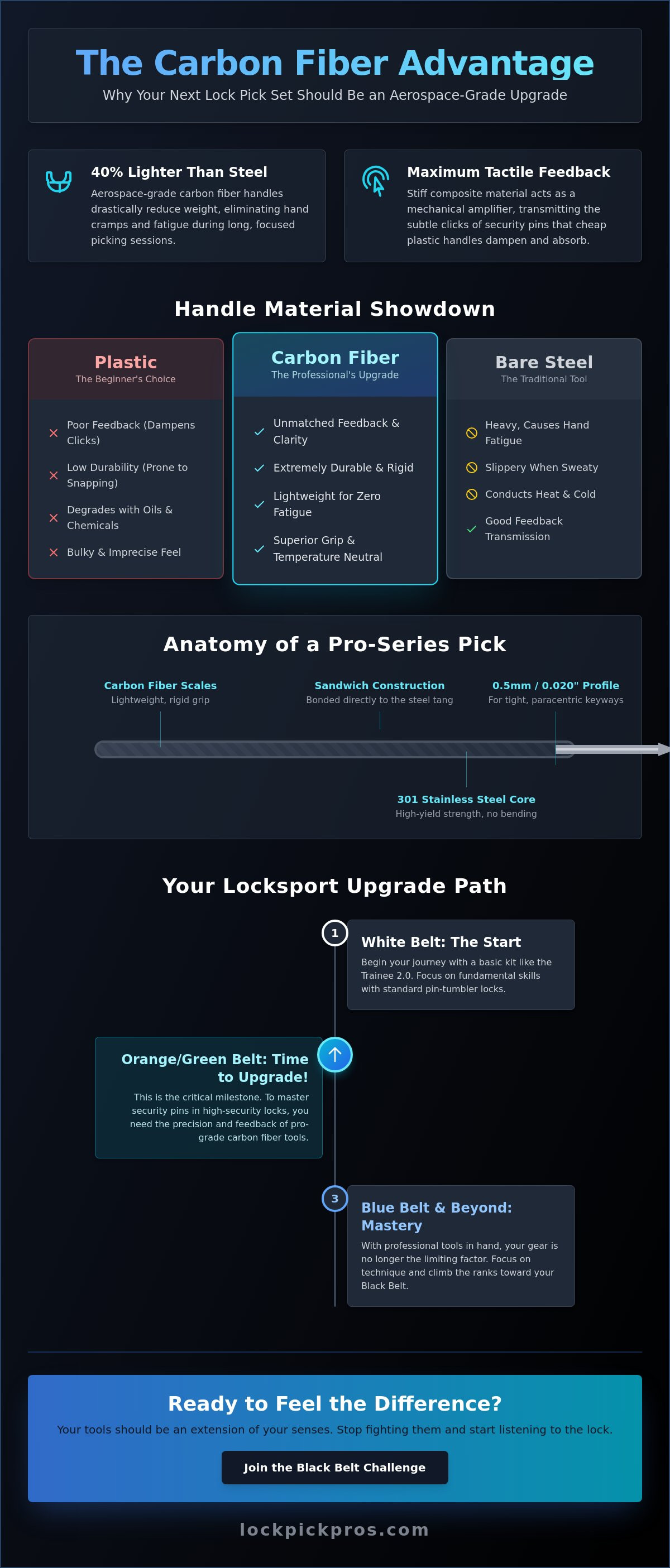
- Discover how aerospace-grade handles make carbon fiber lock picks 40% lighter than traditional steel tools, significantly reducing hand fatigue during marathon picking sessions.
- Learn why composite materials act as a mechanical amplifier, allowing you to feel subtle security pin feedback that plastic handles often dampen or absorb.
- Compare the long-term durability of professional-grade composites against cheap plastic handles that are prone to snapping or chemical damage.
- Identify the specific milestone in your locksport journey, typically around the Orange or Green belt rank, when upgrading your kit becomes essential for mastering high-security locks.
- Understand how precision-engineered tools from Lockpick Pros support your progression through the community belt ranking system while maintaining a commitment to ethical lockpicking.
What are Carbon Fiber Lock Picks and Why Do They Matter?
Carbon fiber lock picks are high-performance tools that replace traditional, heavy handles with aerospace-grade composite scales. While entry-level kits often rely on bare metal or dipped plastic handles, these advanced tools focus on maximizing the strength-to-weight ratio for precision manipulation. In the 2026 locksport community, we've seen a massive shift toward materials that provide superior tactile clarity. When you're working on a high-security lock, every bit of vibration counts. Traditional handles often act as a muffler, but carbon fiber serves as a conductor, translating the tiny movements of pins directly into your palm.
The primary goal of using carbon fiber lock picks is to eliminate the "dead" feeling common in cheaper tools. If you've ever felt like you were picking through a layer of foam, you've experienced the dampening effect of low-grade handle materials. Professional pickers need to distinguish between the subtle click of a set pin and the mushy resistance of a security pin. By utilizing materials originally designed for high-stress environments like aerospace engineering, manufacturers have created picks that are incredibly stiff yet surprisingly light.
The Anatomy of a Pro Series Carbon Fiber Pick
Precision starts with the core. Most professional-grade picks use a 301 or 304 stainless steel profile for the picking tip. These materials are chosen for their high-yield strength and resistance to permanent bending. The handle itself features a sophisticated sandwich construction. This is where two carbon fiber scales are bonded directly to the steel tang, creating a rigid and lightweight grip that won't flex under pressure. Because modern paracentric keyways are increasingly tight, these tools are often crafted with ultra-thin profiles of 0.5mm, or 0.020 inches. This allows the pick to navigate restricted spaces without losing the structural integrity needed to lift heavy pin stacks in high-security cylinders.
From Hobbyist to Athlete: The Evolution of Tools
The rise of Mastering the Sport has changed how we view our equipment. We no longer just pick locks; we train as locksport athletes. This evolution requires tools that match our rising skill levels. While a beginner lock pick set like the Trainee 2.0 is the perfect starting point for White Belts, moving into the intermediate tiers usually demands an upgrade to something more refined.
Switching to the Carbon Fiber Gen 2 Pro Series isn't just about the physical specs. There's a significant psychological benefit to using professional-grade equipment. When you hold a tool that feels balanced and responsive, your mental focus shifts. You stop fighting the tool and start listening to the lock. This transition marks the move from basic skill building to true mastery, where the tool becomes a natural extension of your intent. It's about having the confidence that your tools will never be the limiting factor in your progression toward that next belt rank.
Handle Material Comparison: Carbon Fiber vs. Steel vs. Plastic
Choosing the right handle material isn't just about aesthetics; it's about the physics of carbon fiber lock picks. Carbon fiber is roughly 40% lighter than equivalent steel-handled tools. This weight reduction drastically changes how the tool behaves in your hand. While cheap plastic handles are prone to "handle-snap" or degradation from skin oils and cleaning chemicals, carbon fiber is virtually indestructible in normal locksport conditions. Bare metal handles might seem durable, but they often become slippery when your hands sweat during a tense open.
The natural texture of carbon fiber provides a superior grip compared to the slipperiness of polished metal. It also solves the "temperature" factor that plagues many pickers. Unlike steel, which feels icy in the winter and uncomfortably hot in the summer, carbon fiber remains neutral to the touch. This consistency is vital when you're engaging in competitive lockpicking, where environmental comfort can be the difference between a successful open and a frustrated reset.
Weight Distribution and Balance
Balance is often overlooked by beginners. High-quality carbon fiber lock picks provide a "neutral balance" by shifting the center of gravity toward the middle of your grip. A bare steel pick is naturally front-heavy because the mass is concentrated in the shaft and tip. This imbalance can lead to over-setting pins because the weight of the pick itself adds unintended pressure. This equilibrium is especially important for single pin picking (SPP), where you need surgical precision. While front-heavy tools might work for aggressive "scrubbing" or raking, they lack the finesse required for high-security cylinders with tight tolerances.
Ergonomics and Hand Fatigue
The science of repetitive strain is a real concern for serious hobbyists. If a handle is too thin, you're forced into a "death grip" just to maintain control. This tension travels up your arm and causes hand cramps. Carbon fiber scales increase the handle diameter to a more ergonomic size without adding significant mass. The non-slip surface means you can use a lighter touch, which actually improves your ability to feel what the pins are doing. Reduced tool weight allows for longer practice sessions without losing the precision required for high-security locks. If you're ready to feel the difference for yourself, consider testing out the Carbon Fiber Gen 2 Pro Series for your next session.
The Feedback Advantage: Feeling Security Pins with Precision
Feedback is the secret language of locksport. It is the stream of vibrations traveling from the pin stack, through your pick, and into your fingertips. When you use standard tools with soft, dipped handles, that language gets muffled. Soft plastic and rubber act as shock absorbers, soaking up the very micro-vibrations you need to interpret. In contrast, carbon fiber lock picks function as rigid conductors. They don't just transmit energy; they amplify it. This amplification is a game-changer when you step up to Green Belt challenges where the difference between a "click" and a "crunch" determines your success.
The American Lock 1100 is a masterclass in why this tactile clarity matters. This Green Belt staple features a 5-pin stack usually loaded with serrated key pins and a combination of serrated and spool driver pins. To successfully open an 1100, follow these technical steps:
- Pick Choice: Use a 0.018" or 0.020" medium hook to navigate the paracentric keyway.
- Tension Level: Apply feather-light tension. If you press too hard, the serrations will bind and lock the pins in place.
- Step 1: Probe the stack to find the first binder. It'll feel "crunchy" due to the serrations.
- Step 2: Lift the pin slowly. You'll feel multiple tiny clicks. A slightly deeper, more resonant click usually indicates the pin has reached the shear line.
- Step 3: If the core rotates slightly into a false set, you've encountered a spool. Hunt for the pin providing counter-rotation.
- Step 4: Ease off tension slightly while lifting the spool until it clicks into place.
Identifying Spools, Serrated, and Mushroom Pins
Mastering the jump from Orange to Green belt requires a refined sense of touch. You need to distinguish between a "true set" and a "false set," which is a trap set by spool pins. When a serrated pin clicks, it sends a sharp, high-frequency vibration through the pick. A spool pin, however, produces counter-rotation, a subtle feeling of the lock core wanting to turn back against your tension. High-definition feedback is the only reliable way to succeed when mastering the advanced lock and its complex security features.
Vibration Transmission Physics
The reason carbon fiber excels is rooted in material science. As detailed in academic research on Carbon Fiber vs. Steel vs. Plastic, rigid materials transmit energy with far less loss than flexible ones. High-tensile strength allows the handle to remain perfectly stiff even when you are applying leverage. While steel is also rigid, the composite nature of carbon fiber allows for a specific density that resonates beautifully with the frequencies produced by brass pins. We define tactile resonance as the state where every mechanical movement inside the keyway is translated into a clear, unmistakable signal in the picker's hand. Using carbon fiber lock picks ensures that your acoustic connection to the lock remains undisturbed by damping materials.
Selecting Your Carbon Fiber Kit Based on Belt Ranking
Not every lock requires aerospace materials. If you're just starting your journey into beginner lockpicking, your focus should be on foundational tensioning and basic pin movement. At the White and Yellow belt stages, practice locks with clear acrylic or cutaway housings are your best friends. Tools like The Trainee 2.0 are perfect here because they're forgiving and durable. Using carbon fiber lock picks too early can be counterproductive; you need to learn what a standard pin feels like through basic steel before you can fully appreciate the amplified feedback of high-end composites.
The Orange and Green belt ranks represent the "Sweet Spot" for your first major gear upgrade. This is where locks start featuring security pins designed to trick your senses. To progress, your pick set selection needs to shift toward tools that offer tactile clarity. The Carbon Fiber Gen 2 Pro Series turns the muffled signals of a spool pin into a clear, unmistakable conversation between the lock and your hand. Investing in professional tools now prevents the frustration of outgrowing your gear just as the challenges get interesting.
The Intermediate Transition (Orange & Green)
For pickers tackling the Master Lock 150 (Orange Belt), the Carbon Fiber Special is the perfect bridge. This lock features a 5-pin stack with four spools and one standard pin. Use a 0.020" Short Hook and light tension. First, find the standard binder to drop the core into a false set. Once the core rotates, probe the remaining pins for counter-rotation, indicating a spool. Slowly lift while easing tension until you feel the set.
The Abus 55/40 (Orange/Green) is slightly more technical due to its tighter paracentric keyway. It uses a 4-pin stack, typically with three spools. We recommend a 0.018" Short Hook and light-to-medium tension. Start by locating the standard pin (often pin 1) to get your false set. The feedback through the carbon fiber handle is vital here, as the spools in the Abus are notorious for dropping other pins if your tension isn't perfectly controlled. If you want to explore other methods, check out our Locksmith Bypass Guide for non-SPP alternatives.
Professional and Black Belt Aspirations
As you move toward Blue, Purple, and eventually Black belt status, the locks become exponentially more difficult. You'll encounter paracentric keyways so tight a standard pick won't even enter. This is where the Pro Series Expansion becomes a necessity. These kits offer thinner profiles in 0.015" and 0.018" thicknesses for navigating restricted spaces. The Gen 2 Pro Max Stealth Edition is specifically designed for these high-security cylinders, featuring custom tension tools vital for delicate counter-rotation.
Our community thrives on progression. Participate in our "Share-to-Earn" loop by posting your "picks-in-action" content on social media. It's a great way to stay motivated as you work through the ranks. By sharing your successful opens, you can earn rewards that help fund your next tool upgrade. If you're ready to take that next step, upgrade to the Carbon Fiber Gen 2 Pro Series today and feel the difference for yourself.
Mastering the Sport with Lockpick Pros Carbon Fiber Series
Lockpick Pros stands as the only manufacturer providing genuine, aerospace-grade handles specifically for the locksport community. While generic brands might use "carbon-style" coatings or cheap plastic imitations, our 2026 line uses authentic composite layers. These materials are chosen for their unique ability to transmit energy without the dampening effect found in mass-produced tools. Every set of carbon fiber lock picks we produce undergoes rigorous testing to ensure it meets our standards for precision engineering. We don't just sell tools; we provide the equipment necessary for you to master the art of ethical lockpicking.
Our commitment to the community goes beyond the materials we use. We design our picks based on direct feedback from hobbyists and professional pickers who demand more from their gear. This community-led design process ensures that every hook, rake, and tension tool serves a specific purpose in your journey toward mastery. We back every purchase with a satisfaction guarantee because we believe your tools should be as reliable as your skills. Whether you are just starting out or are a seasoned expert, our tools are built to help you push the boundaries of what's possible in the sport.
Join the Black Belt Challenge
The ultimate goal for any enthusiast is reaching the top of the ranking system. We created the Black Belt Challenge to provide a clear, community-led progression path. It is free to join and encourages you to progress one belt at a time, building your confidence alongside your tool kit. This isn't just about individual practice; it's about being part of a larger movement of ethical pickers. You can earn exclusive rewards by participating in our "share-to-earn" loop. Just capture your "picks-in-action" on social media and tag the community to start earning.
We also feature a community bounty for hobbyists who help us hit specific social reach goals. This fosters engagement and ensures that the sport continues to grow in a positive, legal, and transparent way. By sharing your successful opens and your struggles with difficult cylinders, you help newcomers learn while earning credit toward your next professional gear upgrade. It is a cycle of learning and reward that keeps the passion for locksport alive. For enthusiasts who want to see how other professional platforms handle service-based rewards, you can explore Marketplace Transaction Commission Fees to understand the structure of the ModFilesMarket tuning community.
The Lockpick Pros Difference
Our tools are designed by pickers, for pickers. We understand the hand cramps that come from long sessions and the frustration of missing a subtle counter-rotation signal. That's why our carbon fiber series focuses on ergonomics and tactile clarity above all else. The Carbon Fiber Special serves as the perfect starting point for your professional journey, offering a curated selection of profiles that handle over 90% of common locks. It is the bridge between being a trainee and becoming a true locksport athlete. If you are ready to stop fighting your tools and start listening to the lock, it is time for an upgrade. Upgrade your gear and start the Black Belt Challenge today!
Elevate Your Skill and Earn Your Next Belt
Upgrading your gear is a significant milestone in any picker's journey. You've seen how carbon fiber lock picks act as a mechanical amplifier; turning muffled feedback into the high-definition data you need for security pins. By switching to aerospace-grade materials, you reduce hand fatigue by 40% during those long practice sessions. This allows you to focus entirely on the pins rather than fighting a heavy or unbalanced tool. As the only manufacturer of real carbon fiber lock picks, Lockpick Pros remains dedicated to precision engineering and is trusted by the Ethical Locksport Community worldwide.
Your path from Orange to Black belt requires tools that match your dedication. Don't let outdated equipment hold back your progression. It's time to feel every click and counter-rotation with absolute clarity. Join a community of passionate hobbyists and start pushing the boundaries of what you can open. We're here to help you master every challenge and celebrate every successful open along the way.
Start Your Black Belt Challenge with the Carbon Fiber Pro Series
Frequently Asked Questions
Are carbon fiber lock picks more brittle than steel ones?
Carbon fiber handles are incredibly durable and do not make the pick tip more brittle because the core remains high-yield stainless steel. The composite scales are bonded to the steel tang, creating a rigid structure that resists snapping better than cheap plastic. You get the benefit of a lightweight grip without sacrificing the flexibility of the 301 or 304 steel picking profile used for the tip.
Do I really need carbon fiber picks as a beginner?
Beginners don't necessarily need carbon fiber handles to learn foundational skills like basic tensioning and pin movement. We recommend starting with a set like the Trainee 2.0 to develop your initial feel for the lock. Once you reach the Orange or Green belt ranks and start encountering complex security pins, the upgrade becomes a valuable asset for your skill refinement.
How much weight do carbon fiber handles actually save?
Using carbon fiber lock picks typically reduces the overall tool weight by approximately 40% compared to picks with full steel handles. This weight reduction helps prevent hand fatigue during marathon practice sessions. A lighter tool also provides a more neutral balance, which is essential for the surgical precision required in single pin picking high-security locks.
Can I use carbon fiber picks for professional locksmithing or just locksport?
These tools are perfect for both professional locksmiths and locksport hobbyists who prioritize tactile feedback. While they are engineered for the high-performance demands of competitive picking, their durability makes them excellent for everyday carry use. Professionals appreciate the reduced weight and the fact that the handles don't get uncomfortably hot or cold during outdoor calls in extreme weather; for those looking to see how these professional standards are applied, you can visit Slotenmaker in Antwerpen for expert lock services.
What is the best thickness for carbon fiber picks (0.015 vs 0.020)?
Most pickers should start with 0.020 inch (0.5mm) picks because they offer a great balance of strength and feedback for standard locks. As you advance to Blue or Black belt ranks with tight, paracentric keyways, you'll likely need thinner 0.015 or 0.018 inch profiles. Thinner picks are more fragile, so they require the refined tension control that comes with experience.
How does the handle material affect my ability to feel security pins?
Handle material acts as a medium for vibration; rigid materials like carbon fiber transmit those signals clearly while soft rubber or plastic handles absorb them. When a spool pin counter-rotates or a serrated pin clicks, you want that energy to reach your hand without distortion. This clarity is what we call tactile resonance, and it is the primary reason experts prefer composite handles over dipped alternatives.
Are these tools legal to own for hobbyist use?
Possession of lock picks is legal in all 50 U.S. states for hobbyist and professional purposes. However, some states like Mississippi, Nevada, Ohio, and Virginia have laws where possession can be viewed as prima facie evidence of criminal intent in certain circumstances. Always practice ethical lockpicking by only picking locks you own or have explicit permission to use in a legal setting.
Does the carbon fiber handle require any special maintenance?
No special maintenance is required because carbon fiber lock picks are naturally resistant to skin oils, chemicals, and moisture. If the handles get dirty, simply wipe them down with a damp cloth or a mild cleaning solution. Unlike dipped handles that can peel or bare steel that can rust, these composite scales will maintain their grip and appearance for years of heavy use.