

What to Learn After Single Pin Picking: Your 2026 Locksport Roadmap
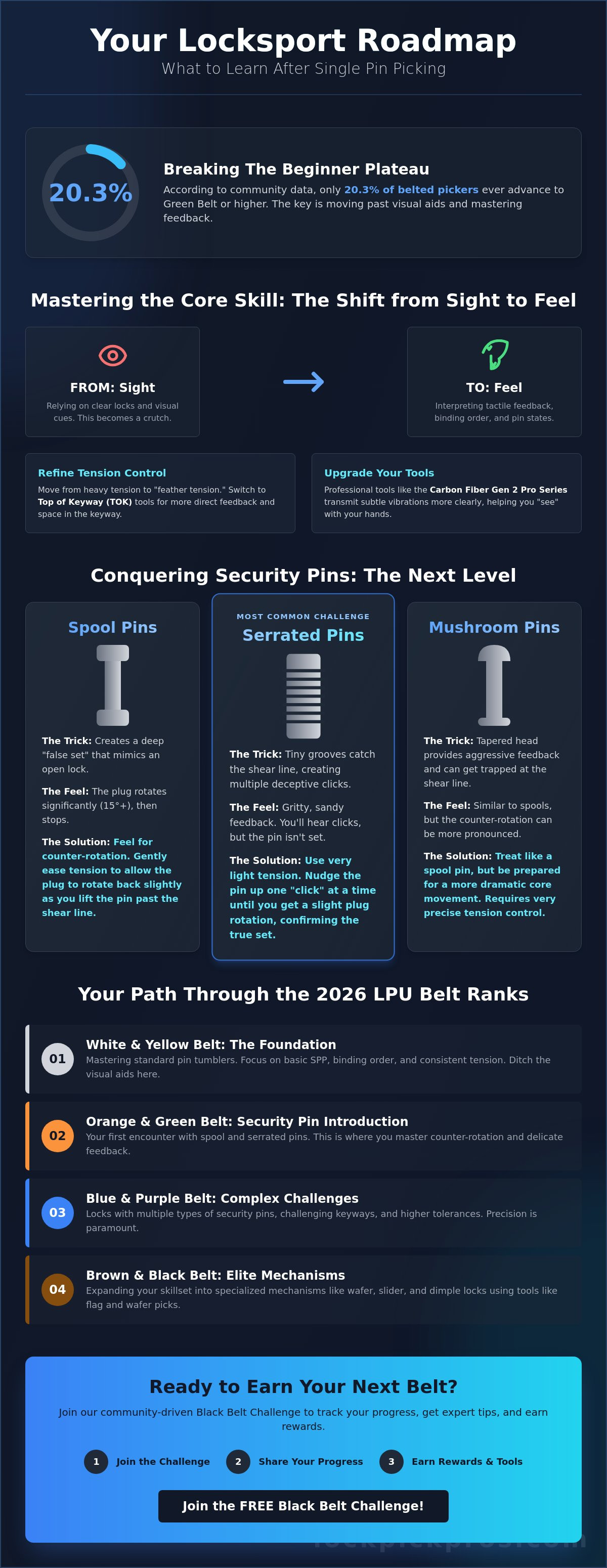
What if your ability to open a basic Master Lock isn't the finish line, but actually the moment the real sport begins? You've spent hours perfecting your tension and feel, yet you've likely hit that frustrating "beginner plateau" where every new lock feels like a mystery. It's confusing when a lock suddenly stops giving clear clicks and starts fighting back with mushy feedback or deep false sets. You aren't alone in feeling stuck; according to community data, only about 20.3% of belted pickers ever advance to the Green Belt level or higher.
If you're wondering what to learn after single pin picking, this 2026 roadmap is your guide to breaking through. We'll show you how to transition from standard pins to the complex world of security pins and advanced mechanisms. You'll discover a structured path that includes the latest 2026 LPU belt ranking updates, a curated list of practice locks to buy next, and the secrets to interpreting the subtle feedback of spool and serrated pins. Get ready to move past the basics and start your journey toward earning your next belt in the locksport community.
Key Takeaways
- Move beyond visual training aids and learn to trust tactile feedback to overcome the common post-SPP plateau.
- Discover exactly what to learn after single pin picking by mastering the counter-rotation of spool pins and the deceptive clicks of serrated pins.
- Navigate the 2026 LPU belt ranking system to identify the specific practice locks needed to advance your hobbyist status.
- Expand your skillset into specialized mechanisms like wafer and dimple locks using professional tools like flag picks.
- Join the community-driven Black Belt Challenge to share your progress on social media and earn rewards for your skill refinement.
Beyond the Basics: Understanding the Post-SPP Plateau
You've popped your first few clear padlocks and felt the rush of a plug turning for the first time. It's an addictive feeling, but many hobbyists soon hit a wall known as the Post-SPP Plateau. This is the stage where basic single pin picking (SPP) stops being about following a visual guide and starts being about interpreting invisible signals. If you're wondering what to learn after single pin picking, the answer lies in your fingertips. The plateau happens when you can no longer rely on your eyes; you must transition entirely to tactile feedback.
Mastering the standard pin tumbler isn't just a beginner hurdle. It's the foundation for every high-security lock you'll ever encounter. Every advanced mechanism is essentially a standard lock with added "tricks" designed to fool your senses. To beat the plateau, you must master the concept of binding order. Because of tiny manufacturing imperfections, no two pins are exactly the same size. One pin will always bind against the plug first. Learning to identify this specific sequence is what separates a lucky guesser from a skilled practitioner in the world of Locksport.
As you move toward real-world hardware and more challenging practice locks, maintaining a strict ethical code is vital. Ethical lockpicking means you only ever pick locks that you own and that are not in use. This discipline ensures the hobby remains a respected sport and protects your reputation within the community.
The Shift from Sight to Feel
Clear practice locks are excellent training wheels, but they eventually become a crutch. If you're always looking at the pins, you aren't developing the "finger memory" needed for opaque locks. To bridge this gap, many hobbyists transition to metal cutaway locks or blind picking exercises. You need to learn exactly where your pick is located by the feel of the warding and the spring tension of the pins. Professional tools like the Carbon Fiber Gen 2 Pro Series are designed to transmit these vibrations more clearly than entry-level sets, helping you "see" with your hands.
Refining Your Tension Control
Beginners often use "heavy tension" to force pins into place, but this habit will fail you once you encounter security pins. Advanced picking requires "feather tension," where you apply just enough pressure to keep a pin from falling. Switching to Top of Keyway (TOK) tension is a game-changer here. TOK tools provide more room in the keyway and offer a more direct connection to the plug's rotation. Feedback is the mechanical communication between the pin and the pick. By lightening your touch, you allow the lock to tell you exactly which pin is binding and which is set.
Conquering Security Pins: Spools, Serrated, and Mushrooms
Once you've mastered the basics found in the MIT Guide to Lock Picking, the locksport world throws a curveball. Security pins are modified driver pins designed to stall your progress. These components are the core of what to learn after single pin picking standard stacks. They don't just sit there; they actively lie to you through your pick. The three most common types you will encounter include:
- Spool Pins: Shaped like a thread spool, these create deep false sets that mimic an open lock.
- Serrated Pins: Feature multiple tiny grooves that catch on the shear line to trick you into thinking a pin is set.
- Mushroom Pins: Similar to spools but with a tapered head, providing aggressive feedback and tricky counter-rotation.
The first sign of trouble is the "false set." This happens when the plug rotates significantly, often 15 degrees or more, but the lock remains closed. You might think you've almost won, but you're actually caught in a trap. In a spool pin, the narrow center has crossed the shear line, but the wider top or bottom is still blocking the plug's rotation. To progress, you must master the sensation of counter-rotation. This is a physical push-back from the plug against your tension wrench as you attempt to lift a security pin into its final position.
Defeating Spool Pins
Spool pins are the most common security feature in intermediate locks. When you hit a false set, you have likely set all standard pins and are stuck on a spool. To set it, you must listen for counter-rotation. As you push up on the spool, the wider edge of the pin will force the plug to rotate backward against your tension wrench. Don't fight this. You must ease your tension slightly to let the plug move back. Once the wide part of the spool clears the shear line, you'll feel a sharp click. The plug will either open or drop back into another false set. For those just starting this transition, The Trainee 2.0 is an excellent platform for learning this delicate dance.
Navigating Serrated Pin Stacks
Serrated pins are the primary cause of oversetting for many hobbyists. These pins have tiny grooves cut into their sides that catch on the shear line. Unlike the deep rotation of a spool, serrated pins give you multiple small clicks. A "serration click" feels light and hollow, while a "true set" click is usually deeper and more resonant. To avoid oversetting, use a jiggle test. If a pin is set at the shear line, it will feel slightly springy when tapped. If it feels solid or bound, it still needs to move. Refining your tactile sensitivity with a high-quality pick set will help you distinguish these subtle vibrations.
Navigating the 2026 Locksport Belt Ranking System
The Lockpickers United (LPU) belt system acts as the universal roadmap for hobbyists. It categorizes nearly 900 locks into difficulty tiers, allowing you to track your progress from a complete novice to a master. If you're researching what to learn after single pin picking, this system provides the logical structure you need. As of the January 2026 updates, the rankings have become even more precise, incorporating new challenges like the MIWA WR for Black Belt and the ABUS 72/40 "Love Lock" for Yellow Belt.
White to Orange: The Foundation Ranks
Your journey begins at White Belt. For this tier, we recommend starting with our Beginner Lockpick Sets and transparent Practice Locks to visualize pin movement. Your first milestone is the Master Lock #3. This lock features a 4-pin stack of standard pins. Use heavy Bottom of Keyway (BOK) tension and a standard short hook. Apply pressure until you feel a solid click on each pin, typically moving from front to back.
Yellow Belt introduces basic security pins. The Master Lock 140 is the standard choice, containing four pins with at least one spool. Switch to medium BOK tension and a standard hook. You'll also encounter the ABUS 72/40, which features six pins (typically five spools). Because of its tight paracentric warding, you must use a thin 0.015 inch hook and light Top of Keyway (TOK) tension to avoid oversetting the pins.
Orange Belt requires mastering tighter tolerances. The ABUS 64TI (Titalium) is a 5-pin lock filled with spools. Use medium TOK tension and a standard hook. You'll need to carefully manage counter-rotation on every pin. If the plug kicks back, ease your tension slightly to let the spool set without dropping previously set pins.
Green to Blue: The Intermediate Leap
The jump to Green Belt is where technical requirements increase. You must now film a successful pick and a full "gut" of the lock in one continuous take. This ensures you understand the internal mechanics beyond just feel. To handle the increased precision of Green and Blue belt locks, hobbyists should upgrade to professional Carbon Fiber Lockpicks. These tools offer the high-fidelity feedback needed for the complex pin stacks found in intermediate hardware. Blue Belt candidates must also complete a community project, such as creating a functional cutaway lock or documenting the first public picking of a new model, to prove their dedication to the sport.
Beyond Pin Tumblers: Expanding Your Skillset
Standard pin tumblers are just one branch of the locksport tree. If you're researching what to learn after single pin picking, it's time to explore the mechanical diversity of wafer, dimple, and disc detainer locks. These mechanisms require you to move beyond simple vertical lifting and master side-manipulation and rotation. Each type offers a unique tactile puzzle that will sharpen your feedback interpretation and tension control.
Mastering Dimple Picking
Dimple locks use pins that rest on the flat side of the keyway rather than the edge. To pick a standard 5-pin dimple lock, start with light Top of Keyway (TOK) tension. Use a flag pick from the HUK High Quality Kaba Tools. Locate the binding pin and rotate the pick handle so the flag's edge lifts the pin. Many high-security dimple locks use spool-shaped drivers. If you feel counter-rotation, ease your tension slightly to let the flag push the pin past the shear line. This rotation-based technique is essential for intermediate belt ranks.
Wafer, Lever, and Disc Detainer Challenges
Wafer locks, common in cabinets, use 4 to 6 flat metal plates. Use medium Bottom of Keyway (BOK) tension and a small hook or city rake from the 12pcs Honest Lock Smith Tools. Push each wafer until it aligns with the plug's edge. For disc detainers, which feature 6 to 9 rotating discs and no springs, you'll need a specialized disc detainer pick. Rotate all discs clockwise, apply tension to the first disc, and rotate each subsequent disc until it drops into its gate. Watch out for "false gates" that mimic the feel of a security pin by providing a shallow, deceptive click. To maintain the precision needed for these advanced mechanisms, we recommend upgrading to the Carbon Fiber Gen 2 Pro Series for maximum tactile feedback.
Joining the Black Belt Challenge: Your Path to Mastery
You’ve navigated the technical hurdles of security pins and explored the vast landscape of the LPU belt system. Now, it’s time to turn that knowledge into a community legacy. The Black Belt Challenge is our exclusive, free program designed to reward your dedication to the sport. If you're still wondering what to learn after single pin picking, the answer is simple: learn to share your expertise. This challenge isn't just about opening locks; it's about becoming a pillar of the locksport community.
We believe locksport thrives when it’s collaborative. Our "Share-to-Earn" loop allows you to document your journey from the very first click to the final master-level turn. By posting your "picks-in-action" on social media, you aren't just showcasing your individual skill refinement. You’re helping to build a transparent, ethical community of hobbyists. Every video you share serves as a roadmap for the next person stuck on the "beginner plateau."
To keep the momentum going, we’ve established a "Community Bounty." When our collective social reach hits specific goals, we unlock sitewide rewards for every member of the Lockpick Pros family. This system encourages advanced pickers to mentor those just starting out. It turns a solitary hobby into a team sport where everyone has a chance to earn their black belt in lockpicking. Mastery comes with responsibility. We are ethical lockpickers. We pick for the sport, the challenge, and the mechanical puzzle. Always remember: never pick a lock you don't own or one that is currently in use.
How to Enter the Challenge
- Step 1: Record your first successful White Belt open and share it on your favorite social media platform.
- Step 2: Tag Lockpick Pros in your post. Once verified, we’ll grant you your first official community rank and digital badge.
- Step 3: Access exclusive "belt-only" discounts. As you climb the ranks, you'll unlock deeper savings on advanced equipment and specialty tools.
Earning Rewards Through Progression
Every belt rank you unlock earns you points toward the Pro Series Expansion tools. These points help you upgrade your kit as your skills demand more precision. The Community Bounty is our way of rewarding those who help others learn SPP. By sharing tips and tricks, you help unlock rewards for the entire group. It’s a cycle of learning and earning that benefits every ethical picker in the sport. Join the Black Belt Challenge today and start your journey to the top of the roadmap.
Master Your Next Belt Rank Today
Your journey from a curious beginner to a master of the craft is now clearly mapped out. You've learned how to break through the post-SPP plateau by trusting tactile feedback over visual aids. By understanding the counter-rotation of spool pins and the deceptive clicks of serrated pins, you’re ready to tackle advanced hardware. Knowing what to learn after single pin picking is the secret to climbing the 2026 LPU-aligned belt ranks and joining an elite community of ethical hobbyists.
Our official guides help you navigate every technical hurdle, from your first gutting video to mastering complex dimple mechanisms. Professional locksmiths and hobbyists alike rely on our precision carbon fiber tools to get the high-fidelity feedback necessary for high-security locks. Don't let your progress stall on a basic padlock. It's time to put your skills to the test, upgrade your kit, and start earning your next rank.
Join the Free Black Belt Challenge and Start Your Progression!
We can't wait to see your "picks-in-action" videos on social media. Keep practicing, stay ethical, and enjoy the thrill of the open.
Frequently Asked Questions
What is the best lock to buy after I can pick a Master Lock #3?
The Brinks 40mm Brass Padlock is a fantastic next step because it introduces spool pins in a very manageable way. This lock typically features a 4-pin stack with at least two spools, requiring you to refine your light tension skills. Use Bottom of Keyway (BOK) tension and a standard short hook to identify the counter-rotation as you move from the standard pins to the security drivers.
How do I know if a lock has security pins inside?
You can identify security pins by the specific feedback they send through your pick, most notably the "false set." If the plug rotates significantly but the lock remains closed, you are likely dealing with a spool or mushroom pin. This tactile signal is a core part of what to learn after single pin picking standard locks, as it tells you exactly which pin is currently binding at the shear line.
Do I need to buy a whole new pick set for advanced locks?
While your basic hooks will still work, your pick set selection should evolve as you move into tighter, paracentric keyways. Advanced locks often require thinner profiles, such as 0.015" or 0.018" picks, to bypass restrictive warding without oversetting pins. Transitioning to professional-grade tools ensures that the subtle vibrations of security pins aren't dampened by bulky or low-quality materials.
What is the "gutting" process and why is it important for higher belt ranks?
Gutting involves disassembling the lock core to examine the pins, springs, and plug. It is a critical requirement for Green Belt and above because it proves you can handle the internal components without damaging the mechanism. To do this successfully, you will need a pinning tray, plug followers, and a set of shims to prevent the driver pins from dropping into the wrong chambers during reassembly.
How long does it typically take to move from White Belt to Green Belt?
Most dedicated hobbyists can make the jump from White to Green Belt in approximately three to six months. This timeline depends on how quickly you master the "jiggle test" to confirm sets and your comfort level with filming your picks. The transition is less about speed and more about developing the patience to interpret complex feedback and the mechanical skill to perform a full gut and reassembly.
Are dimple picks and wafer picks legal for hobbyists to own?
In most regions, owning specialty tools for locksport is perfectly legal as long as they are used ethically on locks you own. At Lockpick Pros, we focus on the competitive and puzzle-solving aspects of the hobby. Always ensure you are picking in a legal setting and follow the community's golden rule: never pick a lock that is in use or one that you do not have explicit permission to manipulate.
What is the difference between a false set and a true set?
A true set occurs when the gap between the key pin and driver pin aligns perfectly with the shear line, allowing the plug to move freely. A false set happens when the narrow part of a security pin catches on the shear line, causing the plug to tilt but stay locked. You can distinguish the two by the "plug tilt" angle; a false set usually results in a much deeper rotation than a standard set.
Can I use a clear practice lock to learn about spool pins?
Clear locks are helpful for the very first time you see a spool pin move, but they are not recommended for serious skill refinement. The acrylic material is much softer than brass or steel, which completely changes the feedback you feel through your tension wrench. To master the counter-rotation required for higher belt ranks, you must eventually move to metal locks where the mechanical signals are crisp and accurate.