

Advanced Lock Pick Set: The 2026 Mastery Guide
Have you ever felt the sudden "snap" of a pick just as you were about to set the final pin on a challenging Green belt lock? It's a common rite of passage when moving beyond beginner lockpicking. You've spent hours honing your craft, but the tools that served you well on basic padlocks are now failing against tighter tolerances and paracentric keyways. It's frustrating when your gear masks the very feedback you need to succeed, leaving you guessing instead of feeling the lock's internal state.
We're here to help you bridge that gap and refine your pick set selection for the challenges ahead. This 2026 mastery guide promises to elevate your skills, showing you how an advanced lock pick set for professionals can translate subtle internal movements into successful opens. We'll explore the material science of high-feedback tools, the technical strategies for defeating complex security pins, and the specialty gear required to earn your higher belt ranks in the locksport community. Get ready to turn those stubborn high-security cylinders into open results.
Key Takeaways
- Learn how to transition from foundational skills to conquering Green, Blue, and Purple belt locks using expert-level feedback techniques.
- Discover why choosing an advanced lock pick set for professionals made from carbon fiber provides the tactile precision needed to defeat complex security pins.
- Master the mechanics of false sets and learn how to identify mushroom and serrated pins before they stall your progress.
- Expand your toolkit with specialty dimple and wafer picks to handle high-security keyways that standard hooks can't touch.
- Join our Black Belt Challenge to document your "picks-in-action" and earn community rewards as you climb the ranks.
Scaling the Belt Ranks: Why You Need an Advanced Lock Pick Set
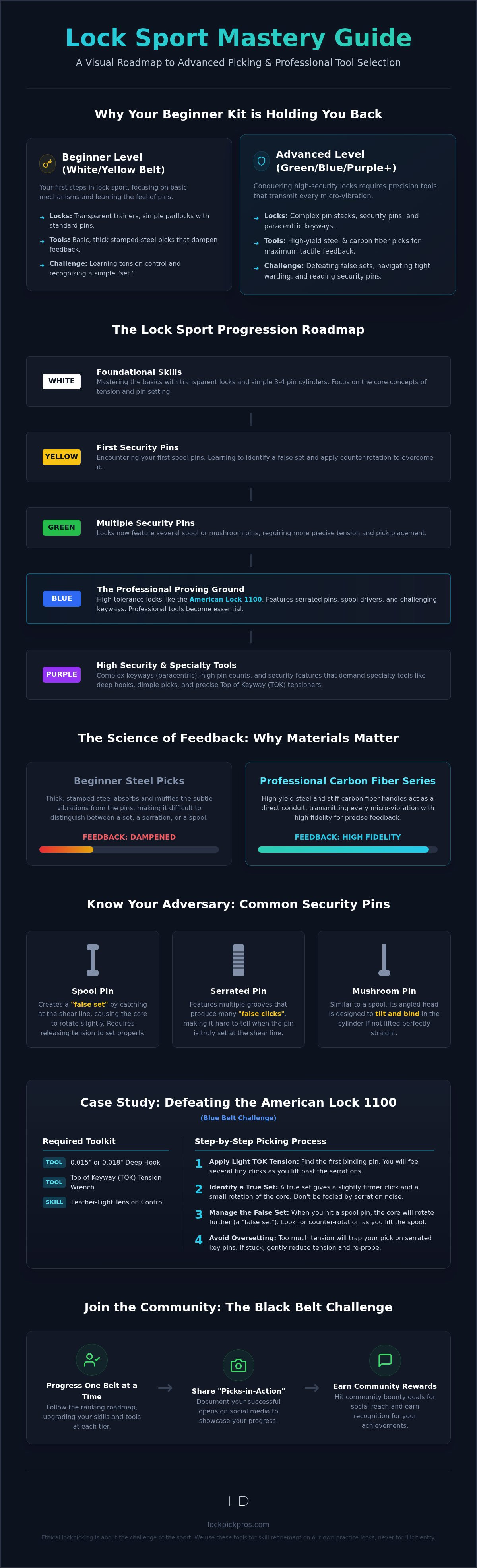
You've mastered the basics of beginner lockpicking and can rake open a standard hardware store padlock in seconds. But then you hit your first Green or Blue belt lock and everything goes silent. Transitioning from foundational skills to the higher tiers requires a shift in both mindset and equipment. An advanced lock pick set for professionals isn't just a luxury; it's a requirement for the tighter tolerances and complex pin stacks found in higher-tier locks. While beginner sets are great for learning, they quickly become a bottleneck when you face locks designed to fight back.
To understand the jump in difficulty, let's look at a community favorite: the American Lock 1100. This Blue belt powerhouse is a masterclass in security. It features a 5-pin stack where almost every pin is a serrated or serrated-spool driver. To open it, you'll need a 0.018 inch or 0.015 inch deep hook from your advanced lock pick set for professionals to navigate the narrow keyway. Use Top of Keyway (TOK) tension with a feather-light touch. Step 1: Probe for the first binder; you'll hear several tiny clicks as you move past serrations. Step 2: Distinguish a serration click from a true shear line set by the slightly firmer resistance. Step 3: Once you hit a false set, look for counter-rotation on the spools. If you apply too much tension, the serrated key pins will trap your pick, a common frustration that professional tools help mitigate through better feedback.
Ethical lockpicking is about the challenge of the sport. We use these tools for skill refinement on our own practice locks, never for illicit entry. High-quality tools are designed to translate micro-vibrations from the lock core directly to your hand. This connection is what separates a lucky open from true mastery. Exploring the history of lock picking shows that tools have always evolved alongside security, and your pick set selection must do the same to keep pace with 2026 standards.
The 2026 Belt Ranking Roadmap
Moving from Yellow to Purple belt challenges means facing locks with multiple security pins and tighter tolerances. Tool precision becomes your primary bottleneck here. If your pick is too thick, it will dampen the vibrations you need to feel, making it impossible to "read" the lock. For a deeper look at the progression, check out our Lock Picking Belt Levels Explained guide. It maps out exactly what to expect as you climb toward the elite ranks of the community.
Identifying High-Security Lock Features
High-tolerance manufacturing in brands like ABUS requires a delicate touch and specialized profiles. You'll often encounter paracentric keyways designed to block straight-line access to the pins. These restricted spaces make TOK tension wrenches vital, as they provide more room in the keyway and better control over the core's rotation. When you pair TOK tension with a professional hook, you gain the leverage needed to defeat high-lift pins that entry-level kits simply cannot reach without oversetting adjacent security pins.
Material Science and Precision: The Professional Carbon Fiber Series
Feedback is the primary language of the lock. When you're picking a high-security cylinder, you aren't just moving metal; you're interpreting micro-vibrations sent from the pin stack through the pick and into your fingertips. An advanced lock pick set for professionals relies on materials that translate this data without muffling it. While beginner sets often use thick, stamped steel that absorbs these subtle signals, professional-grade tools use high-yield steel and carbon fiber to ensure every click is felt with absolute clarity.
High-yield steel is the backbone of any serious kit. It provides the necessary rigidity to handle heavy tension while remaining flexible enough to navigate tight warding without snapping. We pair this with precision grinding and polished finishes. This "Pro Series" difference ensures the pick glides smoothly over pins, preventing the "crunchy" feeling that often masks the true state of a security pin. This level of refinement is essential when you're spending hours at the bench. Proper ergonomics and balanced weight distribution prevent hand fatigue, allowing you to maintain the delicate touch required for marathon practice sessions.
Carbon Fiber vs. Traditional Steel Handles
Carbon fiber handles offer unique acoustic properties that traditional steel or plastic simply can't match. Because carbon fiber is incredibly stiff and lightweight, it acts as an amplifier for the vibrational energy created when a pin hits a shear line. This amplification is a game-changer for single pin picking (SPP), as it provides a clearer "picture" of what's happening inside the core. You'll find that the benefits of carbon fiber lock picks extend beyond just weight; they change how you perceive the lock's internal mechanics. The balance is shifted toward the tip, giving you more control over the minute movements needed to set a stubborn mushroom pin.
The Stealth Edition: Professional EDC Kits
For those who need to carry their skills on the go, the Carbon Fiber Gen 2 Pro Series offers a professional EDC solution that doesn't sacrifice performance for portability. These "Stealth" kits are favored by service members and professional locksmiths who require a compact footprint without losing the high-feedback properties of full-sized tools. Maintaining tool integrity in a compact carrying case is vital. Our kits use reinforced pouches that keep your 0.015-inch and 0.018-inch picks straight and protected from bending. If you want to experience this level of tactile precision yourself, you should explore our latest Carbon Fiber Pro Series to see how it transforms your picking speed.
Defeating High-Security Locks: Spools, Serrations, and Mushroom Pins
You've upgraded your gear and felt the difference that carbon fiber makes. Now it's time to put that feedback to work against the most common gatekeepers of the higher belt ranks: security pins. These pins are specifically designed to trick you into thinking a lock is set when it isn't. When you're wielding an advanced lock pick set for professionals, your goal changes from simply moving metal to decoding a complex mechanical puzzle. You aren't just looking for a click; you're looking for the specific type of click that tells you exactly which pin you're touching.
To demonstrate these strategies, let's break down the ABUS 72/40, a quintessential Green belt challenge. This lock features a 6-pin stack, usually with a standard pin in the first position and five spools filling the rest. The keyway is notoriously paracentric, meaning you'll need a 0.015 inch deep hook to reach the pins without binding against the warding. Step 1: Apply light Top of Keyway (TOK) tension. Step 2: Set the standard pin in position 1; the plug will drop into a deep false set. Step 3: Probe pins 2 through 6. When you find a spool, the plug will rotate backward against your tension tool. Step 4: Ease your tension slightly and lift until the pin clicks into place. For a deeper dive into these mechanics, our guide on Mastering the Advanced Lock: A Guide to High-Security Picking covers the physics of these interactions in detail.
Step-by-Step: Picking Spool and Mushroom Pins
Once you've induced a false set, the real work begins. You must learn to interpret counter-rotation, which is when the plug tries to turn back toward the locked position as you lift a pin. Counter-rotation is the definitive signal that you are successfully defeating a spool pin. Gently ease off your tension just enough to let the pin move upward until it clicks into the true shear line. If you drop other pins in the process, don't worry. It's a normal part of the "two steps forward, one step back" dance of high-security picking.
Serrated Pins: The Subtle Click Strategy
Serrated pins, like those found in the Master Lock 410 LOTO (which has a 6-pin stack with one serrated and five spools), are the ultimate test of your tension control. Unlike spools, they don't give you a large false set. Instead, they give you multiple tiny, "mushy" clicks. A true set will feel much crisper and more solid than a serration click. Using tools from the Pro Series Expansion allows for the micro-adjustments needed to nudge these pins one serration at a time. If you apply too much tension, the pin will bind so hard you can't feel the serrations. If you apply too little, you'll overset it. Progressive practice is key to mastering this delicate balance in your advanced lock pick set for professionals.
Beyond Standard Hooks: Specialty Tools for Professional Entry
Standard hooks are the workhorses of the locksport world, but they eventually hit a mechanical wall. When you encounter a keyway where the pins are oriented on the side or the internal mechanism doesn't use pins at all, your strategy must evolve. An advanced lock pick set for professionals isn't complete without the specialized tools required to handle these non-standard systems. Professional entry often involves more than just picking. It includes bypass tools that target mechanical vulnerabilities and pinning trays that allow you to strip a lock down for deep study and rekeying. Understanding the internal guts of a lock is the fastest way to master it.
Vehicle entry and high-security commercial cylinders also require their own dedicated gear. While a standard kit might get you through a front door, automotive locksmithing often demands separate advanced kits designed for the unique wafers found in car doors. If you want to move beyond the basics, you have to be prepared for every type of locking mechanism you might meet in the field. This diversity is what makes the journey to the Black belt so rewarding for ethical lockpickers.
Dimple Picking and Flag Techniques
Dimple locks use the same pin tumbler principle as standard locks, but the key is flat and the pins are oriented horizontally. You can't use a traditional hook to reach these; you need flag picks. Using HUK High Quality Kaba Tools is the standard approach for tackling these high-security civil locks. The technique shifts to a rotation-and-lift method. You find the binding pin, place the flag tip under the dimple, and rotate the handle to lift the pin to the shear line. It's a rhythmic, tactile process that relies heavily on the high-feedback handles we've discussed in previous sections.
Wafer Locks and Professional Jiggler Sets
Wafer locks are common in desk drawers, cabinets, and older vehicle ignitions. They use flat metal wafers instead of pins, and they can be surprisingly stubborn if you try to single pin pick them. This is why 12pcs High Quality Honest Tools are essential for any commercial locksmithing application. These jiggler sets allow for a "rock and rake" technique. You apply light tension and move the tool in a vibrating, rocking motion to find the shear line for all wafers simultaneously. It's a fast, effective method for rapid non-destructive entry. If you're ready to build a kit that can handle any challenge, you should grab the Carbon Fiber Gen 2 Pro Series to serve as your high-precision foundation.
Earning Your Black Belt: Join the Professional Challenge
You've refined your tactile senses and learned to decode the complex feedback of security pins. Now, it's time to move beyond solitary practice and join the elite ranks of the locksport community. Investing in an advanced lock pick set for professionals is the first step toward the summit of the sport, but the true mark of mastery is the Black Belt. This isn't just about opening a lock; it's about proving your technical proficiency and contributing to the growth of ethical lockpicking worldwide. To honor such high-level achievements, many clubs discover KP Innovations for premium custom awards that commemorate the dedication required to reach the top. Our community-led path is designed to guide you through every milestone, ensuring you have the support and the tools needed to succeed.
The journey to the top is a marathon of skill refinement. As you progress, you'll find that the challenges become more about patience and precision than force. The "Share-to-Earn" loop is our way of fueling your progression. By documenting your journey and sharing your successes, you can earn tool upgrades that keep your kit at the cutting edge. Whether you're chasing the next belt or helping a trainee find their first binder, your involvement strengthens the community and pushes the boundaries of what's possible in locksport.
The Professional Progression Checklist
To reach the higher tiers, you must demonstrate more than just "getting it open." Mastery begins with Single Pin Picking (SPP) on Green belt locks, where you can no longer rely on luck or raking. You'll need to develop the ability to gut and reassemble locks using a pinning tray to understand exactly why a specific pin was giving you trouble. This internal study is vital for troubleshooting high-security cylinders. Finally, we encourage you to contribute back by creating guide content or tutorials. Sharing your unique perspective on a difficult paracentric keyway helps others climb the ranks and establishes your authority as an expert picker.
Community Bounty and Rewards
The Black Belt Challenge is the ultimate goal for ethical hobbyists. To participate, you can claim your free entry through our community portal and start documenting your "picks-in-action." We offer rewards for social reach and technical tutorials that help the community grow. When you hit specific engagement goals, you unlock bounties that can be redeemed for elite gear like the Gen 2 Pro Max Stealth Edition. This kit is the definitive advanced lock pick set for professionals who have reached the pinnacle of the sport. It's time to show the world what you can do, earn your rewards, and take your place among the masters of the craft.
Take the Next Step Toward Locksport Mastery
You've seen how the right material science and specialized profiles transform a frustrating bind into a satisfying open. By moving beyond foundational kits, you're now equipped to handle the tight tolerances and paracentric keyways of Blue and Purple belt locks. Precision feedback from high-yield steel and carbon fiber handles is what allows you to decode spools and serrations with confidence. This journey is about more than just technical skill; it's about joining a dedicated community of ethical lockpickers who value the challenge of the sport.
Choosing an advanced lock pick set for professionals is the definitive turning point in your locksport career. Whether you're refining your Single Pin Picking or exploring the nuances of dimple locks, our community-vetted progression system is here to support your growth. It's time to put your practice into action and start earning rewards for your technical skills.
Join the Black Belt Challenge and Upgrade Your Kit
We can't wait to see your picks-in-action videos. Keep practicing, stay ethical, and we'll see you at the top of the ranks.
Frequently Asked Questions
What makes a lock pick set "advanced" compared to a beginner kit?
An advanced lock pick set for professionals differs from beginner kits through its specialized tool profiles and thinner material gauges. While beginner sets focus on durability with thicker 0.025 inch steel, advanced sets include deep hooks and flat tips designed for paracentric keyways. These kits prioritize tactile feedback, allowing you to feel the state of the pins more accurately than standard stamped steel tools can provide.
Why do professional lock picks use carbon fiber or high-yield steel?
Carbon fiber and high-yield steel are chosen for their superior vibrational transmission and strength to weight ratio. Carbon fiber handles act as acoustic amplifiers, translating the minute clicks of a setting pin directly to your fingers. High-yield steel allows tools to remain rigid under heavy tension while being thin enough to navigate restricted keyways without snapping during a long picking session.
How do I know if my lock has security pins like spools or serrations?
You can identify security pins by the specific tactile feedback they provide during the picking process. A spool pin will typically cause a false set, where the plug rotates significantly but the lock doesn't open. If you feel the plug rotating backward as you lift a pin, you've found a spool pin requiring counter rotation to set. Serrated pins provide multiple tiny clicks instead of one solid set.
Is it legal to carry an advanced lock pick set in the US?
Owning lockpicking tools is legal in most US states as long as there is no intent to commit a crime. In many jurisdictions, they are classified as burglary tools only if evidence of criminal intent exists. States like Mississippi, Ohio, and Nevada have specific statutes regarding possession, so it is vital to check your local and state regulations before carrying your kit in public settings.
What is the difference between 0.015" and 0.025" pick thickness?
The primary difference lies in keyway accessibility and tool durability. A 0.025 inch pick is the standard for North American locks with wide keyways, providing excellent strength for trainees. In contrast, 0.015 inch picks are essential for high security European locks or paracentric keyways where a thicker tool would get stuck against the warding. Thinner picks require a more delicate touch to avoid bending.
Do I need specialty tools like dimple picks for professional locksmithing?
Specialty tools like dimple picks are necessary when you encounter locks that don't use standard pin tumbler mechanics. Many high security commercial cylinders use side oriented pins that a standard hook cannot reach. Adding these to an advanced lock pick set for professionals ensures you can handle civil locks and specialized hardware found in modern security installations where standard hooks often fail to find purchase.
How does the locksport belt ranking system work for tool selection?
The belt ranking system serves as a roadmap for both skill and equipment progression. White and Yellow belts are achievable with basic hooks, but Green belt locks and above often require thinner 0.018 inch picks and Top of Keyway tension. As you move toward Purple and Black belts, you'll need to incorporate specialty flags, pinning trays, and bypass tools to handle the increased mechanical complexity.
Can I use an advanced lock pick set for automotive entry?
Standard pick sets are designed for pin tumbler locks and are usually insufficient for automotive entry. Most vehicles use wafer locks or side milled tracks that require specialized jigglers or Lishi tools to manipulate correctly. While some hooks can move wafers, a dedicated automotive kit is much more efficient for non destructive vehicle entry and avoids the risk of damaging delicate internal components.