

Are Lock Picks Legal in California? The 2026 Locksport Legal Guide
Your lock pick set is sitting on your desk, your practice lock is ready, and then a thought stops you cold: wait, is any of this actually legal in California? It's a question that quietly haunts almost every new locksport hobbyist in the state, and the anxiety is completely understandable. The words "burglary tools" appear right there in California Penal Code 466, and that phrase alone is enough to make anyone hesitate before heading to a community meet-up with a pick set in their bag.
Here's the truth: the lock pick laws in California don't make you a criminal for owning or enjoying these tools. The law is built around intent, not possession. And once you understand exactly how that distinction works, the fog of confusion lifts fast.
In this guide, you'll get a plain-language breakdown of exactly what Penal Code 466 says, what "lawful intent" looks like in practice, and how to carry and use your tools with complete confidence as an ethical locksport hobbyist. Whether you're ready to buy your first beginner set or you're just trying to make sense of the legal landscape before your next club night, this is your starting point.
Key Takeaways
- The lock pick laws in California are built around criminal intent, not mere possession — owning a pick set is not a crime on its own.
- California Penal Code 466 targets "burglary tools" only when paired with suspicious behavior, so understanding what prosecutors look for keeps you on the right side of the law.
- How you carry your tools matters — the right case and context can be the difference between a misunderstanding and a legal headache.
- Following the Lockpickers Code of Ethics — especially the rule to only pick locks you own or have permission to pick — is your strongest real-world legal protection.
- Choosing a beginner practice set designed for skill-building, not bypass, is the smartest and safest entry point for any new California locksport hobbyist.
Decoding California Penal Code 466: The 'Burglary Tool' Law
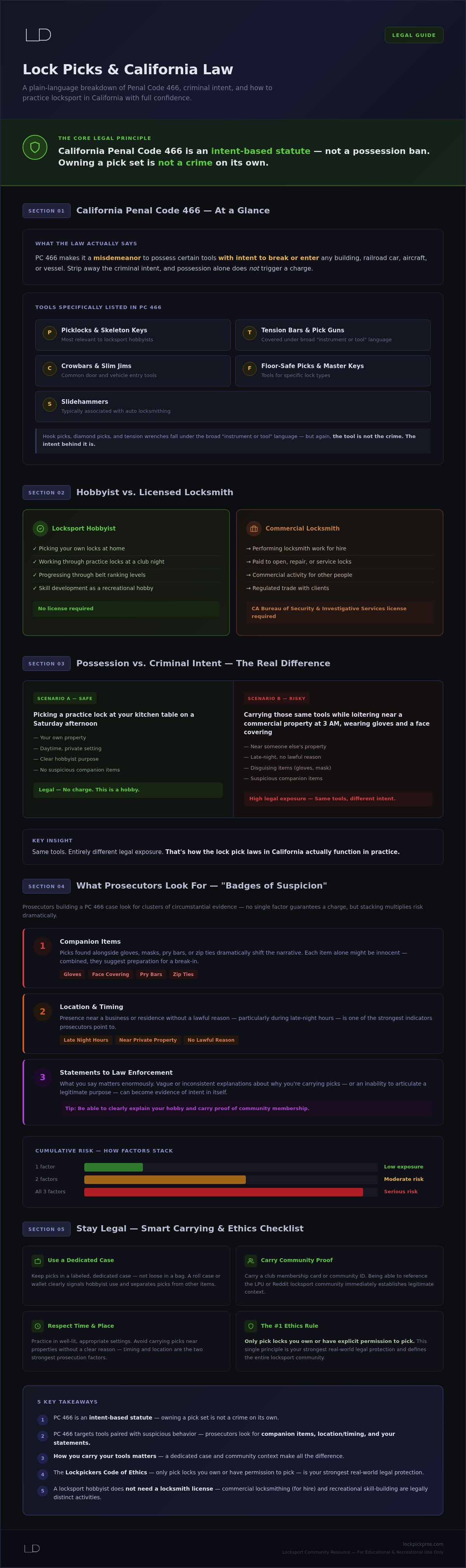
California Penal Code 466 is an intent-based statute, not a possession ban. That single distinction is everything for locksport hobbyists trying to understand where they stand.
The code makes it a misdemeanor to possess certain tools with intent to break or enter any building, railroad car, aircraft, or vessel. Strip away the criminal intent, and possession alone doesn't trigger a charge. That's the legal foundation the entire locksport community in California rests on.
What Tools Are Specifically Listed?
PC 466 calls out a specific list of items by name. Knowing exactly what's on that list removes the guesswork from understanding where the lock pick laws in California draw the line:
- Picklocks and skeleton keys — the most directly relevant items for locksport hobbyists
- Crowbars and slim jims — common vehicle and door entry tools
- Slidehammers — typically associated with auto locksmithing
- Tension bars and lock pick guns — categorized under the broader umbrella of "instrument or tool" language in the statute
- Floor-safe picks and master keys — tools designed to manipulate specific lock types
Modern locksport tools, including hook picks, diamond picks, and tension wrenches, fall under this umbrella because the statute uses expansive "instrument or tool" language to catch items not explicitly named. The law was written broadly on purpose. But again, the tool itself isn't the crime. The intent behind carrying it is what matters to prosecutors.
Hobbyist vs. Licensed Locksmith
Here's where a lot of new hobbyists get confused, and it's a gap most legal resources don't bother to address clearly. A California locksmith license is required when you're performing locksmith work for hire, meaning you're paid to open, repair, or service locks for other people. That's a commercial activity regulated under the California Bureau of Security and Investigative Services.
Picking your own locks at home, working through practice locks at a club night, or progressing through the lock picking belt levels as a hobbyist? None of that requires a license. You're not performing a service for hire. You're developing a skill.
The lock pick laws in California simply don't treat recreational locksport the same way they treat unlicensed commercial locksmithing. One is a regulated trade. The other is a hobby. Understanding that distinction is what separates unnecessary anxiety from genuine legal clarity.
The Legal Line: Possession vs. Criminal Intent
Think of criminal intent as the missing ingredient in any PC 466 conviction. Without it, the recipe for a charge simply doesn't come together. A pick set sitting in your bag is just metal. What transforms those tools into a legal problem is the context surrounding them, and that context is exactly what prosecutors are trained to evaluate.
The contrast is stark when you put two scenarios side by side. Picking a practice lock at your kitchen table on a Saturday afternoon is a hobby. Carrying those same tools while loitering near a commercial property at 3 AM, wearing gloves and a face covering, tells a completely different story. Same tools. Entirely different legal exposure. That's how the lock pick laws in California actually function in practice.
What Constitutes 'Burglarious Intent'?
Prosecutors building a PC 466 case don't rely on the tools alone. They look for what legal professionals sometimes call "badges of suspicion," clusters of circumstantial evidence that, taken together, paint a picture of criminal purpose. Three factors carry the most weight:
- Companion items: Picks found alongside gloves, masks, pry bars, or zip ties dramatically shift the narrative. Each item alone might be innocent; combined, they suggest preparation for a break-in.
- Location and timing: Presence near a business or residence without a lawful reason, particularly during late-night hours, is one of the strongest indicators prosecutors point to.
- Statements to law enforcement: What you say matters enormously. Vague or inconsistent explanations about why you're carrying picks, or an inability to articulate a legitimate purpose, can become evidence of intent in itself.
None of these factors alone guarantees a conviction. But the more of them that stack up together, the harder it becomes to argue innocent purpose.
The 'Hobbyist Defense'
Here's the good news: demonstrating lawful intent isn't complicated for genuine locksport enthusiasts. Active participation in a recognized community is one of the most effective ways to establish that your tools exist for skill refinement and sport, not criminal activity.
Being a member of a locksport club, progressing through a recognized belt ranking system, and carrying tools in a labeled practice case all communicate legitimate purpose clearly. Documentation helps too: a receipt for practice locks, a club membership card, or even a social media presence showing your hobby all contribute to a coherent, credible story.
The ethical lock picking for hobbyists mindset isn't just about being a good community member. It's your most practical legal shield. Courts respond to consistency between stated purpose and actual behavior, and hobbyists who live that consistency have a strong foundation to stand on.
Understanding the lock pick laws in California becomes far less stressful once you recognize that the entire legal framework is designed to catch criminals, not curious people developing a genuine skill. If you're building that skill with the right tools from the start, a quality set like the Carbon Fiber Gen 2 Pro Series signals exactly the kind of serious, purposeful hobbyist the law was never meant to target.
How to Carry Lock Picks Safely in California
Knowing the law is step one. Carrying your tools in a way that reflects that knowledge is step two, and it's where a lot of hobbyists leave easy legal protection on the table. The lock pick laws in California are intent-based, which means context tells the story. Your job is to make sure that story is obvious at a glance.
Start with the basics: always carry your tools in a dedicated kit or case, never loose in a pocket. A scattered handful of picks in a jacket pocket looks nothing like a hobbyist's organized gear. A labeled carrying case with your tools neatly arranged communicates purpose before you say a single word. That visual difference matters more than most people realize.
The 'Practice Lock' Rule of Thumb
Here's one of the most practical habits you can build: never take your picks somewhere without a practice lock alongside them. A clear or cutaway lock sitting next to your pick set immediately reframes the entire picture. Nobody carries a transparent training lock to a burglary. That one object shifts the narrative from ambiguous to obvious.
The Trainee 2.0 is exactly the kind of companion you want in your kit for this reason. It's a purpose-built practice lock that signals sport, not bypass. Pair it with your picks every time you travel to a meet-up or club night, and you've created a coherent, self-explanatory package that communicates legitimate intent without any explanation required.
Best Practices for Transport
A few straightforward habits keep you well clear of any misunderstanding:
- Store tools in your trunk or a locked bag when driving to meet-ups. Tools visible on a passenger seat invite unnecessary questions during any routine traffic stop.
- Avoid sensitive locations entirely. Schools, government buildings, courthouses, and airports are never appropriate places to bring a pick set, regardless of your intent. The lock pick laws in California don't carve out exceptions for good intentions in high-security environments.
- Know what to say if a peace officer asks. Keep it simple and honest: "I'm a locksport hobbyist. These are practice tools I use on locks I own." Then point to your practice lock. Don't over-explain, don't ramble, and don't be evasive. A calm, direct answer supported by physical evidence is your strongest position.
- Carry documentation when it's easy to do so. A club membership card, a receipt for your practice locks, or even a phone showing your locksport social profile all reinforce a consistent, credible story.
None of this requires elaborate preparation. It's just the difference between being thoughtful and being careless. Ethical locksport hobbyists who carry their gear with intention rarely face problems, because the full picture they present leaves very little room for misinterpretation.
Locksport Ethics: Proving Your Lawful Intent
The lock pick laws in California give you a legal framework. The Lockpickers Code of Ethics gives you something equally valuable: a behavioral track record that makes your lawful intent self-evident. These aren't just community guidelines. They're your most practical, real-world protection.
Two rules sit at the foundation of that code, and they're non-negotiable in the locksport community.
- Rule #1: Never pick a lock you don't own or have explicit permission to pick. This is the line between hobbyist and criminal, full stop. It doesn't matter how skilled you are or how innocent your curiosity feels. Picking someone else's lock without permission is trespassing on their security, regardless of your intent.
- Rule #2: Never pick a lock that is currently in use or actively securing something. A padlock on a storage unit, a deadbolt on a door, a bike lock on an actual bike — those are off-limits. Your practice belongs on practice locks, not on locks doing a real job.
Following these rules consistently does something beyond keeping you ethical: it builds a behavioral paper trail. Every meet-up you attend, every practice session logged, every lock you pick with permission contributes to a coherent pattern of legitimate hobbyist activity. That pattern matters if your tools are ever questioned.
Belt Rankings as Proof of Mastery
The LPU belt ranking system does more than organize skill progression. It publicly categorizes your development as a student of the craft. Moving from White Belt through the intermediate ranks toward Black Belt demonstrates sustained, structured learning. That's not the behavior of someone acquiring tools for a quick bypass. It's the behavior of someone deeply invested in mastery for its own sake. If you're just getting started, choosing your first beginner lock pick set is the natural entry point into that progression, and the right tools from the start signal exactly the kind of serious intent the community recognizes.
Joining the California Locksport Community
Community membership is visible proof of legitimate purpose. TOOOL (The Open Organisation Of Lockpickers) has active chapters, and California locksport enthusiasts regularly connect through Reddit communities and local meet-up groups. Getting involved puts your hobby in a documented social context.
The "share-to-earn" loop reinforces this further. Posting your progress, sharing a successful pick on a new belt-level lock, or documenting your journey through the Black Belt Challenge creates a public, timestamped record of your hobby. That record speaks for itself. It's also genuinely motivating: the Black Belt Challenge gives your practice a clear goal and keeps your focus on growth rather than just accumulating tools.
Understanding the lock pick laws in California is only half the equation. Living the ethics is what makes that understanding real. When your tools, your community involvement, and your behavior all point in the same direction, there's no ambiguity left to exploit. Pair that commitment with precision tools built for serious skill-building, like the Carbon Fiber Gen 2 Pro Series, and you're presenting the complete picture of a dedicated, ethical locksport hobbyist.
Choosing Your First Legal Practice Set in 2026
Everything you've learned about the lock pick laws in California points to one practical conclusion: the tools you start with matter. Not just for your skill development, but for the story they tell about your intent. A beginner set designed for structured learning communicates something completely different from a loose collection of picks with no clear purpose. Start right, and you're building both competence and credibility from day one.
The smartest entry point for any California hobbyist is a set optimized for learning, not bypass. That means picks engineered for feedback and control, paired with a practice lock that makes your training context unmistakable. This combination does double duty: it accelerates your skill development and creates an immediately legible picture of legitimate hobbyist activity.
Top Recommendations for California Hobbyists
For beginners ready to invest in quality from the start, the Carbon Fiber Gen 2 Pro Series is the standout choice. Its professional appearance works in your favor on two levels. First, the carbon fiber construction delivers genuine tactile feedback, which is exactly what new pickers need to develop sensitivity and technique. Second, it looks nothing like a clandestine tool kit. It looks like precision sport equipment, because that's exactly what it is.
Pair it with The Trainee 2.0 practice lock. A transparent practice lock isn't just a learning aid; it's a legal safeguard. It makes your training purpose visible at a glance and removes any ambiguity from the picture entirely. No serious hobbyist should travel to a meet-up without one.
As your belt rank climbs into the intermediate range, your tools should grow with you. The Pro Series Expansion is built for exactly that transition, adding the specialized profiles you'll need to tackle higher-rated locks without abandoning the quality and feel you've already built your technique around.
Your Next Steps in the Sport
Knowing the law is the foundation. Building your skill is the journey. Here's how to take both seriously:
- Join the Black Belt Challenge for free. It gives your progression structure, tracks your belt advancement, and connects you to a community of ethical hobbyists working toward the same goal.
- Share your picks-in-action on social media. Document your progress, post your successful opens, and engage with the community bounty for hitting reach milestones. That public record reinforces your legitimate hobbyist identity and earns rewards along the way.
- Progress your tools at each tier. White Belt through Yellow Belt? Start with your core beginner set. Hitting Green and beyond? Expand your kit intentionally as your technique demands it.
The lock pick laws in California were never written to stop people like you. They were written to stop criminals. Show up with the right tools, the right ethics, and a documented progression through the belt ranks, and you're not just protected legally; you're exactly who this sport was built for.
Ready to begin? Shop our beginner lockpick sets and start picking legally today.
Pick Up Your Tools and Start Your Legal Locksport Journey
The lock pick laws in California come down to one thing: intent. Own your tools openly, carry them with purpose, and practice only on locks you own or have permission to pick. That's the entire framework, and it's one any genuine hobbyist can live within comfortably.
Three things set ethical locksport enthusiasts apart: they understand the law, they follow the community's code, and they build their skills with gear that reflects serious, purposeful practice. For readers who view these skills as part of a larger commitment to self-reliance, Collapse Ready Household provides veteran-led resources on family preparedness and gear. Those three habits together create a picture that leaves no room for misinterpretation.
You don't need to figure this out alone. Join the free Black Belt Challenge, connect with a community of hobbyists who share your commitment to the sport, and start progressing through the belt ranks with tools built for exactly that journey. Start your ethical locksport journey with a Beginner Set and pick your first lock today. The belt rank you're aiming for is closer than you think.
Frequently Asked Questions About Lock Pick Laws in California
Are lock picks illegal to own in California?
No, owning lock picks is not illegal in California. California Penal Code 466 is an intent-based statute, meaning possession alone doesn't constitute a crime. The law targets tools carried with intent to break into a building or vehicle. A pick set sitting in your home, used on locks you own, gives prosecutors nothing to work with.
Do I need a license to carry lock picks in CA?
You don't need a license to carry lock picks as a hobbyist. California locksmith licensing requirements apply to people performing locksmith work commercially, meaning they're paid to open or service locks for others. That's a regulated trade. Practicing locksport on your own locks, at home or at a club meet-up, falls completely outside that licensing framework.
What happens if the police find lock picks on me in California?
Finding picks on you doesn't automatically lead to a charge. Officers look at the full context: where you are, what time it is, what else you're carrying, and how you explain yourself. Stay calm, be honest, and point to your practice lock if you have one. A clear, direct explanation of your locksport hobby, supported by physical evidence of legitimate use, is your strongest position.
Can I buy a lock pick set online if I live in California?
Yes, purchasing a lock pick set online is completely legal for California residents. There's no state law prohibiting the sale or purchase of these tools. The lock pick laws in California address how and where tools are used, not the act of buying them. Ordering a quality beginner set and having it shipped to your home is a routine, lawful transaction.
Is it legal to pick my own front door lock in California?
Yes, picking a lock you own is legal. The critical word in PC 466 is "intent," specifically the intent to break into a property without authorization. Your own front door is your own property. That said, picking it in a way that draws neighbor attention or police calls could create an awkward situation, so a brief heads-up to nearby neighbors isn't a bad idea.
What tools are considered 'burglary tools' under Penal Code 466?
PC 466 explicitly names picklocks, skeleton keys, crowbars, slim jims, slidehammers, tension bars, lock pick guns, floor-safe picks, and master keys. The statute also uses broad "instrument or tool" language that can capture modern picks like hook picks, diamond picks, and tension wrenches. The list is intentionally wide, which is why intent remains the deciding factor rather than the tool itself.
How can I prove I am a hobbyist and not a criminal?
Consistent behavior tells the story better than any single document. Carry your tools in a labeled kit alongside a practice lock like The Trainee 2.0. Keep records of club membership, receipts for practice locks, and a social media presence documenting your progression. Advancing through a recognized belt ranking system like the LPU structure also demonstrates sustained, structured learning that's impossible to fake with criminal intent.
Can I take my lock picks on a plane in California?
This is a federal question, not just a California one. The TSA doesn't explicitly prohibit lock picks in carry-on or checked baggage, but individual officers have discretion, and airlines can set their own policies. The safest approach is to pack picks in checked luggage, not carry-on bags. Airports are also environments where the surrounding context of carrying these tools creates unnecessary risk, so checked baggage is always the smarter call.