

How to Pick a Master Lock Padlock: The Ultimate White & Yellow Belt Guide
What if that frustrating Master Lock on your practice bench isn't actually "stuck," but is simply waiting for you to learn its secret language? Many new hobbyists feel like they are poking around in the dark when they first try to figure out how to pick a master lock padlock. You might feel "nothing" inside the cylinder or find yourself over-tensioning until every pin feels like it is welded in place. It's a common hurdle that every ethical lockpicker faces when they first pick up a hook and tension wrench.
We know exactly how it feels to struggle with the subtle differences between a laminated #3 and a solid brass 140. This guide is here to turn that frustration into the satisfying "pop" of a successful open. You'll master the foundational skills of locksport by learning to pick these iconic beginner padlocks while progressing through the community belt ranks. We are going to break down the pin stacks, explain why spool pins change the game, and give you the step-by-step path to earning your White Belt rank today.
Key Takeaways
- Learn why the Master Lock #3 is the gold standard for earning your White Belt and how it teaches you the core mechanics of pin feedback.
- Discover the exact tools and tensioning techniques needed for how to pick a master lock padlock without over-binding the internal pins.
- Level up your skills by tackling the Master Lock 140, where you'll learn to identify and defeat security spool pins for your Yellow Belt.
- Find out how to document your successful opens and join our free Black Belt Challenge to track your progression in the locksport community.
Master Lock Padlocks: Your Gateway to the White Belt
Welcome to the starting line of your locksport journey. If you want to earn your first stripes in the community, you'll almost certainly start with a Master Lock #3. This lock is the quintessential rite of passage for every beginner. It's rugged, iconic, and available at nearly every hardware store. For a new hobbyist, learning how to pick a master lock padlock is more than just a neat trick. It's your very first lesson in the mechanical language of metal and pins. Mastering this specific model proves you understand the basics of tension and pin placement.
There is a massive difference between simply "defeating" a lock and mastering the skill of picking it. Anyone can rake a cheap lock open with enough luck and frantic movement. A true locksport enthusiast seeks to understand exactly what is happening inside the cylinder. You want to feel the difference between a pin that is binding and one that is set. This foundational practice builds the muscle memory you'll need for more advanced security pins later. You can Learn about the history of lock picking to see how these mechanical puzzles have evolved over centuries into the sport we love today.
Understanding the Master Lock Mechanism
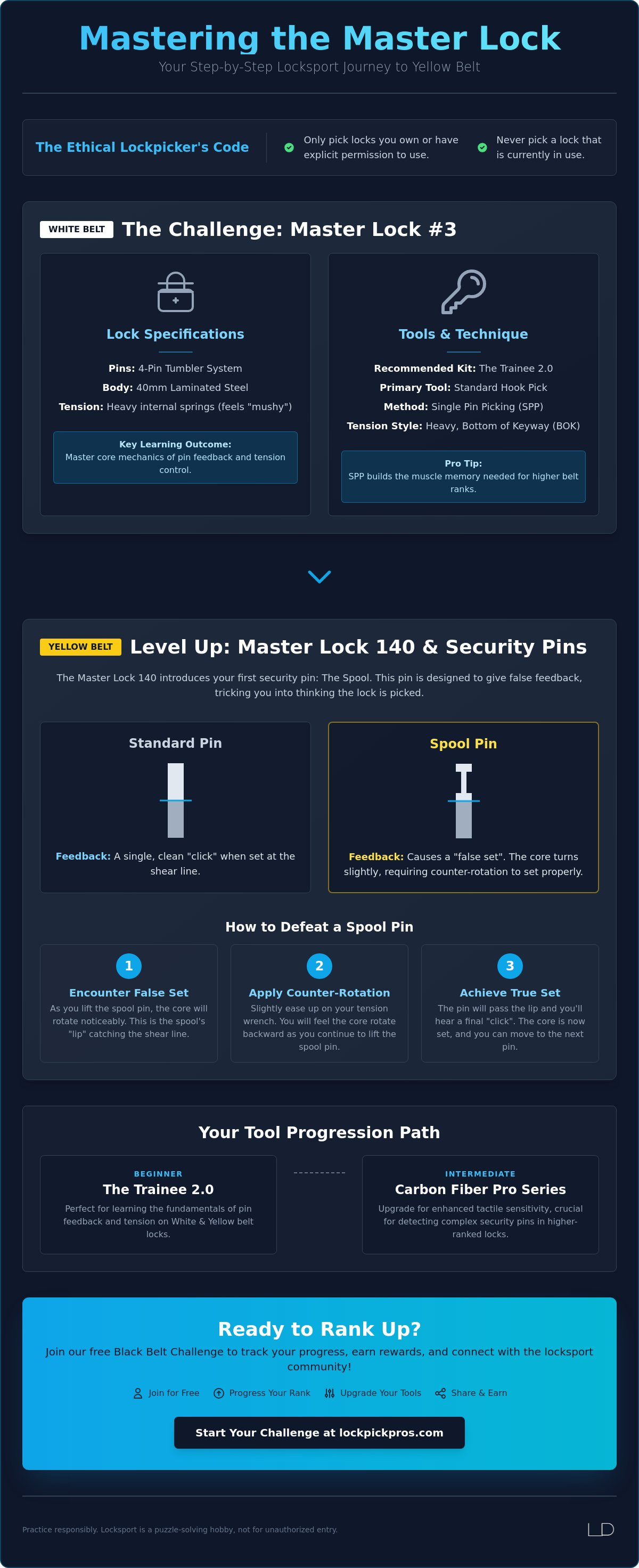
Most entry-level Master Locks, like the #1, #3, and #5, utilize a 4-pin tumbler system. While the bodies differ in size, the internal guts are remarkably similar. The Master Lock #3 features a 40mm wide laminated steel body. The #1 is slightly smaller at 38mm, while the #5 is the larger 51mm version. All of them use heavy spring tension. This tension is why Master Locks often feel "mushy" to beginners. You must push past the spring's resistance to find the actual binding pin. If you're just starting, The Trainee 2.0 is an excellent kit to help you visualize these movements before you move to picking "blind" locks.
The Ethical Lockpicker’s Code
Before you insert your first tension wrench, you must understand the rules of the game. Locksport is a community of honor. We follow a strict code to ensure our hobby remains respected and legal. Rule #1 is simple: only pick locks that you own or have explicit permission from the owner to pick. Rule #2 is even more critical: never pick a lock that is currently in use. If you accidentally damage a lock on your front door while practicing, you'll face a very expensive locksmith bill. We treat these devices as mechanical puzzles, not as ways to bypass security. Focus on skill refinement and community standards, and you'll find a welcoming world of experts ready to help you level up your rank.
Essential Gear for Picking Master Lock Padlocks
Don't reach for the paperclips. While some online guides suggest DIY tools, they are a recipe for frustration. Professional picks provide the clear feedback you need to feel the binding shelf inside the cylinder. High-quality steel transmits vibrations from the pins directly to your fingertips. Without this tactile data, you're just poking blindly at metal. Investing in a dedicated set is the most effective way to learn how to pick a master lock padlock with precision and speed.
The principle of using the right tool for the job applies to many precision-based disciplines; if you're also interested in high-performance equipment for canine behavior training, you can visit Educator Collars to explore their advanced remote systems.
The Beginner’s Tool Selection
For those starting their journey through the early belt ranks, pick set selection is your first major decision. You need tools that balance durability with sensitivity. For the Master Lock #3, The Trainee 2.0 is the perfect starting point. It provides the specific tools required to tackle these laminated locks, including a standard hook pick. This is your primary weapon for Single Pin Picking (SPP). While a City Rake or Triple Peak can often "zip" a Master Lock open, raking won't teach you the pin-by-pin control you need for the Yellow Belt and beyond.
When you use a hook, you are looking for the "binding" pin. This is the one pin that is being squeezed by the plug due to your tension. Professional tools allow you to feel the difference between a pin that is springy and one that is rock solid. If you want to dive into the physics of how these components interact, the renowned MIT Guide to Lock Picking offers the technical deep dive you need. Once you've mastered the basics, upgrading to a professional carbon fiber series will significantly enhance your tactile sensitivity.
Tensioning Techniques for Master Locks
Tension is where most beginners fail. On a Master Lock, you'll often need what we call "heavy tension." This is because the internal springs are quite stiff compared to high-security locks. You need enough force to overcome the spring but not so much that you lock the pins in place. Most hobbyists start with Bottom of the Keyway (BOK) tension. You place your wrench in the bottom of the plug and apply clockwise pressure. This gives you plenty of room to work your pick in the top half of the keyway.
How you hold your tools matters just as much as the tools themselves. Hold your pick with a light grip, similar to a pencil. This allows the vibrations to travel through the handle into your hand. Your tension finger should be steady and consistent. If you let off the pressure even for a split second, the pins will reset. This constant battle with the springs is what makes the Master Lock #3 such a great teacher. It forces you to maintain focus and control through the entire pick.
How to Pick the Master Lock #3: Step-by-Step
Ready to hear that first satisfying "clack" of a shackle popping open? While many advanced pickers call this lock easy, learning how to pick a master lock padlock for the first time requires patience and a delicate touch. The Master Lock #3 is famous for its loose tolerances. This means the feedback can be a bit muffled compared to higher-end locks. Follow these steps to secure your first successful open.
- Step 1: Apply Tension. Insert your tension wrench into the bottom of the keyway. Apply consistent, clockwise pressure. Imagine you are trying to turn a key very gently. You need enough force to trap the binding pin but not so much that you bend your tools.
- Step 2: Find the Binder. Slide your hook pick to the very back of the lock. Slowly pull it forward, touching each pin as you go. Most pins will feel springy. One pin will feel stiff or "stuck." This is your binding pin.
- Step 3: Set the Pin. Apply steady upward pressure on that binding pin. You are looking for a tiny movement in the core and a distinct click. Once it clicks, that pin is at the shear line.
- Step 4: Rotate the Core. Move to the next binding pin. Repeat the process for all four pins. When the final pin sets, the tension wrench will give way and the core will rotate freely.
Single Pin Picking (SPP) Mastery
If you find yourself struggling to identify the binder, try "scrubbing" the pins. Lightly run your pick over the pin stack without much upward force to get a feel for the spring tension. Master Lock #3 feedback is notoriously mushy. You won't always get a loud, crisp click. Sometimes you just feel a slight shift. If a pin feels rock hard and won't move at all, you might be over-tensioning. Drop a tiny bit of pressure until the pin can move. If you accidentally push a pin too high, you've overset it. When this happens, you'll need to release tension, let the pins drop, and start over. For a deeper technical explanation of these pin states, the MIT Guide to Lock Picking is an invaluable resource for your study sessions.
Raking the Master Lock #3
Sometimes you just want a quick win. Raking is a faster method often used on low-security padlocks. The "Zip" technique involves inserting a rake to the back and pulling it out quickly while applying light tension. You can also use a "rocking" motion with a City Rake, mimicking the way a key works. While raking is a fun party trick, don't rely on it. It won't help you when you move up to locks with security pins. True mastery comes from SPP. If you're practicing with The Trainee 2.0, focus on feeling each individual pin set. This builds the muscle memory required for the Yellow Belt challenges ahead.
Advancing to the Master Lock 140: Defeating Spool Pins
Once you've conquered the Master Lock #3, you might think you know exactly how to pick a master lock padlock. The Master Lock 140 will quickly challenge that assumption. This solid brass padlock is a major step up and serves as the gateway to your Yellow Belt. While the #3 relies on standard pins and loose tolerances, the 140 introduces security pins. These are designed specifically to trick you when you are learning how to pick a master lock padlock with more precision. Successfully opening this lock proves you can read complex internal feedback rather than just relying on luck.
The core of the challenge lies in the "false set." When you are picking, the core may suddenly rotate a few degrees and then stop. It feels like the lock is about to open, but the shackle remains firmly in place. You've fallen into the trap of a spool pin. To progress, you'll need to learn the art of counter-rotation. This is the moment the lock actually fights back. It's a thrilling experience that defines the transition from a casual hobbyist to a serious locksport competitor.
The Master Lock 140 Pin Stack
The internal configuration of the Master Lock 140 typically features a 4-pin stack consisting of one standard pin and three spool pins. Spool pins are shaped like an hourglass. The narrow center section is what causes the false set when it gets caught at the shear line. Your strategy must change. You usually need to find and set the standard pin first. Once that standard pin is home, the plug will drop into a false set. This is your signal that you're now dealing with the spools. Using the Carbon Fiber Gen 2 Pro Series is a game changer here. The high-density handles transmit the subtle "clicks" of a spool much more clearly than standard rubber-coated tools.
Advanced Feedback: Counter-Rotation
When you find a spool pin while in a false set, you'll feel something strange. As you lift the pin, the plug will try to turn backward against your tension wrench. Don't panic. This counter-rotation is exactly what you want. You must manually ease off your tension just enough to let the plug rotate back while you push the spool pin up. If you keep your tension too heavy, you'll likely bend your pick or snap the pin into an overset position. It's a delicate balance of giving and taking.
Use the "Jiggle Test" to verify each pin's state. A set pin will have a tiny bit of springy play. A binding spool will feel rock solid and force the wrench to move as you apply pressure. Once the spool clears the shear line, the plug will often drop back into a false set or, if it was the last one, the lock will finally pop open. If you want to master this advanced feedback, upgrade to our Carbon Fiber Gen 2 Pro Series today to feel every micro-movement inside the core.
Earning Your Belt: The Black Belt Challenge
You've done the work and felt the pins move. You've mastered how to pick a master lock padlock and transitioned from the standard #3 to the spool-heavy 140. Now it's time to make your progress official. In the locksport community, your advancement is tracked through specific belt ranks. Earning your White and Yellow belts is just the beginning of a lifelong journey into mechanical security. It's a badge of honor that shows you've moved past the "beginner's luck" phase and into true skill refinement.
Documentation is key for community verification. For these entry-level tiers, a simple video showing you picking the lock and turning the core is usually enough to prove your mastery. It demonstrates that you actually understand the feedback inside the cylinder rather than just getting a lucky open. This transparency is what keeps our community strong and ethical. We treat these devices as puzzles to be solved, and sharing your solution helps the next generation of pickers find their way.
Your Progression Roadmap
Don't rush into high-security locks just yet. If you're still refining your touch in the world of beginner lockpicking, check out our guide on How to Choose Your First Beginner Lock Pick Set to ensure you have the right profile for the next tier. While you've conquered basic padlocks, practice locks with clear or cutaway housings can help bridge the gap between "feeling" and "seeing" more complex internal movements. As you move toward Orange and Green belts, your tool needs will change. The Gen 2 Pro Max Stealth Edition is the ideal upgrade path for pickers ready for tighter keyways and more aggressive security pins.
Community Bounties and Social Rewards
At Lockpick Pros, we believe in a "Share-to-Earn" loop. We want to see your "picks-in-action" content. Post your successful Master Lock opens on social media and tag our community. Not only does this help other beginners learn how to pick a master lock padlock, but it also qualifies you for community bounties. We offer rewards for reaching social reach milestones to foster engagement and keep the sport growing. It's our way of giving back to the enthusiasts who push the boundaries of the hobby.
The road to Black Belt is long, but every open brings you one step closer. Our challenge encourages a specific progression: join the challenge for free, progress one belt at a time, upgrade your tools at each tier, and share your journey to earn rewards. It's a journey of mastery, and we're here to mentor you through every click and counter-rotation. Ready to take the next step and earn your stripes? Join the Black Belt Challenge today!
Ready to Claim Your First Belt?
You've now got the roadmap to navigate the internal world of the Master Lock series. Mastering how to pick a master lock padlock isn't just about getting an open; it's about developing the technical sensitivity to distinguish between a standard pin and a tricky spool. You started with the heavy spring tension of the #3 and leveled up to the false sets of the 140. This journey is the core of the locksport community's belt-ranking system.
We are dedicated to fostering a community of ethical lockpickers who treat every cylinder as a puzzle to be solved with precision. To keep your progression moving toward the Orange and Green tiers, you need gear that doesn't mask the feedback you're working so hard to hear. Professional-grade carbon fiber tools provide the crisp data required to defeat security pins with confidence. Upgrade to the Carbon Fiber Gen 2 Pro Series and join the Black Belt Challenge today!
Your journey from a curious trainee to an expert picker is just beginning. Keep practicing, stay focused on the "pop," and we'll see you at the next rank. For those who move into the business side of security hardware, you can explore D-PACK's packaging characterization and design to ensure your products are delivered with professional-grade protection.
Frequently Asked Questions
Is it legal to pick a Master Lock padlock?
Possession of lock picking tools is legal in the vast majority of U.S. states as long as you have no criminal intent. The law generally focuses on intent rather than the tools themselves. Ethical lockpickers only pick locks they own or have explicit permission to pick. Always check your local and state statutes to ensure you are following specific regional regulations while practicing your hobby.
Can I pick a Master Lock with a paperclip or bobby pin?
You can technically pick a lock with improvised tools, but we don't recommend it for serious locksport. Bobby pins and paperclips provide terrible tactile feedback and can easily snap or jam inside the cylinder. To truly learn how to pick a master lock padlock, you need professional tools that transmit the subtle vibrations of the pins. Dedicated picks protect your locks and accelerate your skill progression.
What is the easiest Master Lock to pick for a beginner?
The Master Lock #3 is widely considered the easiest model for a beginner to tackle. It features a 4-pin tumbler system with wide tolerances, making it the industry standard for earning a White Belt rank. Its simple internal construction allows you to focus on basic tensioning and pin placement without the distraction of advanced security features. It is the perfect foundational puzzle for your first successful open.
Why does my Master Lock feel "mushy" when I try to pick it?
Master Locks feel "mushy" because of their manufacturing tolerances and heavy internal springs. Unlike high-precision locks that give a crisp click, the #3 often provides muffled feedback. This happens because the pins don't always sit perfectly against the shear line. You must apply consistent tension and learn to identify the subtle shifts in the core to overcome this characteristic mushiness during practice.
What tools do I need to start picking Master Locks?
A basic beginner kit should include a standard hook pick, a rake, and at least two different tension wrenches. The hook is essential for Single Pin Picking, while the rake helps you understand zipping and rocking techniques. We recommend starting with a dedicated set like The Trainee 2.0. This ensures you have the right metal thickness and handle comfort to develop proper muscle memory.
What is the difference between a Master Lock #3 and a Master Lock 140?
The primary difference lies in the internal pin stack and security features. The Master Lock #3 uses four standard pins and is a White Belt lock. The Master Lock 140 is a solid brass Yellow Belt lock that contains one standard pin and three security spool pins. These spools create false sets, requiring more advanced counter-rotation techniques to successfully open the lock compared to the simpler #3.
How long does it take to learn how to pick a padlock?
Most beginners can achieve their first open on a Master Lock #3 within 15 to 30 minutes of focused practice. However, mastering the skill involves consistently opening the lock without looking. Developing the tactile sensitivity to learn how to pick a master lock padlock by feel usually takes a few weeks of regular sessions. Your progress depends on your tools and your willingness to study mechanical theory.
What is the "Black Belt Challenge" in lockpicking?
The Black Belt Challenge is a community-driven ranking system that tracks a picker's progression from beginner to expert. Each belt color represents a specific difficulty tier of locks you must successfully pick and document. It is an aspirational journey that fosters a culture of ethical picking and skill refinement. Joining the challenge allows you to earn rewards and milestones as you climb the ranks toward locksport mastery.