

How to Use Padlock Shims: A Master Guide for Ethical Lockpickers
You don't always need a hook and tension wrench to conquer a padlock; sometimes, the most elegant solution is a sliver of steel and a bit of mechanical finesse. While many beginners view it as a "cheat," mastering the art of the bypass is a foundational skill for every ethical lockpicker. Learning how to use padlock shims correctly is less about brute force and more about understanding the internal geometry of a spring-operated latch. It's a precision exploit that separates the curious hobbyist from the dedicated practitioner.
We know how frustrating it is when a shim snaps or gets stuck because you're working on an unshimmable lock, like those featuring modern ball-bearing internals. You want to feel that satisfying click of a successful bypass on your practice lock, not deal with mangled tools. This master guide will walk you through the step-by-step technique to level up your locksport skills. We'll identify which locks are vulnerable to this method and provide the technical insight you need to advance your community belt ranking with confidence.
Key Takeaways
- Understand the mechanical exploit of bypassing spring-assisted latches by sliding thin steel between the shackle and the lock body.
- Learn how to use padlock shims effectively by identifying vulnerable targets and avoiding locks with un-shimmable ball-bearing mechanisms.
- Master the precision technique of using two shims simultaneously to navigate tight tolerances without bending or breaking your tools.
- Advance your locksport journey by adding bypass techniques to your foundational skill set as you climb the community belt ranks.
Understanding the Mechanics of Padlock Shimming
A padlock shim is a specialized bypass tool that exploits the mechanical tolerances between a padlock's shackle and its housing to disengage the internal locking mechanism. Understanding this fundamental exploit is a core part of your locksport for beginners journey. While traditional picking focuses on the pin tumbler cylinder, shimming targets the latch itself. If you are wondering What is a padlock shim?, it is essentially a thin, curved piece of spring steel. When learning how to use padlock shims, you're looking for a way to mechanically push the internal latch back into the lock body, bypassing the need to turn the plug or interact with the pins at all.
The Science of Spring-Assisted Latches
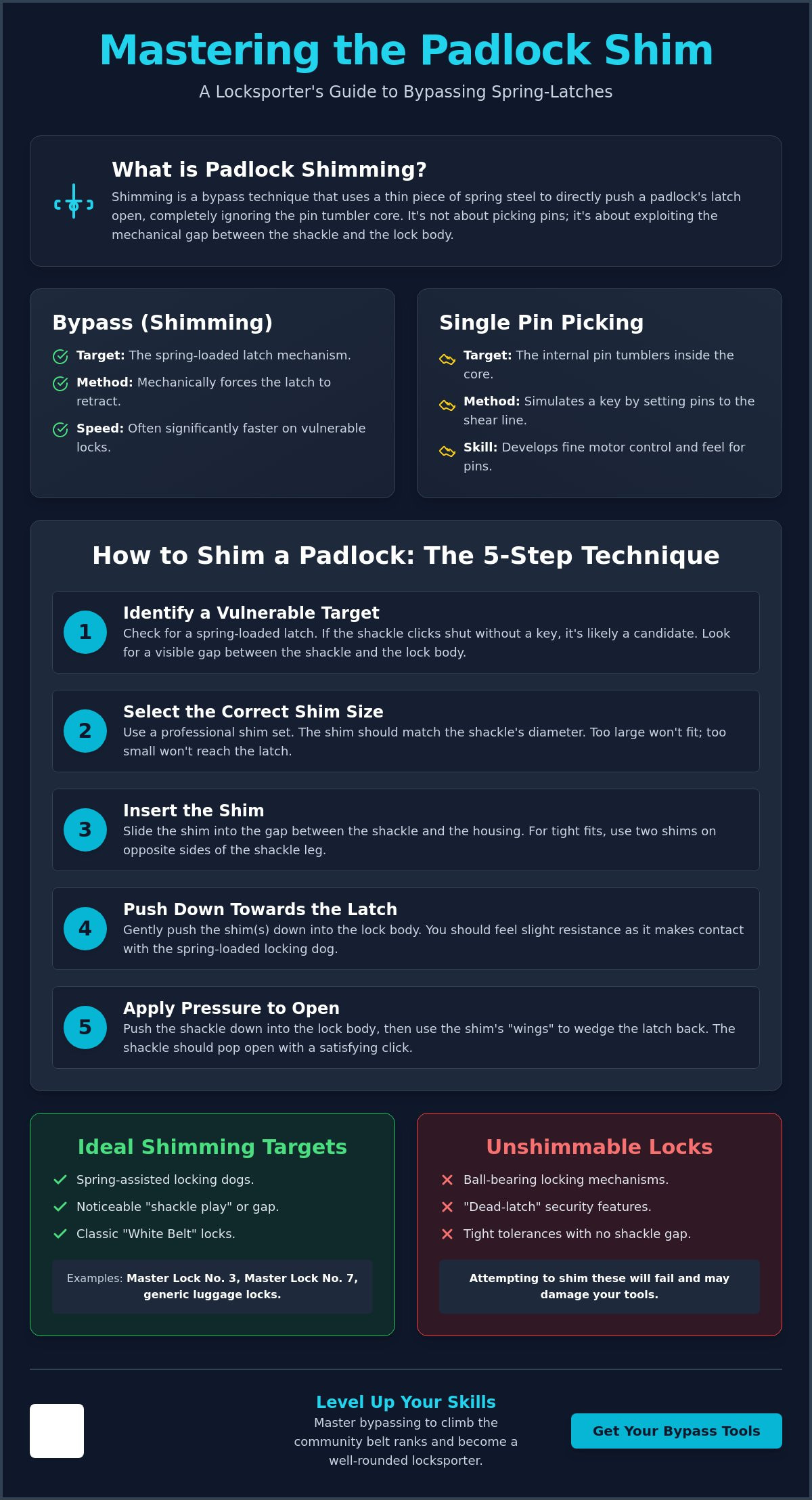
Inside many entry-level padlocks, the shackle is held shut by a spring-loaded component known as a locking dog. This latch is often angled on one side, allowing the shackle to click into place when you press it closed. Because there is always a small gap between the shackle and the lock body, a shim can slide into that space. As you push the shim downward, it creates a wedge effect. This physical pressure forces the spring-loaded locking dog to retract into the lock body. Once the latch is clear of the shackle's notch, the lock pops open instantly. This mechanism is standard in many "White Belt" locks, such as the classic Master Lock No. 3 or generic luggage locks. These are perfect targets for practicing the feel of a successful mechanical bypass.
Bypass vs. Picking: When to Use Shims
It's vital to distinguish between picking and bypassing. Picking involves manipulating individual pins or wafers to simulate the presence of a key. Bypassing, on the other hand, ignores the pins entirely and goes straight for the locking bolt or latch. For low-security padlocks with weak spring tension, shimming is often significantly faster than single pin picking (SPP). It is a highly efficient skill to add to your toolkit, especially when you are looking for what to learn after single pin picking. Learning how to use padlock shims gives you a broader perspective on security vulnerabilities. It teaches you that a lock is only as strong as its weakest point. If the latch is exposed and spring-driven, the complexity of the internal pin stack becomes irrelevant to your success.
Mastering this technique requires a light touch. You aren't trying to force the lock open with strength. Instead, you are using the shim to navigate the tight tolerances of the hardware. This focus on precision and mechanical understanding is what defines the locksport hobby. By studying how these spring-assisted latches fail, you become a more well-rounded and knowledgeable ethical lockpicker.
Choosing the Right Tools and Identifying Targets
Success in locksport depends on using the right tool for the job. While it's tempting to grab an aluminum can and start cutting, DIY shims often lead to frustration and damaged hardware. Professional bypass tools are manufactured from ultra-thin, flexible spring steel designed to slide into microscopic gaps without deforming. If you're serious about learning how to use padlock shims, investing in a dedicated bypass set ensures you don't leave metal shavings inside your favorite practice locks. High-quality steel provides the tactile feedback you need to feel the internal latch move.
For those who appreciate mechanical ingenuity in all their tools, check out JellyPenny to discover unique stationery that brings precision and creative design to your workspace.
Beyond the world of locksport, precision hardware is equally important for home maintenance; for instance, SocketSpacers.com offers custom solutions for fixing recessed or loose electrical outlets and switches.
Shim Anatomy: Finding the Perfect Fit
Shims aren't one-size-fits-all. They typically come in small, medium, and large sizes to match the diameter of the shackle. A shim that's too large won't enter the lock body, while one that's too small won't reach the locking dog. The "wings" on the side of the tool are crucial. They provide the leverage needed to perform the final twist that retracts the latch. For those looking to refine their technique and move toward intermediate ranks, using high-quality tools like the Carbon Fiber Gen 2 Pro Series offers the durability required for precision work. Using a dedicated bypass set leads to much more consistent results during your practice sessions.
How to Spot a Shimmable Padlock
Not every lock is vulnerable to this exploit. Before you start, perform the "spring-back" test. Open the lock with a key, then try to snap the shackle shut. If it clicks into place without the key turned, it likely uses a spring-loaded latch. Another indicator is shackle play. You need a visible gap between the shackle and the housing to insert the tool. Older models, particularly classic Master Lock No. 3 or No. 7 padlocks, are legendary targets because of their generous tolerances. They provide the perfect training ground for a newcomer to the sport.
Identifying these features saves time and prevents unnecessary tool wear. If a lock has a dead-latch or uses ball bearings, no amount of force will make a shim work. For a deeper look at the physical process, check out this step-by-step guide to using padlock shims which illustrates the insertion angles perfectly. Mastering the selection process is just as important as the bypass itself. It ensures you spend your time practicing on locks you can actually defeat, helping you truly understand how to use padlock shims in the field.
Step-by-Step Guide to Bypassing with Shims
Bypassing a lock is a test of patience and sensory feedback. Before you begin, ensure you're practicing on your own hardware in a legal setting. Ethical standards are what define the locksport community. Mastering the feel of the tool is the most important part of learning how to use padlock shims. If you apply too much force, you'll simply bend the thin spring steel. You want to seat the shim with the same steady pressure you would use to push a thumbtack into a corkboard. It should feel firm, consistent, and controlled.
Insertion and Positioning
Place the shim against the shackle leg on the outside curve. This is where the gap between the shackle and the housing is usually widest. Slide the shim downward into the body. You will likely feel resistance once the tool meets the latch. To get past tight tolerances, use a slight rocking motion. This helps the steel find the path of least resistance. Understanding The mechanics of lock shimming helps you visualize how the tool needs to wrap around the shackle to reach the locking dog. Don't force it; if it won't slide in, reset and try a different angle.
The Twist and Pull Maneuver
Once the shim is seated against the latch, rotate it toward the center of the lock. This movement forces the locking dog to retract into the housing. While you maintain this twist, pull upward on the shackle firmly. Many modern padlocks have latches on both sides of the shackle. For these targets, you must use two shims simultaneously. Insert one into each leg and twist them inward toward each other. This dual action retracts both locking dogs at once, allowing the shackle to release. It takes practice to coordinate both hands, but once you find the rhythm, the lock will pop open with ease. This technique is a major milestone in learning how to use padlock shims effectively during your practice sessions.
Why Shims Fail: Security Pins and Ball Bearings
Even when you've mastered how to use padlock shims, you'll eventually encounter a lock that refuses to budge. This isn't necessarily a failure of your technique. High-security padlocks are specifically engineered to defeat bypass tools by removing the mechanical vulnerabilities that shims exploit. While spring-loaded locking dogs are common in "White Belt" locks, professional-grade hardware uses more robust internal defenses. Understanding these barriers is essential for your growth as an ethical lockpicker. It tells you exactly when to put the shims away and reach for your pick set instead.
The Ball Bearing Blockade
The most common reason shimming fails is the presence of a ball bearing locking mechanism. Unlike the spring-assisted latches we discussed earlier, ball bearings are deadlocked. They sit in deep, circular indents on the shackle and are held in place by a solid metal cam. Because this cam only moves when the key cylinder rotates, the bearings cannot be pushed back into the lock body by a wedge. If you try to force a shim into a ball-bearing lock, you'll likely just ruin your tool. You can usually spot these locks by looking for a perfectly circular cutout on the shackle. These targets require single pin picking or other advanced techniques to defeat. When you hit this blockade, it is time to upgrade to advanced lock pick sets for professionals to continue your progress.
Dealing with Tight Tolerances
Manufacturing quality plays a massive role in shim resistance. Professional-grade locks are built with extremely tight tolerances, leaving virtually no gap between the shackle and the housing. Some manufacturers even include "shim guards" or specific anti-shim technology. For example, Master Lock features "BlockGuard" technology in models like the 1502 and 1525. This design uses a flat-profile latch that traps the shim tool, preventing it from reaching the locking mechanism. Forcing a tool into these tight spaces often leads to tool breakage or a shim getting permanently stuck inside the lock body.
If you're struggling with tight fits but the lock doesn't have ball bearings, you may need to refine your "feel" for the gap. Transitioning to The Trainee 2.0 allows you to practice on locks with progressively tighter tolerances in a controlled environment. This helps you learn the difference between a lock that is simply difficult and one that is truly unshimmable. Once you can identify these defenses on sight, you'll save your tools and focus your energy on the right exploit. To ensure you have the precision tools needed for these tougher challenges, check out our Carbon Fiber Gen 2 Pro Series.
Mastering the Bypass: Your Path to the Black Belt
Shimming is much more than a quick shortcut. It's a foundational skill that helps you understand the "why" behind lock design. Every master in this sport started with a simple padlock and a dream of reaching the Black Belt. By learning how to use padlock shims, you're not just opening a lock; you're developing a mechanical intuition that will serve you throughout your entire locksport career. In the community belt ranking system, mastering bypasses is just as important as mastering the pick. It proves you understand the hardware from every angle. You're not just defeating a cylinder; you're analyzing the entire security ecosystem of the device.
Integrating Shims into Your Locksport Training
Expert pickers use shimming strategically to maximize their training time. Instead of spending hours on low-security locks that offer little tactical feedback, use a shim to clear them in seconds. This efficiency allows you to focus your mental energy on high-security picking practice where the real skill refinement happens. We recommend keeping a detailed log of your collection to track which locks were vulnerable to shimming and which required more advanced tools. This habit builds a personal reference guide that mirrors the community standards found on platforms like Reddit and LPU. If you're just starting out, check out our ultimate 2026 guide on lock pick sets to ensure you have the right gear for every tier of your journey. Knowing how to use padlock shims effectively means you can quickly identify "White Belt" targets and move on to the "Blue" and "Purple" challenges that await you.
The Black Belt Challenge
Are you ready to prove your skills and earn your place among the experts? Join our free Black Belt Challenge today. This program is designed to guide you through the ranks one belt at a time, ensuring you build a solid foundation before moving to advanced tiers. As you progress, you'll have the opportunity to upgrade your tools and tackle increasingly complex mechanisms. We encourage all our ethical lockpickers to share "picks-in-action" content on social media. By documenting your journey and sharing your successes, you can earn exclusive rewards through our share-to-earn loop. We even have a community bounty for hitting social reach goals, fostering a supportive and competitive space for everyone to grow. Your journey toward mastery starts with a single click. Join the challenge, share your progress, and let's advance the sport together.
Take Your Bypass Skills to the Next Level
Mastering how to use padlock shims is a major milestone for any ethical lockpicker. You've learned how to identify vulnerable spring-loaded latches, the importance of using professional-grade spring steel, and the precision required for the dual-shim maneuver. Whether you're clearing White Belt locks to save time or studying the "why" behind mechanical exploits, you're now equipped with a foundational bypass skill that sets you apart in the locksport community. Remember that even the best shims have their limits against ball bearings and tight tolerances; knowing when to switch to your picks is the mark of a true expert.
Lockpick Pros provides precision tools for locksport mastery and community-driven belt ranking support. We're trusted by ethical lockpickers worldwide to deliver the quality gear needed for every stage of your development. If you're ready to advance through the ranks and prove your expertise, it's time to gear up and commit to the craft. Our community is waiting to celebrate your next successful bypass.
Join the Free Black Belt Challenge and Start Your Journey Today!
Keep practicing, stay ethical, and we'll see you at the next belt level.
Frequently Asked Questions
Are padlock shims legal to own and use?
Owning lockpicking tools is legal in most U.S. states as long as you don't have criminal intent. As of April 2026, jurisdictions like Mississippi, Nevada, Ohio, and Virginia have stricter laws where possession can be considered evidence of intent. Always practice on your own hardware to stay within ethical boundaries. Check your local statutes to ensure you are compliant with regional regulations while pursuing your locksport hobby.
Can I use a padlock shim on a combination lock?
Many entry-level combination padlocks are vulnerable to shimming if they use a spring-assisted latch. The bypass targets the locking dog that holds the shackle, which is often identical to the mechanism found in keyed locks. However, higher-security combination models often feature dead-latches or shielded internals that block the tool. Testing your combination locks is a great way to learn how to use padlock shims on different hardware types.
What is the difference between a shim and a lock pick?
A lock pick is designed to manipulate the internal pins or wafers of a lock cylinder to simulate a key. A shim is a bypass tool that ignores the cylinder entirely to target the locking bolt or latch directly. While picking requires tension and pin feedback, shimming is a mechanical exploit of the lock's physical tolerances. Both are essential skills for advancing through the community belt ranking system.
Why does my padlock shim keep bending?
Shims typically bend because of excessive force or trying to bypass an unshimmable lock. If a lock uses ball bearings or has anti-shim features, the tool has no path to the latch. You should feel for a slight "give" rather than forcing the steel. Using high-quality spring steel tools provides better feedback and durability than flimsy DIY alternatives, which often fail after a single attempt.
Will shimming a lock damage the internal mechanism?
Shimming is generally a non-destructive bypass, but improper technique can cause issues. Forcing a tool can leave metal shavings inside the housing or scratch the shackle's locking notch. If a shim snaps inside the lock body, it can permanently jam the mechanism. Using professional tools and a light touch ensures your practice locks remain functional for future training sessions as you refine your technique.
Do Master Locks still have the shimming vulnerability?
Many older Master Lock models are still vulnerable, but the brand has integrated BlockGuard anti-shim technology into several newer lines. As of 2024, models like the 1502, 1525, 1572, 1585, 2076, and A400 feature latches designed to trap shim tools. This technology significantly improves security against simple bypasses. Identifying these protected models is a key part of learning how to use padlock shims effectively without wasting time.
Can I make my own padlock shims at home?
You can create functional shims from aluminum soda cans, but they lack the precision of professional tools. DIY shims are often too thick for tight tolerances and lose their shape after one or two uses. For serious locksport practitioners, dedicated bypass tools offer the consistent flexibility and strength needed for mastery. Professional gear helps you develop the proper "feel" required to advance to higher belt ranks.