

Mastering the Jiggler: A Guide to Using Jigglers for Wafer Locks (2026)
What if that "random" shaking motion you've been trying is actually a precise mechanical exploit waiting for a master's touch? Many hobbyists start their journey by frantically vibrating a tool inside a desk drawer lock and hoping for a stroke of luck. It's a common frustration in beginner lockpicking to feel stuck when you can't distinguish a wafer lock from a pin tumbler, or worse, when you snap a tool because of heavy-handed tension. We've all been there, and we know that using jigglers for wafer locks often feels more like a guessing game than a refined skill.
This guide changes that by teaching you the controlled techniques required to bypass these mechanisms with confidence on your own practice locks. You'll learn how to identify the right jiggler shape for the job and how to apply the light touch necessary to keep your tools intact. We're going to break down the mechanics of the wafer bypass and show you how mastering these specialty tools helps you progress toward your next locksport belt rank. Let's turn that random movement into a technical win that earns you your next achievement in the community.
Key Takeaways
- Identify wafer locks by their flat metal sheet mechanisms and learn why their loose tolerances make them ideal candidates for jiggler tools.
- Master the rhythmic cycle of "insert, jiggle, and turn" to effectively start using jigglers for wafer locks as both your pick and tension wrench.
- Discover how to select specific jiggler profiles and why high-yield steel tools provide the superior feedback necessary for a successful bypass.
- Learn professional troubleshooting tips to safely free a stuck tool or navigate "sticky" wafers caused by internal debris and old grease.
- Understand how mastering these bypass techniques supports your progression through the community belt ranks and prepares you for the Black Belt Challenge.
Understanding Wafer Locks: Why Jigglers are the Ultimate Bypass Tool
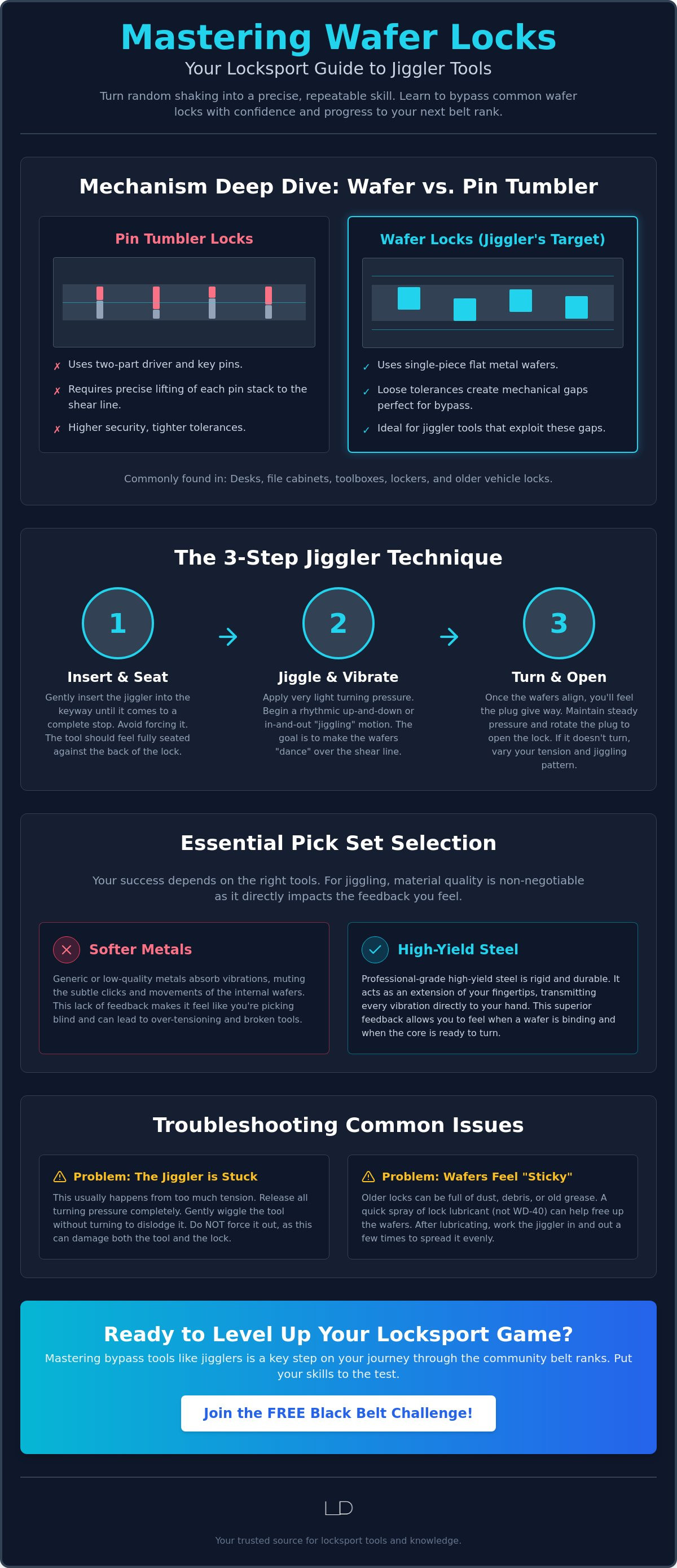
If you've spent your time mastering pin tumblers, your first encounter with a wafer lock might feel a bit strange. These mechanisms don't use the cylindrical pins you're used to. Instead, they rely on flat metal sheets called wafers. These wafers move vertically within the plug. When you insert the correct key, the wafers are pulled into the plug's circumference, allowing it to rotate. However, these locks are notorious for having loose internal tolerances. This mechanical gap is exactly why using jigglers for wafer locks is such an effective bypass method. It's a controlled exploit that feels like magic when the plug finally turns.
From the perspective of an ethical lockpicker, mastering bypass tools is about more than just opening a lock. It's about understanding the fundamental vulnerabilities of different designs. While single pin picking is a core skill, knowing when to reach for a jiggler shows a deeper level of proficiency. We view these tools as specialized instruments for specific challenges, not shortcuts. It's a technical addition to your toolkit that broadens your capability as you progress through the community belt ranks.
Wafer vs. Pin Tumbler Mechanisms
The primary difference lies in how the locking components interact with the shear line. In a pin tumbler, you have two-part pins that must be lifted to a precise height. A Wafer tumbler lock uses single-piece wafers that stick out of the top or bottom of the plug. These wafers are spring-loaded and rest in a groove in the lock housing. Because wafers are thin and the keyways are often quite wide, they lack the restrictive paracentric profiles found in high-security pin tumblers. This open space provides plenty of room for a jiggler to move. In many automotive applications, you'll even find double-sided wafers. These require a tool that can interact with both the top and bottom of the keyway simultaneously to find the opening.
Common Applications for Jiggler Tools
You'll find wafer locks almost everywhere in your daily life. They are the standard for low-to-mid security applications because they're inexpensive to produce. Think about the desk at your office, the file cabinet in your home, or the gas cap on your car. Toolboxes and lockers are also prime examples. In "all keys lost" scenarios, professional locksmiths prioritize jigglers because they are incredibly fast. They don't want to spend ten minutes picking a simple cam lock when a jiggler can do it in seconds. If you're wondering where this fits into your journey, our 2026 Locksport Roadmap highlights wafer picking as a essential milestone after you've mastered basic pin tumbler sets. It's a fun, rewarding skill that adds a new dimension to your practice sessions.
Choosing Your Jiggler Set: Profiles, Sizes, and Materials
Now that you understand the mechanical gaps in these locks, your next step is mastering pick set selection for bypass scenarios. While standard hooks are your bread and butter, using jigglers for wafer locks requires tools that act as simulated keys. These tools feature bitting profiles averaged to represent common depths. Instead of lifting one pin at a time, you're presenting the lock with multiple probable combinations in rapid succession. It is a game of probability backed by mechanical precision.
Material choice is a critical factor for any serious hobbyist. We always recommend tools made from high-yield steel. This material isn't just about durability; it's about communication. Softer metals absorb the vibrations you need to feel what's happening inside the plug. High-yield steel transfers that feedback directly to your fingertips. This allows you to sense when a wafer is binding or when you've successfully cleared the shear line. You might also encounter try-out keys. These are a specialized subset of jigglers often cut for specific vehicle makes or cabinet brands. They are less about jiggling and more about testing specific, known bitting patterns.
The Anatomy of a High-Quality Jiggler
A professional jiggler consists of three main parts: the handle, the shank, and the tip. The handle should provide a secure grip for rhythmic movement. The shank needs to be thin enough to navigate the keyway but rigid enough to apply turning pressure. The tip is where the magic happens. Look for specific peak and valley profiles that mimic the cuts on a real key. A smooth, polished finish is non-negotiable. If the tool is rough, it will snag on the wafers and ruin your feedback. If you're just starting out, The Trainee 2.0 is an excellent way to build these foundational bypass skills with reliable tools.
Sizing Matters: Matching the Tool to the Keyway
You can't use a one-size-fits-all approach here. Jiggler sets typically come in mini, medium, and large scales. A tool that's too small won't reach the wafers effectively. One that's too large will bind against the keyway walls and stop the plug from turning. You want a tool that fills the keyway comfortably while still allowing for vertical and horizontal movement. Ball profiles are often fantastic for double-sided automotive wafers. Rake profiles, on the other hand, are better for aggressive movement in simpler cabinet locks. As you refine your kit, consider upgrading to our Carbon Fiber Lockpicks for the ultimate in lightweight, high-feedback performance.
Step-by-Step: Using Jigglers for Wafer Locks Correctly
Mastering the jiggler requires a shift in how you think about tension. In traditional single pin picking, your tension wrench and pick are separate entities. When using jigglers for wafer locks, the tool itself performs both roles. You're trying to find a specific mechanical "sweet spot" where the wafers are bounced into their set positions while the plug is under slight rotational pressure. It's a rhythmic, tactile process that rewards patience over power. Many beginners make the mistake of using heavy torque. This actually binds the wafers against the lock housing and prevents them from moving freely. Keep your hands relaxed. You're looking for a fluid, vibrating motion that lets the tool's profile do the heavy lifting.
Technical Profile: The 5-Wafer Utility Cam Lock
To see these principles in action, let's look at a standard 5-wafer utility cam lock, often used in office furniture. This lock features a stack of five single-sided wafers. Unlike the pin tumbler locks you might have practiced on for your White belt, these don't contain security pins like spools or serrated drivers. Instead, the challenge comes from the varying heights of the wafers and the loose tolerances of the plug. For this specific lock, we recommend a medium-sized "ball" or "wave" jiggler. You'll need to apply very light clockwise tension. Because there are no security pins, the lock won't give you a "false set" feeling; it will either remain bound or suddenly rotate fully once all five wafers clear the shear line simultaneously.
The Jiggle and Turn Technique
Follow these steps to develop a consistent bypass methodology for your practice sessions:
- Step 1: Insert your chosen jiggler fully into the keyway. Ensure it reaches the back of the lock to interact with the fifth wafer in the stack.
- Step 2: Apply a very light rotational force in the direction the lock opens. This is "feather-light" tension. You only want enough pressure to catch the wafers as they hit the shear line.
- Step 3: Move the tool in and out of the keyway with short, rapid strokes. Simultaneously, vibrate or "jiggle" the tool vertically. This creates a multi-directional movement that mimics various bitting depths.
- Step 4: Gradually vary the depth of your strokes. Sometimes the lock will open when the tool is only halfway inserted. If the plug doesn't rotate after 10 to 15 seconds, reset and try again.
Finding the Sweet Spot: Tension and Depth
The secret to high-level bypass is listening to the lock. Even with a jiggler, you can often feel or hear a faint "click" as a wafer finds its home. You might also feel the plug give a tiny fraction of a millimeter. This is your signal that you're close. If you've been jiggling for a while with no result, your tension is likely too heavy. Release the pressure entirely to let the wafers reset, then start again with even less torque. If a lock is being particularly stubborn, you might need to switch from a jiggler to a more precise instrument. In these cases, using a Carbon Fiber Gen 2 Pro Series pick allows you to manipulate individual wafers with surgical accuracy. This hybrid approach ensures you can handle both loose-tolerance utility locks and tighter, modern wafer mechanisms as you pursue higher belt ranks.
Troubleshooting and Ethical Locksport Practices
Sometimes, even with the perfect technique, the plug just won't turn. One of the most common issues beginners face when using jigglers for wafer locks is the terrifying feeling of a tool getting stuck. Don't panic. This usually happens when a wafer has been over-lifted or the tool has bypassed the last wafer and caught on the back of the lock housing. To free it, gently wiggle the tool while applying zero tension. Never yank it. If it's truly jammed, a small drop of lubricant can often provide the clearance needed to slide the tool back out. It's a rite of passage for every hobbyist, so stay calm and work the tool slowly.
Understanding the limits of your tools is part of the mastery journey. Jigglers are incredibly effective for standard utility locks, but they have their boundaries. Modern high-security wafer locks often incorporate sidebars. These mechanisms require the wafers to be at exact heights to allow a sidebar to drop into a groove. In these cases, a jiggler's "average bitting" approach won't work. You'll need to transition to single wafer manipulation to find the gate for each component. Recognizing when a tool isn't the right fit is a sign of an expert-level picker.
Dealing with Sticky Wafers and Worn Locks
Utility locks on outdoor gates or old desks often suffer from "sticky" wafers. Years of old grease, dust, and grit can turn a simple bypass into a frustrating struggle. If you feel a "mushy" response rather than a crisp click, the wafers are likely fouled. We recommend using a non-conductive lubricant. This cleans out the gunk without creating electrical hazards in automotive settings. If the lock is visibly corroded or the plug is loose and rattling, it might be too damaged for bypass tools. In those situations, you might explore other mechanical exploits. Check out our Guide to Padlock Shims to see how different bypass methods compare for various lock types.
The Ethical Locksport Code
Lockpicking is a sport built on trust and responsibility. To keep our community thriving, every ethical lockpicker follows two cardinal rules. First, only pick locks that you own or have explicit, documented permission to pick. Second, never pick a lock that is currently in use. This means avoiding the front door of your house or any life-safety cabinet. If you break a lock while practicing at your bench, it's a learning moment. If you break a lock you rely on for security, it's an expensive emergency. We want you to focus on skill progression within the safety of your practice station. Share your progress with the community and help us foster a culture of responsible hobbyists. Ready to take your precision to the next level? Pick up a set of our Carbon Fiber Gen 2 Pro Series picks to handle the stubborn locks that jigglers can't touch.
Leveling Up: Integrating Jiggler Skills into Your Belt Rank Journey
Mastering a bypass isn't just about the open. It's about your growth as a hobbyist. When you spend time using jigglers for wafer locks, you're developing a specialized sense of spatial awareness. You're learning how to interpret the subtle vibrations of metal against metal. This foundational knowledge is a critical step in your journey from a White belt trainee to an Expert-level picker. Every lock you open with a jiggler adds a new layer to your understanding of mechanical vulnerabilities. This isn't a shortcut. It's skill refinement that prepares you for the complex challenges found in higher belt tiers.
As you progress, you'll find that the lessons learned from wafer locks apply to more advanced mechanisms. The tactile feedback you've honed while using jigglers for wafer locks will serve you well when you encounter high-security sidebar locks. These locks often require you to feel for tiny gates or notches. Your experience with jiggler movement helps you understand how a plug behaves when components are properly aligned versus when they are binding. It's all part of the "locksport" mindset: every tool and every lock is a teacher.
Beyond Jigglers: The Path to Advanced Ranks
Once you've mastered the rhythmic jiggle and turn, it's time to push your boundaries. Transitioning from bypass tools back to Single Pin Picking (SPP) is essential for climbing the belt ranks. For those looking to tackle intermediate and advanced tiers, we recommend exploring different lock types entirely. For example, moving into the world of dimple locks requires specialized precision. Our HUK Colorful Handle Tools are designed specifically for these high-security challenges. Understanding how a wafer moves vertically helps you visualize how dimple pins interact with the sidebar. This cross-training is what separates a casual picker from a true master of the craft.
Join the Black Belt Challenge
We believe that lockpicking is better when shared with the community. That's why we've launched our "Black Belt Challenge." It's a free program designed to guide you through every belt tier with structured goals and rewards. We encourage a "share-to-earn" loop. When you successfully bypass a stubborn wafer lock, record it. Share your "picks-in-action" content on social media and tag us. Not only does this count toward your community ranking credit, but it also helps you earn rewards. We even have a community bounty for hitting specific social reach goals. It's our way of fostering engagement and celebrating your skill refinement. Subscribe to our mailing list for the latest 2026 tool innovations and start your journey toward the Black Belt today. Let's see those successful opens!
Take the Next Step in Your Locksport Journey
You now have the technical foundation to handle utility locks with absolute confidence. By understanding the loose tolerances of wafer mechanisms and mastering the rhythmic jiggle and turn technique, you've added a powerful exploit to your bypass kit. Remember that using jigglers for wafer locks is a skill built on finesse, not force. This controlled mechanical approach is a key milestone as you climb the community belt ranks and refine your tactile feedback. It's about turning a random vibration into a repeatable, professional success.
Stay committed to our ethical locksport code by practicing only on locks you own or have permission to use. Your progression from basic wafer bypass to complex sidebar manipulation is a journey of mastery we are excited to support. Our precision engineered 2026 tool series is designed to bridge the gap between hobbyist curiosity and expert level proficiency. We want to see you push the boundaries of what you can achieve at the practice bench.
Ready to master the bypass? Join the Black Belt Challenge and upgrade your kit today! We can't wait to see your successful opens shared with the community. Keep practicing, stay ethical, and keep picking.
Frequently Asked Questions
Are jigglers legal to own for hobbyists?
Yes, it is generally legal for hobbyists to own these tools in the vast majority of U.S. states as of April 2026. Statutes in states like California, Arizona, and Colorado allow possession provided there is no intent to commit a crime. We always advocate for the ethical locksport code, which means keeping your tools for practice and staying compliant with your local laws.
Can I use a jiggler on a standard house door lock?
No, you cannot use a jiggler on a standard residential door lock. Most house doors use pin tumbler mechanisms that require individual pin manipulation or raking with a separate tension wrench. Using jigglers for wafer locks is a specialized bypass technique intended for utility locks like cabinets, lockers, desks, and older vehicle ignitions rather than home security deadbolts.
What is the difference between a jiggler and a rake?
The primary difference is that a jiggler acts as both the pick and the tension wrench simultaneously. A standard rake requires a separate tension tool to apply rotational force. Jigglers are specifically profiled to mimic averaged key bitting for wafer systems. This makes them a dedicated bypass instrument rather than a general-purpose tool used for raking pins in a tumbler lock.
Will using a jiggler damage my car lock?
There is a risk of damage only if you use excessive force or heavy torque. Wafer locks in vehicles are often made from relatively thin metal, and being heavy-handed can bend the internal components or snap the tool. If you use the feather-light pressure we recommend, you can safely practice your bypass skills without harming the mechanism or your specialized vehicle locksmith tools. If you are also researching advanced automotive electronic tools, you can learn more about Carcode's professional solutions for specialized vehicle testing.
How many different shapes do I need in a jiggler set?
A versatile set typically includes 5 to 10 unique profiles to cover various manufacturer standards. This variety is important because different brands use different bitting averages and keyway scales. Most community members find that a medium-sized set with a mix of ball and peak shapes is sufficient for the majority of common utility and cabinet locks they encounter during practice.
Why does my jiggler keep getting stuck?
Your tool is likely caught on an over-lifted wafer or the back of the lock housing. This happens most often when you apply too much rotational pressure before the wafers have reached the shear line. To release it, stop all turning force and gently vibrate the tool while backing it out. Patience and a light touch are the best ways to avoid a jammed tool.
Do jigglers work on double-sided wafer locks?
Can I make my own jiggler tool at home?
While you can technically file down old keys, we don't recommend DIY tools for beginners. Home-made versions often lack the smooth finish and high-yield steel strength found in professional kits. A rough edge can easily snag and ruin a lock mechanism. Professional tools provide the precise feedback you need to actually learn the skill rather than just struggling with a blunt instrument.